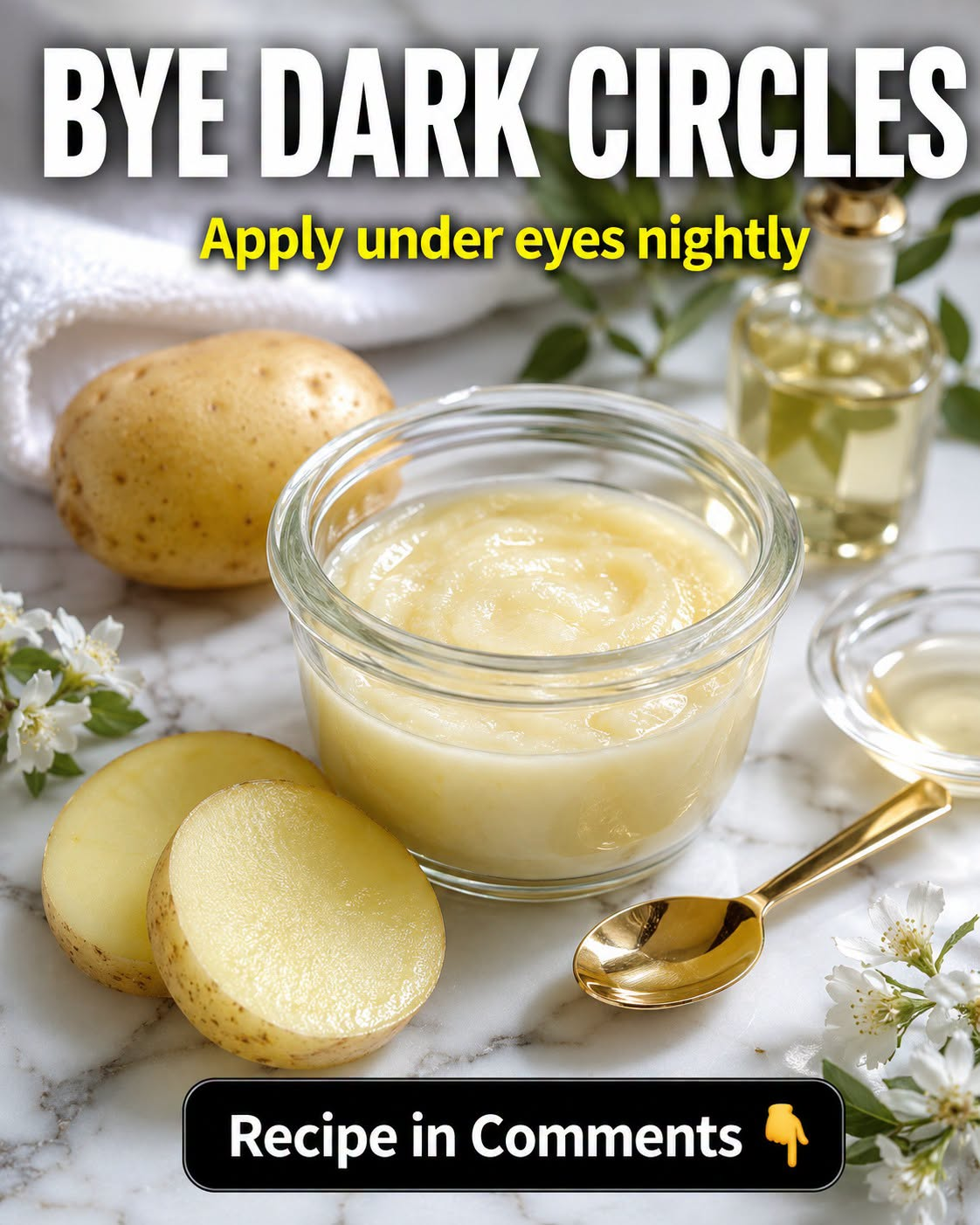
Dark circles under the eyes can make the face look tired, dull, older, or stressed even when you feel healthy. They may appear because of genetics, lack of sleep, allergies, dehydration, pigmentation, thin under-eye skin, or puffiness that creates shadows. Natural remedies can help improve the look of dark circles by cooling swelling, supporting the skin barrier, adding hydration, and reducing dullness, but they cannot permanently erase genetic hollowness or medical pigmentation overnight. Dermatology sources note that persistent dark circles or swelling should be checked by a healthcare provider, especially if they do not improve with rest and gentle care. (Cleveland Clinic)
The image topic suggests a potato-based under-eye remedy. Potato can be used as a cooling base, but the stronger evidence for under-eye improvement comes from ingredients such as caffeine, green tea polyphenols, aloe vera, colloidal oatmeal, honey, and gentle plant oils. Topical caffeine is especially discussed in dermatology literature for infraorbital dark circles because it may reduce vascular congestion and puffiness. (PMC)
Remedy 1: For Normal Skin
Ingredients
1 tablespoon fresh potato juice: gives a cooling effect and light starch layer that can temporarily calm puffiness.
1 teaspoon cooled black tea: contains caffeine, which may help reduce under-eye puffiness and bluish shadows.
1 teaspoon pure aloe vera gel: supports hydration and has soothing, anti-inflammatory compounds.
1 teaspoon cucumber juice: provides water-rich cooling and antioxidant support.
Half teaspoon finely powdered oats: helps soften the skin barrier and reduces dryness.
2 drops sweet almond oil: adds a light emollient layer to prevent tightness.
Scientific Working of Each Ingredient
Caffeine from black tea may help tighten the appearance of puffy under-eyes by supporting microcirculation and reducing fluid-heavy swelling. Aloe vera contains polysaccharides and anti-inflammatory components that calm the delicate area. Oats support the skin barrier, while almond oil softens and reduces roughness. Cucumber and potato mainly work as cooling, water-based compresses rather than strong bleaching agents.
Procedure
Mix potato juice, cooled black tea, aloe gel, cucumber juice, oat powder, and almond oil into a thin paste. Apply only on the lower under-eye area, keeping it away from the lash line and inside the eyes. Leave for 10 minutes at night, then rinse with cool water.
How Often to Apply
Use nightly for 5 days. Continue 3 weeks if your skin feels comfortable.
Initial Results
Within 1 to 3 days, you may notice less puffiness, smoother texture, and a fresher look. Pigmentation usually needs several weeks.
Remedy 2: For Combination Skin
Ingredients
1 tablespoon cooled green tea: contains catechins that support antioxidant protection.
1 teaspoon potato juice: gives a mild cooling base.
1 teaspoon aloe vera gel: hydrates without heaviness.
1 teaspoon cucumber pulp: refreshes and reduces temporary tiredness.
Half teaspoon rice water: adds light starch and softness.
1 drop jojoba oil: balances dryness without feeling too greasy.
Scientific Working of Each Ingredient
Green tea polyphenols help protect skin from oxidative stress and may reduce excess sebum activity, which is useful for combination skin. (PMC) Aloe vera provides water-based comfort, cucumber cools, rice water leaves a soft film, and jojoba oil acts as a light emollient that is less heavy than many oils.
Procedure
Blend all ingredients into a smooth lotion-like mix. Dip a clean cotton pad into it and gently press under the eyes for 8 to 10 minutes. Do not rub. Rinse and pat dry.
How Often to Apply
Apply on alternate nights for 5 days, then 3 times weekly for 3 weeks.
Initial Results
In 1 to 3 days, the under-eye area may look less tired and less shiny, with mild improvement in morning puffiness.
Remedy 3: For Oily Skin
Ingredients
1 tablespoon cooled green tea: antioxidant and oil-balancing support.
1 teaspoon diluted coffee infusion: provides caffeine for puffiness.
1 teaspoon aloe vera gel: lightweight hydration.
1 teaspoon cucumber juice: cooling and refreshing.
Half teaspoon colloidal oat powder or very fine oat flour: soothes without clogging.
Half teaspoon potato juice: gives a fresh compress effect.
Scientific Working of Each Ingredient
Oily skin under the eyes still needs hydration, not heavy oils. Green tea and caffeine are useful because they feel light and may improve puffiness. Aloe hydrates without a greasy finish. Oatmeal helps calm irritation and supports barrier function; clinical work on colloidal oatmeal shows improvement in skin hydration and barrier function. (PubMed)
Procedure
Mix the ingredients into a thin gel. Apply with a clean fingertip using a tapping motion. Leave for 7 to 8 minutes only. Rinse well and avoid applying oil afterward.
How Often to Apply
Use every night for 3 days, then every other night for 2 weeks.
Initial Results
You may see less under-eye puffiness and a cleaner, less heavy look by day 2 or day 3.
Remedy 4: For Dry Skin
Ingredients
1 teaspoon aloe vera gel: hydrates and calms dryness.
1 teaspoon raw honey: acts as a natural humectant and supports skin comfort.
1 teaspoon oat milk or oat paste: softens and protects the barrier.
2 drops almond oil: reduces dryness and tightness.
1 teaspoon cucumber juice: adds cooling water content.
1 teaspoon cooled black tea: adds caffeine support for puffiness.
Scientific Working of Each Ingredient
Dry under-eye skin often makes dark circles look deeper because fine lines create shadows. Honey has antioxidant and anti-inflammatory properties in skin research, while oats support barrier repair and aloe adds lightweight hydration. (PMC) Almond oil seals in moisture, and tea caffeine helps target puffiness.
Procedure
Mix all ingredients until creamy. Apply a very thin layer under the eyes at night. Leave for 10 minutes, then rinse gently. Follow with one tiny drop of almond oil only if the area still feels dry.
How Often to Apply
Use 4 nights per week for 3 weeks.
Initial Results
Within 1 to 3 days, dryness and tightness may reduce, making the under-eye area look softer and less shadowed.
Remedy 5: For Sensitive Skin
Ingredients
1 tablespoon cooled boiled water: safe dilution base.
1 teaspoon pure aloe vera gel: soothing hydration.
1 teaspoon cucumber water: gentle cooling.
Half teaspoon colloidal oat powder: barrier-supporting comfort.
Half teaspoon weak green tea: mild antioxidant support.
1 drop vegetable glycerin: helps hold moisture.
Scientific Working of Each Ingredient
Sensitive skin needs fewer irritants and no harsh acids. Aloe vera and oatmeal are the main calming ingredients. Green tea is used weakly because strong tea can irritate some people. Glycerin is a humectant, meaning it helps the skin hold water, while cucumber water provides a cooling effect.
Procedure
Mix everything into a thin paste. Apply a tiny amount below the eyes, not near the lash line. Leave for only 5 to 7 minutes. Rinse with cool water. Stop immediately if burning, watering, redness, or itching occurs.
How Often to Apply
Use every other night for 5 days. Continue twice weekly only if there is no irritation.
Initial Results
Sensitive skin may look calmer and less puffy in 2 to 3 days, but pigmentation improvement is slower.
Final Tips
Always do a patch test on the side of the face or inner arm before applying any remedy near the eyes. Never use lemon juice, baking soda, toothpaste, undiluted essential oils, turmeric paste, or apple cider vinegar under the eyes because they can irritate or burn delicate skin. Sleep 7 to 9 hours, keep pillow covers clean, remove makeup gently, avoid rubbing the eyes, and use sun protection during the day because UV exposure can worsen pigmentation. Visible freshness may begin within 2 to 3 days, but dark circles usually need 3 to 6 weeks of consistent care. If dark circles are sudden, one-sided, painful, swollen, linked with allergies, or not improving, see a doctor or dermatologist.
Diet Plan
Continue this diet plan for 3 to 4 weeks along with the remedy.
Morning: Drink 1 to 2 glasses of water after waking. Eat eggs, oats, yogurt, or lentils with fruit rich in vitamin C such as orange, guava, kiwi, or strawberries.
Lunch: Add leafy greens, beans, chickpeas, fish, chicken, or tofu. Pair iron-rich foods with vitamin C foods to support better iron absorption.
Evening: Take nuts or seeds such as almonds, walnuts, pumpkin seeds, or sunflower seeds. Avoid too much salty packaged food because salt can increase puffiness.
Dinner: Keep dinner light with vegetables, protein, and whole grains. Avoid heavy fried foods late at night.
Before sleep: Reduce screen time, avoid caffeine late in the day, and drink a small amount of water if you feel dehydrated. If dark circles are linked with fatigue, poor diet, heavy periods, or weakness, ask a doctor about checking iron, vitamin B12, vitamin D, and thyroid levels.
References for the above remedy
- Cleveland Clinic. “Dark Circles Under the Eyes: Causes & Treatment.”
URL: https://my.clevelandclinic.org/health/symptoms/23128-dark-circles-under-eyes - Vrcek I, Ozgur O, Nakra T. “Infraorbital Dark Circles: A Review of the Pathogenesis, Evaluation and Treatment.” Journal of Cutaneous and Aesthetic Surgery.
URL: https://pmc.ncbi.nlm.nih.gov/articles/PMC4924417/ - Surjushe A, Vasani R, Saple DG. “Aloe Vera: A Short Review.” Indian Journal of Dermatology.
URL: https://pmc.ncbi.nlm.nih.gov/articles/PMC2763764/ - Capone K, Kirchner F, Klein SL, et al. “Effects of Colloidal Oatmeal Topical Atopic Dermatitis Cream on Skin Microbiome and Skin Barrier Properties.”
URL: https://pubmed.ncbi.nlm.nih.gov/32484623/ - Mahmood T, Akhtar N. “A Comparison of the Effects of Topical Green Tea and Lotus on Facial Sebum Control.”
URL: https://pmc.ncbi.nlm.nih.gov/articles/PMC3738281/ - Oyetakin-White P, Tribout H, Baron E. “Protective Mechanisms of Green Tea Polyphenols in Skin.”
URL: https://pmc.ncbi.nlm.nih.gov/articles/PMC3390139/ - McLoone P, Warnock M, Fyfe L. “Honey: A Therapeutic Agent for Disorders of the Skin.”
URL: https://pmc.ncbi.nlm.nih.gov/articles/PMC5661189/ - Lin TK, Zhong L, Santiago JL. “Anti-Inflammatory and Skin Barrier Repair Effects of Topical Application of Some Plant Oils.”
URL: https://pmc.ncbi.nlm.nih.gov/articles/PMC5796020/ - Boo YC. “Mechanistic Basis and Clinical Evidence for the Applications of Nicotinamide in Skin Aging Control and Pigmentation.”
URL: https://pmc.ncbi.nlm.nih.gov/articles/PMC8389214/