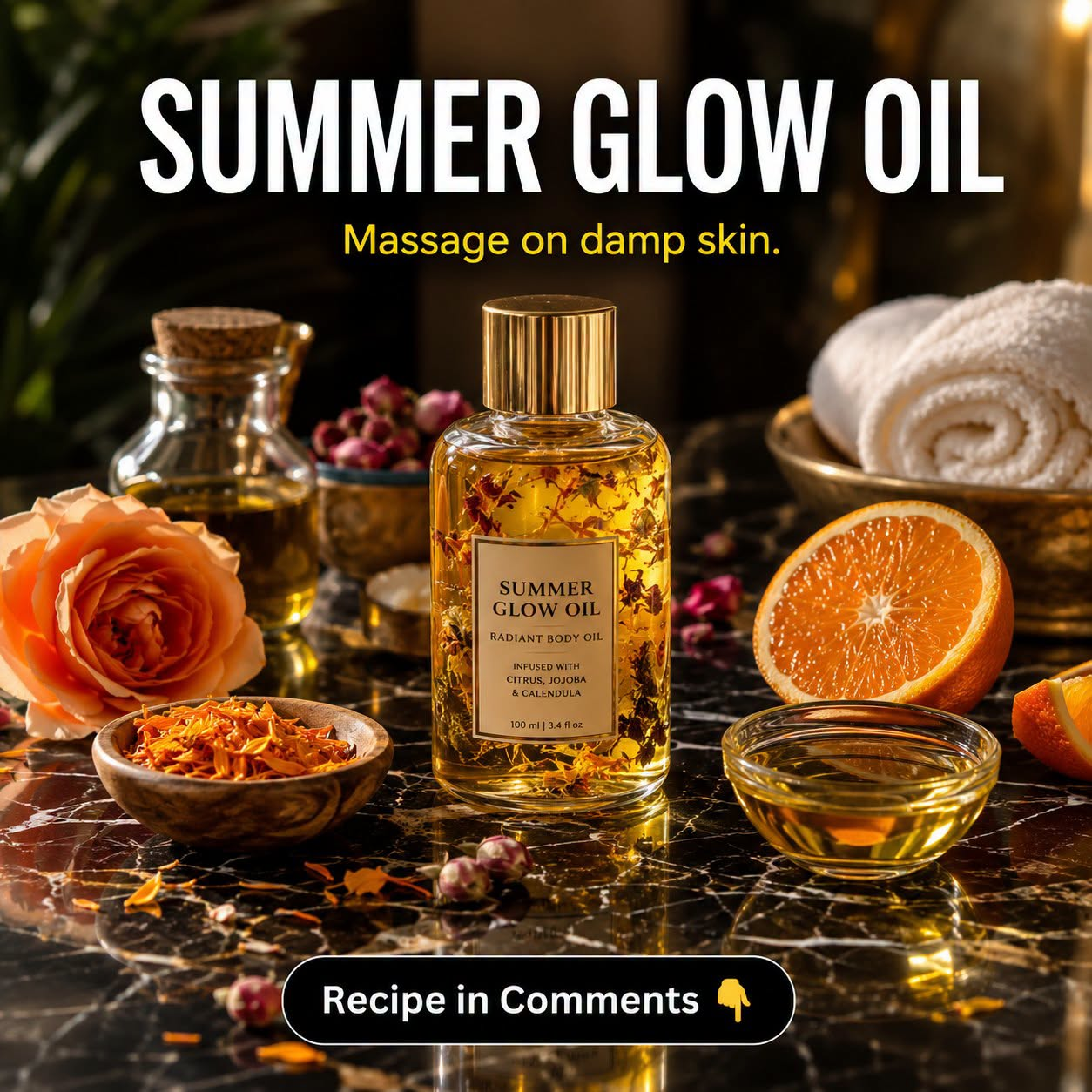
Summer skin can look dull, rough or tired even when the weather is hot and humid. Sun exposure, air conditioning, chlorine, frequent showers and sweating may disturb the skin barrier and leave the body feeling dry or uneven. A natural body oil can create a healthy-looking glow by softening the outer skin layer and reducing moisture loss, but oil works best when applied to slightly damp skin because it helps trap water that is already present. Dermatologists also recommend moisturizing soon after bathing for better moisture retention. (American Academy of Dermatology)
The goal of these remedies is hydrated, smooth and naturally luminous skin—not permanent skin lightening. The finished homemade blends have not been clinically tested as complete formulas; the scientific support comes from research on their individual ingredients. Prepare each water-containing treatment fresh for one use and do not store it. Although the image shows citrus, fresh orange or lemon juice and cold-pressed citrus essential oils are intentionally excluded because some citrus compounds can become phototoxic when exposed to sunlight. (PMC)

Remedy 1: Sunflower, Jojoba and Argan Dew Oil for Normal Skin
Ingredients
- Sunflower seed oil: 2 teaspoons
Rich in linoleic acid and helps soften the skin while supporting its protective barrier. - Jojoba oil: 1 teaspoon
A lightweight liquid wax that spreads easily and reduces roughness without creating an excessively heavy coating. - Argan oil: ½ teaspoon
Provides plant lipids and has clinical evidence suggesting improvement in skin elasticity. - Pure aloe vera gel: 1 teaspoon
Acts as a lightweight hydrating layer and supports moisture in the outer skin. - Vegetable glycerin: ⅛ teaspoon
A humectant that attracts and holds water in the outer skin layer.
Scientific Working of Each Ingredient
Sunflower oil is useful as the main carrier because research has shown better preservation of skin-barrier integrity than olive oil. Jojoba supplies emollient wax esters that smooth the skin surface. Argan oil has been associated with improved measurements of skin elasticity. Aloe supports hydration through a humectant effect, while glycerin helps increase water retention. (PubMed)
Procedure
Mix the aloe gel and glycerin in a small bowl. After a short lukewarm shower, pat the body gently but leave the skin slightly damp. Spread the aloe mixture over the arms and legs.
In a second bowl, combine sunflower, jojoba and argan oils. Massage a thin layer over the damp skin for one to two minutes. Use only enough to leave a soft sheen rather than a greasy coating.
How Often to Apply
Apply once daily after bathing for five to seven days. Continue three or four times weekly to maintain softness.
Initial Results
The skin may feel smoother after the first use. A healthier-looking surface glow and reduced tightness may become noticeable within one to three days.
Remedy 2: Oat and Jojoba Balance Ritual for Combination Skin
Ingredients
- Finely ground colloidal oatmeal: 1 teaspoon
Supports the skin barrier and helps calm dry or rough areas. - Boiled and cooled water: 1 tablespoon
Provides temporary surface hydration. - Jojoba oil: 1 teaspoon
Offers lightweight emollience for dry areas. - Sunflower seed oil: 1 teaspoon
Helps reduce moisture loss without requiring a very heavy layer. - Argan oil: ¼ teaspoon
Adds softness and supports the appearance of supple skin.
Scientific Working of Each Ingredient
Combination body skin may feel oily around the chest or upper back but dry on the arms, elbows or legs. Oat compounds support barrier function and may improve dryness and roughness. Water hydrates temporarily, while jojoba and sunflower oils help seal that moisture. Argan oil adds a small amount of richer emollience to areas that need extra softness. (PubMed)
Procedure
Mix the oatmeal with cooled water to make a thin paste. Apply only to dry areas such as elbows, knees, arms and lower legs. Leave for five minutes and rinse with lukewarm water.
Blend the three oils. While the skin is still damp, apply a small amount to dry areas. Use only one or two drops on normal areas and avoid naturally oily or breakout-prone areas.
How Often to Apply
Use on alternate days for at least five days. Continue two or three times weekly when needed.
Initial Results
Dry patches may feel calmer after one application. The skin may look more even and less rough within two or three days.
Remedy 3: Feather-Light Aloe and Jojoba Glow for Oily Skin
Ingredients
- Pure aloe vera gel: 2 teaspoons
Provides water-based hydration with a light texture. - Vegetable glycerin: ⅛ teaspoon
Helps the skin retain moisture without requiring a thick oil layer. - Boiled and cooled water: 1 teaspoon
Lightens the hydrating phase. - Finely ground colloidal oatmeal: ½ teaspoon
Helps soothe areas irritated by sweat or frequent washing. - Jojoba oil: ½ teaspoon
Provides a thin emollient layer. - Sunflower seed oil: ½ teaspoon
Supplies barrier-supporting fatty acids in a small quantity.
Scientific Working of Each Ingredient
Oily skin can still become dehydrated, particularly after repeated showering, swimming or using strong cleansers. Aloe, water and glycerin provide hydration, while oatmeal supports the surface barrier. The small amount of jojoba and sunflower oil helps reduce water loss without covering the body in a heavy oil film. People with oily skin still benefit from suitable moisturization, but acne-prone areas generally need lightweight, non-greasy care. (PubMed)
Procedure
Mix aloe, glycerin, water and oatmeal. Apply a very thin layer to clean skin for five minutes, then rinse lightly.
Blend the jojoba and sunflower oils. Rub three or four drops between the palms and press onto damp arms and legs. Do not apply the oil to active body acne, inflamed hair follicles or sweaty skin folds.
How Often to Apply
Use once daily for three to five days. After improvement, apply only when the skin feels tight or rough.
Initial Results
The body may feel hydrated without looking excessively oily after the first few uses. A smoother, fresher appearance may develop within two or three days.
Remedy 4: Coconut, Argan and Oat Intensive Glow Oil for Dry Skin
Ingredients
- Virgin coconut oil: 2 teaspoons
Clinically studied as a moisturizer for mild to moderate dry skin. - Sunflower seed oil: 1 teaspoon
Supports the barrier and improves the spreadability of coconut oil. - Argan oil: ½ teaspoon
Provides additional emollient lipids and supports skin elasticity. - Pure aloe vera gel: 2 teaspoons
Supplies lightweight hydration before the oils are applied. - Vegetable glycerin: ¼ teaspoon
Helps draw water into the outer skin layer. - Colloidal oatmeal: 1 teaspoon
Supports dry, rough and easily irritated skin.
Scientific Working of Each Ingredient
Very dry skin benefits from both hydration and an oil layer. Aloe and glycerin increase surface hydration, while oatmeal supports barrier recovery. Coconut oil has performed well as a moisturizer in a randomized clinical study involving people with dry skin. Sunflower and argan oils improve softness and help create a smoother skin surface. (PubMed)
Procedure
Mix aloe, glycerin and oatmeal. Apply the fresh mixture to dry arms, legs, elbows and knees for eight minutes. Rinse lightly and leave the skin slightly damp.
Warm the coconut oil between the palms and mix it with sunflower and argan oils. Massage over the damp skin for two minutes. Concentrate on rough areas rather than applying a thick layer everywhere.
How Often to Apply
Use every evening for seven days. Continue three times weekly after the skin becomes comfortable.
Initial Results
Tightness may improve after the first application. Flaking and rough texture may begin to improve within one to three days, although severely dry skin generally needs longer.
Remedy 5: Minimal Sunflower and Oat Calm Oil for Sensitive Skin
Ingredients
- Sunflower seed oil: 2 teaspoons
A simple emollient with evidence supporting skin-barrier integrity. - Jojoba oil: ½ teaspoon
Adds slip and softness without perfume. - Colloidal oatmeal: 1 teaspoon
Helps support the barrier and soothe dryness. - Pure aloe vera gel: 1 teaspoon
Provides lightweight hydration but should be patch-tested. - Vegetable glycerin: ⅛ teaspoon
Helps reduce moisture loss by improving hydration. - Boiled and cooled water: 1 tablespoon
Creates a gentle, fresh oatmeal hydration layer.
Scientific Working of Each Ingredient
Sensitive skin usually benefits from fewer ingredients and no added fragrance. Oatmeal supports the protective barrier, while aloe and glycerin provide hydration. Sunflower and jojoba oils act as fragrance-free emollients that soften the outer skin. However, even natural ingredients may cause irritation, so patch testing is essential. (American Academy of Dermatology)
Procedure
Before full-body use, apply a small amount of each ingredient to a limited area of the inner arm and observe for irritation.
Mix oatmeal, water, aloe and glycerin. Apply for five minutes and rinse gently. While the skin is still damp, blend the sunflower and jojoba oils and apply a very thin layer.
Do not use on open wounds, active eczema, severe sunburn or infected skin.
How Often to Apply
Use every other evening for five to seven days. Increase the frequency only when the skin remains comfortable.
Initial Results
Mild tightness may improve within one or two uses. Roughness may become less noticeable after two or three days.
Final Tips for a Safe Summer Body Glow
Apply body oil after a short lukewarm shower while the skin is still slightly damp. Oil mainly seals existing water into the skin; it does not replace water-based hydration. Use clean bowls and spoons, and discard all leftover mixtures containing aloe, oatmeal, glycerin or water because homemade preparations do not contain a tested preservative system.
Do not add lemon juice, orange juice, citrus peel, bergamot oil or unknown essential-oil mixtures to a daytime summer body oil. Certain citrus oils contain photoactive compounds that may cause burning, redness, blistering or long-lasting discoloration after ultraviolet exposure. (PMC)
Body oil is not sunscreen. Do not mix it into sunscreen or use it as tanning protection. For outdoor exposure, apply a separate broad-spectrum, water-resistant sunscreen with SPF 30 or higher according to its directions and reapply after swimming or heavy sweating. (American Academy of Dermatology)
Keep towels and application tools clean. Avoid harsh scrubs, very hot water and strongly fragranced ingredients. Perform a patch test before using any new oil over a large area. Stop immediately if burning, swelling, hives, persistent itching or a spreading rash develops.
Visible softness and a hydrated glow may begin within two or three days. Continued moisturizing can make fine dehydration lines appear less obvious, but homemade oil does not permanently remove wrinkles, lighten natural skin color or reverse sun damage.
Diet Plan for Healthy, Hydrated-Looking Skin
Topical care has the most direct effect on dry body skin, but a balanced diet supports normal skin structure and function.
Breakfast
Eat oatmeal, eggs or plain yogurt with guava, berries, oranges or another vitamin-C-rich fruit. Add one glass of water.
Mid-Morning
Choose cucumber, watermelon, seasonal fruit or a small handful of nuts.
Lunch
Include vegetables, whole grains and a protein source such as lentils, beans, fish, chicken or eggs. Add healthy fats from nuts, seeds or avocado when available.
Evening Snack
Choose plain yogurt, fruit, roasted chickpeas or nuts instead of frequently eating sugary snacks.
Dinner
Eat vegetables with protein and whole grains. Include oily fish when suitable, or add walnuts, chia seeds or ground flaxseed to meals.
Drink according to thirst and increase fluid intake during hot weather, exercise or heavy sweating. Research suggests that increasing water intake may modestly improve skin hydration in some people, but drinking excessive water is not a substitute for moisturizing or sun protection. (PubMed)
How Long Should You Continue?
Choose only the remedy designed for your skin type and continue it for seven to fourteen days. Once the skin becomes softer, use the routine two or three times weekly or after bathing as needed.
When dryness, itching, rough patches or irritation continue for more than two weeks, see a doctor or dermatologist. Medical advice is also important when the skin becomes painful, cracked, bleeding, swollen, infected or covered with a persistent rash. Ongoing dryness may sometimes be related to eczema, psoriasis, contact dermatitis or another condition that requires proper treatment.
References for the above remedy
- American Academy of Dermatology. “Dermatologists’ Top Tips for Relieving Dry Skin.”
https://www.aad.org/public/everyday-care/skin-care-basics/dry/dermatologists-tips-relieve-dry-skin - Danby SG, et al. “Effect of Olive and Sunflower Seed Oil on the Adult Skin Barrier.”
https://pubmed.ncbi.nlm.nih.gov/22995032/ - Agero ALC, Verallo-Rowell VM. “A Randomized Double-Blind Controlled Trial Comparing Extra Virgin Coconut Oil with Mineral Oil as a Moisturizer for Xerosis.”
https://pubmed.ncbi.nlm.nih.gov/15724344/ - Boucetta KQ, et al. “The Effect of Dietary and/or Cosmetic Argan Oil on Postmenopausal Skin Elasticity.”
https://pubmed.ncbi.nlm.nih.gov/25673976/ - Dal’Belo SE, et al. “Moisturizing Effect of Cosmetic Formulations Containing Aloe Vera Extract.”
https://pubmed.ncbi.nlm.nih.gov/17026654/ - Fluhr JW, et al. “Glycerol and the Skin: Holistic Approach to Its Origin and Functions.”
https://pubmed.ncbi.nlm.nih.gov/18510666/ - Vaughn AR, et al. “Natural Oils for Skin-Barrier Repair: Ancient Compounds Now Backed by Modern Science.”
https://pubmed.ncbi.nlm.nih.gov/28707186/ - Lin TK, et al. “Anti-Inflammatory and Skin Barrier Repair Effects of Topical Application of Some Plant Oils.”
https://pubmed.ncbi.nlm.nih.gov/29280987/ - Dosoky NS, Setzer WN. “Biological Activities and Safety of Citrus Essential Oils.”
https://pmc.ncbi.nlm.nih.gov/articles/PMC6073409/ - American Academy of Dermatology. “12 Summer Skin Problems You Can Prevent.”
https://www.aad.org/public/everyday-care/skin-care-secrets/routine/prevent-summer-skin-problems