Healthy facial glow comes mainly from a well-hydrated skin barrier, a smooth surface, balanced oil production, good circulation, and protection from ultraviolet damage. Dullness may become more noticeable after sun exposure, dehydration, poor sleep, stress, harsh cleansing, excessive exfoliation, or dry weather. A homemade mask cannot permanently whiten the skin or transform the complexion overnight, but gentle hydration may make the face look softer, fresher, and more luminous within one to three days.
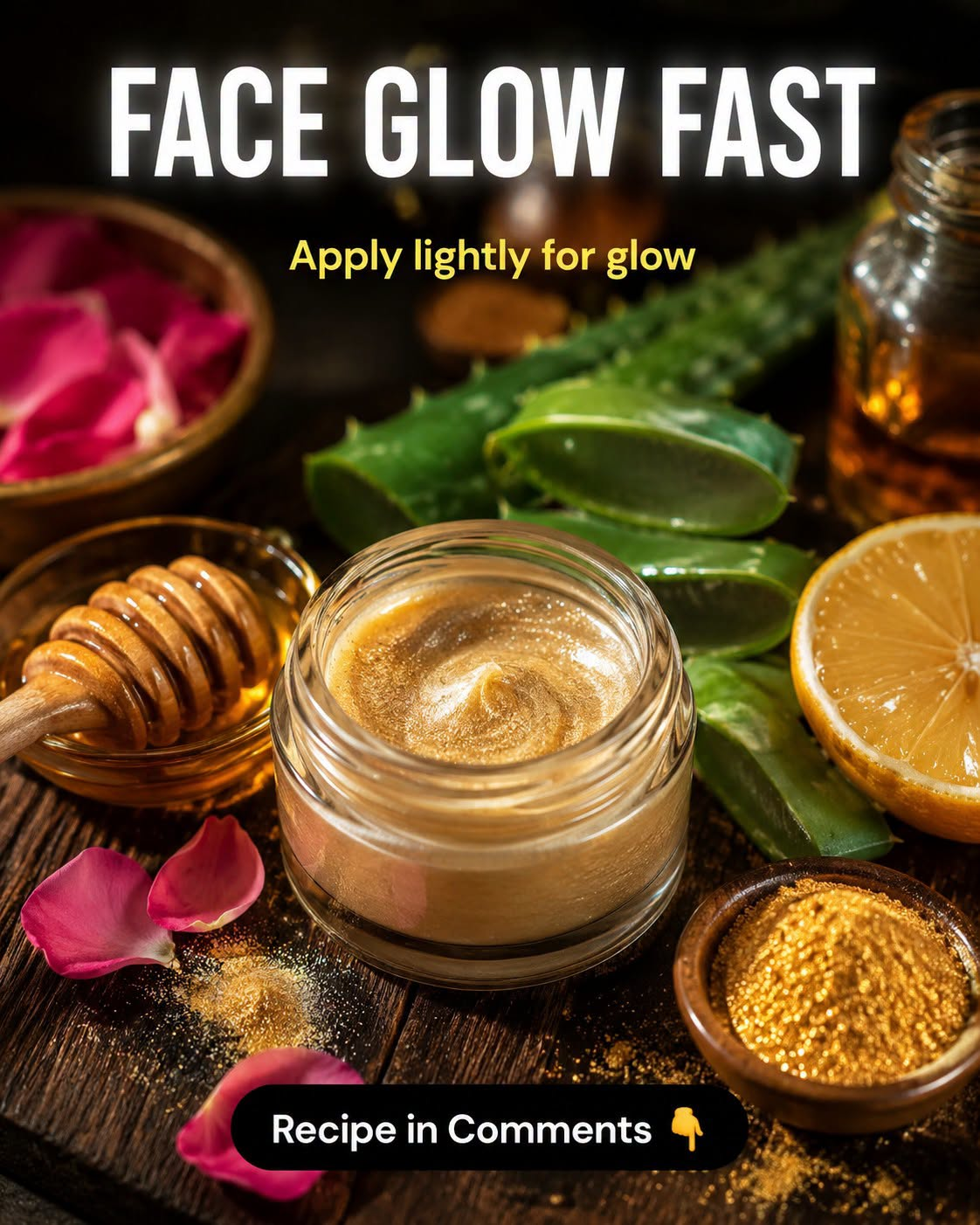
The image shows aloe vera, honey, lemon, rose petals, and a gold-colored powder. Aloe vera has evidence for improving skin hydration, while honey has moisturizing and skin-conditioning properties. However, fresh lemon juice should not be applied to the face because citrus exposure followed by sunlight may cause painful irritation and longer-lasting pigmentation. Decorative gold powder or craft glitter should not be mixed into skincare. Only ingredients specifically manufactured and labeled for safe cosmetic use belong on the skin. (PubMed)
The remedies below are designed according to skin type. The individual ingredients have scientific support, but these exact homemade combinations have not been tested as complete clinical formulas. Perform a patch test for 24 hours and prepare each water-based mixture fresh.

Remedy 1: Cucumber, Rice Bran, and Aloe Radiance Gel for Normal Skin
Normal skin usually maintains a comfortable balance of oil and moisture but may look tired after heat, lack of sleep, or prolonged sun exposure.
Ingredients and Their Scientific Working
Fresh cucumber juice — 1 tablespoon: Cucumber is rich in water and contains plant compounds with antioxidant and skin-conditioning potential. Its main immediate benefit in a homemade remedy is cooling hydration rather than permanent brightening. (PubMed)
Pure aloe vera gel — 1 tablespoon: Aloe contains polysaccharides that act as humectants. Human research found that aloe-containing formulations increased moisture in the outer skin layer. (PubMed)
Cooled green tea — 1 tablespoon: Green-tea polyphenols provide antioxidant activity. Green-tea cosmetic formulations have shown improvements in hydration and skin-surface roughness after regular use. (PubMed)
Rice bran water — 1 tablespoon: Rice-bran compounds have demonstrated antioxidant activity and enhancement of skin hydration in researched formulations. (PubMed)
Vegetable glycerin — 1/4 teaspoon: Glycerin attracts water toward the outer skin and helps create a smoother, more reflective surface. (PubMed)
Jojoba oil — 2 drops: Jojoba provides light emollient support and reduces moisture loss without requiring a heavy oil layer. (PubMed)
Procedure
Strain fresh cucumber juice through a clean cloth. Mix it with aloe gel, cooled green tea, rice bran water, and glycerin. Apply a thin layer to freshly cleansed skin.
Leave the gel on for eight minutes and rinse with cool-to-lukewarm water. While the face is slightly damp, press two drops of jojoba oil over the cheeks and forehead.
How Often to Apply
Apply once nightly for three to five days. Afterward, continue three evenings weekly.
Initial Results
Within one to three days, the face may feel softer and look fresher because surface hydration has improved. Existing pigmentation, acne marks, and deep lines will require longer care.
Remedy 2: Soy, Oat, and Green Tea Dual-Zone Glow Mask for Combination Skin
Combination skin may become oily around the forehead, nose, and chin while the cheeks remain normal or dry. Treating both zones differently helps create a balanced glow without excessive shine.
Ingredients and Their Scientific Working
Plain unsweetened soy milk — 2 tablespoons: Soy-derived compounds have been investigated for effects on uneven tone and skin appearance. Homemade soy milk is milder and less standardized than researched cosmetic extracts. (PubMed)
Cooled green tea — 1 tablespoon: Green tea supports antioxidant protection and may improve surface hydration with repeated topical use. (PubMed)
Finely powdered colloidal oatmeal — 1 teaspoon: Colloidal oatmeal supports the protective barrier and has demonstrated improvements in dryness, moisturization, and roughness. (PubMed)
Pure aloe vera gel — 1 tablespoon: Aloe supplies lightweight water-based hydration. (PubMed)
White kaolin clay — 1/2 teaspoon: Kaolin physically absorbs temporary surface oil. It may reduce shine but does not permanently tighten pores or whiten the skin.
Vegetable glycerin — 1/4 teaspoon: Glycerin helps protect the cheeks from becoming tight after rinsing. (PubMed)
Procedure
Combine soy milk, green tea, oatmeal, aloe, and glycerin. Divide the mixture into two small portions.
Add kaolin clay only to the portion intended for the forehead, nose, and chin. Apply the clay-free mixture to the cheeks. Leave both preparations on for five to seven minutes and rinse before the clay becomes completely dry.
How Often to Apply
Use on alternate evenings for five days. Continue twice weekly afterward.
Initial Results
The T-zone may appear less shiny after the first application. The cheeks may feel smoother within two or three uses, helping the complexion look more evenly luminous.
Remedy 3: Chilled Green Tea and Cucumber Fresh-Glow Mask for Oily Skin
Oily skin still requires moisture. Excessive cleansing or repeated drying masks may disturb the skin barrier and make the face look rough, irritated, or dull.
Ingredients and Their Scientific Working
Strong cooled green tea — 2 tablespoons: Topical green-tea preparations have demonstrated moisturizing effects, and research also suggests possible benefits for excess facial sebum. (PubMed)
Fresh cucumber juice — 1 tablespoon: Cucumber adds water and a temporary cooling effect that can make tired skin feel refreshed. (PubMed)
Pure aloe vera gel — 1 tablespoon: Aloe provides lightweight hydration without a thick oily coating. (PubMed)
Colloidal oatmeal — 1/2 teaspoon: Oatmeal reduces friction and helps protect the barrier during an oil-control routine. (PubMed)
White kaolin clay — 1/4 teaspoon: A small amount absorbs temporary oil and reduces surface shine.
Vegetable glycerin — 1/8 teaspoon: This small amount helps prevent the skin from feeling stripped. (PubMed)
Procedure
Mix all ingredients and refrigerate for five minutes. Do not freeze. Apply a thin layer, concentrating on the forehead, nose, cheeks, and chin.
Leave it on for five minutes and rinse gently. Do not scrub the face while removing the mask.
How Often to Apply
Apply once nightly for three days. Continue every other night for two weeks if there is no irritation or increase in clogged pores.
Initial Results
Excess shine may look reduced after one or two uses. Improved hydration may make the surface look smoother and more naturally radiant within three days.
Remedy 4: Honey, Safflower, and Oat Moisture Wrap for Dry Skin
Dry skin can look dull because rough surface cells scatter light unevenly. Combining a humectant with barrier-supporting ingredients may improve softness and create a healthier glow.
Ingredients and Their Scientific Working
Pure honey — 1 teaspoon: Honey has humectant and skin-conditioning properties. Its dermatological evidence is strongest in skin repair, although it can also provide a moisture-rich coating. (PubMed)
Colloidal oatmeal — 2 teaspoons: Oat compounds improve moisture retention and help reduce scaling and roughness. (PubMed)
Pure aloe vera gel — 1 tablespoon: Aloe supplies water-rich hydration and improves spreadability. (PubMed)
Vegetable glycerin — 1/2 teaspoon: Glycerin draws water into the outer skin layer and can temporarily soften fine dehydration lines. (PubMed)
Cold-pressed safflower oil — 1/2 teaspoon: Linoleic-acid-rich plant oils may support barrier repair and reduce moisture loss. (PubMed)
Rice bran water — 1 tablespoon: Rice-bran compounds contribute antioxidant and hydration-supporting activity in cosmetic research. (PubMed)
Procedure
Mix oatmeal with rice bran water and leave it for five minutes. Add aloe, honey, and glycerin. Apply a smooth layer without scrubbing.
Leave the mask on for eight to ten minutes and rinse. While the skin remains slightly damp, press two or three drops of safflower oil onto dry areas.
How Often to Apply
Use nightly for three to five days. Continue three times weekly afterward.
Initial Results
Tightness may improve after the first application. Within two to three days, rough areas may feel softer and the face may look more luminous because hydration has improved.
Remedy 5: Oat, Rice, and Sunflower Comfort Compress for Sensitive Skin
Sensitive skin may become dull when repeated irritation damages the barrier. A simple routine without fragrance, lemon, essential oils, or strong exfoliating ingredients is usually safer.
Ingredients and Their Scientific Working
Colloidal oatmeal — 2 teaspoons: Colloidal oatmeal has antioxidant and anti-inflammatory activity and may improve dryness, scaling, roughness, and discomfort. (PubMed)
Rice starch water — 2 tablespoons: Rice-derived ingredients have moisturizing and barrier-supporting properties. (PubMed)
Cucumber water — 1 tablespoon: Strained cucumber water supplies gentle cooling moisture. (PubMed)
Vegetable glycerin — 1/4 teaspoon: Glycerin supports moisture retention without exfoliating the skin. (PubMed)
Cold-pressed sunflower seed oil — 2 drops: Sunflower seed oil contains linoleic-acid-rich lipids. Human research found favorable effects on hydration and skin-barrier integrity. (PubMed)
Boiled and cooled water — 1 tablespoon: Additional water produces a light, low-friction compress.
Procedure
Mix the oatmeal, rice starch water, cucumber water, glycerin, and cooled water. Allow the oatmeal to soften for ten minutes.
Dip a clean, soft cotton cloth into the liquid and place it gently over the face for three to five minutes. Do not rub. Rinse and press two drops of sunflower oil over dry areas.
How Often to Apply
Use once daily for three days. Continue every other day only if the skin remains calm.
Initial Results
The face may feel less tight and irritated within one to three applications. Better barrier comfort may help the complexion look smoother and healthier.
Why Lemon and Decorative Gold Powder Should Be Avoided
Fresh lemon juice is not necessary for a glowing complexion. Citrus juice on the skin can interact with sunlight and cause redness, swelling, blistering, or residual dark pigmentation. (American Academy of Dermatology)
The gold-colored powder shown in beauty images may be decorative mica, pigment, glitter, or another material. Do not add craft powder, edible decoration dust, or unlabeled metallic powder to a facial recipe. Cosmetic color ingredients require appropriate safety and manufacturing standards. (U.S. Food and Drug Administration)
Final Tips for a Longer-Lasting Face Glow
Cleanse gently with lukewarm water and avoid rough brushes or repeated scrubbing. Apply moisturizer while the skin is slightly damp because moisturizers help trap water and improve surface smoothness. (American Academy of Dermatology)
Use broad-spectrum, water-resistant SPF 30 or higher every morning. Daily sunscreen has strong evidence for slowing visible photoaging, and continued sun exposure can worsen dullness, roughness, pigmentation, and fine lines. (PubMed)
Sleep regularly, keep pillowcases and facial tools clean, and avoid repeatedly touching or picking the face. Prepare every homemade water-based remedy fresh and discard leftovers rather than storing them without a preservation system.
Do not apply lemon juice, baking soda, toothpaste, undiluted vinegar, concentrated essential oils, or rough sugar scrubs. A remedy that burns or stings is irritating the skin rather than creating a healthy glow.
Visible softness and hydration may begin within two to three days. More meaningful improvement in uneven tone, roughness, acne marks, or sun damage normally requires several weeks.
Diet Plan for Natural Face Glow
A balanced diet supports normal skin function but cannot brighten the face overnight. Research has associated increased fruit and vegetable intake with measurable changes in skin appearance over several weeks rather than a few days. (PubMed)
Breakfast: Choose eggs with whole-grain bread, unsweetened oatmeal with nuts, or plain yogurt with fruit.
Mid-morning: Eat a vitamin-rich fruit such as guava, orange, papaya, kiwi, berries, or an apple.
Lunch: Include vegetables with lentils, chickpeas, beans, fish, eggs, chicken, tofu, or lean meat. Add whole-wheat roti or a moderate portion of rice.
Evening snack: Choose cucumber, carrots, fruit, plain yogurt, walnuts, almonds, or seeds instead of sugary drinks and heavily processed snacks.
Dinner: Eat colorful vegetables with lentils, beans, fish, eggs, tofu, or chicken.
Hydration: Drink water according to thirst, physical activity, climate, and medical needs. Additional water may improve skin hydration and reduce dryness in people whose usual intake is low, but excessive water does not bleach the skin. (PubMed)
Continue the suitable home remedy for three to five days initially. If it suits the skin, reduce use to two or three times weekly and continue for four to six weeks. Follow the balanced diet consistently for at least eight to twelve weeks.
See a dermatologist if dullness occurs with persistent itching, redness, painful acne, spreading pigmentation, severe dryness, swelling, or a rash. Consult a doctor if an unusually pale, yellow, or grey complexion appears suddenly or occurs with fatigue, weakness, breathing difficulty, or other unexplained symptoms.
References for the above remedy
- Dal’Belo SE, et al. Moisturizing Effect of Cosmetic Formulations Containing Aloe Vera Extract.
https://pubmed.ncbi.nlm.nih.gov/17026654/ - Gianeti MD, et al. The Use of Green Tea Extract in Cosmetic Formulations: Not Only an Antioxidant Active Ingredient.
https://pubmed.ncbi.nlm.nih.gov/23742288/ - Ilnytska O, et al. Colloidal Oatmeal Improves Skin Barrier Through Multitherapy Activity.
https://pubmed.ncbi.nlm.nih.gov/27272074/ - Danby SG, et al. Effect of Olive and Sunflower Seed Oil on the Adult Skin Barrier.
https://pubmed.ncbi.nlm.nih.gov/22995032/ - Breternitz M, et al. Placebo-Controlled, Double-Blind, Randomized Study of Glycerol-Based Emollients and Skin Hydration.
https://pubmed.ncbi.nlm.nih.gov/18025807/ - Mukherjee PK, et al. Phytochemical and Therapeutic Potential of Cucumber.
https://pubmed.ncbi.nlm.nih.gov/23098877/ - Manosroi A, et al. Antioxidant Activities and Skin Hydration Effects of Rice Bran Bioactive Compounds.
https://pubmed.ncbi.nlm.nih.gov/21449379/ - Burlando B, Cornara L. Honey in Dermatology and Skin Care: A Review.
https://pubmed.ncbi.nlm.nih.gov/24305429/ - Hughes MCB, et al. Sunscreen and Prevention of Skin Aging: A Randomized Trial.
https://pubmed.ncbi.nlm.nih.gov/23732711/ - Akdeniz M, et al. Does Dietary Fluid Intake Affect Skin Hydration in Healthy Humans?
https://pubmed.ncbi.nlm.nih.gov/29392767/