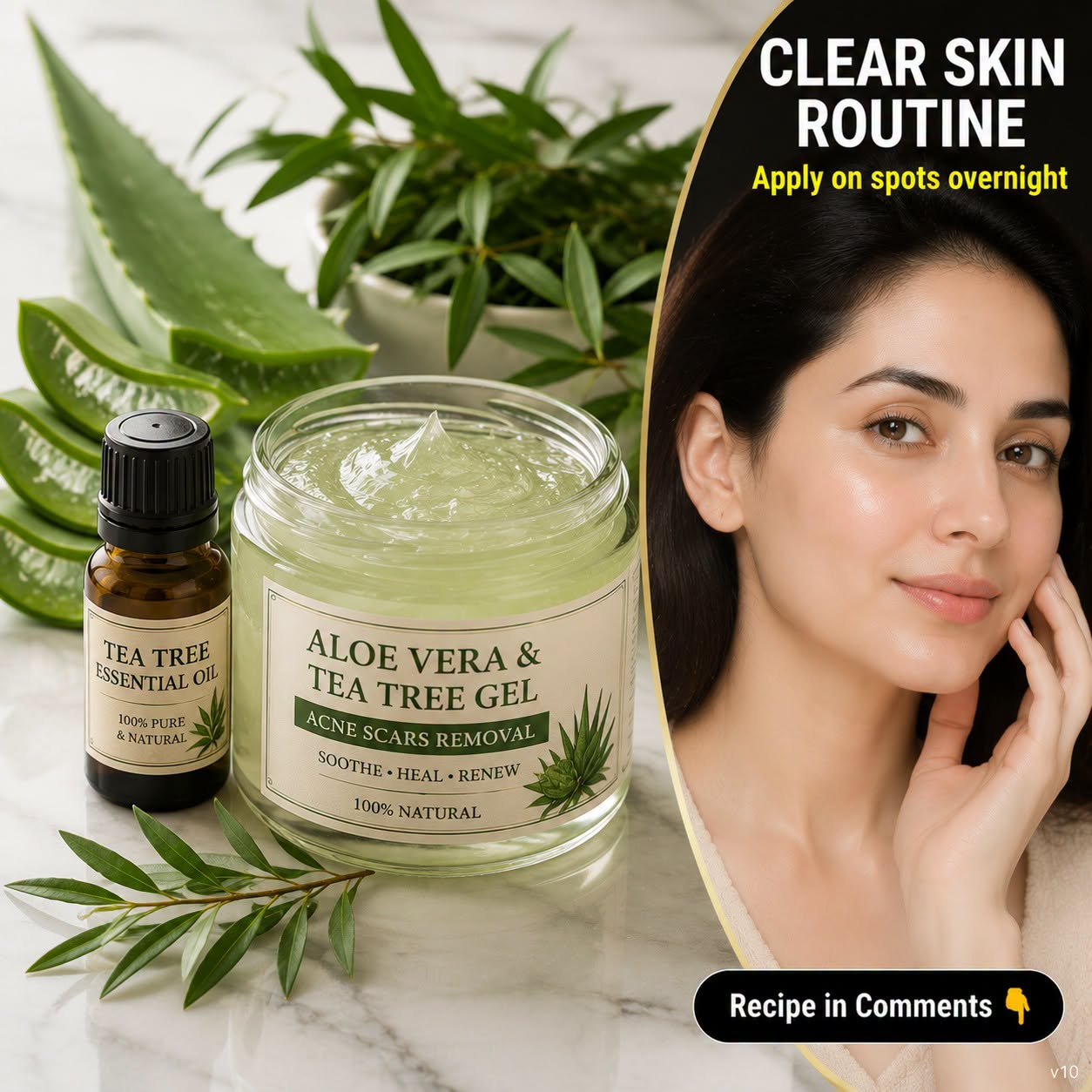
Acne spots, redness, excess oil, dryness, and leftover dark marks can make the skin look uneven and may affect confidence. Aloe vera and tea tree oil are popular natural skincare ingredients, but they should be used carefully and according to skin type. Human studies suggest that properly formulated tea tree oil may help mild-to-moderate acne, while aloe vera may provide soothing and supportive benefits. Green tea may help reduce inflammatory breakouts, and colloidal oatmeal can support hydration and the skin barrier. (PubMed)
The exact homemade mixtures below have not been clinically tested as complete formulas. They are gentle home-use adaptations based on ingredients that have scientific support individually. These remedies may calm mild spots and improve hydration, but they cannot remove deep, pitted, or raised acne scars. Visible scar treatment usually requires professional assessment.
Remedy 1: For Normal Skin
Aloe Vera, Green Tea and Diluted Tea Tree Overnight Spot Gel
Ingredients
- 2 teaspoons pure aloe vera gel — hydrates the skin and may help soothe visible redness.
- 1 teaspoon freshly brewed and cooled green tea — contains antioxidant catechins that may help calm inflammatory spots.
- ¼ teaspoon finely powdered colloidal oatmeal — supports moisture retention and reduces dryness.
- 3 drops vegetable glycerin — acts as a humectant and helps prevent tightness.
- 2 drops tea tree essential oil — provides a gently diluted spot-care ingredient.
- ½ teaspoon boiled and cooled water — improves consistency and prevents the mixture from becoming too concentrated.
Scientific Working of the Ingredients
Tea tree oil contains naturally occurring compounds with antimicrobial and anti-inflammatory activity. Clinical studies have found benefits from standardized 5% tea tree gel for mild-to-moderate acne; however, a carefully diluted homemade formula is preferable because concentrated essential oil may irritate the skin. (PubMed)
Aloe vera supplies moisture and calming compounds. Research has shown supportive benefits when aloe gel was used alongside established acne treatment. Green tea catechins may reduce inflammatory activity associated with acne, while oatmeal helps protect the skin barrier. (PubMed)
Procedure
Mix the aloe vera, green tea, oatmeal, glycerin, and water until smooth. Add tea tree oil last and stir thoroughly. After cleansing, apply a very small amount directly to individual spots. Leave it for 20 minutes during the first use. When no irritation develops after repeated use, normal skin may leave a thin spot application overnight.
Prepare a fresh mixture each time. Do not store homemade water-based gel.
How Often to Apply
Apply once nightly for 3–5 days. Continue for up to two weeks only when the skin remains comfortable.
Initial Results
Within 1–3 days, spots may feel less irritated and the skin may appear calmer. Large pimples, blackheads, dark marks, and scars require considerably more time.
Remedy 2: For Combination Skin
Green Tea, Jojoba and Gentle Clay Balancing Mask
Ingredients
- 1 teaspoon aloe vera gel — provides lightweight hydration.
- 1 teaspoon cooled green tea — supplies antioxidant and soothing compounds.
- 1 teaspoon cosmetic-grade kaolin clay — absorbs excess surface oil from the T-zone.
- ½ teaspoon pure jojoba oil — softens dry areas without creating a heavy greasy layer.
- ¼ teaspoon colloidal oatmeal — reduces the drying effect of clay.
- 1 teaspoon boiled and cooled water — creates a soft, spreadable mask.
Scientific Working of the Ingredients
Combination skin requires oil control without over-drying the cheeks. Clay can temporarily absorb surface oil, while jojoba supplies wax esters that soften the skin. Preliminary human research involving clay and jojoba masks reported improvement in mild acne and inflamed lesions, although larger controlled studies are still required. (PubMed)
Green tea may support oil balance and help reduce inflammatory breakouts. Oatmeal and aloe reduce the chance that the clay mixture will leave dry areas feeling tight. (PubMed)
Procedure
Combine the clay and oatmeal. Add green tea, water, aloe vera, and jojoba oil. Mix until creamy. Apply a thin layer mainly over the forehead, nose, chin, and acne-prone areas. Avoid applying a thick layer over dry cheeks.
Leave for 7–10 minutes. Rinse before the clay becomes completely dry or begins cracking.
How Often to Apply
Use once every alternate day for 3–5 days. Afterward, reduce to two applications weekly.
Initial Results
Oiliness may appear reduced after the first use. During the next 1–3 days, the T-zone may feel cleaner while the cheeks remain softer.
Remedy 3: For Oily Skin
Aloe, Green Tea and Tea Tree Clarifying Spot Mask
Ingredients
- 2 teaspoons cooled green tea — provides antioxidant catechins.
- 1 teaspoon aloe vera gel — hydrates without adding heavy oil.
- 1 teaspoon cosmetic-grade kaolin clay — absorbs excess surface sebum.
- ¼ teaspoon colloidal oatmeal — protects against excessive dryness.
- 2 drops tea tree essential oil — provides diluted targeted spot care.
- ½ teaspoon boiled and cooled water — adjusts the thickness of the mask.
Scientific Working of the Ingredients
Topical green tea has shown promising effects on inflammatory acne lesions and oil production. EGCG, one of its important catechins, appears to influence inflammatory pathways and sebaceous activity. (PubMed)
Tea tree oil may reduce mild inflammatory and non-inflammatory acne when used in an appropriate formulation. More is not better: concentrated tea tree oil may cause redness, burning, or allergic contact dermatitis. (PubMed)
Clay removes excess oil from the surface, while aloe and oatmeal help prevent the uncomfortable tightness that can cause people to over-moisturize or repeatedly wash their faces.
Procedure
Mix the green tea, aloe vera, clay, oatmeal, and water. Add tea tree oil and stir completely. Apply only to oily or breakout-prone areas. Leave for 5–8 minutes and rinse with lukewarm water.
Never leave a clay mask on overnight.
How Often to Apply
Apply once daily for the first 3 days if no irritation develops. After that, use three times weekly.
Initial Results
The face may look less shiny after one use. Mild redness and surface oil may begin improving within 2–3 days, but clogged pores generally require longer and may need proven acne treatment.
Remedy 4: For Dry Skin
Aloe, Oatmeal and Sunflower Barrier-Comfort Mask
Ingredients
- 2 teaspoons aloe vera gel — gives lightweight water-based hydration.
- 1 teaspoon finely ground colloidal oatmeal — helps soothe dryness and support the skin barrier.
- ½ teaspoon cold-pressed sunflower seed oil — supplies skin-softening lipids.
- ¼ teaspoon vegetable glycerin — attracts moisture into the outer skin layer.
- 1 teaspoon cooled green tea — adds antioxidant support.
- 1 teaspoon boiled and cooled water — improves spreadability.
Scientific Working of the Ingredients
Dry, acne-prone skin often becomes more irritated when strong oils, harsh scrubs, or drying masks are used. Colloidal oatmeal contains lipids, proteins, and antioxidant compounds that support moisture and reduce roughness. Clinical research has reported improvements in dryness, hydration, and barrier function. (PubMed)
Sunflower seed oil is rich in barrier-supporting fatty acids. Research comparing plant oils found that sunflower oil preserved barrier function and improved hydration more effectively than olive oil, which may weaken the skin barrier in some people. (PubMed)
Procedure
Mix aloe vera and oatmeal first. Add glycerin, green tea, water, and sunflower seed oil. Apply a thin, even layer to clean skin. Leave for approximately 10 minutes. Rinse gently without rubbing.
Pat the skin dry rather than wiping it.
How Often to Apply
Use once daily for 3–5 days. Continue two or three times weekly when dryness improves.
Initial Results
Tightness and rough texture may feel better after the first or second use. Redness caused by dryness may appear calmer within 2–3 days. This remedy will not remove true acne scars.
Remedy 5: For Sensitive Skin
Cooling Aloe and Colloidal Oat Barrier Compress
Ingredients
- 2 teaspoons pure aloe vera gel — supplies cooling hydration.
- 1 teaspoon colloidal oatmeal — supports sensitive and irritated skin.
- 2 teaspoons boiled and cooled water — creates a mild, fragrance-free base.
- ¼ teaspoon cold-pressed sunflower seed oil — reduces moisture loss.
- 3 drops vegetable glycerin — improves hydration.
- ½ teaspoon weak, cooled green tea — provides gentle antioxidant support.
Scientific Working of the Ingredients
Sensitive skin should avoid concentrated essential oils, strong clay masks, lemon juice, baking soda, and abrasive scrubs. Colloidal oatmeal has established soothing and barrier-supporting properties, making it more suitable for reactive skin than aggressive acne remedies. (PubMed)
Aloe contributes moisture, while glycerin helps retain water in the skin. Sunflower oil supplies a light protective layer. Weak green tea may help calm inflammation, although even natural ingredients can cause sensitivity in certain individuals.
Procedure
Mix all ingredients until smooth. Apply a small amount behind the ear or along the jaw and wait 24 hours before using it over a larger area. When the patch test is comfortable, spread a thin layer over the face.
Leave for 5–7 minutes and rinse with cool or lukewarm water.
How Often to Apply
Use every other day for at least 3–5 days. Do not apply more frequently when the skin is already red, itchy, or burning.
Initial Results
The skin may feel less dry and more comfortable after one or two applications. Irritation may begin settling within 2–3 days when the trigger has also been removed.
Final Tips
Wash the face gently twice daily and after heavy sweating. Avoid scrubbing, picking, squeezing, or repeatedly touching pimples because inflammation can increase the risk of long-lasting dark marks and scars.
Always patch-test each remedy for 24 hours. Tea tree oil must never be swallowed or applied undiluted. Stop immediately if burning, swelling, itching, blistering, or increasing redness develops.
Prepare every water-based remedy fresh and discard leftovers. Homemade aloe mixtures do not contain preservatives and may become contaminated during storage.
Keep pillowcases, makeup tools, face towels, and mobile-phone screens clean. Drink enough water, sleep for approximately 7–9 hours, and reduce unnecessary stress where possible.
Small improvements in hydration, softness, oiliness, and visible redness may begin within 2–3 days. Consistent barrier care may support a healthier glow over time. Better hydration may temporarily soften the appearance of fine lines, but these remedies are not clinically proven wrinkle treatments.
Use daily sun protection because sunlight can make post-acne dark marks appear darker and remain visible for longer.
Diet Plan for Clearer-Looking Skin
A balanced, lower-glycemic eating pattern may support acne management in some people, although diet alone cannot cure hormonal, cystic, or severe acne. Clinical research has reported improvement in some acne patients following a low-glycemic-load diet, but results are not identical for everyone. (PubMed)
Morning
Drink water after waking. Choose eggs, plain oatmeal, whole-grain bread, or unsweetened yogurt when tolerated. Add berries, guava, apple, or another whole fruit instead of sweetened juice.
Lunch
Fill approximately half the plate with vegetables or salad. Add lentils, chickpeas, beans, fish, chicken, or another protein source. Choose whole grains, brown rice, or a moderate portion of traditional bread rather than large amounts of refined carbohydrates.
Evening Snack
Choose a small serving of walnuts, almonds, roasted chickpeas, cucumber, carrots, or whole fruit. Limit sugary drinks, packaged sweets, and frequent high-sugar snacks.
Dinner
Eat vegetables with lentils, beans, fish, or lean protein. Include foods naturally rich in omega-3 fats, such as fatty fish, walnuts, chia seeds, or ground flaxseed.
Daily Habits
Drink according to thirst and climate. Avoid extreme restriction diets. Observe whether a specific food repeatedly appears to worsen breakouts, but do not eliminate a complete food group without professional advice.
How Long to Continue the Home Remedy and Diet Plan
Try the selected skin-type remedy for 7–14 days only when no irritation occurs. Continue the balanced diet plan for at least 6–8 weeks because dietary changes do not produce overnight acne clearance.
See a dermatologist or doctor when acne is painful, deep, cystic, rapidly worsening, leaving scars, affecting confidence, or not improving after 6–8 weeks. Severe or scarring acne often requires evidence-based medical treatment. (PubMed)
References for the above remedy
- Enshaieh S, et al. The efficacy of 5% topical tea tree oil gel in mild to moderate acne vulgaris.
https://pubmed.ncbi.nlm.nih.gov/17314442/ - Hajheydari Z, et al. Effect of Aloe vera topical gel combined with tretinoin in treatment of mild and moderate acne vulgaris.
https://pubmed.ncbi.nlm.nih.gov/23336746/ - Kim S, et al. The effects of green tea on acne vulgaris: A systematic review and meta-analysis.
https://pubmed.ncbi.nlm.nih.gov/32812270/ - Yoon JY, et al. Epigallocatechin-3-gallate improves acne in humans by modulating intracellular molecular targets.
https://pubmed.ncbi.nlm.nih.gov/23096708/ - Ilnytska O, et al. Colloidal oatmeal improves skin barrier through multi-therapy activity.
https://pubmed.ncbi.nlm.nih.gov/27272074/ - Meier L, et al. Clay jojoba oil facial mask for lesioned skin and mild acne.
https://pubmed.ncbi.nlm.nih.gov/22585103/ - Danby SG, et al. Effect of olive and sunflower seed oil on the adult skin barrier.
https://pubmed.ncbi.nlm.nih.gov/22995032/ - Hammer KA, et al. A review of the toxicity of Melaleuca alternifolia tea tree oil.
https://pubmed.ncbi.nlm.nih.gov/16243420/ - Smith RN, et al. A low-glycemic-load diet improves symptoms in acne vulgaris patients.
https://pubmed.ncbi.nlm.nih.gov/17616769/ - Reynolds RV, et al. Guidelines of care for the management of acne vulgaris.
https://pubmed.ncbi.nlm.nih.gov/38300170/