Split ends, medically called trichoptilosis, occur when the protective cuticle at the end of a hair fibre becomes worn and the shaft begins splitting lengthwise. Repeated brushing, rough towel-drying, bleaching, chemical straightening, ultraviolet exposure and high-temperature styling can accelerate this weathering process. Once a strand has physically divided, no oil or homemade mask can permanently fuse it back together; trimming above the damaged section is the only reliable way to remove an existing split. However, natural pre-wash treatments can reduce friction, protein loss, tangling and further breakage, making damaged ends look smoother while helping prevent new splits. (PMC)
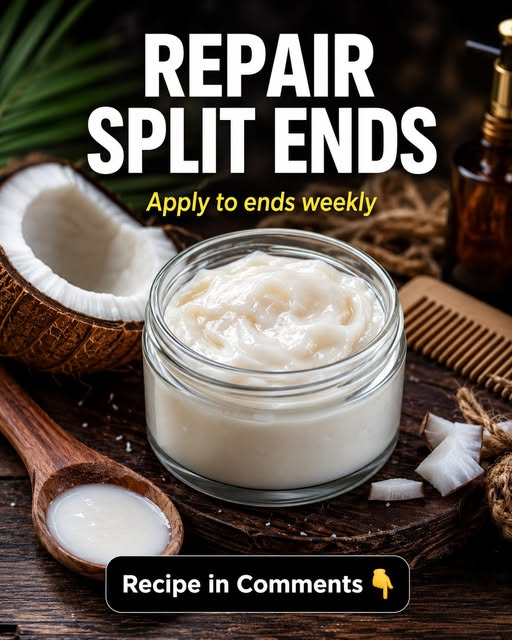
The coconut mask shown in the image is useful mainly because coconut oil has unusually strong evidence for penetrating hair and reducing protein loss. The remedies below are adjusted for different hair conditions. Each formula should be prepared fresh and applied only from the mid-lengths to the ends unless stated otherwise.

Remedy 1: For Normal Hair
Coconut and Argan Protective End Mask
Ingredients
- 2 teaspoons virgin coconut oil: penetrates the hair shaft and helps reduce protein loss.
- 1 teaspoon argan oil: helps protect hair fibres from oxidative damage.
- 1 teaspoon pure aloe vera gel: adds moisture and slip to the fresh mixture.
- 1 teaspoon cooled boiled water: lightens the consistency.
- ¼ teaspoon vegetable glycerin: attracts water and temporarily softens dry-feeling ends.
- ½ teaspoon sunflower oil: spreads easily and helps reduce friction between strands.
Procedure
- Warm the coconut oil between your palms; do not microwave it.
- Combine the coconut, argan and sunflower oils.
- In a separate bowl, mix the aloe gel, water and glycerin.
- Stir both portions together immediately before application.
- Coat the last five to eight centimetres of slightly damp hair.
- Leave the mask on for 20–30 minutes.
- Shampoo the roots and allow the lather to run gently through the ends.
- Rinse thoroughly with lukewarm water.
Because the formula contains water and no preservative, discard anything left in the bowl.
Scientific Working of Each Ingredient
Coconut oil contains lauric acid, a relatively straight, low-molecular-weight fatty acid with an affinity for hair proteins. Laboratory testing found that it reduced protein loss in both damaged and undamaged hair when used before or after washing. Argan-oil pretreatment has also reduced oxidative damage and protein loss in laboratory-tested human hair. Sunflower oil does not offer the same protein-loss protection as coconut oil, but it provides surface lubrication that can reduce friction and improve spreadability. (PubMed)
Aloe and glycerin can make the ends feel softer, but they have not been clinically shown to heal split fibres. Their effect is temporary conditioning rather than structural repair.
How Often to Apply
Use once weekly for at least four weeks. Apply twice weekly only when the hair remains dry between washes.
Initial Results
Within one to three days, the ends may feel softer, look shinier and tangle less. Existing splits will remain until trimmed.
Remedy 2: For Combination Hair
Green Tea and Coconut Zone Treatment
This remedy suits hair that becomes oily near the scalp but remains dry or frayed at the ends.
Ingredients
- 2 tablespoons cooled green tea: provides a lightweight antioxidant base.
- 2 teaspoons aloe vera gel: improves slip without coating the roots heavily.
- 1 teaspoon virgin coconut oil: protects the damaged ends.
- ½ teaspoon argan oil: conditions weathered sections.
- ¼ teaspoon vegetable glycerin: supports temporary moisture retention.
- 1 teaspoon cooled boiled water: dilutes the mixture for fine sections.
Procedure
- Brew plain green tea and allow it to cool completely.
- Mix the tea, aloe, water and glycerin.
- Apply this lightweight portion from the middle of the hair downward.
- Combine the coconut and argan oils separately.
- Press the oils only onto the final few centimetres.
- Leave everything on for 15 minutes.
- Shampoo the scalp without piling the lengths on top of the head.
- Rinse downward to minimise tangling.
Scientific Working of Each Ingredient
This zone-based method prevents heavy oil from flattening the roots while delivering coconut oil where structural damage is most advanced. Hair near the ends is older and has experienced more cumulative grooming, washing, sunlight and chemical exposure. Coconut oil helps limit protein loss, while argan oil may reduce oxidative damage. Green tea and aloe make the mixture easier to distribute, although there is no direct clinical proof that brewed tea repairs split ends. (PubMed)
How Often to Apply
Apply once weekly for four to six weeks. Use the oil portion only on visibly dry ends.
Initial Results
The ends may feel more flexible after one treatment, while the roots should remain relatively lightweight. Permanent repair should not be expected.
Remedy 3: For Fine or Easily Weighed-Down Hair
Lightweight Aloe and Micro-Dose Coconut Mask
Ingredients
- 1 tablespoon pure aloe vera gel: provides a light gel base.
- 1 tablespoon cooled boiled water: reduces heaviness.
- ½ teaspoon virgin coconut oil: gives protein-loss protection in a small amount.
- ¼ teaspoon argan oil: smooths rough-feeling ends.
- 2 drops vegetable glycerin: adds controlled humectant action.
- ½ teaspoon sunflower oil: improves spread without using excessive coconut oil.
Procedure
- Mix the aloe, water and glycerin.
- Blend the three oils in a separate cup.
- Add the oil mixture slowly while stirring.
- Apply a very small amount to the last three to five centimetres of damp hair.
- Comb through once with a wide-tooth comb.
- Leave it on for ten minutes.
- Shampoo once and rinse thoroughly.
- Allow the hair to air-dry partially before gentle styling.
Scientific Working of Each Ingredient
Fine hair can appear limp when too much oil remains on the surface. This recipe uses a smaller coconut-oil quantity to provide some penetrative protection while limiting residue. Oils can reduce adhesion and friction between fibres, which may make detangling less damaging. The effect is preventive and cosmetic; it does not glue split branches together. (PubMed)
How Often to Apply
Use once every seven to ten days for at least one month.
Initial Results
Hair may feel smoother and less rough after the first wash. Reduce the amount further if the ends appear greasy or flat.
Remedy 4: For Dry, Curly or Coily Hair
Rich Coconut and Argan End Balm
Ingredients
- 1 tablespoon virgin coconut oil: helps reduce protein loss from fragile fibres.
- 1 teaspoon argan oil: conditions and protects against oxidative damage.
- 1 teaspoon unrefined shea butter: provides a rich surface coating for coarse ends.
- 1 teaspoon aloe vera gel: adds water-based slip.
- ¼ teaspoon vegetable glycerin: improves temporary softness.
- 1 teaspoon warm water: helps loosen the balm for distribution.
Procedure
- Soften the shea butter between clean fingertips.
- Mix it with the coconut and argan oils.
- Combine the aloe, glycerin and warm water separately.
- Stir everything together just before use.
- Divide the hair into sections and apply the balm to damp ends.
- Detangle from the tips upward with the fingers or a wide-tooth comb.
- Leave it on for 30 minutes under a clean shower cap.
- Shampoo gently and follow with your usual rinse-out conditioner.
Scientific Working of Each Ingredient
Curly and coily fibres can be vulnerable to breakage at bends and during detangling. Coconut oil has the strongest evidence in this formula because it penetrates the shaft and reduces protein loss. Argan oil has demonstrated protective effects against oxidative hair damage in laboratory testing. Shea butter mainly functions as an occlusive surface emollient; robust clinical evidence for split-end repair is lacking, so it should be viewed as a friction-reducing conditioner rather than a proven treatment. (PubMed)
How Often to Apply
Use once weekly for four to eight weeks.
Initial Results
The ends may feel more lubricated and easier to detangle within one application. Breakage reduction requires continued gentle handling.
Remedy 5: For Sensitive Scalp or Fragrance-Sensitive Hair
Minimal Coconut and Sunflower End Wrap
Ingredients
- 1 teaspoon virgin coconut oil: provides the main fibre-protective action.
- 1 teaspoon sunflower oil: supplies lightweight surface lubrication.
- 1 tablespoon pure aloe vera gel: forms a fragrance-free base when tolerated.
- 1 tablespoon cooled boiled water: reduces heaviness.
- 2 drops vegetable glycerin: supports temporary softness.
- ½ teaspoon finely ground colloidal oatmeal: makes the fresh mixture more soothing when it touches nearby skin.
Procedure
- Mix the aloe, water, oatmeal and glycerin.
- Combine the coconut and sunflower oils.
- Stir the two portions together immediately before application.
- Patch-test the mixture behind the ear for 24–48 hours.
- Apply only to the ends, not directly over an inflamed scalp.
- Leave it on for ten minutes.
- Rinse and shampoo gently.
- Stop if burning, itching or redness occurs.
Scientific Working of Each Ingredient
The fragrance-free formula avoids essential oils, citrus juice and spices that can irritate reactive skin. Coconut oil reduces hair protein loss, while sunflower oil mainly coats the strand and assists lubrication. Aloe and oatmeal may improve skin comfort if the mixture contacts the neck or hairline, but they do not reconstruct a split fibre. (PubMed)
How Often to Apply
Use once weekly for three to five weeks when well tolerated.
Initial Results
The ends may feel less rough after one or two applications. Discontinue the remedy if the scalp or surrounding skin becomes irritated.
Final Tips to Prevent New Split Ends
Trim visibly split ends every eight to twelve weeks, or sooner when the splits are travelling upward. Removing the damaged tip prevents continued fraying from making the strand shorter and weaker.
Shampoo mainly at the scalp instead of scrubbing the ends. Use conditioner after washing, detangle from the tips upward and avoid repeatedly brushing wet hair. Gently squeeze water out with a soft towel or cotton shirt rather than rubbing vigorously. Dermatologists also recommend limiting flat irons, curling tools and very hot blow-drying because excessive heat weakens hair. (American Academy of Dermatology)
Reduce bleaching, frequent permanent colour, chemical straightening and tight hairstyles. Protect long hair from strong sunlight with a hat or scarf, as ultraviolet exposure can degrade hair proteins and pigments. (PubMed)
Temporary smoothness may begin within one to three days, but preventing repeated splitting requires at least four to eight weeks of gentler care. No mask can permanently seal an already divided strand.
Diet Plan for Stronger Hair
A diet cannot reconnect split ends because the visible hair shaft is already formed. However, adequate nutrition supports the production of new hair growing from the follicle.
Breakfast: Choose eggs, plain yogurt, chickpeas, lentils or tofu with whole fruit.
Lunch: Eat fish, chicken, beans or lentils with leafy vegetables and whole grains.
Snack: Select pumpkin seeds, walnuts, roasted chickpeas, fruit or plain yogurt.
Dinner: Include protein, colourful vegetables and healthy fats from fish, avocado, nuts or seeds.
Hydration: Drink according to thirst and climate. Water supports general health but does not directly seal split ends.
Continue the hair-care routine for six to eight weeks and maintain the diet pattern long term. Do not begin high-dose biotin, iron or zinc without medical advice or confirmed deficiency.
Consult a dermatologist when breakage continues despite trimming and gentle care, or when it is accompanied by excessive shedding, bald patches, scalp pain, thick scaling, itching or visible changes in the hair shaft close to the roots. Certain hair-shaft disorders, thyroid conditions, nutritional deficiencies and inflammatory scalp diseases can cause unusual fragility and require proper diagnosis.
References for the above remedy
- Taylor D, et al. The Biomechanics of Splitting Hairs.
https://pmc.ncbi.nlm.nih.gov/articles/PMC11285785/ - Adya KA, et al. Light Microscopy of the Hair: A Simple Tool to Untangle Hair Disorders.
https://pmc.ncbi.nlm.nih.gov/articles/PMC3129130/ - Rele AS, Mohile RB. Effect of Mineral Oil, Sunflower Oil and Coconut Oil on Prevention of Hair Damage.
https://pubmed.ncbi.nlm.nih.gov/12715094/ - Kaushik V, et al. Benefit of Coconut-Based Hair Oil via Hair Porosity Quantification.
https://pubmed.ncbi.nlm.nih.gov/35377477/ - Sharifi N, et al. Argan Oil as a Pretreatment of Human Hair Before Exposure to Oxidative Damage.
https://pubmed.ncbi.nlm.nih.gov/35226791/ - Keis K, et al. Investigation of Penetration Abilities of Various Oils Into Human Hair Fibres.
https://pubmed.ncbi.nlm.nih.gov/16258695/ - Dario MF, et al. UV Damage of the Hair.
https://pubmed.ncbi.nlm.nih.gov/19138021/ - American Academy of Dermatology. Tips for Healthy Hair.
https://www.aad.org/public/everyday-care/hair-scalp-care/hair/healthy-hair-tips - Phong C, et al. Coconut, Castor and Argan Oil for Hair in Skin of Color Patients.
https://pubmed.ncbi.nlm.nih.gov/35816075/ - National Center for Complementary and Integrative Health. Aloe Vera: Usefulness and Safety.
https://www.nccih.nih.gov/health/aloe-vera