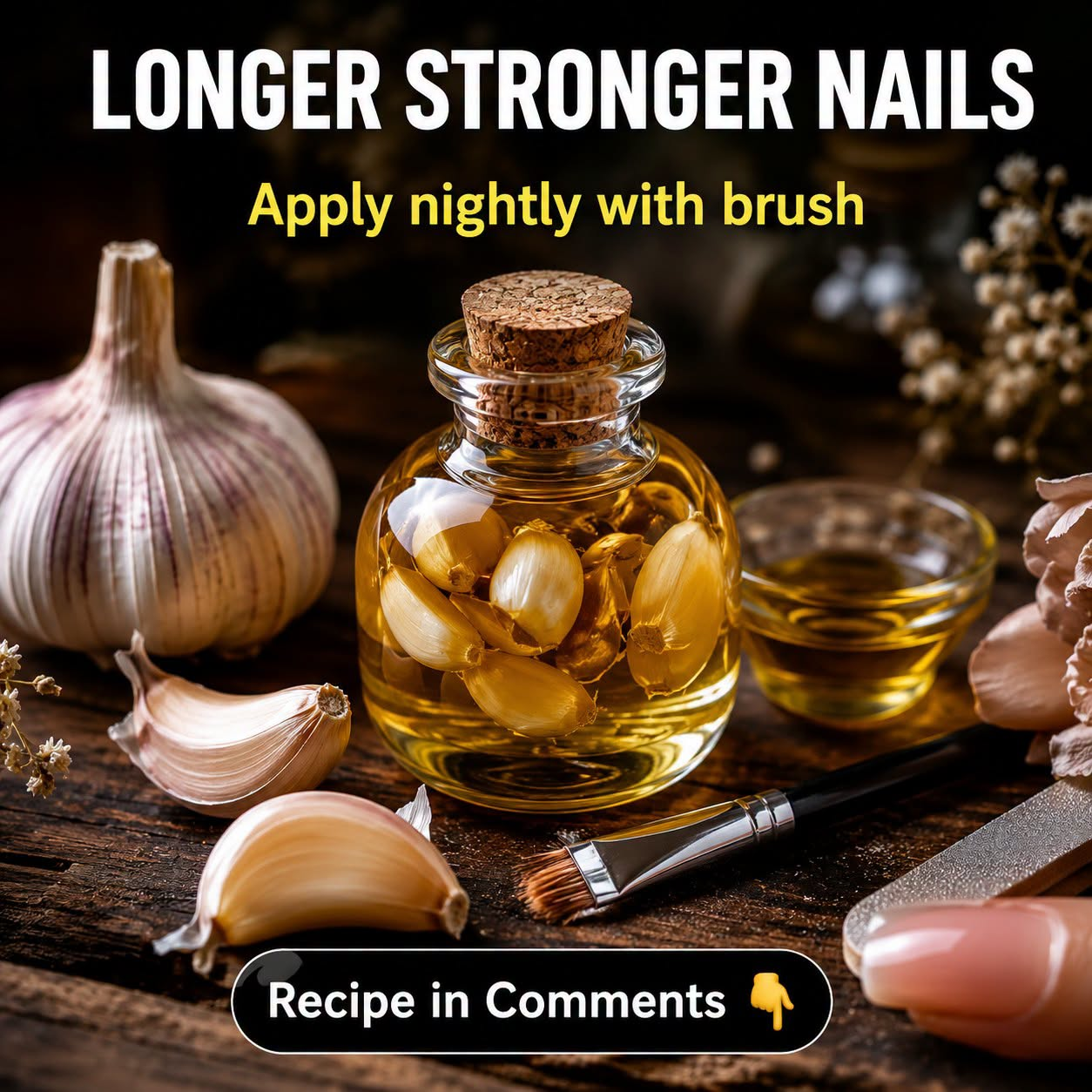
Long, healthy-looking nails can make the hands appear polished and well cared for, but weak nails often peel, split or break before they gain visible length. Frequent handwashing, dishwashing, detergents, nail-polish remover, gel manicures, artificial nails, biting and repeated wet-to-dry cycles can weaken the nail plate. Nails also grow slowly: healthy fingernails average roughly 3.5 millimetres per month, so no home remedy can produce dramatically longer nails within a few nights. The practical goal is to moisturize the nail plate and cuticles, reduce splitting and prevent breakage so that naturally growing nails can retain their length. (PubMed)
The garlic-infused oil shown in the image has intentionally not been recommended. There is no reliable clinical proof that rubbing garlic onto healthy nails accelerates their growth or makes them structurally stronger. Fresh garlic can cause severe irritant or allergic contact dermatitis, including redness, painful blisters and burn-like injuries around the fingers. A safer nightly routine should focus on hydration, protection and reduced exposure to damaging chemicals. (PubMed)
These natural treatments may improve nail flexibility and the appearance of dry cuticles. They will not treat fungal infection, psoriasis, thyroid disease, anaemia or another medical cause of abnormal nails.
Remedy 1: For Normal Hands and Nails
Jojoba, Sunflower and Aloe Nail-Protection Serum
Ingredients and Scientific Benefits
- 1 teaspoon jojoba oil: Forms a lightweight wax-like protective film over the nail and cuticle.
- 1 teaspoon sunflower seed oil: Supplies linoleic-acid-rich lipids that support the surrounding skin barrier.
- ½ teaspoon clear aloe vera gel: Adds lightweight hydration to the nail folds.
- ¼ teaspoon vegetable glycerin: Attracts water and helps reduce excessive dryness.
- ¼ teaspoon finely powdered plain oats: Soothes and conditions the skin surrounding the nails.
- 2 drops water: Helps disperse the glycerin through the fresh mixture.
How the Ingredients Work Scientifically
Nail plates repeatedly lose and absorb water during daily activities. This expansion and contraction can weaken the bonds between nail layers and contribute to peeling. Moisturizing ingredients cannot change the rate at which the nail matrix produces keratin, but they can improve flexibility and reduce environmental damage. Jojoba forms a protective surface film, while glycerin, aloe and oats support hydration around the cuticle. Sunflower oil helps limit moisture loss from the surrounding skin. Reviews of brittle-nail care recommend moisturizers containing both humectants and occlusive ingredients. (PMC)
Procedure
- Combine the aloe gel, glycerin and water in a clean bowl.
- Add the powdered oats and mix until smooth.
- Stir in the jojoba and sunflower oils.
- Wash and dry the hands thoroughly.
- Brush a thin layer over each nail, underneath the free edge and around the cuticle.
- Massage gently for one minute.
- Leave the serum on overnight.
How Often to Apply
Apply nightly for at least five days. Continue for eight to twelve weeks for a meaningful reduction in repeated breakage.
Initial Results
Within one to three days, the cuticles may look smoother and the nails may feel less dry. Noticeable length will take several weeks because the serum prevents breakage rather than forcing faster growth.
Remedy 2: For Combination Hands
Oat, Aloe and Dual-Oil Cuticle Treatment
This remedy is suitable when the palms feel normal or slightly oily but the cuticles and nail edges remain dry.
Ingredients and Scientific Benefits
- 1 teaspoon clear aloe vera gel: Hydrates without coating the entire hand in heavy oil.
- ½ teaspoon finely powdered oats: Helps calm rough, irritated nail folds.
- ¼ teaspoon vegetable glycerin: Retains moisture around the cuticles.
- ½ teaspoon jojoba oil: Protects the nail plate without an excessively greasy finish.
- ½ teaspoon sunflower seed oil: Reduces moisture loss from dry nail edges.
- 1 teaspoon cooled green tea: Creates a lightweight base and supplies antioxidant polyphenols.
How the Ingredients Work Scientifically
This targeted treatment moisturizes the nail unit without applying a thick oily layer to the palms. Humectants such as glycerin hold water, while plant oils reduce evaporation. Oats support irritated skin, and jojoba provides a flexible surface film. The treatment may reduce splitting associated with dryness, but green tea and aloe should be regarded as soothing additions rather than proven nail-growth stimulants. (PubMed)
Procedure
- Mix the aloe, green tea, glycerin and oat powder.
- Stir in both oils.
- Use a clean brush to coat only the nails and cuticles.
- Concentrate on peeling tips and dry sidewalls.
- Leave the treatment on for 20 minutes.
- Wipe away the excess without washing the hands again.
How Often to Apply
Apply every night for five days, then continue four or five nights per week.
Initial Results
Dry cuticles may feel more comfortable after the first two applications. Peeling edges may become less rough within three to five days, although damaged portions must grow out before they disappear completely.
Remedy 3: For Oily or Sweaty Hands
Lightweight Aloe and Glycerin Nail Gel
Ingredients and Scientific Benefits
- 1 teaspoon aloe vera gel: Provides non-greasy hydration.
- 1 teaspoon boiled and cooled water: Creates a lightweight serum base.
- ¼ teaspoon vegetable glycerin: Helps the nail and surrounding skin retain water.
- ½ teaspoon finely powdered plain oats: Supports irritated cuticles.
- 1 teaspoon cooled green tea: Adds a refreshing water-based element.
- 3 drops jojoba oil: Provides minimal occlusion without covering the hands in heavy oil.
How the Ingredients Work Scientifically
Even people with sweaty or oily hands can develop brittle nails because the nail plate itself contains much less lipid than facial skin. A lightweight humectant gel can improve comfort, while a small quantity of jojoba reduces evaporation. Hydration should remain balanced: repeatedly soaking the nails in water can worsen splitting, so this treatment is applied as a thin film rather than used as a long hand soak. Laboratory and clinical observations associate repeated water exposure followed by drying with lamellar splitting of the nail plate. (PubMed)
Procedure
- Mix the aloe gel, water, green tea and glycerin.
- Stir in the oat powder.
- Add three drops of jojoba oil and mix thoroughly.
- Brush a small amount over clean, dry nails.
- Allow the gel to remain for 15 minutes.
- Wipe away any residue with a soft cloth.
How Often to Apply
Use nightly for five days. Continue at least four nights weekly while the nails remain prone to peeling.
Initial Results
The nail folds may feel less tight within one or two days. The nails may appear smoother by day three, but visible strengthening depends on continued protection from detergents and excessive water exposure.
Remedy 4: For Very Dry Hands and Brittle Nails
Coconut, Honey and Oat Overnight Nail Mask
Ingredients and Scientific Benefits
- 1 teaspoon virgin coconut oil: Softens very dry nail folds and forms an emollient layer.
- 1 teaspoon sunflower seed oil: Helps protect the surrounding skin barrier.
- ½ teaspoon honey: Holds moisture against dry, intact skin.
- ¼ teaspoon vegetable glycerin: Attracts water to the outer nail and skin surfaces.
- ½ teaspoon finely powdered oats: Reduces roughness around the cuticles.
- ½ teaspoon aloe vera gel: Provides water-based hydration.
How the Ingredients Work Scientifically
Brittle nails are often made worse by dehydration, household work and repeated contact with water or cleaning chemicals. This remedy combines humectants with oils, creating a more complete moisture-sealing treatment. It may increase flexibility and reduce the tendency of dry nail layers to split. Coconut oil has evidence as a moisturizer for dry skin, while sunflower oil supports barrier integrity; neither has been proven to make the nail matrix grow faster. (PMC)
Procedure
- Combine the honey, glycerin and aloe gel.
- Mix in the powdered oats.
- Add the coconut and sunflower oils.
- Brush the treatment over the nail plates and cuticles.
- Massage gently for one minute.
- Leave it on overnight.
- Wear clean cotton gloves when needed to protect bedding.
How Often to Apply
Use nightly for five days, then continue at least five nights per week for eight weeks.
Initial Results
Dryness may improve after the first night. Cuticles may look softer within two or three days, while fewer cracks and splits may become noticeable after several weeks.
Remedy 5: For Sensitive Skin and Irritated Cuticles
Fragrance-Free Oat and Sunflower Nail Compress
Ingredients and Scientific Benefits
- 1 teaspoon boiled and cooled water: Creates a simple fragrance-free base.
- ½ teaspoon finely powdered oats: Helps calm dry and irritated skin.
- ½ teaspoon aloe vera gel: Supplies gentle hydration.
- ⅛ teaspoon vegetable glycerin: Supports moisture retention at a low concentration.
- ½ teaspoon sunflower seed oil: Reduces water loss.
- ¼ teaspoon jojoba oil: Forms a lightweight protective layer.
How the Ingredients Work Scientifically
Sensitive cuticles can react to fragrance, essential oils, garlic, nail adhesives and polish ingredients. Oats, diluted glycerin and simple plant oils focus on barrier care without strong acids or aromatic compounds. A healthier cuticle helps protect the nail matrix from irritants and microorganisms. However, natural substances may still cause allergy, so the mixture should be patch-tested before use. (American Academy of Dermatology)
Procedure
- Mix the oats, water, aloe and glycerin.
- Apply the paste around the nails for five minutes.
- Rinse gently and pat completely dry.
- Combine the sunflower and jojoba oils.
- Brush one thin coat over each nail and cuticle.
- Leave it on overnight.
How Often to Apply
Use once nightly for three days. Continue for up to five days only if there is no itching, swelling, burning or worsening redness.
Initial Results
Mild tightness may improve within one to three days. Stop using the remedy if the nail folds become warmer, more painful or increasingly swollen.
Final Tips for Growing Longer, Stronger Nails
Keep nails clean and reasonably dry, but moisturize them after handwashing. Wear gloves when washing dishes, cleaning or handling detergents. Avoid using the nails to open containers or scrape surfaces. File snags gently in one direction and keep the nails slightly shorter until peeling has improved.
Do not cut or aggressively push back the cuticles, as they seal the space between the nail and surrounding skin. Limit acetone remover, artificial nails and repeated gel manicures. Dermatologists also advise against biting the nails or pulling off hangnails because these habits damage the nail unit and increase infection risk. (American Academy of Dermatology)
Do not expect a visible increase in length within three days. Early improvements should involve softer cuticles, smoother edges and less dryness. Fingernails usually require several months to grow from the matrix to the tip, so continue protective care for at least eight to twelve weeks.
Diet Plan for Strong, Healthy Nails
A balanced diet supports normal keratin production, but no single food instantly strengthens nails.
For breakfast, eat cooked eggs, plain yogurt, oats or whole-grain bread with fruit. At lunch, include lentils, beans, chicken or fish with leafy vegetables and whole grains. Choose almonds, peanuts, sunflower seeds or pumpkin seeds as a snack. Dinner should contain protein from fish, chicken, tofu, chickpeas or beans with colourful vegetables.
Include iron-rich foods such as lentils, beans, meat and leafy greens, alongside vitamin-C-rich fruit to support iron absorption. Protein, iron, zinc and B vitamins all contribute to normal nail formation, although nutritional supplements should only be used when a deficiency or medical need is identified. (PubMed)
Biotin deficiency can cause brittle nails, but deficiency is uncommon, and evidence supporting high-dose biotin for healthy people is limited. Biotin supplements can also interfere with important laboratory tests. Consult a healthcare professional before using them. (Office of Dietary Supplements)
Continue the selected remedy for at least five days and maintain protective nail care for eight to twelve weeks. See a doctor or dermatologist if brittleness persists or if the nails become painful, swollen, thick, yellow, deeply ridged, spoon-shaped, detached or unusually dark. A new dark streak, nail-fold infection or sudden change affecting several nails requires professional assessment.
References for the above remedy
- American Academy of Dermatology Association. “11 Dermatologists’ Tips for Healthy Nails.”
https://www.aad.org/public/everyday-care/nail-care-secrets/basics/healthy-nail-tips - American Academy of Dermatology Association. “12 Nail Changes a Dermatologist Should Examine.”
https://www.aad.org/public/everyday-care/nail-care-secrets/basics/nail-changes-dermatologist-should-examine - Chessa MA, et al. “Pathogenesis, Clinical Signs and Treatment Recommendations in Brittle Nails.”
https://pubmed.ncbi.nlm.nih.gov/31749091/ - Baboun D, et al. “Natural Treatment Options for Nail Disorders.”
https://pmc.ncbi.nlm.nih.gov/articles/PMC10987172/ - Yaemsiri S, et al. “Growth Rate of Human Fingernails and Toenails in Healthy American Young Adults.”
https://pubmed.ncbi.nlm.nih.gov/19744178/ - Van de Kerkhof PCM, et al. “Brittle Nails.”
https://pubmed.ncbi.nlm.nih.gov/17134428/ - Stern DK, et al. “Management of Simple Brittle Nails.”
https://pubmed.ncbi.nlm.nih.gov/23210755/ - Lee TY, Lam TH. “Contact Dermatitis Due to Topical Treatment with Garlic.”
https://pubmed.ncbi.nlm.nih.gov/1831097/ - National Institutes of Health, Office of Dietary Supplements. “Biotin: Fact Sheet for Health Professionals.”
https://ods.od.nih.gov/factsheets/Biotin-HealthProfessional/ - Cashman MW, Sloan SB. “Nutrition and Nail Disease.”
https://pubmed.ncbi.nlm.nih.gov/20620759/