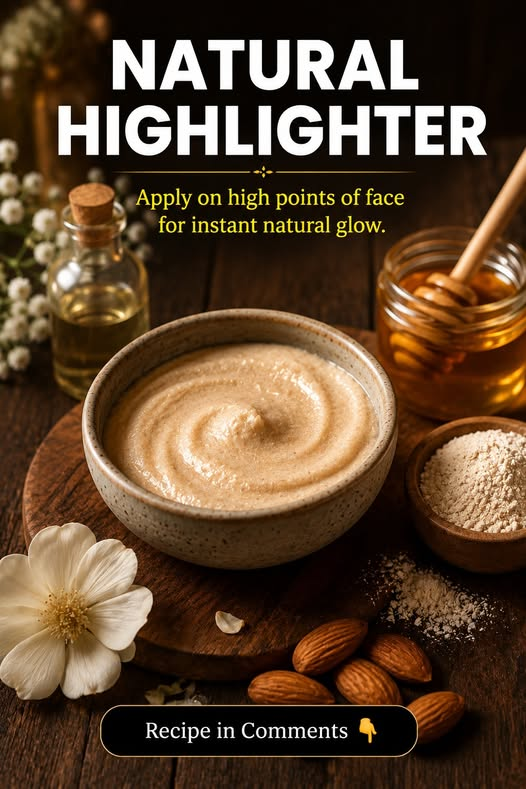
A natural highlighter can give the cheekbones, brow bones and bridge of the nose a fresh, dewy appearance without changing the skin’s natural colour. The “instant glow” comes mainly from two effects: hydration smooths the outer skin layer so it reflects light more evenly, while a tiny amount of cosmetic-grade mineral pigment creates gentle luminosity. It does not remove pigmentation, shrink pores or treat wrinkles immediately.
The oatmeal, honey and oil mixture shown in the image is better used as a short glow-preparation mask rather than being left on the face for many hours. Food-based mixtures contain no preservatives and may become contaminated when stored. The safer method is to prepare one small portion, rinse off the nourishing mask and then apply a freshly mixed amount of highlighter only to the high points of the face.
Use only cosmetic-grade mica labelled for facial use. Never use craft glitter, metallic powder or decorative mica intended for candles, resin or paint. Mica is permitted as a colour additive in cosmetics, but the finished ingredient still needs to be suitable for facial application. (U.S. Food and Drug Administration)
Remedy 1: Yogurt and Aloe Dew Highlighter for Normal Skin
Ingredients and Their Scientific Working
- Plain unsweetened yogurt – 1 tablespoon: Provides moisture and naturally occurring lactic acid that can gently soften loosely attached surface cells.
- Colloidal oatmeal – 1 teaspoon: Oat starches and beta-glucans retain moisture, while avenanthramides help calm irritation and support the skin barrier.
- Strong cooled green tea – 1 teaspoon: Supplies antioxidant polyphenols and gives the mixture a lightweight consistency.
- Pure inner-leaf aloe vera gel – 1 teaspoon: Aloe contains water-binding polysaccharides that can increase short-term surface hydration.
- Vegetable glycerin – 1 drop: Draws water toward the outer skin layer and creates a smoother, slightly plumper appearance.
- Cosmetic-grade champagne or pearl mica – a very small pinch, approximately 1/32 teaspoon: Reflects light from the cheekbones and creates the visible highlighter effect. It does not biologically brighten the skin. Research supports the moisturizing value of properly formulated oatmeal, aloe and glycerin ingredients, but not this complete homemade mixture as a clinical treatment. (PubMed)
Procedure
Mix the yogurt, oatmeal and green tea. Apply the preparation to clean skin for eight minutes, then rinse with lukewarm water and pat dry.
In a separate clean spoon, mix the aloe gel, one drop of glycerin and the tiny pinch of facial mica. Dab a rice-grain-sized quantity on each cheekbone and a smaller amount above the cupid’s bow. Blend by tapping with clean fingertips.
Prepare the highlighter fresh and discard the remainder. Remove it with a gentle cleanser before sleeping.
How Often to Apply
Use the preparation mask once daily for three days and then two or three times weekly. The highlighter finish may be used occasionally whenever an immediate glow is desired.
Initial Results
The face may look fresher immediately after application. During the first one to three days, the skin may also feel softer and less rough, but persistent pigmentation will remain unchanged.
Remedy 2: Rice and Sunflower Two-Zone Highlighter for Combination Skin
Ingredients and Their Scientific Working
- Fresh rice-starch water – 1 tablespoon: Forms a light film over the skin and may support recovery of a weakened outer barrier.
- Colloidal oatmeal – 1 teaspoon: Helps hydrate dry cheek areas and reduces the stripping effect of oil-control ingredients.
- Pure aloe vera gel – 1 teaspoon: Provides lightweight moisture without adding substantial oil to the forehead and nose.
- Kaolin clay – ¼ teaspoon: Absorbs some surface oil and temporarily reduces excessive shine in the T-zone.
- Cold-pressed sunflower seed oil – 1 drop: Linoleic-acid-rich sunflower oil can support barrier integrity and hydration. It should be used only on dry areas.
- Cosmetic-grade pearl mica – a very small pinch: Adds controlled reflection to selected high points rather than making the entire T-zone appear greasy. Human studies support the barrier benefits of rice starch and sunflower oil, although the complete recipe has not undergone clinical testing. (PubMed)
Procedure
Prepare rice water by simmering two tablespoons of rinsed rice in one cup of water for approximately ten minutes. Strain and cool completely.
Mix one tablespoon of rice water with the oatmeal, aloe and kaolin. Apply a thin layer to the T-zone and a lighter layer to the cheeks. Rinse after seven minutes.
For the highlighter, combine a pea-sized amount of aloe with the mica. Add one drop of sunflower oil only when the cheekbones feel dry. Apply to the cheekbones while avoiding the centre of the forehead and nose.
How Often to Apply
Use on alternate days for five days, followed by twice-weekly application. Use the highlighter finish only as needed and wash it off at the end of the day.
Initial Results
The T-zone may appear less oily after one application, while the cheeks may feel more comfortable within two or three days. The luminous finish is immediate but temporary.
Remedy 3: Green Tea Gel Highlighter for Oily Skin
Ingredients and Their Scientific Working
- Strong cooled green tea – 1 tablespoon: Provides antioxidant compounds without requiring a heavy oil base.
- Kaolin clay – 1 teaspoon: Absorbs temporary surface oil and helps reduce unwanted shine.
- Finely milled rice starch – 1 teaspoon: Creates a smooth, lightweight texture and absorbs a small amount of moisture and oil.
- Pure aloe vera gel – 1 tablespoon: Adds water-based hydration and helps prevent the clay from becoming excessively drying.
- Colloidal oatmeal – ½ teaspoon: Supports the skin barrier and reduces the tight feeling caused by over-cleansing.
- Cosmetic-grade pearl mica – a tiny pinch: Creates targeted light reflection without applying oil over acne-prone areas. Dermatologists recommend lightweight hydrating ingredients such as aloe and oil-absorbing clays for masks intended for oily skin. (American Academy of Dermatology)
Procedure
Mix the green tea, clay, rice starch, half of the aloe and oatmeal. Apply a thin layer for five to seven minutes. Rinse before the clay becomes hard or starts cracking.
Mix the remaining aloe with the mica. Apply a very small amount to the upper cheekbones only. Avoid inflamed pimples, broken skin and areas where pores become easily congested.
How Often to Apply
Apply the rinse-off mask once daily for three days, then twice weekly. The highlighter gel can be used occasionally but should not be layered repeatedly throughout the day.
Initial Results
Excessive surface shine may decrease after the first application. The highlighter adds an immediate controlled glow, while smoother texture may become noticeable during the first one to three days.
Remedy 4: Honey and Coconut Highlighter Balm for Dry Skin
Ingredients and Their Scientific Working
- Colloidal oatmeal – 1 tablespoon: Improves moisture retention and softens rough, flaky skin.
- Pasteurized honey – 1 teaspoon: Acts as a humectant and helps keep the rinse-off preparation moist.
- Pure aloe vera gel – 1 tablespoon: Supplies water and soothing polysaccharides.
- Virgin coconut oil – ¼ teaspoon: Works as an emollient and reduces water loss. A randomized trial found coconut oil comparable to mineral oil for moisturizing mild-to-moderate xerosis.
- Vegetable glycerin – 2 drops: Attracts water into dehydrated outer cells and can temporarily soften fine dryness lines.
- Cosmetic-grade golden or champagne mica – a tiny pinch: Provides warm light reflection without changing the underlying pigmentation. Clinical research supports coconut oil as a moisturizer and honey-containing formulations for improving hydration and smoothness, though not as permanent wrinkle treatments. (PubMed)
Procedure
Combine the oatmeal, honey, aloe, one drop of glycerin and half of the coconut oil. Apply for ten minutes and rinse gently. Follow with a fragrance-free moisturizer.
Mix the remaining coconut oil with one drop of glycerin and the mica. Use only a pinhead-sized quantity on each cheekbone. Applying too much can make the face greasy or encourage clogged pores.
How Often to Apply
Use the moisturizing mask daily for three to five days, followed by three applications weekly. Use the balm highlighter only when required and cleanse it off before bed.
Initial Results
Dryness and tightness may improve during the first one to three days. The oil-and-mica finish produces an immediate dewy effect, while continued hydration can soften the appearance of fine dehydration lines.
Remedy 5: Minimal Oat and Sunflower Glow for Sensitive Skin
Ingredients and Their Scientific Working
- Colloidal oatmeal – 1 tablespoon: Has strong evidence as a soothing, barrier-supporting ingredient for dry and reactive skin.
- Fresh rice-starch water – 1 tablespoon: Creates a mild liquid base and leaves a light smoothing film.
- Cooled boiled water – 1 teaspoon: Dilutes the mixture and reduces unnecessary exposure to multiple botanicals.
- Pure aloe vera gel – ½ teaspoon: Adds light hydration but should be omitted if aloe has previously caused irritation.
- Vegetable glycerin – 1 drop: Helps the outer skin layer retain moisture.
- Sunflower seed oil – 1 drop: Creates a subtle natural sheen while supporting the barrier. Mica is intentionally omitted from the first treatment to reduce the number of potential irritants.
Procedure
Patch-test the ingredients before facial use. Mix the oatmeal, rice water, cooled water and aloe. Apply for five minutes during the first use and rinse gently.
After moisturizing, rub one drop of sunflower oil between two clean fingertips. Tap the almost invisible residue onto the upper cheekbones. Do not apply enough to leave a wet or oily layer.
How Often to Apply
Use every other day for three to five days. Apply the oil glow only occasionally and stop if bumps, itching or prolonged redness develop.
Initial Results
Sensitive skin may feel calmer and less tight within two or three applications. The single drop of oil provides a soft, immediate sheen rather than a glittering highlight.
Final Tips for a Safe Natural Highlighter
Test every preparation on a small area before applying it widely. Dermatologists recommend testing new skincare products repeatedly on a small area for seven to ten days because reactions may not appear after the first exposure. (American Academy of Dermatology)
Never store mixtures containing aloe, tea, rice water, yogurt or honey. They contain water and food materials but no effective preservative system. Prepare only enough for one application and use clean utensils.
Do not add lemon juice, cinnamon, undiluted essential oils, baking soda, craft glitter or crushed eyeshadow. Wash the remedy off immediately if it causes burning, stinging, swelling or intense itching.
Apply broad-spectrum, water-resistant SPF 30 or higher every morning. A highlighter creates reflection but provides no meaningful ultraviolet protection. Daily sunscreen helps prevent dark spots, roughness and premature ageing. (American Academy of Dermatology)
Visible hydration and softness may begin within two to three days. Continued moisturizing can maintain the glow and gradually soften fine dehydration lines, but established wrinkles, acne scars and pigmentation require longer-term treatment.
Diet Plan for Naturally Healthy-Looking Skin
Breakfast: Eat eggs, plain yogurt, oats or another protein-rich food with guava, kiwi, berries or an orange.
Mid-morning: Choose almonds, walnuts, pumpkin seeds or one whole fruit.
Lunch: Combine lentils, beans, fish or chicken with leafy vegetables, carrots, tomatoes and whole grains.
Evening snack: Have roasted chickpeas, unsweetened yogurt or fruit instead of sugary drinks and highly processed snacks.
Dinner: Include a protein source, mixed vegetables and a moderate serving of brown rice or whole-grain flatbread.
Vitamin C supports normal collagen production and antioxidant protection, while dietary fats and protein contribute to normal tissue maintenance. Drinking additional water may slightly improve hydration in people whose previous fluid intake was low, but excessive water does not create an instant facial glow. (PubMed)
Follow the skin-type remedy for three to four weeks while maintaining regular cleansing, moisturizing and sun protection. Consult a dermatologist if persistent dullness, itching, acne, scaling, redness or pigmentation continues after four to six weeks. Seek prompt medical care for facial swelling, blistering, pus, spreading rash or difficulty breathing.
References for the above remedy
- American Academy of Dermatology. Do facial masks work, and should I add one to my skincare routine?
https://www.aad.org/public/everyday-care/skin-care-secrets/routine/facial-masks-and-skin-care - American Academy of Dermatology. How to test skincare products.
https://www.aad.org/public/everyday-care/skin-care-secrets/prevent-skin-problems/test-skin-care-products - American Academy of Dermatology. How to apply sunscreen.
https://www.aad.org/public/everyday-care/sun-protection/shade-clothing-sunscreen/how-to-apply-sunscreen - U.S. Food and Drug Administration. Color additives permitted for use in cosmetics.
https://www.fda.gov/cosmetics/cosmetic-ingredient-names/color-additives-permitted-use-cosmetics - De Paepe K, et al. Effect of rice starch as a bath additive on the barrier function of damaged skin.
https://pubmed.ncbi.nlm.nih.gov/12353708/ - Capone K, et al. Effects of colloidal oatmeal cream on skin-barrier properties.
https://pubmed.ncbi.nlm.nih.gov/32484623/ - Dal’Belo SE, et al. Moisturizing effect of cosmetic formulations containing Aloe vera extract.
https://pubmed.ncbi.nlm.nih.gov/17026654/ - Danby SG, et al. Effect of olive and sunflower seed oil on the adult skin barrier.
https://pubmed.ncbi.nlm.nih.gov/22995032/ - Agero ALC, Verallo-Rowell VM. Coconut oil as a moisturizer for mild-to-moderate xerosis.
https://pubmed.ncbi.nlm.nih.gov/15724344/ - Innovative Honey-Based Product and Its Beneficial Effects Measured by Modern Skin Techniques.
https://pubmed.ncbi.nlm.nih.gov/39770550/