
Slow growth, excessive shedding and frequent breakage can make hair look thin and affect confidence. Onion juice and rosemary oil are often promoted as rapid hair-growth treatments, but realistic expectations are important. A small clinical trial found that rosemary oil increased hair count after six months, not within a few days. Another small study found that crude onion juice encouraged regrowth in people with patchy alopecia areata, with the earliest changes beginning after about two weeks. These findings do not prove that every homemade mixture will work or that onion and rosemary can treat all causes of hair loss. However, carefully diluted, evidence-informed remedies may support scalp health, reduce breakage and improve the appearance of thinning hair when used consistently. (PubMed)
The exact blends below have not been tested as complete formulas in clinical trials. Their ingredients have different levels of supporting evidence, and they should be considered supportive home care rather than substitutes for medical diagnosis or proven hair-loss treatment.
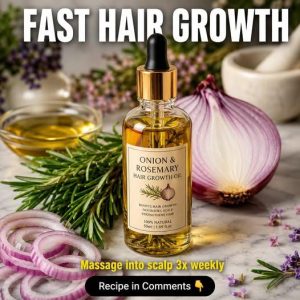
Remedy 1: Onion, Rosemary and Coconut Growth Oil for a Normal Scalp
Ingredients and Their Scientific Benefits
- Virgin coconut oil: 2 tablespoons. Coconut oil can penetrate the hair fibre and has been shown to reduce protein loss from both damaged and undamaged hair. This helps preserve length by reducing breakage. (PubMed)
- Fresh onion juice: 1 tablespoon. A small controlled study involving people with patchy alopecia areata reported better regrowth with onion juice than with tap water. Its sulphur-containing compounds may support keratin formation, although evidence for ordinary pattern thinning remains limited. (PubMed)
- Rosemary essential oil: 4 drops. A randomized comparative trial found an improvement in hair count after six months of rosemary-oil use in men with androgenetic alopecia. Undiluted rosemary oil must never be placed directly on the scalp. (PubMed)
- Pumpkin seed oil: 1 teaspoon. Topical pumpkin seed oil produced promising dermoscopic improvements during a three-month trial involving women with pattern hair loss. (PubMed)
- Pure aloe vera gel: 1 teaspoon. Aloe does not directly prove faster follicle growth, but a controlled trial found that an aloe preparation improved scaling and itching associated with seborrheic dermatitis. A calmer scalp may be easier to maintain consistently. (Taylor & Francis Online)
How This Remedy Works
Rosemary and onion provide the growth-focused elements, while pumpkin seed oil supplies another potentially useful botanical lipid. Coconut oil primarily protects the existing hair shaft, helping the hair become longer by breaking less. Aloe reduces the harshness of the mixture and supports scalp comfort.
Procedure
Extract onion juice by grating and straining a small piece of onion. Mix it with the oils and aloe immediately before application. Divide dry hair into sections, spread the mixture over the scalp and massage gently with the fingertips for three to four minutes. Leave it on for 30 minutes, then wash with a mild shampoo.
How Often to Apply
Use three times weekly for at least 12 weeks. Evaluate density after three months and continue for up to six months when the scalp tolerates it well.
Initial Results
Within one to three days, hair may feel smoother, shinier and less rough. New growth should not be expected this quickly. Follicle-related improvement usually requires several months.
Remedy 2: Lightweight Onion and Rosemary Serum for Combination Scalp
Ingredients and Their Scientific Benefits
- Fresh onion juice: 2 teaspoons for targeted follicle support.
- Aloe vera gel: 1 tablespoon to soothe dry or itchy sections.
- Pumpkin seed oil: 2 teaspoons for lightweight conditioning and potential growth support.
- Rosemary essential oil: 3 drops, properly diluted.
- Raw honey: 1 teaspoon.
- Boiled and cooled water: 1 teaspoon to thin the honey.
How Each Ingredient Works Scientifically
Combination scalps are often oily near the crown but dry around the hairline. Aloe hydrates without creating a heavy oil layer, while pumpkin seed oil provides a lighter base than a coconut-heavy mask. Diluted honey has demonstrated benefits for itching and scaling in a small study of seborrheic dermatitis and dandruff, although it is not a proven treatment for genetic hair loss. (PubMed)
Procedure
Mix the honey with water, then blend in the aloe, onion juice, pumpkin seed oil and rosemary oil. Apply a thin layer to the scalp rather than saturating the hair. Use slightly more aloe mixture on dry areas and less oil on the greasy crown. Massage gently and leave for 20–25 minutes before washing.
How Often to Apply
Apply on alternate days for the first five days, then reduce to twice weekly. Continue for 12 weeks if no irritation develops.
Initial Results
Dry sections may feel less tight within one to three applications, while the roots should remain lighter than they would after a heavy oil treatment. Visible regrowth is not expected during the first week.
Remedy 3: Clarifying Rosemary Scalp Treatment for Oily Hair
Ingredients and Their Scientific Benefits
- Aloe vera gel: 1 tablespoon.
- Fresh onion juice: 2 teaspoons.
- Pumpkin seed oil: 1 teaspoon.
- Rosemary essential oil: 3 drops.
- Tea tree essential oil: 1 drop.
- Boiled and cooled water: 1 tablespoon.
Scientific Working of the Remedy
Tea tree oil has clinical evidence for reducing dandruff, greasiness and itching when used in a properly formulated 5% shampoo. A homemade leave-on preparation should use a much lower amount because essential oils can irritate the skin. Tea tree oil treats neither genetic baldness nor hormonal hair loss, but controlling flakes and itch may reduce scratching and scalp discomfort. (PubMed)
The small quantity of pumpkin seed oil prevents excessive heaviness, aloe supplies a soothing base, and rosemary and onion provide the principal growth-oriented botanicals.
Procedure
Combine all ingredients thoroughly and prepare only enough for one application. Dab the mixture onto the scalp with clean fingertips or cotton, avoiding the hair lengths. Massage without using the nails. Leave for 15–20 minutes and shampoo thoroughly.
How Often to Apply
Use twice weekly for the first two weeks. It may be increased to three times weekly for at least five days only when there is no burning, redness or worsening dandruff.
Initial Results
The scalp may feel cleaner and less greasy after one to three uses. Reduced itching may also occur, but actual hair density cannot change noticeably within several days.
Remedy 4: Nourishing Onion and Rosemary Mask for Dry Scalp
Ingredients and Their Scientific Benefits
- Virgin coconut oil: 2 tablespoons.
- Pumpkin seed oil: 1 tablespoon.
- Fresh onion juice: 2 teaspoons.
- Aloe vera gel: 1 teaspoon.
- Raw honey: 1 teaspoon.
- Rosemary essential oil: 4 drops.
Scientific Working of the Ingredients
Coconut oil protects porous, fragile strands and reduces protein loss, making it particularly useful when dryness and breakage prevent length retention. Honey and aloe support comfort and hydration, while rosemary, onion and pumpkin seed oil provide the ingredients with direct or preliminary hair-regrowth research. (PubMed)
Procedure
Warm the coconut oil indirectly by placing its container in warm water. Do not overheat it. Stir in the pumpkin seed oil, honey, aloe, onion juice and rosemary oil. Apply to the scalp and lightly coat brittle ends with the remaining mixture. Massage for four minutes, leave for 30–40 minutes and wash gently.
How Often to Apply
Use every other day for the first five days only if the scalp is extremely dry, then continue twice weekly for 12 weeks.
Initial Results
Hair can feel softer and appear glossier after the first treatment. Less tangling and breakage may become noticeable within several days, but new growth requires considerably longer.
Remedy 5: Gentle Scalp-Support Mask for Sensitive Skin
People with sensitive, inflamed or eczema-prone scalps should not begin with strong onion juice or rosemary essential oil. These ingredients can cause irritation or allergic contact dermatitis. A gentler routine should first restore comfort and protect the hair shaft.
Ingredients and Their Scientific Benefits
- Finely ground colloidal oatmeal: 1 tablespoon.
- Aloe vera gel: 1 tablespoon.
- Virgin coconut oil: 1 teaspoon.
- Raw honey: 1 teaspoon.
- Pumpkin seed oil: 1 teaspoon.
- Boiled and cooled water: 1–2 tablespoons.
How This Sensitive-Scalp Remedy Works
Colloidal oatmeal has demonstrated anti-inflammatory and barrier-supporting effects in clinical skin studies. It may reduce dryness and itching, although its evidence comes from eczema research rather than hair-growth trials. Coconut oil helps protect fragile hair, while aloe and diluted honey support a calmer scalp. Pumpkin seed oil offers limited but promising topical hair-loss evidence. (PubMed)
Procedure
Mix the oatmeal with water to form a smooth paste. Add the remaining ingredients and apply a thin layer for 10–15 minutes. Rinse with lukewarm water without scrubbing.
How Often to Apply
Use once every other day for three to five days, then once or twice weekly. Only consider a separately diluted rosemary treatment after a successful patch test and professional advice.
Initial Results
Itching, roughness or tightness may begin to settle within one to three days. This formula is intended primarily to support the scalp barrier and prevent breakage, not to create rapid regrowth.
Final Tips for Stronger and Longer Hair
Perform a patch test behind the ear or on the inner arm 24–48 hours before using onion juice, essential oils or honey. Never use rosemary or tea tree essential oil undiluted. Prepare onion mixtures fresh, discard leftovers and avoid applying them to scratched, infected or bleeding skin.
Massage with the pads of the fingers rather than the nails. One small study found increased hair thickness after four minutes of daily scalp massage for 24 weeks, but it did not demonstrate a significant increase in growth rate. (PubMed)
Keep combs, towels and applicators clean. Avoid tight hairstyles, aggressive brushing, frequent high heat and harsh chemical processing. Early improvements within two to three days usually involve softness, shine, moisture or reduced itching. Reduced breakage may become clearer over several weeks, while meaningful follicular regrowth commonly requires three to six months.
Diet Plan to Support Hair Growth
Follow this balanced eating pattern for at least 12 weeks:
Breakfast: Two eggs or unsweetened yogurt with oats, berries or guava. Add one tablespoon of pumpkin seeds.
Lunch: Lentils, beans, chicken or fish with spinach or another dark-green vegetable, whole-grain roti or brown rice, and a vitamin-C-rich salad.
Snack: A small handful of walnuts, almonds or roasted chickpeas with fresh fruit.
Dinner: Fish, chicken, tofu, beans or lentils with mixed vegetables and a moderate serving of whole grains.
Daily fluids: Drink enough water to keep urine pale yellow. Requirements vary according to body size, climate, pregnancy, exercise and medical conditions.
Hair follicles require adequate calories, protein, iron, zinc and other nutrients. However, supplements should not be taken blindly. Dermatologists recommend testing for deficiencies before using iron, zinc or high-dose biotin because unnecessary supplementation can be ineffective or harmful. (American Academy of Dermatology)
Continue the home routine and diet plan for approximately three months before judging the result. See a dermatologist sooner if hair loss appears suddenly, forms round patches, causes pain, produces pus or heavy scaling, or leaves smooth and scar-like areas. Medical assessment is also advisable when shedding continues for more than three months, the part keeps widening, or there is no improvement after consistent care.
References for the above remedy
- Panahi Y, et al. Rosemary oil vs minoxidil 2% for the treatment of androgenetic alopecia: a randomized comparative trial.
https://pubmed.ncbi.nlm.nih.gov/25842469/ - Sharquie KE, Al-Obaidi HK. Onion juice, a new topical treatment for alopecia areata.
https://pubmed.ncbi.nlm.nih.gov/12126069/ - Rele AS, Mohile RB. Effect of mineral oil, sunflower oil, and coconut oil on prevention of hair damage.
https://pubmed.ncbi.nlm.nih.gov/12715094/ - Ibrahim IM, et al. Pumpkin seed oil vs. minoxidil 5% topical foam for female pattern hair loss.
https://pubmed.ncbi.nlm.nih.gov/33544448/ - Vardy DA, et al. A double-blind, placebo-controlled trial of Aloe vera emulsion in seborrheic dermatitis.
https://www.tandfonline.com/doi/abs/10.3109/09546639909055904 - Al-Waili NS. Therapeutic and prophylactic effects of crude honey on chronic seborrheic dermatitis and dandruff.
https://pubmed.ncbi.nlm.nih.gov/11485891/ - Satchell AC, et al. Treatment of dandruff with 5% tea tree oil shampoo.
https://pubmed.ncbi.nlm.nih.gov/12451368/ - Capone K, et al. Effects of colloidal oatmeal topical cream on skin microbiome and barrier properties.
https://pubmed.ncbi.nlm.nih.gov/32484623/ - Koyama T, et al. Standardized scalp massage results in increased hair thickness.
https://pubmed.ncbi.nlm.nih.gov/26904154/ - American Academy of Dermatology. Hair loss: Diagnosis and treatment.
https://www.aad.org/public/diseases/hair-loss/treatment/diagnosis-treat