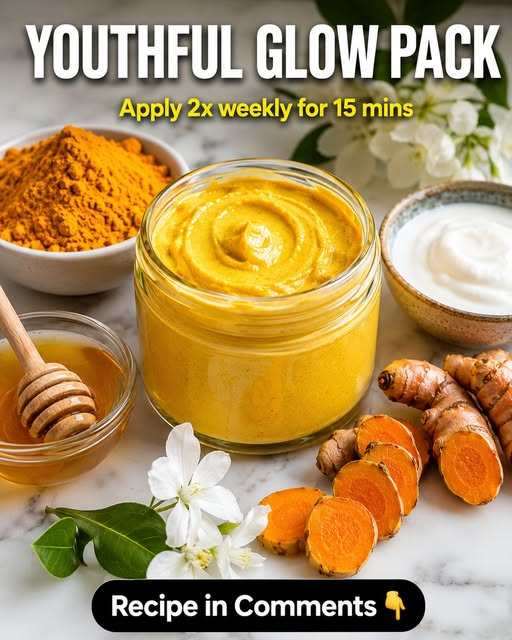
A youthful glow comes mainly from healthy hydration, an intact skin barrier, even texture and protection from ultraviolet damage. The turmeric, yogurt and honey mask shown in the image may temporarily make the complexion look softer and brighter, but it cannot erase wrinkles, rebuild lost collagen or reverse ageing after only a few applications. Research suggests that turmeric-derived curcumin has antioxidant and anti-inflammatory potential, while lactic acid, colloidal oatmeal, aloe, soy and green tea have demonstrated skin benefits in clinical formulations. However, the exact homemade mixtures below have not been tested as finished medical treatments, and kitchen ingredients contain variable concentrations. (PubMed)
Use only a very small amount of turmeric because it can temporarily stain the skin and clothing. Patch-test each mask for 24 hours, avoid broken or inflamed skin and rinse immediately if persistent burning, itching or swelling occurs.

Remedy 1: Turmeric, Yogurt and Honey Glow Pack for Normal Skin
Ingredients and Scientific Benefits
- 1 tablespoon plain unsweetened yogurt: Contains naturally occurring lactic acid that may gently loosen dull surface cells.
- ¼ teaspoon culinary turmeric: Provides curcumin, a plant compound with antioxidant and anti-inflammatory activity.
- 1 teaspoon pure honey: Acts as a humectant and helps the skin retain surface moisture.
- 1 teaspoon clear aloe vera gel: Provides lightweight hydration and may calm temporary redness.
- 1 teaspoon cooled green tea: Supplies antioxidant polyphenols.
- 1 teaspoon finely ground colloidal oatmeal: Supports the moisture barrier and reduces dryness.
Scientific Working of the Ingredients
Turmeric has been examined in clinical studies for several inflammatory and photoageing-related skin concerns, although researchers note that optimal topical concentrations remain uncertain. Yogurt contains lactic acid, but its strength is much lower and less predictable than the standardised lactic-acid creams used in clinical trials. Honey, aloe and oatmeal mainly improve moisture and surface comfort, which can create a plumper, more luminous appearance without changing the skin’s biological age. (PubMed)
Procedure
Mix the ingredients into a smooth paste. Apply a thin layer to clean skin, avoiding the eyelids, eyebrows and hairline. Leave it on for eight to ten minutes. Wet the mask with lukewarm water, remove it gently without scrubbing and apply moisturiser.
How Often to Apply
Use twice during the first five days. After that, apply no more than twice weekly when well tolerated.
Initial Results
Within one to three days, the skin may feel softer and appear temporarily brighter because of improved hydration. Pigmentation, deep lines and sun damage will not disappear this quickly.
Remedy 2: Soy, Cucumber and Green-Tea Pack for Combination Skin
Ingredients and Scientific Benefits
- 1 tablespoon unsweetened soy milk: Contains soy proteins associated with improvements in uneven tone and skin texture.
- 1 teaspoon cucumber juice: Adds water and provides a cooling sensation.
- 1 teaspoon aloe vera gel: Hydrates dry areas without applying a heavy oil to the T-zone.
- 1 teaspoon cooled green tea: Provides antioxidant and soothing polyphenols.
- 1 teaspoon colloidal oatmeal: Helps protect dry sections and absorb a small amount of surface oil.
- ½ teaspoon plain yogurt: Provides mild exfoliating action.
Scientific Working of the Ingredients
A 12-week controlled study found that a moisturiser containing stabilised soy compounds improved mottled pigmentation, texture, fine lines and overall appearance. This does not prove that ordinary soy milk will produce identical results, but it provides a scientific reason for including soy as supportive care. Aloe, cucumber and green tea add light hydration, while oatmeal reduces the risk of over-drying combination skin. (PubMed)
Procedure
Stir everything together and apply a light layer over the cheeks, forehead and chin. Use less product around the nose if that area becomes greasy easily. Leave it on for seven minutes and rinse without using a facial brush or washcloth.
How Often to Apply
Apply on days one, three and five. Do not use another scrub, peel or exfoliating acid on the same evening.
Initial Results
Drier sections may look smoother within two or three applications, while the T-zone may feel refreshed. Long-term changes in uneven tone generally require several weeks.
Remedy 3: Oil-Free Turmeric and Aloe Mask for Oily Skin
Ingredients and Scientific Benefits
- 1 tablespoon aloe vera gel: Supplies oil-free moisture.
- 1 tablespoon cooled green tea: Provides polyphenols that help limit oxidative stress.
- 1 teaspoon colloidal oatmeal: Thickens the mask and absorbs some surface oil.
- 1 teaspoon unsweetened soy milk: Supports a more even-looking complexion.
- ½ teaspoon plain yogurt: Encourages gentle removal of dull surface cells.
- ⅛ teaspoon turmeric: Adds a low amount of curcumin while reducing staining risk.
Scientific Working of the Ingredients
Oily skin can still become dehydrated, particularly when it is repeatedly scrubbed or treated with drying ingredients. Aloe provides hydration without adding a rich oil, while oatmeal supports barrier function. Turmeric and green-tea compounds demonstrate anti-inflammatory and antioxidant activity, but neither should replace acne treatment. The strongest clinical evidence concerns measured extracts and professionally formulated products rather than kitchen masks. (PubMed)
Procedure
Mix the ingredients and spread a very thin layer over intact skin. Do not apply it to picked pimples, open acne lesions or freshly shaved areas. Leave it on for five to seven minutes, rinse completely and apply a lightweight moisturiser.
How Often to Apply
Use every other evening for five days, giving a maximum of three applications.
Initial Results
The skin may feel less greasy and look smoother within one to three days. Acne, enlarged pores and acne marks will not be permanently removed by this mask.
Remedy 4: Oat, Honey and Sunflower Moisture Pack for Dry Skin
Ingredients and Scientific Benefits
- 1 tablespoon finely ground colloidal oatmeal: Helps reduce roughness and water loss.
- 1 tablespoon plain yogurt: Adds moisture and provides gentle lactic-acid exfoliation.
- 1 teaspoon aloe vera gel: Increases surface hydration.
- 1 teaspoon honey: Helps attract water to the outer skin layer.
- 1 teaspoon unsweetened soy milk: Supports tone and texture.
- 2 drops sunflower-seed oil: Supplies linoleic-acid-rich emollient support.
Scientific Working of the Ingredients
Dry skin reflects light unevenly and can make fine lines look deeper. Colloidal-oatmeal formulations have improved hydration and barrier measurements in controlled studies. Sunflower oil has also preserved barrier integrity and increased hydration in adult skin research, whereas olive oil produced barrier damage and mild redness. For this reason, sunflower oil is a more suitable choice for this particular mask. (PubMed)
Procedure
Combine the ingredients and apply them to slightly damp skin. Leave the pack on for ten minutes. Rinse gently, pat the face until it remains slightly damp and immediately apply moisturiser.
How Often to Apply
Use once daily for three days, followed by twice weekly if the skin remains comfortable.
Initial Results
Tightness and flaky texture may improve after one or two applications. Hydration can make fine lines look temporarily softer, but it does not permanently remove wrinkles.
Remedy 5: Gentle Oat and Aloe Pack for Sensitive Skin
Ingredients and Scientific Benefits
- 1 tablespoon previously boiled and cooled water: Creates a simple, low-irritation base.
- 1 tablespoon colloidal oatmeal: Supports barrier repair and helps relieve dryness.
- 1 teaspoon aloe vera gel: Adds light hydration when tolerated.
- 1 teaspoon cucumber juice: Provides gentle cooling.
- 1 teaspoon unsweetened soy milk: Offers mild skin-tone support.
- 1 teaspoon cooled green tea: Supplies antioxidant compounds.
Scientific Working of the Ingredients
Sensitive skin often looks dull when inflammation damages the moisture barrier. The priority is therefore calming and hydration rather than aggressive exfoliation. Clinical studies show that formulated colloidal oatmeal can improve skin hydration, pH and barrier function. Even aloe and plant extracts can cause contact reactions in some people, so this recipe deliberately excludes turmeric, honey, citrus juice and essential oils. (PubMed)
Procedure
Mix the ingredients and strain out any rough particles. Apply a thin layer to a small section of the face during the first use. After successful patch testing, apply it for five minutes and rinse with cool or lukewarm water.
How Often to Apply
Apply only twice during the first five days. Do not increase the frequency when redness, eczema or rosacea is active.
Initial Results
Skin may feel calmer and more comfortable within one to three days. Sensitive skin should not be expected to show dramatic brightening during this time.
Final Tips for Maintaining a Youthful Glow
Apply broad-spectrum SPF 30 or higher every morning. In a randomised trial, regular sunscreen use reduced measurable skin ageing compared with discretionary use over 4.5 years. Sunscreen and moisturiser have far stronger evidence for preventing premature ageing than any homemade mask. (PubMed)
Keep pillowcases, towels, brushes and mixing bowls clean. Never add lemon juice, undiluted vinegar, baking soda, toothpaste or essential oils to these masks. Avoid scrubbing when removing turmeric because friction can cause irritation and dark marks.
Hydration-related glow may begin within two or three days. Continued moisturising and sun protection can gradually improve smoothness and make dehydration lines less visible, but established wrinkles usually require months of consistent care and may need dermatologist-directed treatment. Poor sleep has also been associated with weaker barrier recovery and more visible signs of ageing. (PubMed)
Diet Plan for Healthy, Glowing Skin
Breakfast: Eat eggs, plain yogurt or oatmeal with berries, guava, papaya, kiwi or orange.
Lunch: Choose lentils, beans, chicken, fish or tofu with whole grains and vegetables such as spinach, carrots, tomatoes, broccoli and bell peppers.
Afternoon: Have water or unsweetened green tea with almonds, walnuts, pumpkin seeds or sunflower seeds.
Dinner: Eat a moderate portion of protein with vegetables, salad and brown rice or whole-grain bread.
Daily habits: Drink according to thirst, sleep for approximately seven to nine hours and avoid smoking. A varied diet supplies protein, vitamin C, carotenoids, essential fats and other nutrients needed for normal barrier and collagen function, but food cannot reverse established wrinkles by itself. (PubMed)
Continue the suitable mask for four to six weeks, never exceeding the recommended frequency. Stop immediately if burning, swelling, persistent redness or acne worsens. Consult a dermatologist when dullness is accompanied by severe itching, rash, sudden pigmentation, painful acne or no improvement after six to eight weeks.
References for the above remedy
- Vaughn AR, Branum A, Sivamani RK. Effects of Turmeric on Skin Health: A Systematic Review of the Clinical Evidence.
https://pubmed.ncbi.nlm.nih.gov/27213821/ - Di Lorenzo R, et al. Clinical Studies on Topical Curcumin.
https://pubmed.ncbi.nlm.nih.gov/38008088/ - Wallo W, Nebus J, Leyden JJ. Efficacy of a Soy Moisturizer in Photoaging: A Double-Blind, Vehicle-Controlled Study.
https://pubmed.ncbi.nlm.nih.gov/17941363/ - Capone K, Kirchner F, Klein SL, Tierney NK. Effects of Colloidal Oatmeal Cream on Skin Barrier Properties.
https://pubmed.ncbi.nlm.nih.gov/32484623/ - Stiller MJ, et al. Topical Glycolic Acid and Lactic Acid Creams for Photodamaged Skin.
https://pubmed.ncbi.nlm.nih.gov/8651713/ - Dal’Belo SE, Gaspar LR, Maia Campos PM. Moisturizing Effect of Cosmetic Formulations Containing Aloe Vera Extract.
https://pubmed.ncbi.nlm.nih.gov/17026654/ - Camouse MM, et al. Topical Green and White Tea Extracts Provide Protection from Solar-Simulated Ultraviolet Light.
https://pubmed.ncbi.nlm.nih.gov/19492999/ - Danby SG, et al. Effect of Olive and Sunflower Seed Oil on the Adult Skin Barrier.
https://pubmed.ncbi.nlm.nih.gov/22995032/ - Hughes MC, Williams GM, Baker P, Green AC. Sunscreen and Prevention of Skin Aging: A Randomized Trial.
https://pubmed.ncbi.nlm.nih.gov/23732711/ - OyetakinWhite P, et al. Does Poor Sleep Quality Affect Skin Ageing?
https://pubmed.ncbi.nlm.nih.gov/25266053/