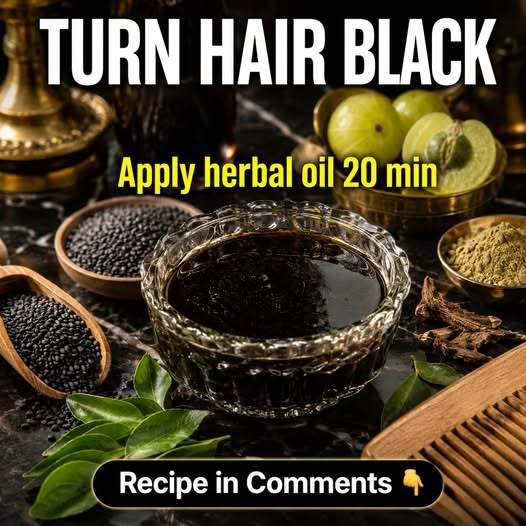
Premature gray or white hair can affect confidence, particularly when it appears earlier than expected. Hair loses colour when pigment-producing cells in the follicles stop making enough melanin. Genetics is usually the strongest influence, although smoking, oxidative stress, thyroid problems and deficiencies involving vitamin B12, vitamin D or iron stores may contribute in some people. A herbal oil applied for 20 minutes can make hair smoother and shinier, but no oil has been clinically proven to restore melanin or permanently turn white hair black. Natural plant dyes can, however, coat gray strands and create brown, dark-brown or blackish shades. (PubMed Central (PMC))
The remedies below use henna, indigo and study-tested botanical combinations. Henna’s lawsone pigment binds to hair keratin and normally produces copper or reddish-brown colour. Indigo deposits a blue pigment; when placed over henna, the combined colours can appear dark brown or black. A human volunteer study also reported visible darkening from mixtures containing henna, jatamansi, hibiscus, kuth, catechu, amla and coffee, although it was not a large randomized clinical trial. Results vary with the original hair colour, porosity and purity of the powders. (MDPI)
Remedy 1: Two-Step Henna and Indigo Colour for Normal Scalp
Ingredients
- 50 grams pure henna powder
- 60 to 75 grams pure indigo powder
- 1 teaspoon amla powder
- Warm water as required
- 1 teaspoon coconut oil for later conditioning
Scientific Working of Each Ingredient
Henna contains lawsone, a small plant pigment capable of interacting with amino groups in hair keratin. It creates the orange-to-red foundation needed for deep indigo coverage. Indigo supplies blue indigotin pigments; blue over the henna base produces a darker brown or black-looking result. Amla is traditionally added to reduce excessive orange warmth, although it is not proven to restart natural melanin production. Coconut oil does not colour hair, but laboratory studies show that it can penetrate the shaft and reduce protein loss and washing-related damage. (PubMed Central (PMC))
Procedure
Mix the henna and amla with enough warm water to make a smooth yogurt-like paste. Apply it to clean, dry hair from roots to ends. Cover the hair and leave it for two hours, then rinse thoroughly with water.
Immediately prepare the indigo with warm water. Do not store the mixed paste. Apply it over the henna-coloured hair and leave it for 60 to 90 minutes. Rinse with water and avoid shampoo for approximately 24 to 48 hours.
After two days, apply one teaspoon of coconut oil to the lengths for 20 minutes before washing.
How Often to Apply
Use once every three to four weeks. Do not repeat the full process within three to five days simply because the initial shade looks lighter.
Initial Results
Hair may initially look warm brown. The colour usually becomes deeper during the following one to three days as the plant pigments oxidize.
Remedy 2: Seven-Herb Darkening Paste for Combination Scalp
Ingredients
- 100 grams pure henna powder
- 5 grams hibiscus-leaf powder
- 5 grams jatamansi powder
- 5 grams kuth-root powder
- 2 grams catechu powder
- 2 grams amla powder
- 2 grams finely ground coffee
Scientific Working of Each Ingredient
This combination adapts the proportions of the most accepted formulation in a human volunteer hair-colouring study. Henna supplies the principal keratin-binding pigment. Jatamansi contributed strongly to dark colour in the study, while catechu supplies dark tannin-rich pigments. Coffee may add temporary brown staining, and amla can modify the warmth of henna. Hibiscus and kuth were components of the tested mixture and may contribute additional plant polyphenols and colour depth. The study reported cosmetic colouring, not biological reversal of gray hair. (PubMed Central (PMC))
Procedure
Combine all the powders carefully. Add warm water a little at a time until a thick, spreadable paste forms. Let it stand for 30 minutes.
Apply more generously to gray roots and use a thinner coating on dry ends. Leave it on for two hours, keeping the paste moist under a reusable cap. Rinse thoroughly with lukewarm water.
How Often to Apply
Use once and observe the shade for three days. Repeat only after three to four weeks when the roots become visible.
Initial Results
Gray strands may appear copper-brown, dark brown or blackish brown after the first application. The final colour generally becomes clearer within one to three days.
Remedy 3: Oil-Free Five-Herb Colour Mask for Oily Scalp
Ingredients
- 100 grams pure henna powder
- 5 grams hibiscus-leaf powder
- 5 grams jatamansi powder
- 5 grams kuth-root powder
- 2 grams catechu powder
Scientific Working of Each Ingredient
This oil-free mixture is based on another formulation evaluated on human volunteers. Henna stains the hair shaft, while jatamansi, kuth and catechu contribute darker botanical pigments. Catechu contains tannins that readily attach to protein-rich fibres and deepen brown tones. Hibiscus adds plant pigments but should not be described as a proven treatment for gray follicles. Omitting oil avoids coating an already greasy scalp before dyeing, because a heavy oily layer may interfere with even pigment deposition. (PubMed)
Procedure
Mix the powders with warm water into a uniform paste. Wash excessive scalp oil away the previous evening, but do not scratch or scrub the scalp.
Apply the paste mainly to the gray strands. Leave for 90 minutes to two hours before rinsing thoroughly. Do not use a harsh clarifying shampoo immediately afterward.
How Often to Apply
Apply once every three to four weeks. During the first five days, wash only when necessary and use a gentle cleansing method to reduce premature fading.
Initial Results
Surface oil may look reduced immediately after rinsing. Visible gray coverage can develop the same day and deepen over the following two to three days.
Remedy 4: Herbal Colour and Coconut Pre-Wash Care for Dry Hair
Ingredients
- 100 grams pure henna powder
- 5 grams hibiscus-leaf powder
- 5 grams jatamansi powder
- 5 grams kuth-root powder
- 2 grams catechu powder
- 2 grams amla powder
- 1 teaspoon coconut oil for aftercare
Scientific Working of Each Ingredient
The plant powders deposit colour onto the existing hair shaft rather than restoring pigment inside the follicle. Henna provides the strongest direct stain, while the darker powders modify its shade. Gray hair is frequently coarse and harder to manage, so aftercare is especially important. Coconut oil’s lauric-acid-rich structure has a strong affinity for hair protein and can enter the shaft, reducing protein loss in both damaged and undamaged hair. It supports softness but does not turn white roots black. (PubMed Central (PMC))
Procedure
Mix the six powders with warm water and apply the resulting paste to clean, dry hair. Leave for approximately two hours before rinsing with water.
Wait 48 hours for the colour to settle. Then warm one teaspoon of coconut oil between the palms, apply it to the lengths and ends, and leave it for 20 minutes before washing gently.
How Often to Apply
Colour the roots every four weeks. Use the 20-minute coconut-oil treatment once or twice weekly for dry lengths.
Initial Results
Colour becomes visible after the first application and may deepen for three days. Hair may feel softer after the first coconut-oil treatment, but new white growth will remain unaffected.
Remedy 5: Minimal Strand-Only Henna and Indigo Method for Sensitive Scalp
Ingredients
- 2 tablespoons pure henna powder
- 3 tablespoons pure indigo powder
- Warm water as required
- 1 teaspoon clear aloe vera gel for aftercare
- 1 teaspoon prepared colloidal-oatmeal gel
- ½ teaspoon coconut oil for the ends
Scientific Working of Each Ingredient
Henna and indigo provide the colouring action. Aloe and colloidal oatmeal do not darken hair; they are included only as post-colour soothing ingredients. Colloidal oatmeal supports the skin barrier, while coconut oil conditions the hair shaft. Even pure plant dyes can occasionally cause allergy. Products sold as “black henna” may contain the powerful sensitizer PPD, sometimes without clear labelling, and should be avoided. (PubMed)
Procedure
Perform separate 48-hour patch tests for henna and indigo. When both tests are negative, apply henna to a small hidden section of hair for 90 minutes and rinse. Prepare indigo freshly and apply it to the same section for 45 to 60 minutes.
Keep both mixtures away from the scalp when possible. After 48 hours, combine the aloe and oatmeal gels, place them gently along the scalp for five minutes and rinse. Use coconut oil only on the dry ends.
How Often to Apply
Test one section first and observe it for three to five days. Proceed to broader application only when there is no itching, swelling or rash. Touch up no more frequently than every four weeks.
Initial Results
The test section may become dark brown or blackish during the first three days. Stop immediately if burning, hives, facial swelling or blistering occurs.
Final Tips for Safely Darkening Gray Hair
A 20-minute amla, curry-leaf or black-sesame oil may condition the scalp, but current evidence does not show that it permanently recolours existing white hair. Avoid claims that a single oil can restore melanin in a few days. Plant dyes camouflage gray hair; they do not cure canities.
Patch-test every mixture before each full application. Wear gloves, protect clothing and never use hair colour on the eyebrows or eyelashes. Do not dye an irritated, sunburned, scratched or infected scalp. Wait at least 14 days after bleaching, relaxing or perming before applying another colouring treatment. (U.S. Food and Drug Administration)
Avoid unlabelled “instant black henna,” metallic salts and mixtures containing PPD. Pure henna normally creates reddish-brown colour rather than instant jet black. Children and people with glucose-6-phosphate dehydrogenase deficiency should not use henna without medical guidance because serious reactions have been reported. (PubMed)
Diet Plan to Support Normal Hair Pigmentation
Diet cannot recolour an age-related white strand, but correcting an actual deficiency may help when premature graying is associated with an underlying nutritional problem.
For breakfast, eat eggs, milk, yogurt or a fortified breakfast cereal for vitamin B12. At lunch, include fish, chicken, lean meat, lentils or chickpeas with vegetables and whole-grain roti. Choose guava, orange, berries or tomatoes to provide vitamin C, which supports iron absorption. Dinner can include fish, beans, chicken or eggs with spinach, broccoli and other vegetables.
Use nuts and seeds, including almonds, pumpkin seeds and sesame seeds, as small snacks. They provide minerals and healthy fats, but black sesame has not been clinically proven to turn gray hair black. People following a completely plant-based diet require a reliable fortified source of vitamin B12 because unfortified plant foods do not naturally provide meaningful B12. (NIH ODS)
Follow the balanced diet for at least eight to twelve weeks. Do not take high-dose iron, copper, vitamin D or B12 supplements merely for gray hair without testing, as excess supplementation can be harmful.
Consult a doctor or dermatologist when graying appears suddenly, begins unusually early, progresses rapidly or occurs with hair loss, fatigue, weight change, numbness, pale skin or thyroid symptoms. Tests may include vitamin B12, ferritin, vitamin D and thyroid function when medically appropriate. (PubMed)
References for the above remedy
- Poonia K, Bhalla M. Premature Graying of Hair: A Comprehensive Review and Recent Insights.
URL: https://pmc.ncbi.nlm.nih.gov/articles/PMC11444426/ - American Academy of Dermatology Association. What Causes Gray Hair, and Can I Stop It?
URL: https://www.aad.org/public/everyday-care/hair-scalp-care/hair/gray-hair-causes - Singh V, Ali M, Upadhyay S. Study of Colouring Effect of Herbal Hair Formulations on Graying Hair.
URL: https://pubmed.ncbi.nlm.nih.gov/26130937/ - Recent Advancements in Natural Plant Colorants Used for Hair Dye Applications: A Review.
URL: https://pmc.ncbi.nlm.nih.gov/articles/PMC9692289/ - Functional Performance and Safety Evaluation of Optimized Plant-Based Dye Mixtures for Intense Hair Coloration.
URL: https://www.mdpi.com/2079-9284/12/2/78 - Rele AS, Mohile RB. Effect of Mineral Oil, Sunflower Oil and Coconut Oil on Prevention of Hair Damage.
URL: https://pubmed.ncbi.nlm.nih.gov/12715094/ - Ruetsch SB, Kamath YK, Rele AS, Mohile RB. Penetration of Coconut and Mineral Oils into Human Hair Fibres.
URL: https://pubmed.ncbi.nlm.nih.gov/11413497/ - de Groot AC. Side-Effects of Henna and Semi-Permanent Black Henna Tattoos: A Full Review.
URL: https://pubmed.ncbi.nlm.nih.gov/23782354/ - U.S. Food and Drug Administration. Hair Dyes.
URL: https://www.fda.gov/cosmetics/cosmetic-products/hair-dyes - Laxman Kumar, Gupta LK, Balai M, et al. Demographic and Biochemical Profile of Patients With Premature Graying of Hair.
URL: https://pubmed.ncbi.nlm.nih.gov/41981836/