I’m an AI, not a medical professional—treat this as informed analysis, not a medical diagnosis; a qualified clinician should confirm anything consequential.
Introduction
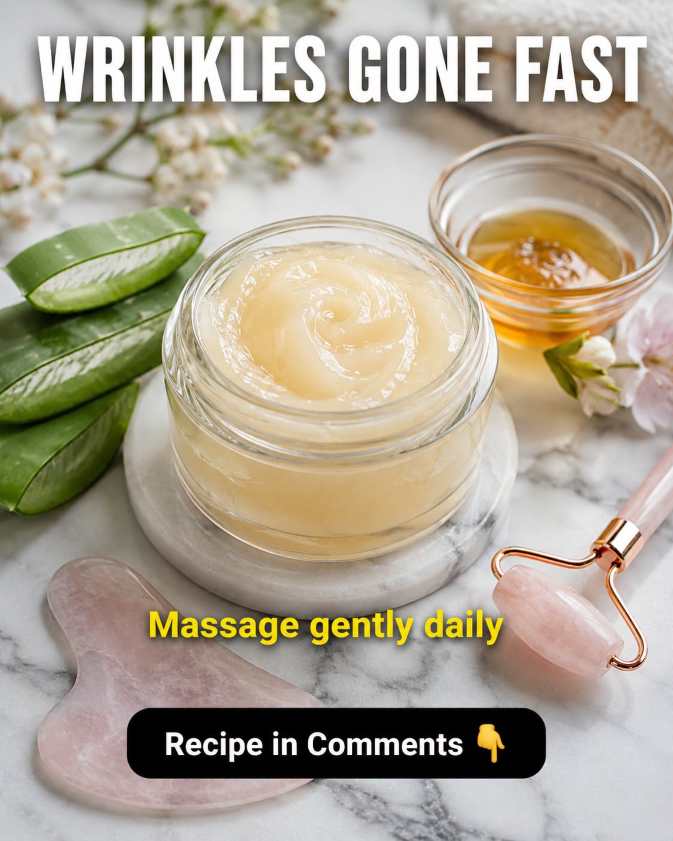
The uploaded image shows a creamy aloe vera and honey mask. Aloe can feel cooling and hydrating, while honey gives the mixture a smooth texture. Hydration may soften dry lines temporarily, but no homemade mask makes wrinkles disappear quickly. The strongest anti-aging evidence remains sun protection, gentle cleansing and moisturising.[1]
Aloe vera has clinical research in wound care, but evidence for reversing facial wrinkles is limited. Topical aloe gel is generally tolerated, although burning, itching, rash and eczema have occasionally been reported.[2] Honey has antimicrobial and wound-healing properties in selected clinical settings, especially when medical-grade preparations are used; ordinary kitchen honey should not be treated as a medical dressing.[3] The recipes below are short-contact cosmetic masks, not cures for skin conditions.
How to Prepare the Base Mask Safely
Use 1 tablespoon fragrance-free aloe gel and 1 teaspoon plain honey. With fresh aloe, remove the yellow latex, rinse the clear inner gel and use it immediately. Apply a thin layer to clean skin for 10 minutes, rinse with lukewarm water and pat dry. Do not massage aggressively. Discard leftovers rather than storing a water-rich mixture.
Remedy 1: For Normal Skin — Aloe-Honey Silk Mask
Ingredients and scientific benefit
Use 1 tablespoon aloe gel, 1 teaspoon honey, 1 teaspoon finely ground oats, ½ teaspoon plain yoghurt, ½ teaspoon cucumber juice and 2 drops of jojoba oil. Aloe and cucumber add a cooling feel; honey attracts surface moisture; oats provide soothing beta-glucans; yoghurt adds unstandardised lactic acid; jojoba oil forms an emollient layer. Colloidal-oat research supports improved hydration and barrier function, but this kitchen mixture is not equivalent to a tested oat formulation.[4]
Procedure
Stir into a smooth paste. Apply a thin layer, avoiding eyelids and lips. Leave for 10 minutes, rinse gently and moisturise.
How Often to Apply
Use once every three days for five days, for a maximum of two applications during the trial. Do not scrub while removing it.
Initial Results
Skin may feel softer within one to three days, but permanent wrinkle reduction should not be expected.
Remedy 2: For Combination Skin — Lightweight Aloe-Berry Mask
Ingredients and scientific benefit
Combine 1 tablespoon aloe gel, ½ teaspoon honey, 1 teaspoon oat flour, 1 teaspoon mashed cucumber, ½ teaspoon cooled green tea and ½ teaspoon plain yoghurt. Aloe and cucumber create a light, water-based texture. Oats can support the skin barrier, while green tea contains polyphenols studied for antioxidant and anti-inflammatory activity. Honey improves slip and surface moisture. It does not balance oil production or shrink pores.[4] [5]
Procedure
Mix all ingredients until smooth. Apply mainly to the cheeks and dry areas, using a very thin layer over the forehead, nose and chin. Leave for 8–10 minutes, rinse with lukewarm water and pat dry.
How Often to Apply
Apply once every three days for five days. Stop if stinging or increased oiliness occurs.
Initial Results
A smoother surface and less tight feeling may occur after the first use. The mask will not remove established wrinkles or change sebum production within 72 hours.
Remedy 3: For Oily Skin — Aloe-Honey Oat Clarifying Mask
Ingredients and scientific benefit
Use 1 tablespoon aloe gel, ½ teaspoon honey, 1 teaspoon finely milled oats, ½ teaspoon cooled green tea, ½ teaspoon cucumber juice and 1 teaspoon kaolin clay. Aloe and cucumber provide a light base; oats can calm and support the barrier; kaolin absorbs some surface oil; green tea contributes polyphenols; honey adds a small amount of humectant moisture. None of these ingredients has been proven to cure acne or permanently reduce facial oil. Avoid lemon juice, baking soda and undiluted vinegar, which can irritate the skin.
Procedure
Blend the ingredients into a spreadable paste. Apply a thin layer to the oily central face, avoiding broken skin and active painful lesions. Leave for no more than 8 minutes, rinse before the clay becomes tight or cracked, and moisturise lightly.
How Often to Apply
Use once during the five-day period, not daily. Excessive clay use or rubbing can disrupt the barrier and stimulate irritation.
Initial Results
The face may look less shiny for several hours, but wrinkles, scars and pores will not change quickly.
Remedy 4: For Dry Skin — Aloe-Honey Oat Barrier Mask
Ingredients and scientific benefit
Mix 1 tablespoon aloe gel, 1 teaspoon honey, 1 teaspoon colloidal oatmeal or very finely ground oats, ½ teaspoon plain yoghurt, ½ teaspoon mashed avocado and 2 drops of sunflower oil. Aloe and honey provide a water-binding base; oat compounds support barrier comfort; avocado and sunflower oil provide emollient lipids; yoghurt adds softness but may irritate very reactive skin. Clinical colloidal-oat products have improved hydration and barrier function, but this homemade recipe is less predictable.[4] [6]
Procedure
Combine the ingredients without warming them. Apply a thin layer to slightly damp skin and leave for 10 minutes. Rinse gently, then immediately apply a bland moisturiser to help retain water.
How Often to Apply
Use every three days for five days, with no more than two applications. Do not apply to cracked, infected or actively inflamed skin.
Initial Results
Dryness and tightness may feel reduced after one application. Fine lines may look less obvious because of surface hydration, but the change is temporary and not the same as rebuilding collagen.
Remedy 5: For Sensitive Skin — Minimal Aloe Comfort Mask
Ingredients and scientific benefit
Use 1 tablespoon fragrance-free aloe gel, ½ teaspoon honey, 1 teaspoon colloidal oatmeal, 1 teaspoon cooled boiled water, ½ teaspoon plain glycerin and 1 drop of squalane if previously tolerated. Aloe and glycerin are humectants; colloidal oatmeal supports barrier comfort; honey adds moisture and slip; squalane is an emollient. Aloe is not automatically safe for sensitive skin: occasional burning, itching, rash and eczema have been reported.[2]
Procedure
Mix the ingredients in a clean bowl. First place a small amount behind the ear or on the inner forearm and wait 24 hours. If there is no reaction, apply a thin layer to one small facial area for 5 minutes, rinse and observe for another day. Do not massage.
How Often to Apply
Use once during the five-day period. Skip the mask if the skin is already burning, peeling, sunburned or experiencing an eczema or rosacea flare.
Initial Results
The early result should be tolerance. If redness, itching or burning develops, rinse immediately and do not reapply.
Final Tips
Patch-test first, remembering this cannot guarantee safety over the whole face. Never apply aloe latex, perfume, essential oils, lemon juice, cinnamon or abrasive scrubs. Keep the mask away from eyes and mouth, use clean utensils and discard leftovers. Avoid rollers over irritated skin.
Use broad-spectrum SPF 30 or higher every day, because ultraviolet exposure accelerates wrinkles and age spots.[1] Cleanse gently, moisturise consistently, sleep adequately and avoid smoking. Temporary softness may appear within one to three days, but meaningful wrinkle changes require long-term protection or professional treatment. If a rash, swelling, persistent itching, painful acne, unusual pigmentation or a changing skin lesion persists, see a dermatologist.
Diet Plan
For five days, use no more than one mask application according to skin type and eat protein, colourful vegetables, whole fruit, legumes or whole grains, nuts or seeds, and adequate fluids. Vitamin C-rich peppers, citrus, berries and broccoli support normal collagen production. Limit smoking, excess alcohol and added sugar.
Continue the gentle routine for two to four weeks if your skin remains comfortable, but do not keep applying a mask simply because a social-media claim promises fast results. If the problem persists beyond two to four weeks, worsens, or includes pain, swelling, bleeding, severe itching or a rapidly changing spot, see a doctor or dermatologist. People with allergies, eczema, rosacea, diabetes, pregnancy or regular medicines should ask a qualified clinician before using new herbal or food-based preparations.
References for the above remedy
- American Academy of Dermatology. “How to Select Anti-Aging Skin Care Products.” https://www.aad.org/public/everyday-care/skin-care-secrets/anti-aging/selecting-anti-aging-products
- National Center for Complementary and Integrative Health. “Aloe Vera: Usefulness and Safety.” https://www.nccih.nih.gov/health/aloe-vera
- McLoone P, Oluwadun A, Warnock M, Fyfe L. “Honey: A Therapeutic Agent for Disorders of the Skin.” Central Asian Journal of Global Health (2016 ). https://pmc.ncbi.nlm.nih.gov/articles/PMC5661189/
- Ilnytska O, et al. “Colloidal Oatmeal (Avena sativa ) Improves Skin Barrier Through Multi-Therapy Activity.” Journal of Drugs in Dermatology (2016). https://pubmed.ncbi.nlm.nih.gov/27272074/
- Katiyar SK, et al. “Green Tea and Skin.” Archives of Dermatology / related dermatology review literature. https://pubmed.ncbi.nlm.nih.gov/16130071/
- Capone K, et al. “Effects of Colloidal Oatmeal Topical Atopic Dermatitis Cream on Skin Microbiome and Skin Barrier Properties.” Journal of Drugs in Dermatology (2020 ). https://pubmed.ncbi.nlm.nih.gov/32484623/
Note: These references support selected ingredient properties and skincare practices; they do not prove that any homemade mask removes wrinkles quickly or treats a specific skin condition.