
Thin, flat, or lackluster hair can make the scalp appear more visible and the overall hairstyle look less full. Hair thickness is influenced by genetics, the diameter of individual strands, hair density, scalp health, nutrition, and breakage. Although a home remedy cannot permanently change genetically determined hair density, conditioning the hair shaft and reducing dryness and breakage can make hair look fuller, smoother, and healthier.
A carefully prepared treatment using rosemary, coconut oil, aloe vera, yogurt, honey, and fenugreek combines ingredients traditionally used for scalp and hair care. Some components have laboratory or clinical evidence for particular hair-related effects, while others mainly provide conditioning and moisture. It is important to distinguish these cosmetic benefits from proven hair-growth treatment.
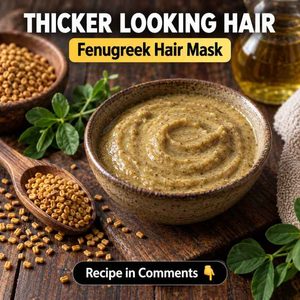
Remedy: Rosemary and Fenugreek Hair-Fullness Mask
Scientific Working of Each Ingredient
Rosemary: Scalp and Hair-Growth Support
Rosemary contains biologically active compounds such as rosmarinic acid and other antioxidant constituents. A small randomized controlled trial comparing rosemary oil with 2% minoxidil over six months reported an increase in hair count in both groups, with no significant difference between them at six months. This is interesting evidence, but it is not enough to establish rosemary oil as equivalent to medical hair-loss treatments.
Potential benefits:
- Antioxidant activity may help protect the scalp from oxidative stress.
- Massage with diluted oil can improve scalp conditioning.
- Limited clinical evidence suggests potential support for hair growth over several months.
Coconut Oil: Protection Against Hair Protein Loss
Coconut oil is particularly useful for the hair shaft, rather than being a proven hair-regrowth treatment.
Its lauric acid has an affinity for hair proteins and can penetrate the hair fiber. Research has found that coconut oil can reduce protein loss from hair, which may help decrease damage and breakage.
Potential benefits:
- Reduces protein loss.
- Lubricates individual strands.
- Reduces friction during grooming.
- Makes dry hair appear smoother and fuller.
Fenugreek: Conditioning and Scalp Care
Fenugreek seeds contain mucilage, proteins, and other plant compounds. Evidence for fenugreek as a treatment for hair loss in humans remains limited, so its main practical role here is conditioning.
Potential benefits:
- Mucilage provides a slippery, conditioning texture.
- Helps reduce tangling.
- Makes dry strands feel softer.
- May improve the cosmetic appearance of hair.
Aloe Vera: Moisture and Scalp Comfort
Aloe vera contains polysaccharides and other compounds used in cosmetic preparations.
Potential benefits:
- Provides hydration.
- Helps condition dry hair.
- Supports scalp comfort.
- Makes strands feel smoother.
Yogurt: Conditioning Support
Yogurt provides water, proteins, and fats that can temporarily improve the feel of dry hair.
Potential benefits:
- Conditions rough strands.
- Improves softness.
- Helps reduce the dry appearance of hair.
Honey: Moisture Retention
Honey acts as a humectant and can help attract moisture.
Potential benefits:
- Improves softness.
- Helps reduce a dry, rough appearance.
- Supports smoother-looking strands.
Ingredients
- Rosemary-infused oil — 1 tablespoon
- Coconut oil — 1 tablespoon
- Fenugreek seeds — 1 tablespoon
- Aloe vera gel — 2 tablespoons
- Plain unsweetened yogurt — 2 tablespoons
- Honey — 1 teaspoon
- Water — ½ cup
How to Make Rosemary-Infused Oil
- Add ½ cup of water to a small pan with 1 tablespoon of dried rosemary.
- Simmer gently for about 5 minutes.
- Allow it to cool completely and strain.
- Use the resulting rosemary infusion in the mask rather than applying concentrated essential oil directly to the scalp.
This approach is gentler than putting undiluted essential oil directly onto the scalp.
Procedure: How to Apply
- Soak the fenugreek seeds in water overnight.
- Grind the softened seeds into a smooth paste.
- Add yogurt, aloe vera gel, honey, coconut oil, and the cooled rosemary infusion.
- Mix until a smooth mask forms.
- Divide clean, slightly damp hair into sections.
- Apply the mixture primarily to the scalp and hair lengths.
- Massage the scalp gently with your fingertips for 3–5 minutes.
- Leave the treatment on for 20–30 minutes.
- Rinse thoroughly.
- Wash with a mild shampoo if necessary.
- Allow the hair to dry naturally.
Do not vigorously rub the scalp during application; mechanical irritation can increase breakage and discomfort.
How Often to Apply
Use the treatment once or twice a week.
Continue for 6–8 weeks to assess changes in softness, breakage, and overall appearance. If rosemary is being used specifically for possible hair-growth support, the limited clinical evidence involved months rather than days, so dramatic results within 2–3 days should not be expected.
Initial Results Within 1–3 Applications
Early cosmetic improvements may include:
- Softer-feeling hair.
- Less frizz.
- Easier detangling.
- More shine.
- Hair appearing slightly fuller because conditioned strands lie more smoothly.
Actual increases in hair density or growth cannot realistically be expected within a few days.
Thicker-Looking Hair According to Hair Type
For Normal Hair
Use:
- Rosemary infusion — 1 tablespoon
- Coconut oil — 1 tablespoon
- Aloe vera — 1 tablespoon
- Yogurt — 2 tablespoons
- Honey — 1 teaspoon
Use once weekly.
For Dry Hair
Use:
- Rosemary infusion — 1 tablespoon
- Coconut oil — 1½ tablespoons
- Aloe vera — 2 tablespoons
- Yogurt — 2 tablespoons
- Honey — 1 teaspoon
Concentrate on the lengths and ends as well as the scalp.
For Oily Scalp
Use:
- Rosemary infusion — 2 tablespoons
- Aloe vera — 2 tablespoons
- Yogurt — 1 tablespoon
- Fenugreek paste — 1 tablespoon
Use less coconut oil and keep it mainly on the lengths.
For Fine Hair
Use:
- Rosemary infusion — 2 tablespoons
- Aloe vera — 2 tablespoons
- Fenugreek paste — 1 tablespoon
- Honey — ½ teaspoon
Avoid excessive oil because heavy conditioning can make fine hair look flatter.
For Sensitive Scalp
Use:
- Aloe vera gel — 2 tablespoons
- Rosemary infusion — 1 tablespoon
- Plain yogurt — 1 tablespoon
Avoid concentrated rosemary essential oil and stop immediately if burning, itching, redness, or swelling occurs.
Final Tips for Fuller-Looking Hair
- Avoid tight hairstyles that repeatedly pull on the roots.
- Reduce frequent straightening, curling, and high-temperature blow-drying.
- Use conditioner on the lengths to reduce friction and breakage.
- Detangle gently with a wide-tooth comb.
- Avoid aggressively brushing wet hair.
- Keep the scalp clean and treat persistent dandruff rather than scratching it.
- Eat sufficient protein and a varied diet.
- Do not rely on home remedies if hair is rapidly thinning.
A thicker-looking appearance can often be achieved through better conditioning and reduced breakage, whereas genuine reduction in hair density requires identifying the underlying cause.
Diet Plan for Stronger, Fuller-Looking Hair
Breakfast
- Eggs or yogurt
- Guava, orange, berries, or another fruit
- A small serving of nuts
Lunch
- Chicken, fish, beans, or lentils
- Green vegetables
- Whole grains such as brown rice or whole-wheat roti
Evening
- Pumpkin or sunflower seeds
- Fruit
- Water or unsweetened tea
Dinner
- A protein source
- Mixed vegetables
- A healthy source of fat such as nuts, seeds, or olive oil
Continue a balanced diet for 8–12 weeks. Hair grows slowly, so nutritional improvements cannot be judged after only a few days.
If you have sudden hair loss, bald patches, substantial thinning, scalp inflammation, or persistent excessive shedding, see a dermatologist. Causes such as iron deficiency, thyroid disorders, hormonal changes, medications, or androgenetic hair loss may require specific treatment rather than a home mask.
References for the above remedy
- Panahi Y, et al. Rosemary oil vs. minoxidil 2% for the treatment of androgenetic alopecia: a randomized comparative trial. SKINmed.
https://pubmed.ncbi.nlm.nih.gov/25842469/ - Rele AS, Mohile RB. Effect of mineral oil, sunflower oil, and coconut oil on prevention of hair damage. Journal of Cosmetic Science.
https://pubmed.ncbi.nlm.nih.gov/12715094/ - Gavazzoni Dias MFR. Hair cosmetics: an overview. International Journal of Trichology.
https://www.ncbi.nlm.nih.gov/pmc/articles/PMC4387693/ - American Academy of Dermatology. Hair loss: diagnosis and treatment information.
https://www.aad.org/public/diseases/hair-loss/treatment/diagnosis-treat - American Academy of Dermatology. Tips for healthy hair.
https://www.aad.org/public/everyday-care/hair-scalp-care/hair - National Center for Biotechnology Information. Aloe vera: traditional uses and dermatological applications.
https://www.ncbi.nlm.nih.gov/pmc/articles/PMC2763764/ - National Center for Biotechnology Information. Honey and its biological activities.
https://www.ncbi.nlm.nih.gov/pmc/articles/PMC5424551/
Note: The strongest human evidence among the ingredients above is limited; rosemary has preliminary clinical evidence, while coconut oil has better evidence for reducing hair-shaft protein loss and damage. The remaining ingredients are primarily included for conditioning and moisture rather than as clinically established hair-growth treatments.