
Hair thinning, excessive shedding and slow length retention can make the hair appear less healthy and affect confidence. The underlying cause may be hereditary pattern hair loss, temporary shedding after illness or stress, nutritional deficiency, scalp inflammation, tight hairstyles, hormonal changes or an autoimmune condition such as alopecia areata. Because each cause requires a different approach, no single onion-and-rosemary oil can work for everyone.
The rosemary-and-onion treatment shown in the image includes ingredients that have been investigated in small human studies. Rosemary oil has shown potential for hereditary pattern hair loss after six months, while onion juice has been studied specifically for patchy alopecia areata. Neither ingredient has been proven to create visible new hair in a few days. During the first one to three days, realistic changes may include softer hair, reduced dryness or less breakage. Noticeable regrowth generally requires several months. (PubMed)
Perform a 24–48-hour patch test before using any treatment. Do not apply essential oils directly to the scalp, and never place onion juice, oils or masks on scratched, infected or severely inflamed skin.
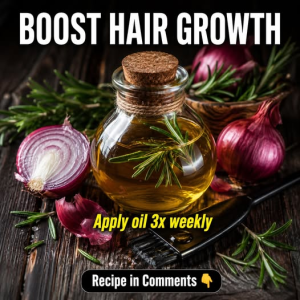
Remedy 1: Rosemary Scalp Oil for Normal Scalp and Early Pattern Thinning
Ingredients
- Jojoba oil – 1 tablespoon: Provides lightweight wax esters that improve scalp lubrication without heavily coating the hair.
- Grapeseed oil – 1 tablespoon: Creates a light carrier base and helps distribute essential oils safely.
- Virgin coconut oil – 1 teaspoon: Penetrates the hair fibre and helps reduce grooming-related protein loss.
- Sunflower seed oil – 1 teaspoon: Supplies linoleic acid and adds slip to reduce friction.
- Rosemary essential oil – 6 drops: The main studied ingredient for hereditary pattern thinning.
- Lavender essential oil – 2 drops: Provides fragrance and may support scalp comfort, although its independent hair-growth evidence is limited.
Scientific Working of the Remedy
A randomised comparative trial involving people with androgenetic alopecia compared rosemary oil with 2% minoxidil for six months. Neither group showed a significant improvement after three months, but both experienced an increase in hair count after six months. This means rosemary must be used consistently and should not be promoted as a rapid-growth remedy. (PubMed)
Coconut oil does not stimulate new follicles, but laboratory research found that it reduced protein loss from damaged and undamaged hair. Preventing breakage allows more of the existing hair length to remain visible, which can make the hair look fuller over time. (PubMed)
Procedure
Combine all four carrier oils in a clean dark-glass bottle. Add the rosemary and lavender oils, close the bottle and shake gently.
Part the hair into sections and apply approximately one teaspoon across the scalp. Massage gently with the fingertips for four minutes without scratching. Leave the oil on for 30–60 minutes, then shampoo thoroughly.
How Often to Apply
Apply three times weekly for at least three months. Evaluate hair density after six months rather than after a few weeks.
Initial Results
Within one to three days, the scalp may feel more comfortable and dry hair may feel softer. New growth should not be expected during this period.
Remedy 2: Onion Juice Protocol for Combination Scalp with Patchy Hair Loss
This remedy is intended only for small, smooth patches consistent with dermatologist-diagnosed alopecia areata. It is not a proven treatment for general shedding, receding hairlines or female-pattern thinning.
Ingredients
- Fresh red onion juice – 1 tablespoon: Contains sulfur-containing compounds and was tested in a small alopecia areata study.
- Boiled and cooled water – 1 teaspoon: Slightly reduces the strength for irritation-prone areas.
- Pure aloe vera gel – 1 tablespoon: Provides a soothing post-treatment base.
- Colloidal oatmeal – 1 teaspoon: Helps calm dryness and supports the scalp barrier.
- Cooled green tea – 1 tablespoon: Supplies antioxidant polyphenols.
- Jojoba oil – 2 drops: Softens dry skin around the treated patch.
Scientific Working of the Remedy
In a small controlled study, crude onion juice was applied to patchy alopecia areata. Hair regrowth was observed in 73.9% of the onion group after four weeks and 86.9% after six weeks. However, the study was small, used twice-daily application and involved one specific autoimmune type of hair loss. These results cannot be applied to every cause of thinning. (PubMed)
The aloe, oatmeal, green tea and jojoba are used afterward to reduce dryness and discomfort. They should not be described as independent cures for alopecia areata.
Procedure
Grate a small onion and press it through a clean cloth. Mix one tablespoon of juice with one teaspoon of cooled water.
Apply a small amount only to the bald patch. Leave it for 10 minutes during the first application. Rinse and shampoo gently.
Mix the aloe, oatmeal, green tea and jojoba separately. Apply this soothing mixture for five minutes, then rinse thoroughly.
How Often to Apply
Use once daily for the first five days if no irritation occurs. The original trial used twice-daily treatment for two months, but such frequent use can irritate sensitive skin. Continue only after discussing the condition with a dermatologist.
Initial Results
The area may feel cleaner or slightly dry during the first three days. Genuine regrowth should not be expected before several weeks.
Remedy 3: Clinical Aromatherapy Blend for Oily-to-Normal Scalp
Ingredients
- Grapeseed oil – 4 teaspoons: A lightweight carrier used to spread the concentrated oils.
- Jojoba oil – 1 teaspoon: Supports lubrication without a thick, greasy finish.
- Rosemary essential oil – 3 drops: Included in the clinically studied aromatherapy combination.
- Lavender essential oil – 3 drops: Adds another component of the trialled blend.
- Cedarwood essential oil – 2 drops: Included in the research mixture for alopecia areata.
- Thyme essential oil – 1 drop: A highly concentrated oil that must remain carefully diluted.
Scientific Working of the Remedy
A randomised, double-blind trial studied rosemary, lavender, cedarwood and thyme essential oils diluted in jojoba and grapeseed oils in people with alopecia areata. Participants massaged the mixture into their scalp daily for seven months. Improvement was seen in 44% of the active-treatment group, compared with 15% of participants using carrier oils alone. (PubMed)
This blend is not clinically proven for ordinary oily-scalp shedding or hereditary pattern baldness. Its most relevant evidence concerns alopecia areata, which should first be diagnosed by a dermatologist.
Procedure
Place the grapeseed and jojoba oils in a clean bottle. Add the essential oils one at a time and mix well.
Apply approximately half a teaspoon to the affected areas. Massage gently for two minutes and leave it on for 30 minutes before washing. Avoid the eyes, forehead and broken skin.
How Often to Apply
Begin three times weekly for the first two weeks. If the scalp remains comfortable, it may be used daily under professional guidance. The clinical study continued for seven months.
Initial Results
The oil may reduce a dry or tight sensation in one to three days. Visible regrowth requires months and is not guaranteed.
Remedy 4: Coconut Pre-Wash Treatment for Dry, Breakage-Prone Hair
Ingredients
- Virgin coconut oil – 1 tablespoon: Reduces protein loss and penetrates the hair shaft.
- Jojoba oil – 1 teaspoon: Improves flexibility and surface smoothness.
- Grapeseed oil – 1 teaspoon: Provides light lubrication.
- Aloe vera gel – 1 tablespoon: Adds water-based hydration in a separate conditioning stage.
- Colloidal oatmeal – 1 teaspoon: Helps calm a dry scalp.
- Plant-derived glycerin – 2 drops: Attracts moisture toward the hair and scalp surface.
Scientific Working of the Remedy
Dry hair often appears unable to grow because its ends break at approximately the same rate that new length develops from the scalp. Coconut oil was found to reduce hair protein loss more effectively than sunflower and mineral oils when used before or after washing. It therefore supports length retention rather than changing follicular growth speed. (PubMed)
Aloe, oatmeal and glycerin help with surface hydration and scalp comfort. They do not create new follicles.
Procedure
Mix the coconut, jojoba and grapeseed oils. Apply the blend mainly to the hair lengths and dry ends, using only a small amount on the scalp. Leave it for 30 minutes.
Combine aloe, oatmeal and glycerin separately. Apply this mixture to dry scalp areas for five minutes. Rinse and shampoo gently, then condition the lengths.
How Often to Apply
Use twice weekly for at least four weeks. Applying heavy oil every day may cause buildup.
Initial Results
Hair may feel softer and become easier to detangle after the first application. Reduced snapping and improved length retention require several weeks.
Remedy 5: Gentle Daily Scalp Massage for Sensitive Scalp
Ingredients
- Pure aloe vera gel – 1 tablespoon: Provides gentle slip for massage.
- Boiled and cooled water – 2 tablespoons: Creates a lighter texture.
- Colloidal oatmeal – 1 teaspoon: Helps reduce scalp dryness.
- Rice starch – ½ teaspoon: Thickens the massage gel without abrasive particles.
- Plant-derived glycerin – 2 drops: Supports moisture retention.
- Jojoba oil – 1 drop: Reduces friction during massage.
Scientific Working of the Remedy
A small study involving nine healthy men investigated four minutes of standardised scalp massage daily for 24 weeks. Hair-shaft thickness increased, but the study did not establish an increase in hair count and was too small to prove massage as a treatment for baldness. The possible benefit was attributed to mechanical stretching of dermal papilla cells. (PMC)
This gentle gel simply reduces friction while performing the massage. It is suitable for people who cannot tolerate fragranced essential oils.
Procedure
Mix the oatmeal and rice starch. Gradually add water, aloe, glycerin and jojoba oil.
Apply a small quantity to the scalp. Using the pads of the fingers, press and move the skin gently in small circles for four minutes. Do not rub the hair shafts together. Rinse afterward if residue remains.
How Often to Apply
Massage once daily for at least five days. Continue for 24 weeks to follow the period used in the study.
Initial Results
Relaxation and reduced scalp tightness may occur immediately. Increased hair thickness cannot be assessed within three days.
Final Tips for Supporting Hair Growth
Avoid tight ponytails, extensions, frequent bleaching, excessive straightening and rough towel-drying. Detangle gently from the ends upward and apply conditioner to reduce friction. Keep combs, brushes, pillowcases and scalp applicators clean.
Patch-test onion juice and every essential oil blend. Stop treatment if it causes burning, swelling, blistering, severe itching or increased shedding. Essential oils should never be swallowed or used undiluted.
Take photographs of the same scalp area once monthly under similar lighting. Hair changes happen too slowly to judge accurately every day. A treatment generally needs three to six months before meaningful comparison.
Diet Plan for Healthy Hair Growth
Follow the diet plan for at least eight to twelve weeks.
Breakfast: Eat eggs, plain yogurt, milk or a fortified plant alternative with oatmeal or whole-grain bread. Include fruit rich in vitamin C.
Lunch: Choose lentils, chickpeas, beans, chicken, fish or lean meat with leafy vegetables and a whole-grain carbohydrate.
Snack: Eat a small serving of pumpkin seeds, sesame seeds, almonds, walnuts or roasted chickpeas.
Dinner: Include protein such as fish, eggs, tofu, beans or chicken with vegetables. Hair fibres are largely protein, so extremely restrictive diets can contribute to shedding.
Iron and zinc: Include meat, lentils, beans, seeds and leafy vegetables. Combine plant iron with vitamin-C-rich foods to improve absorption.
Vitamin B12 and vitamin D: Obtain B12 from eggs, dairy foods, fish, meat or fortified foods. Vitamin D may require testing when deficiency is suspected.
Do not take high-dose biotin, iron, zinc or vitamin D without medical advice. Reviews have found limited evidence that biotin improves hair in people without an underlying deficiency, while unnecessary supplementation may cause adverse effects or interfere with laboratory tests. (PubMed)
Continue the selected remedy for at least three months unless irritation occurs. See a dermatologist if hair loss persists, progresses rapidly or causes visible scalp thinning. Medical evaluation is especially important for sudden bald patches, scalp pain, heavy scaling, pus, eyebrow loss, menstrual irregularities, unexplained weight changes or shedding that begins after illness, childbirth or a new medicine. Identifying the cause early improves the chance of effective treatment. (American Academy of Dermatology)
References for the above remedy
- Panahi Y, et al. Rosemary Oil vs Minoxidil 2% for the Treatment of Androgenetic Alopecia.
https://pubmed.ncbi.nlm.nih.gov/25842469/ - Sharquie KE, Al-Obaidi HK. Onion Juice, a New Topical Treatment for Alopecia Areata.
https://pubmed.ncbi.nlm.nih.gov/12126069/ - Hay IC, et al. Randomized Trial of Aromatherapy: Successful Treatment for Alopecia Areata.
https://pubmed.ncbi.nlm.nih.gov/9828867/ - Rele AS, Mohile RB. Effect of Mineral Oil, Sunflower Oil and Coconut Oil on Prevention of Hair Damage.
https://pubmed.ncbi.nlm.nih.gov/12715094/ - Kaushik V, et al. Benefit of Coconut-Based Hair Oil Through Hair Porosity and Strength Measurements.
https://pubmed.ncbi.nlm.nih.gov/35377477/ - Koyama T, et al. Standardized Scalp Massage Results in Increased Hair Thickness.
https://pmc.ncbi.nlm.nih.gov/articles/PMC4740347/ - Almohanna HM, et al. The Role of Vitamins and Minerals in Hair Loss: A Review.
https://pubmed.ncbi.nlm.nih.gov/30547302/ - Patel DP, et al. A Review of the Use of Biotin for Hair Loss.
https://pmc.ncbi.nlm.nih.gov/articles/PMC5582478/ - American Academy of Dermatology Association. Hair Loss: Diagnosis and Treatment.
https://www.aad.org/public/diseases/hair-loss/treatment/diagnosis-treat - American Academy of Dermatology Association. Hair Loss: Tips for Managing.
https://www.aad.org/public/diseases/hair-loss/treatment/tips