
Acne can leave behind brown, gray, red, or purple marks that remain visible long after a pimple heals. These flat marks are often called “acne scars,” but dermatologists distinguish them from true scars. Flat discoloration is usually post-inflammatory hyperpigmentation (PIH) and can fade gradually, whereas indented ice-pick, boxcar, rolling, or raised scars involve structural changes in collagen and usually need professional treatment for substantial improvement. (American Academy of Dermatology) Natural skincare is most useful for calming inflammation, preventing new acne, strengthening the skin barrier, and gradually improving post-acne discoloration. The exact homemade mixtures below have not been tested as complete clinical formulas; the scientific support comes from their individual ingredients.
Remedy 1: For Normal Skin — Centella, Soy and Green Tea Repair Mask
Ingredients and Scientific Working
- Standardized Centella asiatica extract — ¼ teaspoon: Centella contains asiaticoside and related triterpenes associated with wound healing and collagen-related processes. A clinical trial in people with facial acne scars found standardized Centella improved healing after laser resurfacing. (PubMed)
- Plain unsweetened soy milk — 1 tablespoon: Controlled clinical research supports stabilized soy preparations for improving uneven pigmentation and skin tone. (PubMed)
- Strong cooled green tea — 1 tablespoon: EGCG has anti-inflammatory and sebostatic activity, and an eight-week randomized split-face trial found significant improvement in acne. (PubMed)
- Pure aloe vera gel — 1 tablespoon: Provides lightweight hydration and soothing support for recovering skin.
- Colloidal oatmeal — ½ teaspoon: Helps maintain hydration and reduce barrier irritation.
- High-linoleic sunflower oil — 2 drops: Human research found sunflower oil preserved skin-barrier integrity and improved hydration. (PubMed)
Procedure
Mix Centella extract with soy milk and aloe until smooth. Add cooled green tea and oatmeal, then finish with two drops of sunflower oil. Apply a thin layer to clean skin without rubbing old acne marks.
Leave for 8–10 minutes and rinse gently with lukewarm water.
How Often to Apply
Use on alternate evenings during the first 3–5 days. If your skin remains comfortable, continue three times weekly for 8–12 weeks.
Initial Results
Within 1–3 days, the skin may feel smoother, calmer, and better hydrated. Significant scar or pigment fading should not be expected this quickly.
Remedy 2: For Combination Skin — Mulberry, Soy and Cucumber Tone-Balancing Gel
Ingredients and Scientific Working
- Cosmetic-grade mulberry extract — 2–3 drops: Standardized mulberry preparations have shown pigment-lightening effects in human clinical research, although the evidence is stronger for melasma than specifically for post-acne marks.
- Plain soy yogurt — 1 tablespoon: Provides moisture plus soy compounds supported by controlled studies for uneven pigmentation. (PubMed)
- Fresh cucumber juice — 1 tablespoon: Provides cooling hydration and keeps the formula light.
- Pure aloe vera gel — 1 teaspoon: Adds moisture without heavy oil.
- Rice starch — ½ teaspoon: Gives the mask a smooth texture and helps avoid abrasive scrubbing.
- Vegetable glycerin — 1 drop: Helps drier cheek areas retain water.
Procedure
Combine the soy yogurt, cucumber juice, and aloe. Add rice starch, glycerin, and mulberry extract.
Apply a slightly thicker layer over dry cheeks and only a thin layer across the oily T-zone. Leave for approximately 8 minutes and rinse.
How Often to Apply
Use every other day during the first 3–5 days. Continue three times weekly for 6–8 weeks if there is no burning or redness.
Initial Results
Combination skin may look more hydrated and balanced within several applications. Pigmentation changes develop over weeks rather than days.
Remedy 3: For Oily Skin — Green Tea, Licorice and Aloe Anti-Mark Gel
Ingredients and Scientific Working
- Strong cooled green tea — 2 tablespoons: Topical green-tea preparations have demonstrated benefits for inflammatory acne, which is important because controlling new acne helps prevent additional marks and scars. (PubMed)
- Skin-safe pre-diluted licorice extract — 1–2 drops: Licorice is among the natural ingredients studied for hyperpigmentation because its constituents can influence melanin-related pathways. Clinical evidence is less extensive than for soy, so it should be treated as supportive rather than guaranteed. (PubMed)
- Pure aloe vera gel — 1 tablespoon: Provides non-greasy hydration.
- Rice starch — 1 teaspoon: Creates an oil-free gel texture.
- Colloidal oatmeal — ½ teaspoon: Prevents the mask from becoming excessively drying.
- Plain soy milk — 1 teaspoon: Adds another evidence-supported ingredient for uneven pigmentation. (PubMed)
Procedure
Mix aloe, green tea, and soy milk. Stir in rice starch and oatmeal, then add the diluted licorice extract.
Spread a thin layer over oily and post-acne areas. Leave for 7–8 minutes and rinse gently.
How Often to Apply
Use once daily for the first 3 days if well tolerated, then every other evening.
Initial Results
Oiliness and redness may improve before pigmentation does. A calmer acne cycle means fewer opportunities for new PIH to develop.
Remedy 4: For Dry Skin — Honey, Soy and Sunflower Barrier-Recovery Mask
Ingredients and Scientific Working
- Pure honey — 1 teaspoon: Honey has antimicrobial, anti-inflammatory, and wound-supportive properties, although it has not been proven to erase mature acne scars.
- Plain soy yogurt — 1 tablespoon: Provides moisture and soy-derived compounds relevant to uneven tone.
- High-linoleic sunflower oil — ¼ teaspoon: Helps maintain barrier integrity and hydration. (PubMed)
- Pure aloe vera gel — 1 tablespoon: Adds water-rich hydration.
- Colloidal oatmeal — 1 teaspoon: Helps reduce dryness and irritation.
- Vegetable glycerin — 2 drops: Supports water retention in the outer skin layer.
Procedure
Mix honey and soy yogurt first. Add aloe and oatmeal, followed by sunflower oil and glycerin.
Apply to slightly damp skin for 8–10 minutes. Rinse without scrubbing.
How Often to Apply
Use every other evening for the first 3–5 days. Continue three times weekly for 6–8 weeks.
Initial Results
Dryness and surface roughness may improve within 1–3 days, which can make the complexion look smoother. This does not rebuild the collagen lost in a pitted acne scar.
Remedy 5: For Sensitive Skin — Soy, Oat and Rice Minimalist Recovery Mask
Ingredients and Scientific Working
- Plain unsweetened soy milk — 1 tablespoon: Soy has one of the stronger bodies of controlled clinical evidence among natural pigmentation-supporting ingredients. (PubMed)
- Colloidal oatmeal — 1 teaspoon: Supports the barrier and reduces unnecessary irritation.
- Rice starch — 1 teaspoon: Provides a gentle, non-exfoliating base.
- Pure aloe vera gel — 1 teaspoon: Adds soothing hydration.
- Sunflower seed oil — 1–2 drops: Helps reinforce the moisture barrier. (PubMed)
- Cool distilled water — 1 tablespoon: Dilutes the mixture for reactive skin.
Procedure
Mix rice starch and oatmeal first. Add soy milk, water, and aloe, followed by sunflower oil.
Patch-test first. If comfortable, apply for only 5–7 minutes and rinse gently.
How Often to Apply
Use every other day during the first 3–5 days. Continue twice weekly if the skin remains calm.
Initial Results
Sensitive skin may feel less tight or irritated after several uses. Avoid aggressive “scar fading” because irritation itself can make post-inflammatory dark spots more persistent. (American Academy of Dermatology)
What About Turmeric, Honey, Aloe and Lemon?
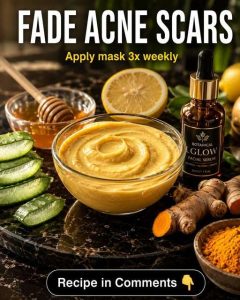
The image shows turmeric, honey, aloe, and lemon. Turmeric has interesting anti-inflammatory dermatology research, and clinical literature suggests curcumin-containing interventions may benefit several inflammatory skin conditions. However, evidence does not prove that an ordinary homemade turmeric mask removes established atrophic acne scars. (PubMed)
Honey and aloe are better viewed as soothing or barrier-supporting ingredients than scar erasers.
Raw lemon juice is intentionally excluded. Acne-prone skin that becomes irritated can develop more inflammation and darker post-inflammatory marks, so harsh acidic DIY treatments can be counterproductive. Dermatologists recommend gentle treatment and avoiding irritation when trying to fade dark spots. (American Academy of Dermatology)
Can Home Remedies Really Remove Pitted Acne Scars?
Not reliably. Once acne creates an indentation or raised scar, the skin’s collagen architecture has changed. The American Academy of Dermatology explains that flat PIH can fade, while true acne scars remain and often require treatment targeted to the scar type. (American Academy of Dermatology)
Home remedies can make the surrounding skin softer, calmer, and more even-looking, but deep ice-pick, rolling, and boxcar scars may require options such as microneedling, subcision, resurfacing procedures, or other dermatologist-directed treatments.
Final Tips for Faster and Safer Improvement
Treat active acne first. Dermatologists emphasize that stopping new breakouts helps prevent additional inflammation and new scars. (American Academy of Dermatology) Do not squeeze, scratch, or pick pimples because this increases the risk of both scars and dark marks. (American Academy of Dermatology)
Use broad-spectrum SPF 30 or higher every morning. Continued UV exposure can make post-inflammatory pigmentation harder to fade. Keep makeup brushes, phones, pillowcases, and towels clean, and introduce only one new treatment at a time.
Hydration and surface glow may start improving within 2–3 days, but post-acne pigmentation usually requires several weeks or months. True scars will not vanish in this timeframe.
Diet Plan for Clearer, Healthier Skin
Breakfast: Eggs or plain yogurt with oats and guava, kiwi, berries, or orange.
Mid-morning: A small serving of almonds, walnuts, or pumpkin seeds.
Lunch: Lentils, beans, fish, chicken, eggs, or tofu with leafy greens, tomatoes, carrots, and whole grains.
Afternoon: One whole fruit with water or unsweetened green tea.
Dinner: Protein with two vegetables and a moderate portion of brown rice, potatoes, or whole-grain bread.
Choose mostly whole foods, adequate protein, fruits, vegetables, healthy fats, and fiber. A diet cannot fill a pitted scar, but preventing ongoing acne is important because repeated inflammatory breakouts increase the chance of additional scarring. (American Academy of Dermatology)
How Long Should You Continue?
Choose one remedy appropriate for your skin type and follow it for approximately 8–12 weeks, alongside gentle acne care and daily sun protection.
If there is little improvement after 8–12 weeks, or if you have deep indented scars, raised scars, painful cystic acne, recurrent nodules, or worsening pigmentation, see a doctor or dermatologist. Professional scar treatment usually begins after active acne is adequately controlled. (American Academy of Dermatology)
References for the above remedy
- American Academy of Dermatology Association. Acne scars: Overview.
https://www.aad.org/public/diseases/acne/derm-treat/scars - American Academy of Dermatology Association. Acne scars: Signs and symptoms.
https://www.aad.org/public/diseases/acne/derm-treat/scars/symptoms - Damkerngsuntorn W, et al. The Effects of a Standardized Extract of Centella asiatica on Postlaser Resurfacing Wound Healing in Patients With Facial Acne Scars.
https://pubmed.ncbi.nlm.nih.gov/32310680/ - Yoon JY, Kwon HH, Min SU, et al. Epigallocatechin-3-Gallate Improves Acne in Humans by Modulating Intracellular Molecular Targets.
https://pubmed.ncbi.nlm.nih.gov/23096708/ - Elsaie ML, et al. The Efficacy of Topical 2% Green Tea Lotion in Mild-to-Moderate Acne Vulgaris.
https://pubmed.ncbi.nlm.nih.gov/19363854/ - Leyden J, Shergill B, Micali G, Downie J, Wallo W. Natural Options for the Management of Hyperpigmentation.
https://pubmed.ncbi.nlm.nih.gov/21623927/ - Hermanns JF, et al. Assessment of Topical Hypopigmenting Agents on Solar Lentigines of Asian Women.
https://pubmed.ncbi.nlm.nih.gov/12077522/ - Danby SG, AlEnezi T, Sultan A, et al. Effect of Olive and Sunflower Seed Oil on the Adult Skin Barrier.
https://pubmed.ncbi.nlm.nih.gov/22995032/ - Vaughn AR, Branum A, Sivamani RK. Effects of Turmeric (Curcuma longa) on Skin Health: A Systematic Review of the Clinical Evidence.
https://pubmed.ncbi.nlm.nih.gov/27213821/ - American Academy of Dermatology Association. How to Fade Dark Spots in Darker Skin Tones.
https://www.aad.org/public/everyday-care/skin-care-secrets/routine/fade-dark-spots