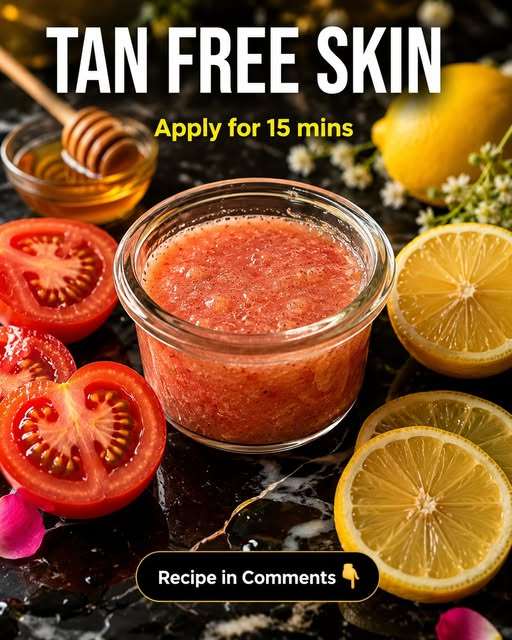
Sun tanning happens when ultraviolet and visible light stimulate the skin to produce more melanin as a protective response. Although a tan may fade naturally as pigmented surface cells are gradually replaced, repeated sun exposure can keep the skin dark, uneven and dull. It can also contribute to premature lines, roughness and persistent patches of pigmentation. Home remedies may improve hydration, calm irritation and support a more even-looking complexion, but they cannot safely remove a tan in 15 minutes or restore the skin’s original tone within three days.
The tomato, honey and lemon mask shown in the image should be approached carefully. Honey can support surface moisturization, but evidence for raw tomato as a topical tan remover is limited. Fresh lemon juice is best avoided because citrus compounds followed by sunlight can trigger phytophotodermatitis, causing burning, blisters and prolonged hyperpigmentation—the opposite of the intended result. (PubMed)
The remedies below use gentler ingredients studied for pigmentation, photoprotection, hydration or skin-barrier support. Clinical studies usually test standardized extracts and professionally prepared creams rather than homemade mixtures, so these recipes should be viewed as supportive care rather than substitutes for dermatological treatment.
Remedy 1: Soy, Green Tea and Oat Mask for Normal Skin
Ingredients and Their Scientific Benefits
- Unsweetened soy milk – 1 tablespoon: Contains soy-derived proteins and isoflavone-related compounds associated with improvements in uneven pigmentation.
- Cooled green tea – 1 tablespoon: Supplies catechin polyphenols that help reduce oxidative stress caused by ultraviolet exposure.
- Colloidal oatmeal – 1 teaspoon: Supports the skin barrier and helps reduce roughness and moisture loss.
- Pure aloe vera gel – 1 teaspoon: Adds lightweight hydration and a cooling texture.
- Raw honey – ½ teaspoon: Acts as a humectant that helps the surface retain water.
- Finely blended cucumber – 1 teaspoon: Adds water and provides a refreshing, cooling effect.
Scientific Working of the Ingredients
A controlled 12-week study found that a stabilized soy moisturizer improved mottled pigmentation, dullness, skin tone and overall texture. Homemade soy milk is less concentrated and is not equivalent to the tested preparation, but it provides a mild base for normal skin. Green-tea extracts have demonstrated antioxidant and photoprotective effects in human skin studies, while oatmeal, honey and aloe mainly help the complexion look smoother by improving hydration. (PubMed)
Procedure
Combine the soy milk and cooled green tea. Add the oatmeal, aloe, honey and cucumber, then mix until a smooth paste forms. Apply a thin layer to cleansed skin, avoiding the eyes and lips. Leave it on for eight to ten minutes and rinse with cool or lukewarm water.
How Often to Apply
Use once daily for the first three days. After that, apply twice weekly for six to eight weeks.
Initial Results
Within one to three days, the skin may feel softer and look less dehydrated. Noticeable tan fading normally requires several weeks of sun protection and consistent care.
Remedy 2: Licorice and Amla Brightening Mask for Combination Skin
Ingredients and Their Scientific Benefits
- Cosmetic-grade licorice extract powder – ¼ teaspoon: Contains pigment-regulating compounds studied for uneven skin tone.
- Amla powder – ¼ teaspoon: Supplies antioxidant polyphenols and vitamin-C-related compounds.
- Colloidal oatmeal – 1 teaspoon: helps balance oily and dehydrated facial areas.
- Pure aloe vera gel – 1 teaspoon: provides non-greasy moisture.
- Cooled green tea – 1 tablespoon: adds antioxidant polyphenols and creates a lightweight base.
- Vegetable glycerin – two drops: attracts water to dry areas without adding heavy oil.
Scientific Working of Licorice and Amla
Licorice contains compounds such as glabridin and liquiritin that have been investigated for their influence on pigmentation pathways. In a clinical study, a prepared cream containing licorice, Emblica and another botanical ingredient improved melasma over 60 days and produced fewer adverse effects than the comparison treatment. That evidence applies to the tested formulation, not an unmeasured herbal paste, which is why only a small amount is used here. (PubMed)
Procedure
Mix the licorice, amla and oatmeal. Add the green tea gradually, followed by the aloe and glycerin. Apply a slightly thicker layer to dry cheek areas and a very thin layer over the forehead, nose and chin. Rinse after seven to eight minutes.
How Often to Apply
Apply on alternate days for five days. Continue twice weekly when no irritation develops.
Initial Results
Dry areas may look smoother within two or three days, while excessive shine may feel better controlled. Changes in established tanning should be assessed after six to eight weeks.
Remedy 3: Green Tea and Kaolin Mask for Oily Skin
Ingredients and Their Scientific Benefits
- Kaolin clay – 1 teaspoon: Absorbs excess surface oil and temporarily improves the appearance of shine.
- Cooled green tea – 1 tablespoon: Contains catechins studied for ultraviolet-related oxidative damage.
- Pure aloe vera gel – 1 teaspoon: Provides water-based hydration.
- Licorice extract powder – ⅛ teaspoon: Adds a gentle pigment-supporting botanical active.
- Colloidal oatmeal – ½ teaspoon: Reduces the excessively dry feeling that clay can produce.
- Fresh cucumber juice – 1 teaspoon: Dilutes the mask and gives it a cooling consistency.
Scientific Working for Oily, Tanned Skin
Kaolin does not remove melanin or permanently close pores. Its purpose is to absorb oil so the skin looks cleaner and less shiny. Green-tea extracts have shown ultraviolet-protective activity, while an eight-week study of a professionally formulated green-tea cream reported improvement in the facial melanin index after approximately six weeks. A brewed infusion is much weaker than the researched formulation, so gradual rather than dramatic results should be expected. (PubMed)
Procedure
Mix the kaolin, oatmeal and licorice first. Add the green tea, aloe and cucumber juice to create a soft paste. Spread a thin layer over the face without rubbing. Rinse after six to eight minutes, before the clay becomes completely dry and cracked.
How Often to Apply
Use twice during the first five days. Continue once or twice weekly according to oiliness.
Initial Results
Surface shine may decrease after the first application. The face may appear fresher within one to three days, but the tan itself will not disappear that quickly.
Remedy 4: Soy, Avocado and Sunflower Mask for Dry Skin
Ingredients and Their Scientific Benefits
- Unsweetened soy milk – 1 tablespoon: Provides soy-derived compounds associated with more even-looking pigmentation.
- Ripe avocado – 1 tablespoon: Supplies emollient fatty acids that soften rough, dry skin.
- Colloidal oatmeal – 1 teaspoon: Improves hydration and supports barrier function.
- Pure aloe vera gel – 1 teaspoon: Adds water-based moisture.
- Raw honey – 1 teaspoon: Helps retain moisture on the skin’s surface.
- Cold-pressed sunflower-seed oil – ¼ teaspoon: Provides linoleic-acid-rich emollient support.
Scientific Working for Dry Skin
Dryness exaggerates dullness and can make tanned areas appear patchier. Soy addresses uneven tone, while oatmeal, honey, avocado and aloe primarily improve surface softness. In a controlled adult study, sunflower-seed oil preserved barrier integrity and improved hydration, whereas olive oil damaged the barrier and caused mild redness. Sunflower oil is therefore used instead of olive oil in this recipe. (PubMed)
Procedure
Mash the avocado until completely smooth. Mix in the soy milk, oatmeal, aloe, honey and sunflower oil. Apply to slightly damp skin for ten minutes. Rinse gently and follow with a fragrance-free moisturizer.
How Often to Apply
Apply on alternate days for the first five days, followed by twice-weekly use for six to eight weeks.
Initial Results
Dryness and rough texture may improve within one to three days. Pigmentation normally needs several weeks to fade, particularly when the skin is repeatedly exposed to sunlight.
Remedy 5: Oat, Aloe and Cucumber Recovery Mask for Sensitive Skin
Ingredients and Their Scientific Benefits
- Colloidal oatmeal – 1 tablespoon: Clinically studied for hydration and barrier support.
- Pure aloe vera gel – 1 teaspoon: Adds lightweight moisture and a cooling sensation.
- Finely blended cucumber – 1 teaspoon: Supplies water without strong acidity.
- Cool boiled or distilled water – 1 tablespoon: Creates a fragrance-free base.
- Vegetable glycerin – two drops: Helps retain moisture in the outer skin layer.
- Sunflower-seed oil – two drops: Supports dryness without the heavier feel of rich oils.
Scientific Working for Sensitive Skin
Sensitive skin should not be treated with aggressive exfoliation because burning, stinging and inflammation may worsen pigmentation. Clinical research on a 1% colloidal-oatmeal cream found improvements in skin hydration, pH and barrier function. This mask focuses on recovery rather than rapid lightening, allowing natural skin-cell turnover to take place without repeated irritation. (PubMed)
Procedure
Combine the oatmeal and water and allow the mixture to stand for two minutes. Add the aloe, cucumber, glycerin and sunflower oil. Test it on a small jawline area first. When comfortable, apply for five minutes and rinse without scrubbing.
How Often to Apply
Use once and wait 48 hours. When no redness or itching occurs, apply twice during the next three to five days, followed by once weekly.
Initial Results
Sensitive skin may feel calmer and less dry within two or three days. Stop immediately if the mask causes burning, swelling, hives or persistent redness.
Final Tips for Faster and Safer Tan Fading
Daily sun protection is more important than any mask. Apply broad-spectrum, water-resistant SPF 30 or higher approximately 15 minutes before going outdoors and reapply every two hours or after sweating or swimming. Tinted sunscreen containing iron oxide provides additional protection against visible light, which can worsen pigmentation, particularly in deeper skin tones. (American Academy of Dermatology)
Avoid raw lemon, lime, baking soda, undiluted vinegar, harsh scrubs and vigorous rubbing. Use clean bowls and prepare a fresh mask for each application because homemade recipes contain no preservatives. Patch-test every remedy for 24–48 hours.
Hydration-related glow and smoother texture may begin within two or three days. Continued glow, more even tone and reduced visibility of fine dehydration lines require regular care. Natural tanning usually fades gradually, and deeper pigmentation can take months rather than days. (American Academy of Dermatology)
Diet Plan for Healthy, Even-Looking Skin
Breakfast: Eat eggs, plain yogurt, lentils or tofu with a vitamin-C-rich fruit such as guava, kiwi, berries or an orange.
Lunch: Choose fish, chicken, beans or chickpeas with leafy vegetables, tomatoes, carrots and whole grains.
Snack: Have a small portion of almonds, walnuts, pumpkin seeds or fresh fruit instead of sugary drinks.
Dinner: Include a protein source with colourful vegetables and a moderate serving of brown rice, oats, barley or wholegrain bread.
Daily routine: Drink water according to thirst, sleep for seven to nine hours and avoid crash diets. Food supports general skin health but cannot replace sunscreen or directly bleach a tan.
Continue the suitable home remedy for six to eight weeks and follow the diet plan as an ongoing healthy eating pattern. Consult a dermatologist if pigmentation becomes darker, sharply defined, itchy or painful; appears without sun exposure; persists beyond eight to twelve weeks; or develops during pregnancy or after starting medication. Professional evaluation is also necessary for suspected melasma, blistering, severe sunburn or any changing skin lesion.
References for the above remedy
- Wallo W, Nebus J, Leyden JJ. Efficacy of a Soy Moisturizer in Photoaging: A Double-Blind, Vehicle-Controlled, 12-Week Study.
https://pubmed.ncbi.nlm.nih.gov/17941363/ - Costa A, et al. Association of Emblica, Licorice and Belides as an Alternative to Hydroquinone in the Clinical Treatment of Melasma.
https://pubmed.ncbi.nlm.nih.gov/21152784/ - Camouse MM, et al. Topical Application of Green and White Tea Extracts Provides Protection From Solar-Simulated Ultraviolet Light in Human Skin.
https://pubmed.ncbi.nlm.nih.gov/19492999/ - Phetdee K, et al. Effect of Green Tea Extract Loaded Chitosan Microparticles on Facial Skin: A Randomized Placebo-Controlled Study.
https://pubmed.ncbi.nlm.nih.gov/34965006/ - Capone K, et al. Effects of Colloidal Oatmeal Topical Cream on Skin Barrier Properties.
https://pubmed.ncbi.nlm.nih.gov/32484623/ - Danby SG, et al. Effect of Olive and Sunflower Seed Oil on the Adult Skin Barrier.
https://pubmed.ncbi.nlm.nih.gov/22995032/ - Górska A, et al. Innovative Honey-Based Product and Its Effects Measured by Skin Techniques.
https://pubmed.ncbi.nlm.nih.gov/39770550/ - Castanedo-Cazares JP, et al. Near-Visible Light and UV Photoprotection in the Treatment of Melasma: A Randomized Trial.
https://pubmed.ncbi.nlm.nih.gov/24313385/ - American Academy of Dermatology. Melasma Self-Care and Sun Protection.
https://www.aad.org/public/diseases/a-z/melasma-self-care - Hankinson A, et al. Lemons in the Arizona Sunshine: Furocoumarins and Phytophotodermatitis.
https://pubmed.ncbi.nlm.nih.gov/29324427/