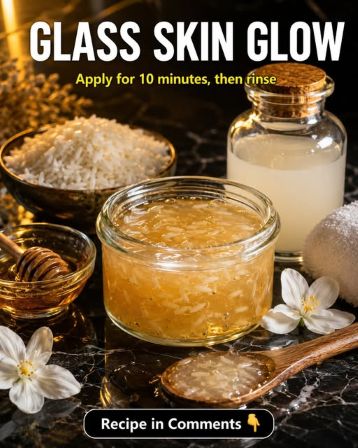
“Glass skin” is a beauty term for skin that looks exceptionally smooth, hydrated, even-toned, and naturally reflective. It is not a medical condition, and no homemade mask can permanently create poreless skin in ten minutes. However, improving water content in the outer skin layer, strengthening the skin barrier, calming irritation, and reducing dullness can make the complexion look noticeably smoother and more luminous. The rice-based treatment shown in the image has some scientific basis: human research found that rice-starch exposure improved recovery of experimentally damaged skin barrier function, while broader dermatological reviews report moisturizing, anti-inflammatory, and antioxidant properties for several rice-derived ingredients. (PubMed)
The following remedies use ingredients with human clinical evidence or strong dermatological support. The exact homemade combinations have not themselves been tested as complete clinical formulas, so results should remain realistic. Early improvement means softer, better-hydrated skin—not permanent pore removal or wrinkle reversal within a few days.
Remedy 1: For Normal Skin — Rice Starch, Honey and Soy Glass-Skin Mask
Ingredients and Scientific Working
- Food-grade rice starch — 1 teaspoon: Rice starch can support recovery of the skin barrier. In a human study, rice-starch bath exposure improved the healing capacity of damaged skin by about 20%. (PubMed)
- Plain unsweetened soy milk — 1 tablespoon: Soy-derived compounds have human evidence for improving dullness, blotchiness, uneven pigmentation, texture, and overall appearance. (PubMed)
- Pure aloe vera gel — 1 teaspoon: Aloe acts as a humectant and has demonstrated improvement in skin hydration in human testing. (PubMed)
- Raw honey — ½ teaspoon: Honey supplies sugars and other compounds that help create a moisture-retaining, emollient surface; dermatological literature also describes antimicrobial and skin-supporting properties. (PubMed)
- Colloidal oatmeal — ½ teaspoon: Oat compounds have antioxidant and anti-inflammatory activity and can reduce roughness and dryness. (PubMed)
- Vegetable glycerin — 2 drops: A humectant that helps hold water in the superficial skin layers.
Procedure
Mix the rice starch and oatmeal first. Add soy milk, aloe, honey, and glycerin until a soft gel-like paste forms. Apply a thin layer to freshly cleansed skin without rubbing.
Leave for 8–10 minutes, keeping the mask away from the eyes. Rinse with lukewarm water and pat dry.
How Often to Apply
Use once daily for the first 3 days if completely comfortable, then three times weekly.
Initial Results
Within 1–3 days, skin may feel softer and appear more plump because of improved surface hydration. More meaningful improvement in dullness and uneven tone requires several weeks; the controlled soy study lasted 12 weeks. (PubMed)
Remedy 2: For Combination Skin — Soy, Licorice and Oat Balancing Glow Mask
Ingredients and Scientific Working
- Plain soy milk — 1 tablespoon: Clinical research supports soy for improving dullness, texture, blotchiness, and mottled pigmentation. (PubMed)
- Colloidal oatmeal — 1 teaspoon: Helps support drier facial areas and calm irritation without requiring a heavy oil.
- Pure aloe vera gel — 1 teaspoon: Adds lightweight hydration.
- Skin-safe pre-diluted licorice extract — 1–2 drops: Licorice contains compounds such as glabridin that can interfere with pathways involved in excess pigment production; evidence is stronger for standardized extracts than homemade licorice preparations. (PubMed)
- Rice starch — ½ teaspoon: Supports barrier-friendly hydration and provides the smooth texture associated with a “glass skin” finish.
- Vegetable glycerin — 1 drop: Adds extra moisture to dry cheek areas without making the T-zone excessively oily.
Procedure
Blend everything until smooth. Spread a slightly thicker layer over dry cheeks and a very thin layer across the forehead, nose, and chin.
Leave for 7–10 minutes, then rinse gently. Do not allow the mask to become completely dry and cracked.
How Often to Apply
Use every other day for the first 3–5 days. Continue three times weekly for 6–8 weeks if tolerated.
Initial Results
Dry areas may become smoother within several applications, while the overall complexion may look more even because a hydrated surface reflects light better. Pigmentation changes take substantially longer.
Remedy 3: For Oily Skin — Green Tea and Rice Clarifying Glow Gel
Ingredients and Scientific Working
- Strong cooled green tea — 1 tablespoon: Green tea provides EGCG. Human clinical research has shown topical EGCG can reduce acne-related inflammation and influence sebaceous activity. (PubMed)
- Rice starch — 1 teaspoon: Creates a lightweight, non-oily mask while supporting the barrier.
- Pure aloe vera gel — 1 tablespoon: Provides water-based hydration without adding a heavy lipid layer.
- Colloidal oatmeal — ½ teaspoon: Helps prevent the over-drying and irritation that can make oily skin feel tight after cleansing.
- Plain soy milk — 1 teaspoon: Adds evidence-supported skin-tone and texture benefits.
- Distilled or boiled-and-cooled water — 1 teaspoon: Adjusts the gel to a light consistency.
Procedure
Brew green tea and cool it completely. Combine it with aloe and soy milk, then slowly stir in rice starch and oatmeal.
Apply a thin layer for 7–8 minutes. Rinse thoroughly and avoid scrubbing around active pimples.
How Often to Apply
Use once daily for the first 3 days if there is no irritation, then every other day for several weeks.
Initial Results
The face may feel less greasy and more refreshed within 1–3 days, but acne and excess sebum do not disappear instantly. In a randomized clinical study, EGCG-related acne improvement was evaluated over eight weeks. (PubMed)
Remedy 4: For Dry Skin — Coconut, Sunflower and Oat Barrier-Glow Mask
Ingredients and Scientific Working
- Virgin coconut oil — ¼ teaspoon: A randomized double-blind trial found virgin coconut oil effective at improving hydration in people with dry skin. (PubMed)
- High-linoleic sunflower seed oil — ¼ teaspoon: Human research found that sunflower oil preserved skin-barrier integrity and improved hydration. (PubMed)
- Colloidal oatmeal — 1 teaspoon: Helps decrease roughness, scaling, itch, and irritation.
- Pure aloe vera gel — 1 tablespoon: Adds water-rich hydration.
- Raw honey — ½ teaspoon: Gives the mask a moisture-retaining texture.
- Rice starch — ½ teaspoon: Adds a silky finish and complements the barrier-focused preparation.
Procedure
Mix aloe and honey first. Add oatmeal and rice starch, then blend in only the measured amounts of coconut and sunflower oil.
Apply to damp skin for 10 minutes. Rinse gently and pat the face dry rather than rubbing it with a towel.
How Often to Apply
Use every other evening for the first 3–5 days, then two or three times weekly.
Initial Results
Dryness, tightness, and surface roughness can begin improving within several days. A smoother moisturized surface often looks more luminous, but genuine wrinkle reduction requires much longer than a few days.
Remedy 5: For Sensitive Skin — Minimal Rice and Oat Comfort Mask
Ingredients and Scientific Working
- Colloidal oatmeal — 1 teaspoon: Among the better-studied natural ingredients for supporting irritated and dry skin; clinical studies report improvement in barrier function, hydration, dryness, and roughness. (PubMed)
- Rice starch — 1 teaspoon: Human data support its role in recovery of damaged barrier function. (PubMed)
- Pure aloe vera gel — 1 tablespoon: Provides uncomplicated water-based moisturization.
- Sunflower seed oil — 2 drops: Helps provide barrier lipids without using olive oil, which has performed poorly for skin-barrier integrity in human research. (PubMed)
- Distilled or boiled-and-cooled water — 1 tablespoon: Dilutes the mixture and makes application gentler.
Procedure
Mix the rice starch and oatmeal, then add aloe and water. Finish with two drops of sunflower oil.
Patch-test first. If comfortable, apply for only 5–7 minutes before rinsing.
How Often to Apply
Start every other day for 3–5 days. If there is no burning, itching, rash, or persistent redness, continue twice weekly.
Initial Results
The goal during the first 1–3 days is calmer, softer, less tight skin—not dramatic whitening or exfoliation.
Is Rice Water Really a Proven Glass-Skin Remedy?
Rice has become strongly associated with “glass skin” routines, but it is important to separate tradition from clinical proof. Human evidence exists for rice starch and certain standardized rice-derived preparations, including effects on barrier recovery and hydration. Reviews also identify potentially useful compounds in rice bran. However, a jar of homemade fermented rice water has not been proven in high-quality clinical trials to create poreless or permanently translucent skin. (PubMed)
For this reason, these recipes favor fresh mixtures and measured rice starch rather than recommending strongly fermented DIY rice water.
Final Tips for Maintaining a Glass-Skin Glow
Daily sun protection is essential. UV exposure contributes to uneven pigmentation, collagen breakdown, wrinkles, and premature skin aging. Dermatologists recommend broad-spectrum, water-resistant sunscreen with SPF 30 or higher when skin is exposed outdoors. (American Academy of Dermatology)
Wash the face gently, keep makeup brushes and towels clean, avoid picking pimples, and do not use lemon juice, baking soda, undiluted vinegar, or aggressive grain scrubs. Damaging the barrier can make the complexion rougher rather than more luminous.
Patch-test every new ingredient. Prepare fresh DIY masks in small quantities instead of storing wet rice, milk, aloe, or food mixtures for repeated use.
Adequate sleep and hydration also matter. A human study found that increased dietary water intake influenced measures of skin hydration, particularly among women whose usual water consumption was relatively low. (PubMed)
Visible softness and hydration may begin within 2–3 days. Continued improvement in glow, tone, texture, and fine lines is more realistically assessed over 6–12 weeks, and wrinkle reduction from home masks is not guaranteed.
Diet Plan for Naturally Radiant Skin
Breakfast: Oatmeal with plain yogurt plus berries, kiwi, guava, papaya, or orange.
Mid-morning: A small handful of almonds or walnuts and water.
Lunch: Lentils, beans, eggs, fish, chicken, or tofu with carrots, tomatoes, leafy greens, and whole grains.
Afternoon: One whole fruit with unsweetened tea or water.
Dinner: A protein source with two different vegetables and a moderate serving of brown rice, potatoes, or whole-grain bread.
Rotate colorful fruits and vegetables rather than relying on one “beauty food.” Human trials show that increased dietary carotenoids from fruits and vegetables can accumulate in the skin and alter its coloration in a way associated with a healthier-looking complexion. (PubMed)
How Long Should You Continue?
Choose one remedy that matches your skin type and use it consistently for 6–8 weeks rather than applying all five treatments. Continue a balanced diet, adequate hydration, gentle cleansing, and daily sun protection throughout this period.
If your skin remains persistently rough, itchy, inflamed, severely dry, suddenly develops pigmentation, or you experience recurring acne, burning, swelling, peeling, or a rash, stop experimenting with home remedies and see a doctor or dermatologist. Eczema, rosacea, contact dermatitis, acne, melasma, and other conditions require diagnosis and may worsen when repeatedly treated with DIY ingredients.
References for the above remedy
- De Paepe K, Hachem JP, Vanpee E, et al. Effect of Rice Starch as a Bath Additive on the Barrier Function of Healthy but SLS-Damaged Skin and Skin of Atopic Patients.
https://pubmed.ncbi.nlm.nih.gov/12353708/ - Zamil DH, Perez-Sanchez A, Katta R. Dermatological Uses of Rice Products: Trend or True?
https://pubmed.ncbi.nlm.nih.gov/35587098/ - Wallo W, Nebus J, Leyden JJ. Efficacy of a Soy Moisturizer in Photoaging: A Double-Blind, Vehicle-Controlled, 12-Week Study.
https://pubmed.ncbi.nlm.nih.gov/17941363/ - Dal’Belo SE, Gaspar LR, Maia Campos PMBG. Moisturizing Effect of Cosmetic Formulations Containing Aloe Vera Extract in Different Concentrations Assessed by Skin Bioengineering Techniques.
https://pubmed.ncbi.nlm.nih.gov/17026654/ - Reynertson KA, Garay M, Nebus J, et al. Anti-Inflammatory Activities of Colloidal Oatmeal Contribute to the Effectiveness of Oats in Treatment of Itch Associated With Dry, Irritated Skin.
https://pubmed.ncbi.nlm.nih.gov/25607907/ - Yoon JY, Kwon HH, Min SU, et al. Epigallocatechin-3-Gallate Improves Acne in Humans by Modulating Intracellular Molecular Targets and Inhibiting P. acnes.
https://pubmed.ncbi.nlm.nih.gov/23096708/ - Agero ALC, Verallo-Rowell VM. A Randomized Double-Blind Controlled Trial Comparing Extra Virgin Coconut Oil With Mineral Oil as a Moisturizer for Mild to Moderate Xerosis.
https://pubmed.ncbi.nlm.nih.gov/15724344/ - Danby SG, AlEnezi T, Sultan A, et al. Effect of Olive and Sunflower Seed Oil on the Adult Skin Barrier: Implications for Neonatal Skin Care.
https://pubmed.ncbi.nlm.nih.gov/22995032/ - Palma L, Marques LT, Bujan J, Rodrigues LM. Dietary Water Affects Human Skin Hydration and Biomechanics.
https://pubmed.ncbi.nlm.nih.gov/26345226/ - Pezdirc K, Hutchesson MJ, Whitehead R, Ozakinci G, Perrett D, Collins CE. Consuming High-Carotenoid Fruit and Vegetables Influences Skin Yellowness and Plasma Carotenoids in Young Women: A Randomized Crossover Trial.
https://pubmed.ncbi.nlm.nih.gov/27160341/