
Hair thinning, excessive shedding, and slow-looking growth can affect confidence, but healthy hair growth cannot be accelerated dramatically in a few days. Genetics, hormones, nutrition, stress, scalp disease, and hair-care habits all influence the hair cycle. Natural ingredients such as rosemary oil, pumpkin seed oil, and onion juice have been investigated in human studies, while scalp massage may improve hair thickness over time. However, the evidence differs by type of hair loss. Rosemary has clinical evidence for androgenetic alopecia, onion juice was studied specifically in alopecia areata, and pumpkin seed oil has been investigated for pattern hair loss. (PubMed) The remedies below therefore focus on realistic, evidence-informed scalp care rather than promising overnight regrowth.
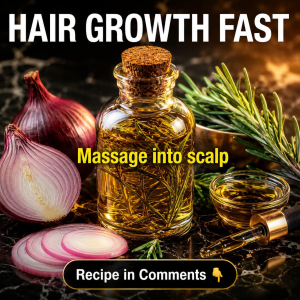
Remedy 1: For Normal Scalp — Rosemary, Coconut and Aloe Growth-Support Oil
Ingredients and Scientific Working
- Rosemary essential oil — 5 drops: Rosemary oil was compared with 2% minoxidil in a six-month randomized study. Hair counts improved significantly after six months, although there was no significant increase at three months. (PubMed)
- Virgin coconut oil — 1 tablespoon: Coconut oil penetrates the hair shaft and was shown to reduce protein loss from damaged and undamaged hair, helping retain existing length by reducing breakage. (PubMed)
- Pumpkin seed oil — 1 teaspoon: Human clinical research suggests pumpkin seed oil may improve hair-growth measurements in pattern hair loss. (PubMed)
- Pure aloe vera gel — 1 teaspoon: Provides water-rich hydration and soothing slip for the scalp.
- Jojoba oil — 1 teaspoon: Works as a light carrier so concentrated rosemary oil is not applied directly.
- Sunflower oil — 1 teaspoon: Adds lubrication and helps reduce friction during scalp massage.
Procedure
Mix the carrier oils first. Add rosemary oil, then stir in aloe immediately before application. Part the hair and apply a small amount over the scalp. Massage gently with fingertips for 3–4 minutes.
Leave for 30–45 minutes and wash with a gentle shampoo.
How Often to Apply
Use 3 times weekly for the first 3–5 days of the routine, then continue three times weekly for at least 3–6 months.
Initial Results
Within 1–3 days, the hair may feel softer and less dry. New hair growth should not be expected this soon. Rosemary’s clinical hair-count improvement required months. (PubMed)
Remedy 2: For Combination Scalp — Pumpkin Seed and Aloe Lightweight Root Serum
Ingredients and Scientific Working
- Pumpkin seed oil — 2 teaspoons: A randomized comparative trial in women with female-pattern hair loss found promising improvements with topical pumpkin seed oil over three months. (PubMed)
- Aloe vera gel — 1 tablespoon: Creates a light base suitable for areas that become oily while helping dry sections feel comfortable.
- Grapeseed oil — 1 teaspoon: A lightweight carrier that reduces friction during massage.
- Coconut oil — ½ teaspoon: Helps reduce hair-fiber protein loss and breakage. (PubMed)
- Rosemary oil — 3 drops: Adds a second botanical with human evidence in androgenetic alopecia. (PubMed)
- Distilled water — 1 teaspoon: Helps keep the preparation light.
Procedure
Mix pumpkin seed, grapeseed, and coconut oils. Add rosemary. Combine a teaspoon of this oil blend with the aloe and water immediately before use.
Apply mainly to thinning areas while using less on oily roots. Massage for three minutes, leave for 30 minutes, and rinse.
How Often to Apply
Apply every other day during the first 3–5 days, then continue 2–3 times weekly for 12–24 weeks.
Initial Results
The scalp may feel less tight and the hair may become easier to manage within a few applications. Clinical changes in density or hair count take substantially longer.
Remedy 3: For Oily Scalp — Onion, Aloe and Green Tea Pre-Wash Tonic
Ingredients and Scientific Working
- Fresh onion juice — 1 tablespoon: In a small controlled trial involving patchy alopecia areata, crude onion juice produced significantly more regrowth than tap water. The study does not prove that onion treats all forms of thinning. (PubMed)
- Pure aloe vera gel — 1 tablespoon: Dilutes the harshness of onion while providing soothing hydration.
- Cooled green tea — 1 tablespoon: Provides antioxidant tea polyphenols in a non-oily base.
- Distilled water — 1 tablespoon: Further reduces onion concentration.
- Vegetable glycerin — ¼ teaspoon: Helps prevent excessive dryness.
- Colloidal oatmeal — ½ teaspoon: Supports an irritated or itchy skin barrier.
Procedure
Grate fresh onion and strain it through clean cloth so no pieces remain. Mix one tablespoon of juice with the other ingredients.
Patch-test first. Apply a thin layer to the scalp for 10 minutes only, then shampoo thoroughly.
How Often to Apply
Start every other day for 3–5 days to assess tolerance. If comfortable, use 2–3 times weekly.
Initial Results
The scalp may feel cleaner within 1–3 days, but visible regrowth cannot occur this quickly. In the onion study, terminal hairs started appearing after about two weeks, and the participants had alopecia areata specifically. (PubMed)
Remedy 4: For Dry Scalp — Rosemary, Pumpkin Seed and Coconut Repair Massage
Ingredients and Scientific Working
- Virgin coconut oil — 1 tablespoon: Helps protect hair protein and reduce breakage. (PubMed)
- Pumpkin seed oil — 1 tablespoon: Has human clinical evidence relevant to pattern hair loss. (PubMed)
- Rosemary essential oil — 4 drops: Supported by a six-month clinical study in androgenetic alopecia. (PubMed)
- Aloe vera gel — 1 teaspoon: Adds hydration to a dry-feeling scalp.
- Jojoba oil — 1 teaspoon: Improves spreadability while diluting essential oil.
- Ground colloidal oatmeal — ½ teaspoon: Helps calm dryness and irritation.
Procedure
Blend coconut, pumpkin seed, and jojoba oils. Add rosemary. Apply a small amount to the scalp and massage gently for four minutes. Apply aloe mixed with oatmeal over particularly dry areas.
Leave for 30–60 minutes and wash thoroughly.
How Often to Apply
Use twice weekly initially. If comfortable after 3–5 days, increase to three applications weekly.
Initial Results
Dryness and hair roughness may improve within 1–3 days. Reduced breakage can help hair retain length, but follicular regrowth requires months.
Remedy 5: For Sensitive Scalp — Oil-Free Aloe-Oat Massage Routine
Sensitive scalps often tolerate fewer active botanicals. For this reason, this remedy focuses primarily on mechanical scalp massage, which has preliminary human evidence for increasing hair thickness.
Ingredients and Scientific Working
- Pure aloe vera gel — 1 tablespoon: Provides slip so the scalp is not aggressively rubbed.
- Colloidal oatmeal — ½ teaspoon: Helps calm dryness and irritation.
- Distilled water — 1 tablespoon: Creates a lighter gel.
- Vegetable glycerin — 2 drops: Helps retain moisture.
- Cucumber juice — 1 teaspoon: Adds water and a cooling feel.
A small human study found that standardized four-minute daily scalp massage increased average hair thickness after 24 weeks. It did not establish massage as a rapid cure for baldness. (PubMed)
Procedure
Mix the ingredients into a thin gel. Apply enough to provide slip, then massage the scalp using the pads of the fingers for exactly four minutes. Do not scratch with the nails.
Rinse after 10 minutes.
How Often to Apply
Begin daily or every other day for 3–5 days. Continue the four-minute massage consistently for several months if it causes no irritation.
Initial Results
The scalp may feel more comfortable within 1–3 days. The massage study measured increased thickness after 24 weeks, not after several days. (PubMed)
Do Rosemary and Onion Really Make Hair Grow Fast?
The image highlights rosemary and onion, and both have interesting evidence—but the phrase “hair growth fast” needs realistic interpretation.
Rosemary oil produced significant hair-count improvement after six months in one randomized comparative study. (PubMed) Onion juice showed encouraging regrowth in a small trial, but the participants had alopecia areata rather than ordinary male- or female-pattern thinning. (PubMed)
Natural treatments therefore need consistency and the correct diagnosis. Applying more oil, stronger onion juice, or undiluted essential oils will not make follicles grow faster and can irritate the scalp.
Final Tips for Faster, Healthier Hair
Massage gently instead of scratching. Avoid excessively tight ponytails, braids, extensions, repeated bleaching, and frequent high-temperature styling because breakage can prevent you from retaining the hair you grow.
Eat adequate protein and do not begin high-dose biotin, iron, or zinc simply because hair is shedding. The American Academy of Dermatology notes that deficiencies of iron, protein, zinc, or biotin can contribute to hair loss, but supplements should be used appropriately rather than automatically. (American Academy of Dermatology)
Patch-test every botanical mixture. Essential oils should never be applied undiluted. If onion, rosemary, or another treatment causes burning, swelling, severe itching, or a rash, discontinue it.
The realistic 1–3 day improvement is softer hair, less dryness, or a calmer scalp. Genuine improvement in density or thickness usually requires 3–6 months.
Diet Plan for Healthy Hair Growth
Breakfast: Two eggs or plain yogurt with oatmeal and guava, kiwi, berries, or orange.
Mid-morning: A small handful of walnuts, almonds, pumpkin seeds, or sesame seeds.
Lunch: Lentils, chickpeas, chicken, fish, beans, tofu, or lean meat with leafy vegetables and whole grains.
Afternoon: Plain yogurt with fruit or roasted chickpeas.
Dinner: Fish, eggs, chicken, lentils, or tofu with spinach, broccoli, carrots, or other vegetables and brown rice or whole-grain bread.
Include regular sources of protein, iron, zinc, vitamin B12, and essential fats. Nutritional deficiency is one recognized and potentially reversible cause of hair loss. (American Academy of Dermatology) Drink adequate water, sleep consistently, and avoid crash diets that severely restrict protein or calories.
How Long Should You Continue?
Choose one remedy suitable for your scalp rather than using all five simultaneously. Follow it consistently for 3–6 months before judging hair-regrowth results.
If excessive shedding continues, bald patches appear, the part becomes rapidly wider, the scalp becomes painful or scarred, or hair loss continues despite several months of care, see a doctor or dermatologist. Thyroid disease, nutritional deficiency, androgenetic alopecia, alopecia areata, scalp disorders, medications, and other conditions can all cause hair loss, and finding the underlying cause is essential for effective treatment. (American Academy of Dermatology)
References for the above remedy
- Panahi Y, Taghizadeh M, Marzony ET, Sahebkar A. Rosemary oil vs minoxidil 2% for the treatment of androgenetic alopecia: a randomized comparative trial.
https://pubmed.ncbi.nlm.nih.gov/25842469/ - Ibrahim IM, Hasan MS, Elsabaa KI, Elsaie ML. Pumpkin seed oil vs. minoxidil 5% topical foam for the treatment of female pattern hair loss: a randomized comparative trial.
https://pubmed.ncbi.nlm.nih.gov/33544448/ - Cho YH, Lee SY, Jeong DW, et al. Effect of pumpkin seed oil on hair growth in men with androgenetic alopecia: a randomized, double-blind, placebo-controlled trial.
https://pubmed.ncbi.nlm.nih.gov/24864154/ - Sharquie KE, Al-Obaidi HK. Onion juice (Allium cepa L.), a new topical treatment for alopecia areata.
https://pubmed.ncbi.nlm.nih.gov/12126069/ - Koyama T, Kobayashi K, Hama T, et al. Standardized Scalp Massage Results in Increased Hair Thickness by Inducing Stretching Forces to Dermal Papilla Cells.
https://pubmed.ncbi.nlm.nih.gov/26904154/ - Rele AS, Mohile RB. Effect of mineral oil, sunflower oil, and coconut oil on prevention of hair damage.
https://pubmed.ncbi.nlm.nih.gov/12715094/ - Gupta AK, Wang H, Wang T, Talukder M. Do Non-Prescription Products Help in Managing Androgenic Alopecia?
https://pubmed.ncbi.nlm.nih.gov/40475103/ - American Academy of Dermatology Association. Hair loss: Who gets and causes.
https://www.aad.org/public/diseases/hair-loss/causes/18-causes - American Academy of Dermatology Association. Hair loss: Diagnosis and treatment.
https://www.aad.org/public/diseases/hair-loss/treatment/diagnosis-treat - Ahmed A, et al. Herbal Remedies for Hair Loss: A Review of Efficacy and Safety.
https://pubmed.ncbi.nlm.nih.gov/40771449/