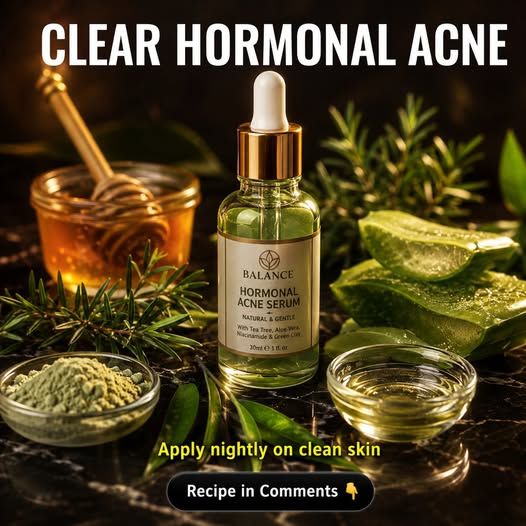
Hormonal acne commonly appears as recurring, inflamed breakouts around the chin, jawline and lower face. It can affect confidence, especially when spots return before menstruation or remain painful beneath the skin. Natural ingredients may help control surface oil, inflammation, dryness and irritation, but they cannot directly correct an underlying hormonal imbalance. Current dermatology guidelines recommend treatments such as benzoyl peroxide, topical retinoids, azelaic acid, clascoterone, combined contraceptives and spironolactone when appropriate. Plant-based remedies should therefore be used as supportive skincare for mild breakouts, not as replacements for medical care. (American Academy of Dermatology)
The complete homemade mixtures below have not been tested as finished formulas. Their scientific support comes from studies of individual ingredients or professionally prepared formulations. Fresh mixtures should be prepared for one application because homemade water-based skincare can become contaminated when stored.
Remedy 1: Green Tea and Aloe Calming Gel for Normal Skin
Ingredients and Scientific Benefits
- Strong cooled green tea: 2 tablespoons. Green tea contains epigallocatechin gallate, or EGCG, which may help reduce inflammation, excessive sebum activity and acne-causing bacterial activity. Clinical research and a meta-analysis found that topical green-tea preparations reduced inflammatory acne lesions. (PubMed)
- Pure aloe vera gel: 1 tablespoon. Aloe helps soothe redness and support hydration. In one clinical trial, aloe gel improved the effectiveness and tolerability of tretinoin, although aloe alone was not tested as a hormonal-acne cure. (PubMed)
- Finely ground colloidal oatmeal: 1 teaspoon. Oatmeal supports the skin barrier and may reduce irritation.
- Vegetable glycerin: ¼ teaspoon. Glycerin draws water into the outer skin layer and can reduce dryness caused by acne routines. Controlled research supports its ability to improve skin hydration. (PubMed)
- Tea tree essential oil: 1 drop. Properly formulated 5% tea-tree gels have reduced mild-to-moderate acne in clinical trials. This much weaker homemade dilution is intended to reduce irritation risk and cannot be assumed to produce the same results. (PubMed)
How This Remedy Works
Green tea and diluted tea tree oil provide the acne-focused activity. Aloe, oatmeal and glycerin help maintain hydration so that the skin does not become excessively dry or irritated. Protecting the barrier is important because aggressive drying and scrubbing can make acne appear worse.
Procedure
Brew green tea with boiled water and allow it to cool completely. Mix two tablespoons with the aloe, oatmeal and glycerin. Add one drop of tea tree oil and stir thoroughly. Apply a thin layer to clean skin, avoiding the eyes and lips. Leave it on for 10 minutes before rinsing with lukewarm water.
How Often to Apply
Use once daily for the first three to five days. When there is no itching or redness, continue four evenings per week for six to eight weeks.
Initial Results
Within one to three days, the skin may feel calmer, softer and less oily. Existing pimples will not normally disappear within this period. Reduced lesion formation usually requires several weeks of consistent care.
Remedy 2: Balancing Oat and Green Tea Mask for Combination Skin
Ingredients and Scientific Benefits
- Cooled green tea: 1 tablespoon
- Pure aloe vera gel: 1 tablespoon
- Colloidal oatmeal: 1 teaspoon
- Kaolin clay: 1 teaspoon
- Vegetable glycerin: ⅛ teaspoon
Scientific Working of Each Ingredient
Combination skin requires oil control around the forehead, nose and chin without stripping the cheeks. Green tea may reduce sebum and inflammatory lesions, while aloe supplies lightweight hydration. Oatmeal supports the skin barrier, and glycerin helps hold water in dry areas. Kaolin physically absorbs surface oil, but it is not a clinically proven treatment for hormonal acne and should not be allowed to dry into a hard, cracking layer. (PubMed)
Procedure
Combine all ingredients until a smooth, spreadable paste forms. Apply a slightly thicker layer to oily areas and a very thin layer to the cheeks. Leave it on for seven to eight minutes. Rinse before the mask becomes completely dry, then pat the face gently with a clean towel.
How Often to Apply
Apply every other day for the first five days. Afterward, use it two or three times weekly for six weeks.
Initial Results
The T-zone may look less shiny after the first few applications, while the cheeks should feel comfortable rather than tight. Inflamed spots may look temporarily calmer, but hormonal breakouts can still return without treatment of their underlying cause.
Remedy 3: Oil-Control Tea Tree Mask for Oily Skin
Ingredients and Scientific Benefits
- Cooled green tea: 2 tablespoons
- Kaolin clay: 2 teaspoons
- Pure aloe vera gel: 1 teaspoon
- Colloidal oatmeal: ½ teaspoon
- Tea tree essential oil: 1 drop
How the Remedy Works Scientifically
Topical green-tea preparations have demonstrated reductions in sebum and inflammatory acne lesions. Tea tree oil has antimicrobial and anti-inflammatory activity, with the strongest clinical evidence involving properly manufactured 5% gels used for several weeks. Aloe and oatmeal reduce the drying effect of the clay, while kaolin removes excess surface oil temporarily. (PubMed)
Procedure
Mix the green tea, clay, aloe and oatmeal. Add one drop of tea tree oil and blend it evenly throughout the mask. Apply a thin layer to oily, acne-prone areas. Leave it on for no more than eight minutes and rinse thoroughly.
How Often to Apply
Use on alternate days for three to five days, then reduce to twice weekly. Do not combine it on the same evening with strong exfoliants or other potentially irritating treatments.
Initial Results
The face may appear less greasy within one to three applications. Red, superficial pimples may feel less irritated, but deep hormonal cysts are unlikely to shrink significantly in a few days.
Remedy 4: Aloe and Oat Barrier Mask for Dry Acne-Prone Skin
Ingredients and Scientific Benefits
- Pure aloe vera gel: 1 tablespoon
- Cooled green tea: 1 tablespoon
- Colloidal oatmeal: 1½ teaspoons
- Vegetable glycerin: ¼ teaspoon
- High-linoleic sunflower seed oil: 2 drops
Scientific Working of the Ingredients
Dry skin can still develop acne, particularly when an impaired barrier triggers irritation. Aloe provides soothing hydration, while oatmeal and glycerin support moisture retention. Sunflower seed oil has preserved barrier integrity and improved hydration in controlled skin research, although these studies were not conducted specifically on facial acne. Green tea provides anti-inflammatory support without requiring a harsh scrub. (PubMed)
Procedure
Mix the aloe, green tea, oatmeal and glycerin. Add only two drops of sunflower oil. Apply the mask for 10 minutes and rinse gently. Omit the oil if it appears to increase clogged pores.
How Often to Apply
Apply once daily for three days, then continue three times weekly for six to eight weeks.
Initial Results
Tightness and roughness may improve within one to three days. Better hydration can make redness look less prominent, but it does not mean that the hormonal process has been corrected.
Remedy 5: Essential-Oil-Free Oatmeal Treatment for Sensitive Skin
Ingredients and Scientific Benefits
- Colloidal oatmeal: 1 tablespoon
- Boiled and cooled water: 2 tablespoons
- Pure aloe vera gel: 1 teaspoon
- Cooled green tea: 1 teaspoon
- Vegetable glycerin: ¼ teaspoon
How This Sensitive-Skin Remedy Works
Sensitive skin may react badly to essential oils, fragrance, clay and acidic kitchen ingredients. Colloidal-oatmeal preparations have improved hydration, pH and barrier function in clinical studies. Aloe and glycerin provide hydration, while a small amount of green tea offers gentle antioxidant and anti-inflammatory support. This remedy is designed mainly to calm the skin barrier; it is not a direct treatment for deep hormonal acne. (PubMed)
Procedure
Soak the oatmeal in cooled water for two minutes. Add the aloe, green tea and glycerin. Apply a thin layer without rubbing. Leave it on for five to seven minutes and rinse with lukewarm water.
How Often to Apply
Use once daily for the first three to five days. Continue three or four times weekly when the skin remains comfortable.
Initial Results
Burning, tightness and surface redness may feel better within several applications. Stop immediately if itching, swelling, hives or worsening inflammation develops.
Final Tips for Managing Hormonal Acne
Patch-test every preparation for 24–48 hours before applying it to the entire face. Never apply undiluted tea tree oil, rosemary oil or other essential oils. Avoid lemon juice, baking soda, toothpaste, garlic and undiluted vinegar because they can irritate or damage the skin.
Wash gently no more than twice daily and after heavy sweating. Do not scrub, squeeze or repeatedly touch pimples. Use clean towels and wash makeup applicators regularly. Select non-comedogenic skincare and apply broad-spectrum SPF 30 or higher during the day. Dermatologists advise giving a consistent routine several weeks or months rather than changing treatments every few days. (American Academy of Dermatology)
The first improvements within two to three days should be limited to hydration, reduced shine or calmer-looking redness. Meaningful acne reduction usually takes six to twelve weeks. Natural skincare is unlikely to prevent new cysts when the main trigger is hormonal.
Diet Plan to Support Clearer Skin
Follow this low-glycemic, balanced pattern for at least eight to twelve weeks:
Breakfast: Eggs, unsweetened yogurt or lentils with whole-grain toast, oats or a small whole-wheat roti. Add berries, guava, apple or another whole fruit.
Lunch: Grilled fish, chicken, chickpeas or lentils with vegetables, salad and a moderate serving of brown rice or whole-grain roti.
Snack: A small handful of almonds, walnuts or roasted chickpeas instead of biscuits, sweets or sugary drinks.
Dinner: Fish, beans, chicken or tofu with cooked vegetables and a small portion of whole grains.
Drinks: Choose water or unsweetened tea. Reduce frequent soft drinks, sweetened juices, desserts and refined-flour snacks.
Randomized trials have found that low-glycemic-load diets can improve acne lesion counts over approximately 10–12 weeks, although diet alone will not treat every case of hormonal acne. (PubMed)
Some observational research has found an association between dairy intake and acne, especially milk, but this does not prove that dairy causes acne in everyone. Rather than eliminating an entire food group, keep a food-and-breakout diary and discuss major dietary restrictions with a qualified professional. (PubMed)
Continue the suitable home remedy and diet plan for six to eight weeks. See a dermatologist when acne is painful, deep, scarring or not improving after eight to twelve weeks. Medical evaluation is particularly important when adult acne occurs with irregular periods, difficulty conceiving, increased facial hair or scalp-hair thinning, as these signs may justify assessment for androgen excess or polycystic ovary syndrome. (PubMed)
References for the above remedy
- American Academy of Dermatology. Updated guidelines for the management of acne.
https://www.aad.org/news/updated-guidelines-acne-management - Enshaieh S, et al. The efficacy of 5% topical tea tree oil gel in mild to moderate acne vulgaris.
https://pubmed.ncbi.nlm.nih.gov/17314442/ - Yoon JY, et al. Epigallocatechin-3-gallate improves acne by modulating molecular targets and inhibiting acne-associated bacteria.
https://pubmed.ncbi.nlm.nih.gov/23096708/ - Kim S, et al. The effects of green tea on acne vulgaris: systematic review and meta-analysis.
https://pubmed.ncbi.nlm.nih.gov/32812270/ - Hajheydari Z, et al. Aloe vera gel combined with tretinoin in mild and moderate acne.
https://pubmed.ncbi.nlm.nih.gov/23336746/ - Capone K, et al. Effects of colloidal oatmeal cream on skin microbiome and barrier properties.
https://pubmed.ncbi.nlm.nih.gov/32484623/ - Chrit L, et al. Randomized study of skin moisturization using a glycerol-based hydration cream.
https://pubmed.ncbi.nlm.nih.gov/16679823/ - Smith RN, et al. A low-glycemic-load diet improves symptoms in acne vulgaris patients.
https://pubmed.ncbi.nlm.nih.gov/17616769/ - Kwon HH, et al. Clinical and histological effects of a low-glycemic-load diet in acne.
https://pubmed.ncbi.nlm.nih.gov/22678562/ - Carmina E, et al. Female adult acne and androgen excess: report from the Androgen Excess and PCOS Committee.
https://pubmed.ncbi.nlm.nih.gov/35155970/