
Hormonal acne commonly appears as recurring inflamed pimples, often around the chin, jawline and lower face, and may flare with hormonal changes. Because hormones can increase oil production and influence inflammation and clogged pores, a homemade mask cannot correct the underlying hormonal cause. Natural ingredients can, however, support a gentle acne-care routine by calming irritation, reducing excess surface oil and supporting the skin barrier. Clinical evidence for natural acne treatments is much more limited than for standard treatments such as benzoyl peroxide, retinoids, salicylic acid and azelaic acid, so the remedies below are best considered supportive care for mild acne—not replacements for medical treatment. (American Academy of Dermatology)
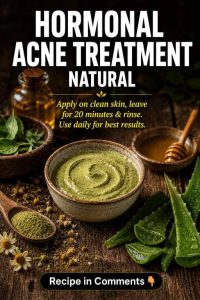
Remedy 1: Green Tea, Aloe and Oat Calming Mask for Normal Skin
Ingredients
- Freshly brewed green tea – 2 tablespoons: Contains polyphenols, including EGCG, which have antioxidant and anti-inflammatory properties.
- Pure aloe vera gel – 1 tablespoon: Provides a soothing, water-rich base.
- Finely ground oats – 1 tablespoon: Helps make the mask gentle and reduces the need for abrasive scrubbing.
- Raw honey – ½ teaspoon: Functions mainly as a humectant in this mixture.
- Ground flaxseed – ½ teaspoon: Helps thicken the mask and supplies plant-derived lipids.
- Plain unsweetened yogurt – 1 teaspoon: Creates a soft, spreadable consistency; omit if dairy irritates your skin.
Scientific Working of the Ingredients
Green tea has attracted interest because EGCG can influence inflammatory pathways, although clinical evidence specifically supporting homemade topical green-tea masks remains limited. Oral green-tea extract has also been studied in women with post-adolescent acne, but this does not establish a homemade tea mask as a hormonal-acne treatment. (PubMed)
Aloe vera has somewhat more direct clinical evidence as an adjunct. In an eight-week randomized trial, a formulated 50% aloe gel combined with tretinoin produced greater reductions in inflammatory and non-inflammatory lesions than tretinoin plus vehicle. Importantly, the trial studied a standardized formulation combined with medication—not kitchen-prepared aloe alone. (PubMed)
Procedure
Brew green tea and let it cool completely. Mix two tablespoons with aloe, finely ground oats and the remaining ingredients. Apply a thin layer to clean skin without rubbing. Leave for 10–15 minutes and rinse gently with lukewarm water.
How Often to Apply
Use once daily or every other day for 3–5 days initially.
Initial Results
The skin may feel calmer and less dry within 1–3 days. Existing acne lesions are unlikely to disappear that quickly.
Remedy 2: Aloe, Green Tea and Cucumber Mask for Combination Skin
Ingredients
- Pure aloe vera gel – 1 tablespoon
- Cooled green tea – 1 tablespoon
- Finely grated cucumber – 1 tablespoon
- Finely ground oats – 1 teaspoon
- Honey – ½ teaspoon
- Ground flaxseed – ½ teaspoon
Scientific Working of the Ingredients
Combination acne-prone skin needs hydration without aggressively stripping the oily areas. Aloe supplies a lightweight moisturizing base, while oats reduce the need for physical exfoliation.
Cucumber mostly contributes water and a cooling sensation. It should not be presented as a clinically proven acne treatment. Likewise, honey may support moisture retention, but evidence is insufficient to claim that ordinary household honey clears hormonal acne.
The goal of this mask is therefore skin comfort and barrier support, rather than changing hormone concentrations.
Procedure
Mix the grated cucumber with aloe and cooled green tea. Add oats, flaxseed and honey. Apply evenly to clean skin, avoiding the eyes. Leave for 10 minutes, then rinse.
How Often to Apply
Use once daily for 3 days and then 2–3 times weekly if your skin tolerates it.
Initial Results
Redness or tightness may appear reduced within several applications. Comedones and deeper hormonal pimples generally need substantially longer treatment.
Remedy 3: Carefully Diluted Tea Tree Treatment for Oily Acne-Prone Skin
Ingredients
- Commercially formulated 5% tea tree oil acne gel – a thin layer
- Pure aloe vera gel – 1 teaspoon for separate soothing use
- Cooled green tea – 1 tablespoon
- Finely ground oats – 1 teaspoon
- Cucumber – 1 tablespoon
- Water – as needed
Why Tea Tree Oil Has Better Acne Evidence
Tea tree oil is one of the few plant-derived topical ingredients with randomized clinical evidence for acne. A double-blind placebo-controlled study involving 60 patients found that 5% tea tree oil gel improved total lesion counts and acne severity in mild-to-moderate acne over 45 days. (PubMed)
An earlier randomized comparison also investigated 5% tea tree oil against 5% benzoyl peroxide. (PubMed)
This evidence applies to formulated 5% topical preparations, however. It does not mean undiluted essential oil should be applied directly to the face. Pure tea tree oil can irritate or sensitize skin.
Procedure
For a calming base, combine aloe, cooled green tea, cucumber and finely ground oats. Leave it on for about 10 minutes and rinse.
At another time, apply a properly formulated 5% tea tree acne gel according to its directions. Do not improvise concentrations with undiluted essential oil.
How Often to Apply
Use the soothing mask 2–3 times weekly. Follow the labeled directions for a standardized tea-tree preparation.
Initial Results
Oiliness or redness may improve first. The clinical tea-tree study evaluated acne improvement over 45 days, so a three-day cure would be unrealistic. (PubMed)
Remedy 4: Aloe-Oat Barrier Mask for Dry Hormonal Acne
Ingredients
- Pure aloe vera gel – 1 tablespoon
- Finely ground oats – 1 tablespoon
- Cooled green tea – 1 tablespoon
- Honey – ½ teaspoon
- Ground flaxseed – ½ teaspoon
- Mashed cucumber – 1 tablespoon
Scientific Working of the Ingredients
Dry acne-prone skin presents a special problem: excessive washing and harsh DIY acids can damage the barrier while doing little for the hormonal trigger.
Aloe and cucumber provide a water-rich base, oats minimize friction, and honey contributes humectant properties. Green-tea polyphenols provide antioxidant activity. This combination is deliberately gentle because controlling irritation is particularly important when acne skin is already dry.
The aloe trial discussed earlier suggests that standardized aloe gel can be useful as an adjunct to conventional topical acne treatment, but aloe alone should not be represented as equivalent to tretinoin or other evidence-based acne medications. (PubMed)
Procedure
Mix all ingredients until smooth. Apply a thin layer to clean skin and leave for approximately 10 minutes. Rinse gently and follow with a non-comedogenic moisturizer.
How Often to Apply
Apply every other day for 3–5 days. Continue 2–3 times weekly only if it remains comfortable.
Initial Results
Dryness and tightness may improve within several days. Deep pimples are unlikely to resolve within that period.
Remedy 5: Minimal Aloe and Oat Mask for Sensitive Acne-Prone Skin
Ingredients
- Finely ground oats – 1 tablespoon
- Pure aloe vera gel – 1 tablespoon
- Cool water – 1 tablespoon
- Cooled green tea – 1 teaspoon
- Mashed cucumber – 1 tablespoon
For very sensitive skin, fewer ingredients are preferable. More ingredients do not automatically produce better acne treatment.
Scientific Working of Each Ingredient
Aloe vera: Supplies a soothing gel base and has limited clinical evidence as an adjunct to tretinoin. (PubMed)
Oats: Provide a soft base that avoids abrasive exfoliation.
Green tea: Supplies polyphenolic antioxidants, although evidence for homemade topical preparations remains insufficient to call it a proven acne treatment.
Cucumber and water: Primarily provide hydration and cooling rather than directly treating acne.
Procedure
Mix the ingredients into a smooth paste. Patch-test first. Apply without rubbing or exfoliating and leave for 5–10 minutes. Rinse with cool-to-lukewarm water.
How Often to Apply
Start every other day for 3–5 days. Stop immediately if you develop itching, burning, swelling or persistent redness.
Initial Results
Sensitive skin may feel calmer after several applications. Do not expect hormonal breakouts to disappear within three days.
Ingredients to Avoid in DIY Hormonal Acne Remedies
Avoid putting undiluted essential oils, lemon juice, baking soda, toothpaste, garlic, cinnamon paste or harsh sugar/salt scrubs on acne lesions. Irritating the skin can worsen redness and damage the barrier.
Also avoid repeatedly squeezing hormonal pimples. Picking increases inflammation and can contribute to post-inflammatory dark marks and scarring.
What Actually Treats the Hormonal Part of Hormonal Acne?
This distinction is important. The remedies above primarily support the skin, whereas true hormonal acne sometimes needs treatment targeting acne pathways or hormonal influences.
The American Academy of Dermatology’s updated guideline strongly recommends treatments including topical benzoyl peroxide and retinoids and also supports other topical and systemic options. Hormonal therapies such as combined oral contraceptives and spironolactone are among the guideline-supported options for appropriate patients. (American Academy of Dermatology)
Therefore, persistent jawline or menstrual-cycle-associated acne should not be managed indefinitely with masks alone.
Final Tips for Hormonal Acne
Wash the face gently twice daily and after heavy sweating, but avoid aggressive scrubbing. Keep pillowcases, makeup tools and anything frequently touching the face clean. Choose non-comedogenic skincare and avoid picking pimples. Patch-test natural ingredients because “natural” does not mean non-irritating.
You might notice improved hydration or reduced irritation within 2–3 days, but meaningful reduction of acne lesions usually takes weeks. Do not expect home remedies to permanently eliminate wrinkles, scars, pigmentation or hormonal acne in several days.
Adequate sleep, regular physical activity and a balanced diet can complement treatment, particularly when stress or dietary patterns seem to accompany breakouts.
Diet Plan to Support Hormonal Acne Care
Diet does not explain every case of hormonal acne, but glycemic load has stronger evidence than most popular “acne detox” claims. A randomized 12-week trial found a greater reduction in acne lesions among participants following a low-glycemic-load diet, although weight loss may have contributed to the result. (PubMed) More recent systematic-review evidence likewise suggests that high glycemic index/load can modestly worsen acne in some people. (PubMed)
For breakfast, choose eggs with vegetables, unsweetened oatmeal with nuts or another minimally processed high-fiber meal rather than sugary cereals and pastries.
For lunch, combine vegetables with lentils, beans, fish or chicken and a moderate portion of whole grains.
For a snack, choose nuts, seeds, vegetables or low-sugar fruit instead of sweetened drinks and highly refined snacks.
For dinner, emphasize vegetables, legumes or lean protein alongside whole grains. Drink water regularly and minimize frequent sugary drinks.
Dairy does not need to be automatically eliminated. Observational studies have found associations between dairy—particularly some forms of milk—and acne, but the evidence is heterogeneous and does not prove that dairy causes acne in everyone. (PubMed)
Follow a consistent acne-friendly skincare and dietary routine for around 6–12 weeks rather than judging it after three days. See a dermatologist or doctor if acne is painful, cystic, causing scars, suddenly becomes severe, or fails to improve. Medical assessment is particularly worthwhile when acne occurs with other possible hormonal symptoms such as irregular periods or excess facial/body hair.
References for the above remedy
- American Academy of Dermatology. Acne Clinical Guideline.
https://www.aad.org/member/clinical-quality/guidelines/acne - American Academy of Dermatology. Updated Guidelines for the Management of Acne.
https://www.aad.org/news/updated-guidelines-acne-management - Enshaieh S, et al. The efficacy of 5% topical tea tree oil gel in mild to moderate acne vulgaris: a randomized, double-blind placebo-controlled study.
https://pubmed.ncbi.nlm.nih.gov/17314442/ - Bassett IB, Pannowitz DL, Barnetson RS. A comparative study of tea-tree oil versus benzoyl peroxide in the treatment of acne.
https://pubmed.ncbi.nlm.nih.gov/2145499/ - Hajheydari Z, et al. Effect of Aloe vera topical gel combined with tretinoin in treatment of mild and moderate acne vulgaris: a randomized, double-blind, prospective trial.
https://pubmed.ncbi.nlm.nih.gov/23336746/ - Smith RN, et al. A low-glycemic-load diet improves symptoms in acne vulgaris patients: a randomized controlled trial.
https://pubmed.ncbi.nlm.nih.gov/17616769/ - Morales-Sánchez MA, et al. Effect of adding a low glycemic load and index diet over 12 weeks in the treatment of moderate acne: a randomized controlled trial.
https://pubmed.ncbi.nlm.nih.gov/36030545/ - Burris J, et al. A Low Glycemic Index and Glycemic Load Diet Decreases Insulin-like Growth Factor-1 among Adults with Moderate and Severe Acne.
https://pubmed.ncbi.nlm.nih.gov/29691143/ - Juhl CR, et al. Dairy Intake and Acne Vulgaris: A Systematic Review and Meta-Analysis of 78,529 Children, Adolescents, and Young Adults.
https://pubmed.ncbi.nlm.nih.gov/30096883/ - Meixiong J, et al. Diet and acne: A systematic review.
https://pubmed.ncbi.nlm.nih.gov/35373155/