
Dark spots may develop after acne, sun exposure, irritation, minor injuries, hormonal changes, or inflammatory skin conditions. They can make the complexion appear uneven and may affect confidence, but they usually need more than seven days to fade. A superficial mark may take several months to disappear naturally, while deeper pigmentation can last longer. Daily sun protection, gentle skincare, and consistent treatment are more important than aggressive scrubbing or strong kitchen acids. (American Academy of Dermatology)
The ingredients below have scientific support for reducing melanin production, calming inflammation, gently improving skin turnover, or protecting the moisture barrier. However, the exact homemade mixtures have not been tested as clinical treatments, and fresh ingredients contain unpredictable concentrations. Expect improved hydration, smoothness, and brightness during the first few days—not complete removal of pigmentation.
Before applying any remedy, test it behind the ear or along the jaw for 24 hours. Never use lemon juice, baking soda, undiluted vinegar, toothpaste, or essential oils on dark spots. Citrus juice can react with sunlight and cause severe inflammation, blistering, and additional pigmentation. (PubMed)
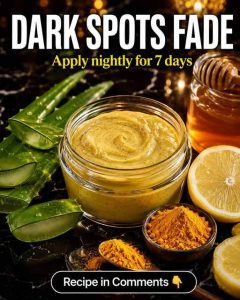
Remedy 1: Aloe, Soy and Licorice Brightening Mask for Normal Skin
Ingredients and Their Scientific Benefits
- 1 tablespoon clear aloe vera gel: Aloe contains aloesin, a compound that can interfere with tyrosinase, an enzyme involved in melanin formation.
- 1 tablespoon unsweetened soy milk: Soy proteins contain serine protease inhibitors that may reduce the transfer of melanin into surface skin cells.
- 1 teaspoon cooled green tea: Green-tea polyphenols provide antioxidant and anti-inflammatory support.
- 1 teaspoon finely ground colloidal oatmeal: Oat compounds help retain moisture and reduce irritation.
- 1 teaspoon cooled licorice-root tea: Licorice contains glabridin, which has demonstrated tyrosinase-inhibiting activity.
- ½ teaspoon pure honey: Honey acts as a humectant, helping the skin feel softer and less dry.
Scientific Working of the Remedy
Aloesin and licorice compounds target processes involved in pigment formation, while soy may reduce the movement of pigment into keratinocytes. Green tea limits oxidative stress, and oatmeal and honey support the skin barrier. Clinical research has studied formulated extracts rather than ordinary kitchen preparations, so this mask should be viewed as gentle supportive care rather than a replacement for medical treatment. (Wiley Online Library)
Procedure
Mix everything in a clean bowl until smooth. Apply a thin layer to cleansed skin, avoiding the eyelids and lips. Leave it on for 10 minutes, rinse with cool or lukewarm water, and apply a fragrance-free moisturiser. Prepare a fresh portion each time.
How Often to Apply
Apply once each evening for five days, provided there is no burning, itching, or redness.
Initial Results
Within one to three days, the skin may look more hydrated and less dull. Individual dark spots are unlikely to change significantly this quickly.
Remedy 2: Yogurt and Green-Tea Mask for Combination Skin
Ingredients and Their Scientific Benefits
- 1 tablespoon plain, unsweetened yogurt: Naturally contains a variable amount of lactic acid for mild surface exfoliation.
- 1 teaspoon aloe vera gel: Helps soothe areas that feel dry or irritated.
- 1 teaspoon soy milk: Provides soy-derived proteins associated with improved uneven pigmentation.
- 1 teaspoon cooled green tea: Offers antioxidant and calming properties.
- 1 teaspoon colloidal oatmeal: Absorbs some excess oil while protecting drier areas.
- 1 teaspoon cooled licorice-root tea: Supplies pigment-regulating licorice compounds.
Scientific Working of the Remedy
Lactic acid can loosen dull surface cells and improve uneven texture. In a controlled clinical trial, formulated 8% lactic-acid cream improved mottled pigmentation after prolonged use; ordinary yogurt is much weaker and should not be expected to produce the same result. Soy and licorice provide additional pigment-focused support, while aloe and oatmeal help prevent irritation that could worsen post-inflammatory marks. (PubMed)
Procedure
Combine the ingredients and spread a light layer over the face. Apply slightly less to the oily forehead, nose, and chin. Leave it on for five to eight minutes before rinsing thoroughly.
How Often to Apply
Use on alternate evenings—days one, three, and five. Do not combine it on the same night with scrubs, peels, retinoids, or exfoliating acids.
Initial Results
The dry areas may feel softer within two days, while the oily areas may appear temporarily less greasy. Pigmentation improvement requires continued care over several weeks.
Remedy 3: Oil-Free Soy and Oat Spot Mask for Oily Skin
Ingredients and Their Scientific Benefits
- 1 tablespoon cooled green tea: Helps calm inflammatory activity associated with acne.
- 1 tablespoon aloe vera gel: Provides light hydration without adding heavy oil.
- 2 teaspoons unsweetened soy milk: Supplies soy proteins studied for uneven pigmentation.
- 1 teaspoon colloidal oatmeal: Helps thicken the mask and gently absorb surface oil.
- 1 teaspoon licorice-root tea: Contains compounds that may reduce melanogenesis.
- ½ teaspoon plain yogurt: Provides very gentle exfoliating support.
Scientific Working of the Remedy
Oily and acne-prone skin frequently develops post-inflammatory hyperpigmentation after pimples are picked or irritated. This oil-free mixture focuses on inflammation control, light hydration, and mild surface renewal. Soy-containing moisturisers have produced measurable improvements in mottled pigmentation, while green-tea preparations have shown improvements in skin dullness and melanin measurements after consistent use. (PubMed)
Procedure
Mix into a thin paste. Apply only to intact skin, not open, scratched, or freshly squeezed acne. Leave for five to seven minutes, rinse, and follow with a lightweight non-comedogenic moisturiser.
How Often to Apply
Apply every other night for seven days, with a maximum of four applications.
Initial Results
Oiliness and redness may look calmer within one to three days. Existing brown acne marks will generally require several weeks or months to become noticeably lighter.
Remedy 4: Oat, Honey and Sunflower Comfort Mask for Dry Skin
Ingredients and Their Scientific Benefits
- 1 tablespoon colloidal oatmeal: Forms a moisture-binding film and helps reduce dryness.
- 1 tablespoon aloe vera gel: Adds water-based hydration and soothing compounds.
- 1 tablespoon unsweetened soy milk: Supports a more even-looking complexion.
- 1 teaspoon honey: Attracts moisture to the skin’s surface.
- 1 teaspoon licorice-root tea: Provides pigment-regulating plant compounds.
- 2 drops cold-pressed sunflower-seed oil: Supplies linoleic-acid-rich emollient support.
Scientific Working of the Remedy
Dryness weakens the protective barrier and makes the complexion look rough, grey, or uneven. Oatmeal, honey, aloe, and sunflower oil primarily improve softness and moisture retention, allowing the skin to tolerate pigment-focused ingredients more comfortably. Colloidal oatmeal has clinical support for improving barrier function and soothing inflammatory skin, while linoleic-acid-rich sunflower oil is generally more barrier-friendly than undiluted olive oil. (PubMed Central (PMC))
Procedure
Blend into a creamy paste and apply to slightly damp skin. Leave it on for 10 to 12 minutes. Rinse gently without rubbing and immediately apply moisturiser to seal in water.
How Often to Apply
Use nightly for three to five days. Stop using it if dryness, tightness, or small bumps increase.
Initial Results
Dry flakes and tightness may improve after one or two applications, making the skin appear brighter. True melanin reduction will take considerably longer.
Remedy 5: Gentle Oat and Aloe Compress for Sensitive Skin
Ingredients and Their Scientific Benefits
- 1 tablespoon colloidal oatmeal: Helps soothe itching, dryness, and barrier irritation.
- 1 tablespoon cooled green tea: Provides mild antioxidant support.
- 1 teaspoon aloe vera gel: May calm heat and redness when tolerated.
- 1 teaspoon unsweetened soy milk: Offers gentle pigment-supporting proteins.
- 1 teaspoon finely blended cucumber pulp: Adds water and a cooling sensation.
- ½ teaspoon cooled licorice-root tea: Provides a small amount of licorice compounds.
Scientific Working of the Remedy
Sensitive skin can produce more pigmentation when it is repeatedly irritated. Therefore, the first goal is to protect the barrier and prevent inflammation. Oatmeal has stronger evidence for sensitive and irritated skin than harsh DIY exfoliants. Licorice, soy, and green tea may provide gradual brightening support, but any botanical can cause an individual reaction. (PubMed Central (PMC))
Procedure
Mix gently and apply to a small section of the face first. After patch testing, spread a thin layer over affected areas for five minutes. Rinse without using a washcloth or facial brush.
How Often to Apply
Apply only twice during the first five days. Sensitive skin should not be treated nightly with multi-ingredient masks.
Initial Results
The skin may feel calmer and more comfortable within one to three days. Stop immediately if stinging lasts longer than a few seconds.
Final Tips for Faster and Safer Dark-Spot Improvement
Use broad-spectrum SPF 30 or higher every morning. For melasma or persistent facial pigmentation, tinted sunscreen containing iron oxide offers additional protection from visible light. Reapply when outdoors, sweating, or exposed to strong sunlight. Without photoprotection, new pigment may develop faster than old pigment fades. (PubMed)
Keep towels, pillowcases, makeup brushes, and skincare tools clean. Avoid picking acne, scratching bites, or repeatedly rubbing dark areas. Choose gentle, fragrance-free cleansers and stop any remedy that burns or causes persistent redness. Adequate sleep and hydration can improve the overall appearance of the skin, but they cannot directly erase established pigmentation.
Visible softness and hydration may begin within two or three days. Meaningful reduction in dark spots usually requires at least six to twelve weeks of consistent care, and some marks take six to twelve months to fade.
Diet Plan to Support Healthy, Even-Looking Skin
Diet cannot bleach dark spots, but a balanced eating pattern supplies antioxidants and nutrients needed for normal skin repair.
Morning: Drink water and eat eggs, plain yogurt, or oats with berries, guava, orange, papaya, or another vitamin-C-rich fruit.
Lunch: Choose lentils, beans, chicken, fish, or tofu with whole grains and a large serving of vegetables. Include tomatoes, carrots, spinach, bell peppers, or broccoli.
Afternoon: Have unsweetened green tea with a small portion of almonds, walnuts, pumpkin seeds, or sunflower seeds.
Dinner: Eat a moderate portion of protein with cooked vegetables, salad, and brown rice or whole-grain bread.
Continue the gentle home routine for six to eight weeks while using sunscreen every day. Consult a dermatologist when pigmentation spreads, becomes raised, changes colour or shape, appears without an obvious cause, or does not improve after eight to twelve weeks. Professional assessment is especially important for melasma, medication-related pigmentation, pregnancy-related changes, or marks caused by persistent acne or eczema.
References for the above remedy
- American Academy of Dermatology. How to fade dark spots in darker skin tones.
https://www.aad.org/public/everyday-care/skin-care-secrets/routine/fade-dark-spots - Hollinger JC, Angra K, Halder RM. Are natural ingredients effective in the management of hyperpigmentation? A systematic review.
https://pmc.ncbi.nlm.nih.gov/articles/PMC5843359/ - Jones K, Hughes J, Hong M, Jia Q, Orndorff S. Modulation of melanogenesis by aloesin: a competitive inhibitor of tyrosinase.
https://onlinelibrary.wiley.com/doi/full/10.1034/j.1600-0749.2002.02014.x - Wallo W, Nebus J, Leyden JJ. Efficacy of a soy moisturiser in photoaging: a double-blind, vehicle-controlled study.
https://pubmed.ncbi.nlm.nih.gov/17941363/ - Yokota T, Nishio H, Kubota Y, Mizoguchi M. Inhibitory effect of glabridin from licorice extracts on melanogenesis and inflammation.
https://pubmed.ncbi.nlm.nih.gov/9870547/ - Wisuitiprot W, et al. Effect of green-tea-extract-loaded microparticles on facial skin: a randomized placebo-controlled study.
https://pubmed.ncbi.nlm.nih.gov/34965006/ - Sobhan M, et al. Efficacy of colloidal oatmeal cream as add-on therapy for irritant hand eczema.
https://pmc.ncbi.nlm.nih.gov/articles/PMC7103792/ - Stiller MJ, et al. Topical glycolic acid and lactic acid creams for photodamaged skin: a double-blind clinical trial.
https://pubmed.ncbi.nlm.nih.gov/8651713/ - Harshman J, Quan Y, Hsiang D. Lemon exposure, phytophotodermatitis and burn-like skin injuries.
https://pubmed.ncbi.nlm.nih.gov/29324427/ - Baswan SM, et al. Orally administered mixed carotenoids protect human skin against ultraviolet-induced pigmentation.
https://pubmed.ncbi.nlm.nih.gov/32072695/