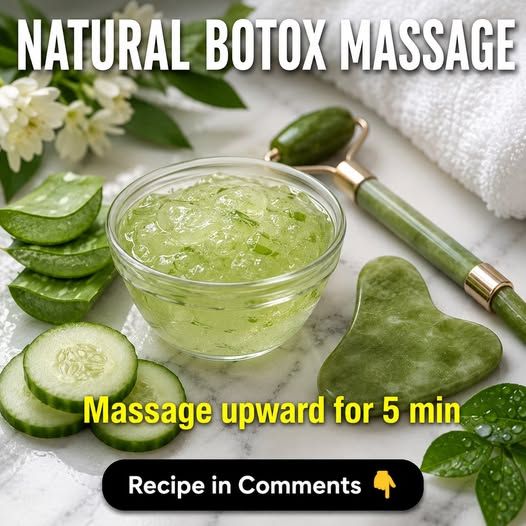
“Natural Botox massage” is a popular name for gentle facial massage intended to make the skin look smoother, brighter and temporarily more lifted. It does not work like injected botulinum toxin, which temporarily relaxes selected facial muscles. Massage mainly increases short-term blood flow, reduces temporary puffiness and spreads hydrating ingredients across the skin. A small randomized trial found improvements in facial contour and elasticity after participants used a facial roller or gua sha for ten minutes, five times weekly, for eight weeks. Another study found that five minutes of roller massage temporarily increased facial skin blood flow. These findings are promising, but they do not prove that massage permanently removes wrinkles or replaces professional treatment. (PubMed)
The following remedies provide enough slip for a gentle five-minute massage while supporting hydration and the skin barrier. The individual ingredients have scientific support, but these exact homemade mixtures have not been clinically tested. Prepare a fresh portion for every application.
Remedy 1: Green Tea and Honey Massage Gel for Normal Skin
Ingredients
- 1 tablespoon clear aloe vera gel: creates lightweight slip and surface hydration.
- 2 teaspoons cooled green tea: supplies antioxidant tea polyphenols.
- 1 teaspoon honey: works as a water-attracting humectant.
- ½ teaspoon food-grade rice starch: gives the gel a smooth, non-greasy texture.
- ⅛ teaspoon vegetable glycerin: helps the outer skin retain moisture.
- 1 teaspoon cooled, previously boiled water: adjusts the mixture for gentle massage.
Scientific Working of the Ingredients
A clinical trial using a specially formulated green-tea extract found improvements in elasticity after four weeks and changes in dullness after six weeks. Brewed tea is weaker than the standardized extract, so it should be considered an antioxidant-supportive ingredient rather than a proven wrinkle treatment. Glycerin improves hydration and mechanical properties, while rice starch has demonstrated barrier-supporting effects on irritated skin. Better hydration can temporarily plump fine lines and improve light reflection. (PubMed)
Procedure
Mix all ingredients until smooth. Apply a thin layer to clean, slightly damp skin. Using the pads of two or three fingers, glide from the centre of the chin toward the ears, from the sides of the mouth toward the upper ears, and from the eyebrows upward across the forehead. Use light pressure and never drag dry skin.
Massage for three to five minutes, leave the remaining gel on for another five minutes, and rinse with lukewarm water.
How Often to Apply
Use once daily for five days. Continue three times weekly for six to eight weeks when the skin remains comfortable.
Initial Results
Within one to three days, the skin may feel softer and appear temporarily fresher. Meaningful changes in elasticity should not be expected after only a few applications.
Remedy 2: Yogurt and Oat Balancing Massage Cream for Combination Skin
Ingredients
- 1 tablespoon plain, unsweetened yogurt: provides a creamy base and naturally occurring lactic acid.
- 1 teaspoon colloidal oatmeal: supports dry areas and reduces friction.
- 1 teaspoon aloe vera gel: supplies oil-free hydration.
- 1 teaspoon cooled black tea: provides plant polyphenols.
- ⅛ teaspoon vegetable glycerin: reduces dehydration on the cheeks.
- 2 drops sunflower seed oil: softens dry areas without heavily coating the T-zone.
Scientific Working of the Ingredients
Properly formulated lactic acid has been shown to improve skin smoothness, firmness and the appearance of lines when used consistently for several months. Yogurt contains a much lower and unpredictable amount, so its effects will be milder. Colloidal-oatmeal formulations have improved hydration and barrier measurements in clinical studies. Sunflower seed oil is rich in linoleic acid and preserved barrier integrity in a human study, whereas olive oil weakened it. (PubMed)
Procedure
Blend the yogurt, oatmeal, aloe and tea before adding the glycerin and oil. Apply slightly more to the cheeks and less to the forehead, nose and chin.
Massage upward and outward for three minutes. Around the eyes, use only the ring fingers and tap gently along the orbital bone without approaching the eyelids. Leave the mask for five additional minutes and rinse thoroughly.
How Often to Apply
Apply on alternate evenings for five days. Continue twice weekly for up to six weeks.
Initial Results
Dry cheek areas may feel smoother within one or two days. The T-zone may look less dull, but this remedy will not permanently shrink pores or tighten loose skin.
Remedy 3: Aloe and Rice Glide Gel for Oily Skin
Ingredients
- 1½ tablespoons clear aloe vera gel: provides massage slip without heavy oil.
- 2 teaspoons cooled green tea: offers antioxidant polyphenols.
- 1 teaspoon rice starch: absorbs some surface moisture.
- ½ teaspoon colloidal oatmeal: protects against excessive drying.
- ⅛ teaspoon vegetable glycerin: maintains water in the outer skin layer.
- 1 teaspoon cooled water: creates a lightweight consistency.
Scientific Working of the Ingredients
Oily skin can still become dehydrated, particularly after strong cleansers. Glycerin helps hold water in the stratum corneum, while oatmeal supports barrier function. Formulated green-tea preparations have shown improvements in facial elasticity and dullness over several weeks, but ordinary tea should not be expected to produce the same strength of effect. (PubMed)
Procedure
Whisk the ingredients into a thin gel. Apply with clean fingertips. Begin at the jaw and glide toward the ears. Move from the nose across the cheeks toward the temples, then massage the forehead from the eyebrows toward the hairline.
Use very light pressure over acne-prone areas and do not massage painful pimples. After three minutes, rinse the gel away.
How Often to Apply
Use once daily for three to five days. Afterward, continue three evenings per week for six weeks.
Initial Results
The face may look temporarily less shiny after the first application. Hydration and gentle massage can create a fresher appearance within one to three days, but acne and established wrinkles require separate treatment.
Remedy 4: Coconut, Honey and Oat Massage Balm for Dry Skin
Ingredients
- 1 tablespoon prepared colloidal-oatmeal gel: reduces roughness and provides a soft base.
- 1 teaspoon honey: attracts and retains surface moisture.
- 1 teaspoon aloe vera gel: adds water-based hydration.
- ¼ teaspoon virgin coconut oil: supplies emollient lipids.
- ⅛ teaspoon vegetable glycerin: helps plump dehydrated surface lines.
- 1 teaspoon cooled water: prevents the balm from becoming too thick.
Scientific Working of the Ingredients
A randomized trial found that virgin coconut oil improved hydration and surface lipid levels in people with dry skin. Glycerin has well-established hydrating properties, while colloidal oatmeal supports barrier repair. These ingredients can make dry creases appear softer, but they cannot rebuild facial volume or physically lift sagging tissue. (PubMed)
Procedure
Combine the oatmeal gel, honey, aloe and water. Add the coconut oil and glycerin last. Apply to damp skin.
Use slow outward strokes along the jaw and cheeks. On the forehead, glide upward without repeatedly folding or stretching the skin. Massage for five minutes, leave for another five minutes and rinse gently.
How Often to Apply
Apply daily for three days, then every other day for the following week. Continue twice weekly for six to eight weeks if it does not cause clogged pores or irritation.
Initial Results
Dryness and tightness may improve after the first application. Fine dehydration lines may look temporarily softer within two or three days.
Remedy 5: Minimal Rice and Oat Massage Milk for Sensitive Skin
Ingredients
- 1 tablespoon finely ground colloidal oatmeal: helps soothe and protect the barrier.
- 1 teaspoon rice starch: provides a smooth, low-friction texture.
- 2 tablespoons cooled, previously boiled water: creates a gentle liquid base.
- ⅛ teaspoon vegetable glycerin: supports hydration.
- 2 drops sunflower seed oil: supplies a small amount of barrier-supporting lipid.
Scientific Working of the Ingredients
Sensitive skin usually responds better to short ingredient lists without fragrance, acids or essential oils. Clinical research has found that colloidal-oatmeal preparations improve hydration and barrier function. Rice starch has also supported recovery of damaged barrier function, while sunflower seed oil preserved stratum-corneum integrity and improved hydration in adult volunteers. (PubMed)
Procedure
Mix the oatmeal and rice starch with water and let the mixture stand for three minutes. Add the glycerin and sunflower oil.
Apply with clean fingertips and perform feather-light outward strokes for no more than two minutes. Do not use a hard stone or roller on reactive skin. Leave the mixture for three additional minutes and rinse.
How Often to Apply
Patch-test first. When no reaction occurs, apply every other day for three to five days. Continue once or twice weekly as needed.
Initial Results
Reduced tightness may be noticeable within one day. A calmer and smoother appearance may develop within two or three days, provided the skin is not actively inflamed.
Correct Five-Minute Natural Botox Massage Technique
Keep the fingers, roller or gua-sha tool clean. Apply enough gel to prevent pulling. Hold a gua-sha tool almost flat against the face rather than pressing its edge into the skin.
Begin at the chin and move toward the ears. Continue from the corners of the mouth toward the ears, from the sides of the nose toward the temples, and from the eyebrows upward toward the hairline. Perform each movement slowly three to five times. Pressure should feel comfortable and should never cause pain, strong redness or bruising.
Massage studies reporting measurable contour or elasticity changes used regular routines lasting five to eight weeks. Therefore, a single five-minute session may produce temporary glow or reduced puffiness, but it will not create an injection-like effect. (PubMed)
Final Tips
Perform a patch test for four to five days before using a new mixture over the entire face. Avoid lemon juice, undiluted vinegar, baking soda, essential oils and rough sugar or coffee scrubs.
Do not massage skin affected by sunburn, active eczema, painful cystic acne, infection, open wounds or unexplained swelling. Avoid facial massage immediately after cosmetic procedures. People who have received botulinum-toxin injections are specifically advised not to rub or massage the treated areas because pressure may move the injected substance away from the intended muscles. (American Academy of Dermatology)
Clean facial tools after every use and allow them to dry completely. Use broad-spectrum sun protection and a suitable moisturizer daily. Dermatologists consider sunscreen and moisturizer the foundation of an effective anti-ageing routine. Moisturization may soften fine lines within a few days, while most meaningful skincare improvements require at least six weeks. (American Academy of Dermatology)
Diet Plan for Smoother, Healthier-Looking Skin
Follow this eating pattern consistently for at least eight to twelve weeks.
Breakfast: Eat eggs, plain yogurt, beans or lentils for protein. Add oatmeal and a vitamin-C-rich fruit such as guava, orange, kiwi, strawberries or papaya.
Lunch: Choose fish, chicken, chickpeas or lentils with spinach, tomatoes, carrots and whole-grain roti or brown rice.
Afternoon snack: Have a small portion of walnuts, almonds, pumpkin seeds or sunflower seeds with fresh fruit.
Dinner: Select fish, chicken, tofu or beans with cooked vegetables. Include healthy fats from seeds, nuts or a small amount of plant oil.
Daily habits: Drink according to thirst, weather and activity. Obtain sufficient sleep, avoid smoking and limit frequent sugary drinks and heavily fried foods.
Continue the massage routine for six to eight weeks before judging gradual changes. Stop immediately if it causes redness, acne, burning or bruising. Consult a dermatologist when wrinkles or sagging remain a major concern, change suddenly, or occur with facial weakness, one-sided drooping, pain or swelling. Home massage cannot replace botulinum toxin, fillers, skin-tightening procedures or medically prescribed skincare.
References for the above remedy
- Ahn SH, Hwang UJ, Han HS, et al. Comparative Effects of Facial Roller and Gua Sha Massage on Facial Contour, Muscle Tone, and Skin Elasticity: Randomized Controlled Trial.
URL: https://pubmed.ncbi.nlm.nih.gov/40439289/ - Miyaji A, Sugimori K, Hayashi N. Short- and Long-Term Effects of Using a Facial Massage Roller on Facial Skin Blood Flow and Vascular Reactivity.
URL: https://pubmed.ncbi.nlm.nih.gov/30477852/ - American Academy of Dermatology Association. Botulinum Toxin Therapy: Frequently Asked Questions.
URL: https://www.aad.org/public/cosmetic/wrinkles/botulinum-toxin-faqs - Capone K, Kirchner F, Klein SL, Tierney NK. Effects of Colloidal Oatmeal Topical Cream on Skin Barrier Properties.
URL: https://pubmed.ncbi.nlm.nih.gov/32484623/ - Korponyai C, Szél E, Behány Z, et al. Effects of Locally Applied Glycerol and Xylitol on Skin Hydration and Barrier Function.
URL: https://pubmed.ncbi.nlm.nih.gov/27349297/ - Danby SG, AlEnezi T, Sultan A, et al. Effect of Olive and Sunflower Seed Oil on the Adult Skin Barrier.
URL: https://pubmed.ncbi.nlm.nih.gov/22995032/ - Agero ALC, Verallo-Rowell VM. Randomized Trial Comparing Extra Virgin Coconut Oil With Mineral Oil for Xerosis.
URL: https://pubmed.ncbi.nlm.nih.gov/15724344/ - Smith WP. Epidermal and Dermal Effects of Topical Lactic Acid.
URL: https://pubmed.ncbi.nlm.nih.gov/8784274/ - De Paepe K, Hachem JP, Vanpee E, et al. Effect of Rice Starch on Damaged Skin-Barrier Function.
URL: https://pubmed.ncbi.nlm.nih.gov/12353708/ - American Academy of Dermatology Association. How to Select Anti-Aging Skincare Products.
URL: https://www.aad.org/public/everyday-care/skin-care-secrets/anti-aging/selecting-anti-aging-products