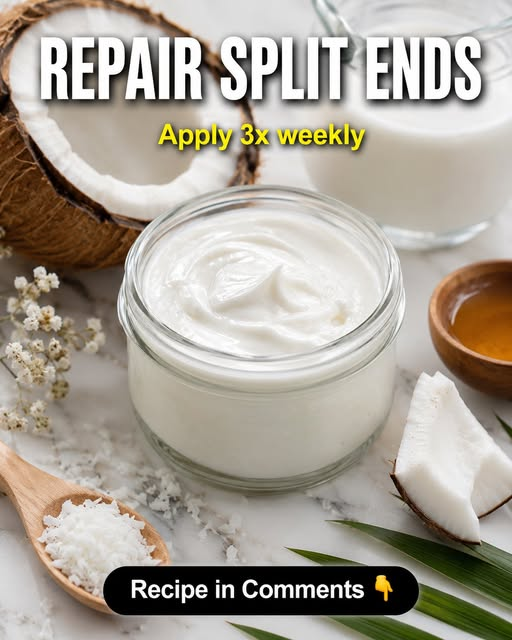
Split ends develop when the protective outer cuticle becomes worn, cracked, or lifted and the hair shaft begins separating at the tip. Heat styling, bleaching, chemical straightening, rough towel drying, excessive brushing, sunlight, friction, and repeated wetting can weaken the hair fiber. Once a strand has physically split, no homemade mask can permanently fuse it back together because the visible hair shaft is not living tissue. Trimming is the only reliable way to remove an existing split. Natural treatments can temporarily coat rough ends, reduce friction, limit further protein loss, improve softness, and make damaged ends appear smoother. (PubMed)
The coconut-milk cream shown in the image may work as a temporary conditioning treatment, but coconut milk itself has not been clinically proven to repair split ends. The strongest evidence belongs to coconut oil. Research found that coconut oil penetrates the hair shaft and reduces protein loss from damaged and undamaged hair. (PubMed)
The remedies below are adapted for different hair and scalp types. Their purpose is to protect and smooth the hair—not permanently glue split fibers together.
Remedy 1: Coconut Milk and Flax Repair Mask for Normal Hair
This balanced treatment is suitable for hair that is neither extremely oily nor very dry but has rough, frayed ends.
Ingredients and Scientific Working
Unsweetened coconut milk — 2 tablespoons: Coconut milk creates a creamy coating that improves slip and temporarily softens rough strands. Evidence for permanent split-end repair is lacking.
Virgin coconut oil — 1 teaspoon: Coconut oil can enter the hair fiber and reduce protein loss. Its affinity for hair protein may help protect weakened ends from additional grooming damage. (PubMed)
Fresh flaxseed gel — 1 tablespoon: Flaxseed mucilage creates a smooth film that reduces friction during detangling.
Pure aloe vera gel — 1 tablespoon: Aloe provides moisture and improves the spreadability of the mask.
Pure honey — 1 teaspoon: Honey acts as a humectant and helps the mixture remain soft rather than drying hard on the hair.
Boiled and cooled water — 1 tablespoon: Water creates a lighter texture and helps distribute the treatment evenly.
Procedure
Mix coconut milk, flaxseed gel, aloe, honey, and water until smooth. Add coconut oil and whisk thoroughly.
Apply from the middle lengths toward the ends. Concentrate the thickest layer on visibly frayed areas. Avoid placing a heavy amount on the scalp.
Leave the treatment on for 20 minutes. Rinse with lukewarm water and wash gently if necessary. Detangle from the ends upward with a wide-tooth comb.
How Often to Apply
Use three times weekly for four weeks. After the ends feel softer, reduce use to once or twice weekly.
Initial Results
Within one to three applications, the ends may feel softer, look shinier, and appear less frizzy. The split fibers remain present and may become visible again after washing.
Remedy 2: Argan and Aloe Lightweight Treatment for Fine or Combination Hair
Fine hair may have an oily root area while the ends become dry and fragile. Heavy oils can make this hair type flat, so use only a small amount.
Ingredients and Scientific Working
Pure aloe vera gel — 1 tablespoon: Aloe creates a lightweight water-based conditioning layer.
Fresh flaxseed gel — 1 tablespoon: Flax gel reduces friction and gives light slip without requiring a thick oil coating.
Cooled green tea — 1 tablespoon: Green tea provides a light liquid base and antioxidant plant compounds.
Virgin coconut oil — 1/2 teaspoon: A small quantity helps reduce protein loss without heavily coating fine hair. (PubMed)
Cold-pressed argan oil — 3 drops: Laboratory research found that argan-oil pretreatment reduced oxidative hair damage and protein loss. (PubMed)
Finely powdered colloidal oatmeal — 1/2 teaspoon: Softened oatmeal thickens the mixture and improves lubrication.
Procedure
Mix aloe, flaxseed gel, green tea, and oatmeal. Allow the oatmeal to soften for five minutes. Add coconut and argan oils.
Apply only from approximately ear level to the tips. Keep the treatment away from oily roots.
Leave it on for 15 minutes, then rinse gently. Use only the amount needed because excessive oil can weigh down fine strands.
How Often to Apply
Use twice weekly for three to four weeks.
Initial Results
The ends may feel smoother after the first application. Within several uses, reduced tangling may make the hair easier to comb and less likely to break.
Remedy 3: Green Tea and Coconut End Gel for Oily Scalp With Dry Ends
An oily scalp does not mean the ends are adequately moisturized. Shampoo removes oil from the roots, while older ends may remain weathered and fragile.
Ingredients and Scientific Working
Strong cooled green tea — 2 tablespoons: Green tea provides a non-greasy liquid base.
Pure aloe vera gel — 1 tablespoon: Aloe adds lightweight moisture without coating the scalp with heavy oil.
Fresh flaxseed gel — 1 tablespoon: Flaxseed mucilage improves slip and helps reduce mechanical friction.
Virgin coconut oil — 1/2 teaspoon: Apply it only to the ends. Coconut oil has demonstrated benefits for hair protein retention and protection from damage. (PubMed)
Vegetable glycerin — 1/8 teaspoon: A very small amount helps maintain moisture in the gel.
Finely powdered colloidal oatmeal — 1/2 teaspoon: Softened oatmeal supports a smooth texture without rough scrubbing.
Procedure
Combine all ingredients and stir until evenly blended. Apply only to the last several centimetres of the hair.
Leave for 10–15 minutes. Wash the scalp normally, allowing shampoo foam to run through the lengths rather than rubbing the ends aggressively.
Dermatologists recommend applying shampoo mainly to the scalp and using conditioner after every wash because conditioning reduces breakage and split ends. (American Academy of Dermatology)
How Often to Apply
Use three times weekly for three weeks.
Initial Results
The ends may feel less stiff and tangled within one to three uses. The roots should remain lighter because the oil is not applied to the scalp.
Remedy 4: Coconut, Avocado, and Argan Mask for Dry, Coarse, or Curly Hair
Dry, curly, coarse, and chemically treated hair often needs additional lubrication because friction and tangling increase the risk of breakage.
Ingredients and Scientific Working
Virgin coconut oil — 1 tablespoon: Coconut oil penetrates the hair and reduces protein loss. Long-term use has also been associated with better resistance to weathering-related damage. (PubMed)
Unsweetened coconut milk — 2 tablespoons: Coconut milk creates a creamy conditioning base and temporarily improves softness.
Ripe avocado — 1 tablespoon, smoothly mashed: Avocado provides fatty acids and lubrication that improve manageability.
Cold-pressed argan oil — 1/2 teaspoon: Argan oil may help protect hair protein from oxidative damage. (PubMed)
Pure aloe vera gel — 1 tablespoon: Aloe improves spreadability and reduces pulling during application.
Pure honey — 1 teaspoon: Honey helps retain moisture within the mask.
Procedure
Mash the avocado until completely smooth. Add coconut milk, aloe, and honey. Mix in coconut and argan oils.
Apply generously to the middle lengths and ends. Cover with a clean shower cap and leave for 20–25 minutes.
Rinse gently and detangle while the hair is damp and lubricated. Curly and textured hair should be handled in sections to reduce pulling. (American Academy of Dermatology)
How Often to Apply
Use twice weekly for four to six weeks.
Initial Results
Dry ends may feel softer after the first treatment. After several uses, reduced friction and tangling may improve shine and make the hair appear fuller and healthier.
Remedy 5: Minimal Oat and Coconut Treatment for Sensitive Scalp and Fragile Hair
Sensitive scalps may react to fragrance, essential oils, raw onion, strong herbs, or complicated mixtures. This simple treatment is applied mainly to the hair rather than the scalp.
Ingredients and Scientific Working
Colloidal oatmeal — 2 teaspoons: Softened oatmeal forms a gentle conditioning base and reduces roughness during application.
Fresh flaxseed gel — 1 tablespoon: Flax gel provides slip without fragrance or essential oils.
Pure aloe vera gel — 1 tablespoon: Aloe adds lightweight moisture. Omit it if aloe has caused irritation before.
Virgin coconut oil — 1 teaspoon: Coconut oil protects the hair fiber and reduces protein loss. (PubMed)
Boiled and cooled water — 2 tablespoons: Water dilutes the treatment and prevents an excessively sticky texture.
Jojoba oil — 3 drops: Jojoba provides light lubrication and helps reduce friction at the ends.
Procedure
Mix oatmeal with cooled water and leave it for ten minutes. Add flax gel and aloe. Mix coconut and jojoba oils separately.
Apply the oat mixture to the lower half of the hair. Press the oil blend only onto the tips. Leave for ten minutes and rinse gently.
Do not apply the treatment to inflamed, painful, broken, or infected scalp skin.
How Often to Apply
Use twice weekly for two to three weeks. Stop if itching, redness, burning, or scalp discomfort develops.
Initial Results
The hair may feel less rough within one to three applications. The treatment may reduce friction but will not reconnect existing splits.
Why Split Ends Return After a Mask
Hair masks and oils create a temporary coating around damaged fibers. This can flatten lifted cuticle edges, reduce friction, improve shine, and make split tips appear joined. The effect is cosmetic and gradually disappears with shampooing and daily wear.
Coconut oil offers additional protection because it can penetrate the hair shaft instead of remaining only on the surface. Studies found reduced protein loss, improved tensile properties, and reduced increases in hair porosity with coconut-based oils. (PubMed)
Existing splits should still be trimmed. Regular haircuts remove damaged ends before the split travels farther up the shaft, but cutting does not make hair grow faster. (American Academy of Dermatology)
Final Tips to Prevent New Split Ends
Use a gentle shampoo and apply conditioner after every wash. Concentrate conditioner on the oldest and most fragile portion of the hair—the middle lengths and ends. (American Academy of Dermatology)
Do not rub wet hair with a rough towel. Blot gently or wrap it in a soft towel. Wet hair is more vulnerable to stretching and breakage, so detangle slowly from the tips upward using a wide-tooth comb. (American Academy of Dermatology)
Reduce flat ironing, curling, bleaching, chemical relaxing, tight hairstyles, and aggressive brushing. Heat and chemical treatments disturb the cuticle and weaken the fiber. (PubMed)
Protect the hair during swimming. Chlorine can remove protective lipids and damage hair protein, increasing dryness and split ends. Wet the hair first, apply a small amount of oil or conditioner to the lengths, and rinse promptly after swimming. (American Academy of Dermatology)
Avoid placing raw lemon juice, baking soda, undiluted essential oils, or rough salt scrubs on damaged ends. These do not repair the hair shaft and may increase dryness or irritation.
Visible softness may begin within one to three applications. Reduced breakage usually requires several weeks of consistent protection. Severely split ends should be trimmed rather than repeatedly coated.
Diet Plan for Stronger New Hair
Diet cannot repair a strand that has already split, but adequate nutrition supports the production of new hair at the follicle.
Breakfast: Choose eggs with whole-grain bread, unsweetened oatmeal with milk and nuts, or plain yogurt with seeds.
Mid-morning: Eat guava, orange, kiwi, papaya, berries, or another vitamin-C-rich fruit.
Lunch: Include lentils, chickpeas, beans, fish, eggs, chicken, tofu, or lean meat. Add vegetables and whole-wheat roti or a moderate serving of rice.
Evening snack: Choose almonds, walnuts, pumpkin seeds, sunflower seeds, or fresh fruit.
Dinner: Eat vegetables with lentils, beans, eggs, fish, tofu, or chicken. Include sufficient protein because the hair shaft is primarily composed of keratin protein.
Hydration: Drink according to thirst, climate, and physical activity. Water supports general health but cannot fuse damaged hair ends.
Follow the balanced diet for at least eight to twelve weeks. Avoid unnecessary high-dose hair supplements. Excessive supplementation may sometimes worsen hair loss, and supplements should not be used without evidence of deficiency. (PubMed)
Continue the appropriate mask two or three times weekly for four to six weeks. Trim visibly split ends and maintain gentle hair care afterward.
See a dermatologist or doctor if breakage is sudden, severe, affects hair close to the scalp, or occurs with excessive shedding, bald patches, itching, scaling, scalp pain, fatigue, unexplained weight changes, or other symptoms. Persistent breakage may be related to chemical damage, hair-shaft disorders, nutritional problems, thyroid disease, or another medical condition. (PubMed)
References for the above remedy
- Rele AS, Mohile RB. Effect of Mineral Oil, Sunflower Oil, and Coconut Oil on Prevention of Hair Damage.
https://pubmed.ncbi.nlm.nih.gov/12715094/ - Ruetsch SB, et al. Secondary Ion Mass Spectrometric Investigation of Penetration of Coconut and Mineral Oils Into Human Hair Fibers.
https://pubmed.ncbi.nlm.nih.gov/11413497/ - Kaushik V, et al. Benefit of Coconut-Based Hair Oil via Hair Porosity Quantification.
https://pubmed.ncbi.nlm.nih.gov/35377477/ - Sharifi N, et al. Argan Oil as a Pretreatment of Human Hair Before Exposure to Oxidative Damage.
https://pubmed.ncbi.nlm.nih.gov/35226791/ - Draelos ZD. The Biology of Hair Care.
https://pubmed.ncbi.nlm.nih.gov/11059373/ - Dias MFRG. Hair Cosmetics: An Overview.
https://pubmed.ncbi.nlm.nih.gov/25878443/ - Draelos ZD. Hair Care and Dyeing.
https://pubmed.ncbi.nlm.nih.gov/26370650/ - American Academy of Dermatology. How to Stop Damaging Your Hair.
https://www.aad.org/public/diseases/hair-loss/insider/stop-damage - American Academy of Dermatology. Hair Loss: Tips for Managing.
https://www.aad.org/public/diseases/hair-loss/treatment/tips - Rushton DH. Nutritional Factors and Hair Loss.
https://pubmed.ncbi.nlm.nih.gov/12190640/