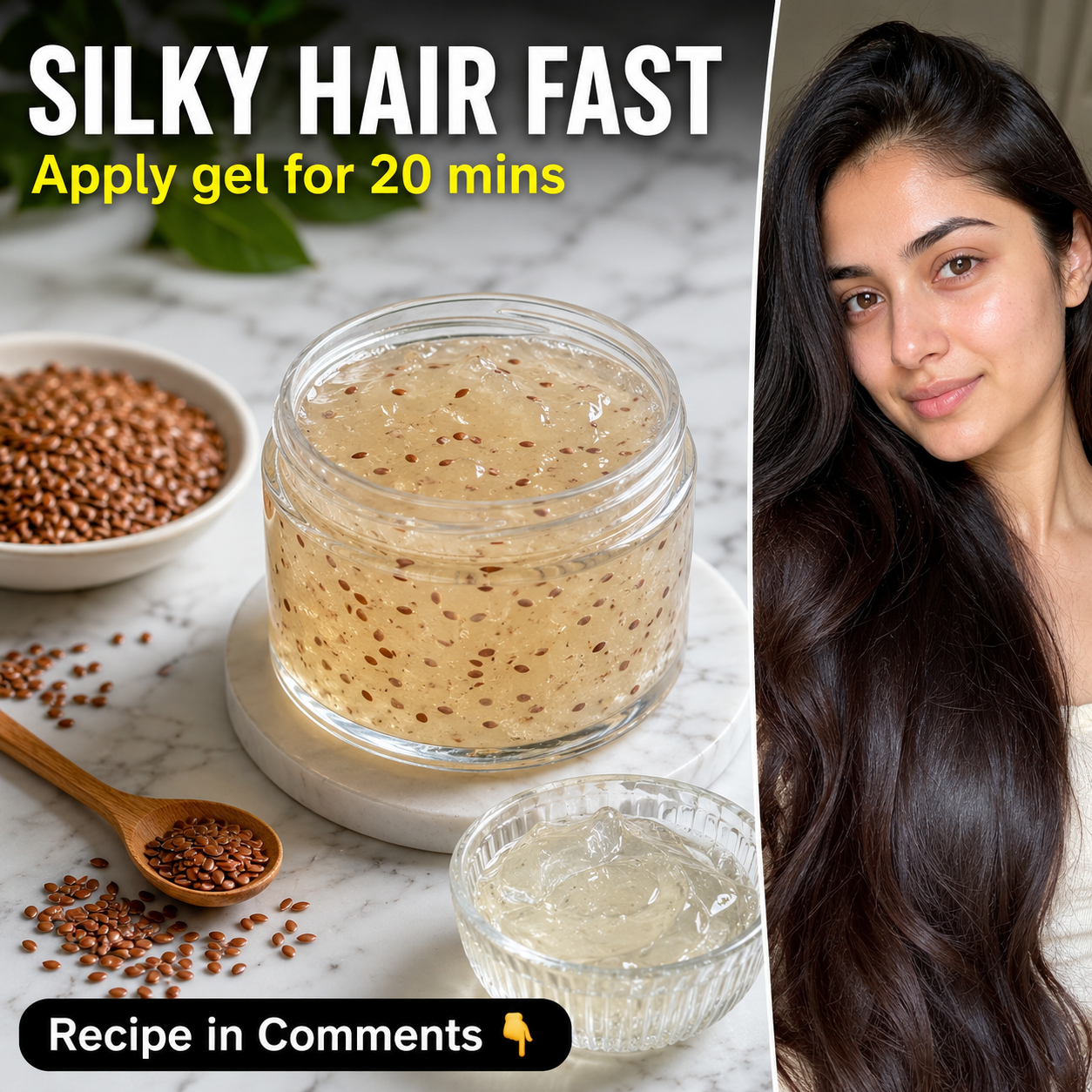
Silky hair looks healthy, smooth, shiny, and easy to manage, but frizz, dryness, rough ends, heat styling, hard water, and harsh washing can make the hair cuticle lifted and dull. The image shows a flaxseed gel remedy, which is one of the most useful natural options for quick softness because boiled flaxseeds release a slippery mucilage that coats the hair lightly and improves slip. This does not permanently change damaged hair in one use, but it can make hair feel smoother within 20 minutes by reducing friction and helping strands lie flatter. Flaxseed mucilage is rich in polysaccharides that form gel-like films, while coconut oil has evidence for reducing protein loss from hair fibers, and dermatology guidance supports gentle hair handling to reduce breakage and frizz. (PMC)

Remedy 1: For Normal Hair
Scientific Working of Flaxseed, Aloe, Coconut Water, Honey and Coconut Oil
Flaxseed gel gives slip and light hold because its mucilage forms a soft film around strands. Aloe vera adds water-based smoothness and scalp comfort. Coconut water gives a lightweight rinse-like hydration feel without heaviness. Honey works as a humectant, attracting moisture to the hair surface. Coconut oil is used only in a small amount because it can reduce protein loss and protect the hair shaft from wash-related damage. (PubMed)
Ingredients:
Flaxseeds: 2 tablespoons
Water: 1 cup
Aloe vera gel: 1 tablespoon
Coconut water: 2 tablespoons
Raw honey: 1 teaspoon
Coconut oil: 1/2 teaspoon
Procedure:
Boil flaxseeds in water for 7 to 10 minutes until a gel forms. Strain while warm and let it cool. Mix 3 tablespoons of flaxseed gel with aloe vera, coconut water, honey, and coconut oil. Apply from mid-length to ends, then lightly smooth the remaining amount near the roots. Leave for 20 minutes. Rinse with cool to lukewarm water and let hair air-dry.
How Often to Apply:
Apply every other day for 5 days, then once weekly.
Initial Results:
Within 1 to 3 days, hair may feel softer, smoother, less tangled, and slightly shinier.
Remedy 2: For Combination Hair
Scientific Working of Flaxseed, Green Tea, Aloe, Rice Water and Argan Oil
Combination hair often has oily roots but dry ends. Flaxseed gel smooths lengths without making roots greasy. Green tea gives a fresh scalp feel and contains antioxidant compounds. Aloe vera adds light hydration. Rice water gives a temporary smooth coating because of its starch content, but it should not be overused because too much starch can make hair stiff. Argan oil is used only on the ends because research suggests argan oil pretreatment may help protect hair from oxidative damage. (PubMed)
Ingredients:
Flaxseed gel: 3 tablespoons
Cooled green tea: 2 tablespoons
Aloe vera gel: 1 tablespoon
Fresh rice water: 1 tablespoon
Argan oil: 3 drops
Raw honey: 1/2 teaspoon
Procedure:
Mix flaxseed gel, green tea, aloe vera, rice water, honey, and argan oil. Apply mainly from ear-length down to the ends. Use only a thin layer on the scalp if roots are oily. Leave for 20 minutes, then rinse well. Dry with a soft towel or cotton T-shirt without rubbing.
How Often to Apply:
Use once daily for 3 days, then twice weekly.
Initial Results:
In 1 to 3 days, dry ends may look smoother while the roots feel lighter and cleaner.
Remedy 3: For Oily Hair
Scientific Working of Flaxseed, Green Tea, Lemon Water, Aloe and Oat Water
Oily hair needs a light gel, not heavy oils. Flaxseed gel gives smoothness without a greasy layer. Green tea refreshes the scalp. Aloe vera hydrates lightly. Oat water gives mild soothing support. A few drops of lemon diluted in water can reduce the heavy feel, but it should not be used on irritated, scratched, or sensitive scalp. This remedy avoids oils because oiling the scalp does not suit everyone and may worsen greasy or dandruff-prone scalps. (Cleveland Clinic)
Ingredients:
Flaxseed gel: 3 tablespoons
Cooled green tea: 2 tablespoons
Aloe vera gel: 1 tablespoon
Oat water: 1 tablespoon
Lemon juice: 4 drops diluted in 1 tablespoon water
Raw honey: 1/4 teaspoon
Procedure:
Mix all ingredients until smooth. Apply a thin layer to scalp and lengths. Do not overload the roots. Leave for 15 to 20 minutes. Rinse thoroughly with cool water. Avoid applying oil afterward.
How Often to Apply:
Apply for 3 days continuously, then use twice weekly.
Initial Results:
Hair may feel fresher, less sticky, and softer within 1 to 3 days. If itching, flakes, or scalp odor persists, it may be dandruff or another scalp condition.
Remedy 4: For Dry Hair
Scientific Working of Flaxseed, Banana, Coconut Oil, Glycerin and Aloe
Dry hair needs moisture plus sealing. Flaxseed gel coats rough strands and improves slip. Banana gives a creamy conditioning texture. Aloe vera and vegetable glycerin are humectant-style ingredients that help hold water on the hair surface. Coconut oil supports the hair shaft by reducing protein loss. A small amount of honey adds softness and shine. Glycerin should be used in a small quantity because too much can feel sticky. (PubMed)
Ingredients:
Flaxseed gel: 4 tablespoons
Ripe banana paste: 1 tablespoon, fully blended
Aloe vera gel: 1 tablespoon
Vegetable glycerin: 1/2 teaspoon
Coconut oil: 1 teaspoon
Raw honey: 1 teaspoon
Procedure:
Blend banana until completely smooth, then mix with flaxseed gel, aloe vera, glycerin, coconut oil, and honey. Apply from roots to ends, focusing on dry lengths. Cover hair loosely for 20 minutes. Rinse very well so no banana particles remain. Shampoo lightly only if needed.
How Often to Apply:
Apply every other day for 5 days, then once or twice weekly.
Initial Results:
Within 1 to 3 days, dry hair may feel softer, less rough, less frizzy, and easier to comb.
Remedy 5: For Sensitive Scalp
Scientific Working of Flaxseed, Oat Water, Aloe, Sunflower Oil and Honey
Sensitive scalp needs the simplest formula. Flaxseed gel gives a soft coating without strong fragrance. Oat water is gentle and calming. Aloe vera supports scalp comfort. Sunflower oil is used in a tiny amount for softness, especially because sunflower oil is known as a barrier-supporting emollient in skin research. Honey is optional and should be skipped if it causes itching. Avoid essential oils, lemon, vinegar, and strong herbal powders on sensitive scalp. (PubMed)
Ingredients:
Fresh flaxseed gel: 3 tablespoons
Oat water: 2 tablespoons
Aloe vera gel: 1 tablespoon
Sunflower oil: 3 drops
Raw honey: 1/4 teaspoon, optional
Plain water: 1 tablespoon, if needed to thin the mixture
Procedure:
Mix the ingredients into a soft gel. Do a patch test behind the ear first. If there is no redness or burning after 24 hours, apply to hair lengths and a small amount to the scalp. Leave for 15 minutes only. Rinse gently. Do not scrub the scalp.
How Often to Apply:
Use once every 2 days for 5 days, then once weekly.
Initial Results:
Hair may feel calmer, softer, and less frizzy within 1 to 3 days. Stop immediately if burning, rash, swelling, or itching appears.
Final Tips
Use fresh flaxseed gel and store leftovers in the refrigerator for only 3 to 4 days. Always strain the gel properly so seeds do not stick in the hair. Do not sleep with wet hair, do not rub hair roughly with a towel, and avoid high heat styling because heat and friction can worsen cuticle damage. The American Academy of Dermatology advises gentle towel wrapping, limiting heat tools, and careful handling to reduce hair damage. (American Academy of Dermatology)
For fast silkiness, continue these remedies for 3 to 5 days. For deeper repair, length retention, and reduced breakage, continue for 8 to 12 weeks with gentle hair care. Visible smoothness may start within 2 to 3 days, but hair growth or severe breakage needs more time. If hair fall is sudden, patchy, painful, linked with scalp sores, severe dandruff, thyroid symptoms, anemia, postpartum changes, or does not improve, see a doctor or dermatologist.
Diet Plan
For silky, strong hair, follow the remedy for at least 5 days and continue a supportive diet for 8 to 12 weeks. Hair is made largely of keratin protein, so low protein intake, iron deficiency, vitamin D deficiency, zinc deficiency, and crash dieting can worsen shedding and weak hair. Over-supplementing vitamin A, selenium, or unnecessary hair supplements may also contribute to hair loss, so food-first nutrition is safer unless a doctor recommends supplements. (PMC)
Morning: Eat eggs, Greek yogurt, lentil pancakes, or oatmeal with flaxseeds and nuts.
Mid-morning: Take guava, orange, berries, or kiwi for vitamin C.
Lunch: Eat chicken, fish, lentils, beans, tofu, or chickpeas with whole grains and leafy vegetables.
Evening snack: Take walnuts, almonds, pumpkin seeds, or roasted chickpeas.
Dinner: Eat protein with vegetables and healthy fats such as olive oil, avocado, sesame seeds, or fish.
Hydration: Drink enough water through the day. Add coconut water once or twice weekly if it suits your body.
Continue this plan for 2 to 3 months. If dull hair, heavy shedding, scalp itching, or breakage continues, see a doctor for ferritin, vitamin D, thyroid, hormonal, or scalp evaluation.
References for the above remedy
- Lorenc F, et al. “Structural Characterization and Functional Properties of Flaxseed Mucilage.”
URL: https://pmc.ncbi.nlm.nih.gov/articles/PMC9368198/ - Puligundla P, et al. “A Review of Extraction Techniques and Food Applications of Flaxseed Mucilage.”
URL: https://pmc.ncbi.nlm.nih.gov/articles/PMC9223220/ - Rele AS, Mohile RB. “Effect of mineral oil, sunflower oil, and coconut oil on prevention of hair damage.”
URL: https://pubmed.ncbi.nlm.nih.gov/12715094/ - Dias MFRG. “Hair Cosmetics: An Overview.”
URL: https://pmc.ncbi.nlm.nih.gov/articles/PMC4387693/ - Sharifi N, et al. “Argan oil as a pretreatment of human hair before exposure to oxidative hair damage.”
URL: https://pubmed.ncbi.nlm.nih.gov/35226791/ - American Academy of Dermatology Association. “Tips for healthy hair.”
URL: https://www.aad.org/public/everyday-care/hair-scalp-care/hair/healthy-hair-tips - American Academy of Dermatology Association. “10 hair-care habits that can damage your hair.”
URL: https://www.aad.org/public/everyday-care/hair-scalp-care/hair/habits-that-damage-hair - Cleveland Clinic. “Hair Oiling: 3 Benefits and How To Do It.”
URL: https://health.clevelandclinic.org/oiling-hair - Guo EL, Katta R. “Diet and hair loss: effects of nutrient deficiency and supplement use.”
URL: https://pmc.ncbi.nlm.nih.gov/articles/PMC5315033/ - Almohanna HM, et al. “The Role of Vitamins and Minerals in Hair Loss: A Review.”
URL: https://pmc.ncbi.nlm.nih.gov/articles/PMC6380979/