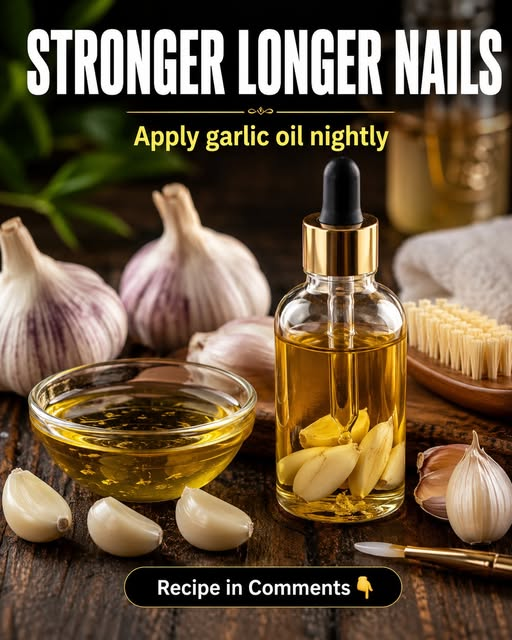
Weak, peeling, slow-growing nails can make hands look tired and less polished, even when the skin is healthy. Many people try garlic oil for stronger longer nails because garlic contains sulfur-rich compounds linked with antimicrobial activity, while oils help reduce dryness around the nail plate. However, it is important to be realistic: natural nail care can make nails more flexible, smoother, and less likely to break within a few days, but true nail length takes weeks because nails grow slowly. The remedies below use diluted, gentle, easy-to-find ingredients according to the skin around your nails. Never apply raw garlic directly to skin, because it can irritate or burn sensitive skin.
Remedy 1: For Normal Skin
Diluted Garlic and Jojoba Nail Strength Oil
Scientific working of the ingredients: Garlic is rich in sulfur compounds that may support a cleaner nail environment, especially when nails are exposed to moisture. Jojoba oil works like a light protective seal because its wax-like structure helps soften the cuticle without feeling heavy. Olive oil adds emollient fatty acids that reduce dryness and improve nail flexibility. Vitamin E oil supports the oil blend by protecting lipids from oxidation. Beeswax creates a thin protective layer over the nail surface, while glycerin attracts water to reduce roughness.
Ingredients:
- 1 small garlic clove, lightly crushed
- 1 tablespoon jojoba oil
- 1 teaspoon olive oil
- 3 drops vitamin E oil
- ¼ teaspoon beeswax shavings
- 3 drops vegetable glycerin
Procedure: Warm jojoba oil and olive oil using a double-boiler method for 1–2 minutes. Add the crushed garlic and let it infuse for 10 minutes only. Strain completely so no garlic pieces remain. Add vitamin E, beeswax, and glycerin, then mix well. At night, wash hands, dry fully, and massage one tiny drop into each nail and cuticle for 2 minutes.
How Often to Apply: Apply nightly for 5–7 days, then continue 3–4 nights per week for one month.
Initial Results: Within 1–3 days, nails may look shinier, cuticles may feel softer, and small surface dryness may appear smoother. Length and real thickness need several weeks.
Remedy 2: For Combination Skin
Aloe, Green Tea, and Sunflower Nail Balance Serum
Scientific working of the ingredients: Combination skin around nails usually means oily cuticle folds but dry tips. Aloe vera supplies water-binding polysaccharides that calm tightness. Green tea provides antioxidant polyphenols that protect the skin around nails from environmental stress. Sunflower oil is rich in linoleic acid, which supports the skin barrier without being too greasy. Honey and glycerin act as humectants, pulling moisture into the nail surface and surrounding skin. Rice water leaves a light starch-based film that temporarily smooths rough edges.
Ingredients:
- 1 teaspoon fresh aloe vera gel
- 1 teaspoon cooled green tea
- ½ teaspoon sunflower oil
- ¼ teaspoon raw honey
- 3 drops vegetable glycerin
- 1 teaspoon rice water
Procedure: Mix aloe gel, green tea, honey, glycerin, and rice water until smooth. Add sunflower oil last and whisk lightly. Apply a thin layer over nails and cuticles. Leave for 20 minutes, then rinse gently and apply one drop of plain sunflower oil to seal.
How Often to Apply: Use on alternate nights for 5 days, then twice weekly.
Initial Results: In 1–3 days, nail tips may feel less dry while the cuticle area feels balanced instead of greasy.
Remedy 3: For Oily Skin
Tea Tree, Cucumber, and Grapeseed Cuticle Clarifying Oil
Scientific working of the ingredients: Oily or sweaty skin around nails can trap debris and make the nail fold look dull. Tea tree oil has studied antifungal activity, but it must be heavily diluted. Grapeseed oil is lightweight and absorbs faster than heavy oils. Cucumber juice gives a cooling water base, while aloe vera reduces tightness. Flaxseed gel forms a flexible coating that helps the nail edge feel smoother. Rose water refreshes without harsh alcohol.
Ingredients:
- 1 tablespoon grapeseed oil
- 1 drop tea tree essential oil
- 1 teaspoon cucumber juice
- 1 teaspoon aloe vera gel
- 1 teaspoon flaxseed gel
- ½ teaspoon rose water
Procedure: Mix tea tree oil into grapeseed oil first to dilute it properly. In a separate bowl, combine cucumber juice, aloe gel, flaxseed gel, and rose water. Massage the oil blend around the cuticle first, then apply the gel mixture over the nail plate. Leave for 15 minutes and rinse. Do not use tea tree oil on broken skin.
How Often to Apply: Use 3 times in 5 days, preferably at night.
Initial Results: Within 1–3 days, the nail area may look cleaner, less dull, and less sticky. Yellow, thick, painful, or separating nails need medical care, not home treatment alone.
Remedy 4: For Dry Skin
Shea, Coconut, and Glycerin Overnight Nail Butter
Scientific working of the ingredients: Dry nails split because they lose flexibility. Shea butter and coconut oil act as rich emollients that reduce roughness and help protect the nail surface from repeated water exposure. Sunflower oil supports the surrounding skin barrier. Glycerin attracts moisture, while aloe gel adds water-based hydration. Beeswax locks the mixture in place overnight. A tiny amount of honey improves softness because it is naturally humectant.
Ingredients:
- 1 teaspoon shea butter
- ½ teaspoon coconut oil
- ½ teaspoon sunflower oil
- 3 drops vegetable glycerin
- ½ teaspoon aloe vera gel
- ¼ teaspoon honey
- ¼ teaspoon beeswax
Procedure: Melt shea butter, coconut oil, sunflower oil, and beeswax gently. Remove from heat, then stir in aloe, honey, and glycerin. Massage a rice-grain amount onto each nail and cuticle. Wear cotton gloves for 30–60 minutes if possible.
How Often to Apply: Apply nightly for 5 days, then every other night for 3–4 weeks.
Initial Results: In 1–3 days, nails may bend less sharply, cuticles may stop looking white and flaky, and peeling edges may feel smoother.
Remedy 5: For Sensitive Skin
Oat, Chamomile, and Calendula Comfort Balm
Scientific working of the ingredients: Sensitive skin needs fragrance-free, low-irritation care. Oat contains soothing compounds that reduce dryness-related discomfort. Chamomile tea adds a calming water phase. Calendula-infused oil is traditionally used for dry, delicate skin. Sunflower oil supports barrier repair with linoleic acid. Aloe gives cooling hydration, and beeswax creates a soft protective coat. This remedy avoids garlic and essential oils because sensitive skin can react easily.
Ingredients:
- 1 teaspoon finely ground oat powder
- 1 teaspoon cooled chamomile tea
- 1 teaspoon calendula-infused oil
- ½ teaspoon sunflower oil
- ½ teaspoon aloe vera gel
- ¼ teaspoon beeswax
Procedure: Mix oat powder with chamomile tea to make a soft paste. Add aloe gel. Warm calendula oil, sunflower oil, and beeswax until melted, then combine with the oat paste. Apply around nails for 15–20 minutes. Rinse gently and apply a tiny amount of sunflower oil.
How Often to Apply: Use once daily for 3–5 days, then 2–3 times weekly.
Initial Results: Within 1–3 days, redness from dryness may look calmer and cuticles may feel less tight. Stop immediately if itching, burning, or swelling occurs.
Final Tips
Keep nails short while repairing them, because shorter nails break less. Wear gloves when washing dishes, cleaning, or using detergents. Do not bite nails or cut cuticles deeply, because small cuts around the nail can invite infection. Keep nail tools clean and avoid sharing clippers. Avoid frequent acetone remover, harsh nail hardeners, acrylic removal by peeling, and aggressive buffing. Always patch test any remedy on the inner arm for 24 hours before applying it around nails. Visible softness and shine usually begin within 2–3 days, while stronger growth and fewer splits usually need 4–8 weeks of consistent care.
Diet Plan for Stronger Longer Nails
Home remedies protect the outside of the nail, but diet supports the new nail growing from the root. Continue this diet plan for at least 8–12 weeks. For real nail length and full replacement of damaged nail tips, continue gentle care for 3–6 months.
Morning: Eat 1 boiled egg or a bowl of yogurt with nuts and seeds. Eggs provide protein and biotin, while nuts and seeds provide zinc and healthy fats.
Lunch: Choose lentils, beans, chicken, fish, tofu, or chickpeas with whole grains. Nails are made mostly of keratin, a protein, so low protein intake can make nails weaker.
Evening snack: Take citrus fruit, guava, berries, or amla with a handful of almonds or walnuts. Vitamin C supports collagen formation around the nail bed, while healthy fats support skin moisture.
Dinner: Add leafy greens, carrots, sweet potatoes, fish, beans, or paneer. These foods support iron, zinc, vitamin A, and amino acid intake.
Hydration: Drink enough water daily so urine stays pale yellow. Dehydration can make nails and cuticles look dry.
If nails remain painful, yellow, green, thick, separating, bleeding, suddenly stop growing, or keep breaking despite 6–8 weeks of care, see a doctor or dermatologist. Also speak to a doctor before taking biotin supplements, especially before blood tests, because high-dose biotin may interfere with some lab results.
References for the above remedy
- Mayo Clinic. “Fingernails: Do’s and don’ts for healthy nails.” URL: https://www.mayoclinic.org/healthy-lifestyle/adult-health/in-depth/nails/art-20044954 (Mayo Clinic)
- Mayo Clinic. “7 fingernail problems not to ignore.” URL: https://www.mayoclinic.org/healthy-lifestyle/adult-health/in-depth/7-fingernail-problems-not-to-ignore/art-20546860 (Mayo Clinic)
- NIH Office of Dietary Supplements. “Biotin — Health Professional Fact Sheet.” URL: https://ods.od.nih.gov/factsheets/Biotin-HealthProfessional/ (Office of Dietary Supplements)
- Hochman LG, Scher RK, Meyerson MS. “Brittle nails: response to daily biotin supplementation.” PubMed. URL: https://pubmed.ncbi.nlm.nih.gov/8477615/ (PubMed)
- Colombo VE, Gerber F. “Treatment of brittle fingernails and onychoschizia with biotin.” PubMed. URL: https://pubmed.ncbi.nlm.nih.gov/2273113/ (PubMed)
- Hexsel D, et al. “Oral supplementation with specific bioactive collagen peptides improves nail growth and reduces symptoms of brittle nails.” PubMed. URL: https://pubmed.ncbi.nlm.nih.gov/28786550/ (PubMed)
- Tyagi M, et al. “Nail cosmetics: What a dermatologist should know!” Indian Journal of Dermatology, Venereology and Leprology. URL: https://ijdvl.com/nail-cosmetics-what-a-dermatologist-should-know/ (IJDVL)
- Buck DS, et al. “Comparison of two topical preparations for the treatment of onychomycosis: Melaleuca alternifolia oil and clotrimazole.” PubMed. URL: https://pubmed.ncbi.nlm.nih.gov/8195735/ (PubMed)
- Nickles MA, et al. “Complementary and Alternative Therapies for Onychomycosis.” URL: https://pmc.ncbi.nlm.nih.gov/articles/PMC9274952/ (PMC)
- Chiriac A, et al. “Self-medication garlic-induced irritant skin lesions.” URL: https://pmc.ncbi.nlm.nih.gov/articles/PMC7949515/ (PMC)