
Thin-looking hair, excessive shedding, breakage, dandruff, and an unhealthy scalp can affect both appearance and confidence. Natural ingredients such as rosemary, onion juice, coconut oil, honey, and aloe vera have been studied for specific hair or scalp benefits, but they should be used with realistic expectations. Hair cannot become substantially thicker after one 30-minute application. In a human trial of rosemary oil for androgenetic alopecia, significant increases in hair count were observed after six months rather than three months. Coconut oil can help hair look fuller sooner by reducing protein loss and breakage, while improving dandruff or scalp irritation may create a healthier environment for hair. (PubMed)
The following routines are designed for different scalp conditions. “Normal, combination, oily, dry, and sensitive” refer to the scalp and surrounding skin rather than the hair follicle itself.
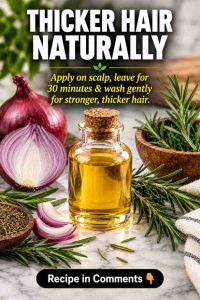
Remedy 1: For Normal Scalp
Rosemary, Coconut and Aloe Strengthening Scalp Treatment
Ingredients
- 1 tablespoon virgin coconut oil — penetrates the hair shaft and has been shown to reduce hair protein loss.
- 1 tablespoon pure aloe vera gel — helps soothe and hydrate scalp skin.
- 5–6 drops rosemary essential oil — human research suggests potential benefit for androgenetic hair thinning when used consistently.
- 1 teaspoon raw honey — provides humectant and scalp-conditioning effects.
- 1 teaspoon clean water — makes the mixture easier to spread without adding more oil.
How This Remedy Works Scientifically
Rosemary is one of the better-studied herbal ingredients for pattern hair loss. A randomized comparative study involving 100 people found that both rosemary oil and 2% minoxidil groups experienced significant increases in hair count after six months, although neither produced significant growth after only three months. (PubMed)
Coconut oil contributes differently. It does not stimulate follicles in the same way; instead, research found that coconut oil substantially reduced protein loss from both damaged and undamaged hair. Less breakage can gradually make hair appear denser and healthier. (PubMed)
Procedure: Mix all ingredients thoroughly. Apply a thin layer directly to the scalp and massage gently for 2–3 minutes. Leave for 30 minutes, then wash with lukewarm water and a gentle cleanser.
How Often to Apply: 3 times weekly. Continue for at least 8–12 weeks; assessment of true regrowth should extend to several months.
Initial Results: Within 1–3 days, hair may feel softer, smoother, and less dry. Reduced breakage may become noticeable over the following weeks. Do not expect new visible hair growth within three days.
Remedy 2: For Combination Scalp
Onion, Aloe and Honey Root Mask
Ingredients
- 1 tablespoon freshly prepared onion juice — has human clinical evidence in patchy alopecia areata.
- 1 tablespoon aloe vera gel — soothes dry or irritated areas.
- 1 teaspoon raw honey — supports hydration and scalp comfort.
- 1 teaspoon coconut oil — protects dry hair lengths against protein loss.
- 1 tablespoon water — reduces the strength and stickiness of the mixture.
Scientific Working of Onion Juice
Onion juice is frequently promoted for hair growth, but its strongest human evidence is specifically for patchy alopecia areata, not ordinary thinning or genetic baldness. In a controlled clinical study, people applying crude onion juice experienced significantly more hair regrowth than those using tap water. (PubMed)
The precise mechanism responsible for this finding is not fully established, so claims that onion juice will rapidly grow everyone’s hair should be avoided. Aloe, honey, and coconut oil mainly support scalp condition and hair-shaft protection.
Procedure: Blend a small amount of onion and strain it carefully. Combine one tablespoon of the juice with the remaining ingredients. Apply mainly to the scalp rather than soaking the entire hair length. Leave for 20–30 minutes and rinse thoroughly.
How Often to Apply: Every other day or 3 times weekly for at least 5 days initially. If tolerated, continue for 6–8 weeks while monitoring the scalp.
Initial Results: The scalp may feel cleaner and hair can feel conditioned within 1–3 applications. Actual regrowth, if it occurs, requires weeks to months.
Important: Stop immediately if onion causes burning, significant redness, swelling, or persistent itching.
Remedy 3: For Oily or Dandruff-Prone Scalp
Honey, Aloe and Rosemary Scalp-Cleansing Mask
Ingredients
- 3 tablespoons raw honey — clinically studied for seborrheic dermatitis and dandruff.
- 1 teaspoon warm water — helps dilute and distribute honey.
- 1 tablespoon aloe vera gel — provides soothing hydration without a heavy oily coating.
- 3 drops rosemary essential oil — offers scalp-supporting properties while keeping the formula diluted.
- 1 teaspoon coconut oil — used sparingly to condition damaged strands.
Why It Works
A small human study investigated diluted crude honey in people with chronic seborrheic dermatitis and dandruff. Participants reported substantial improvements in itching and scaling during treatment, suggesting that honey may be particularly useful when apparent “thinning” is accompanied by an unhealthy, flaky scalp. (PubMed)
Rosemary has also been studied for scalp seborrheic dermatitis. In a randomized trial, topical rosemary lotion reduced symptoms, although ketoconazole performed better for scalp flaking. Rosemary produced greater reduction in itching in that particular study. (PubMed Central (PMC))
Procedure: Combine the honey and warm water first. Add aloe and rosemary, then mix in the small amount of coconut oil. Apply over the scalp, especially oily or flaky areas. Leave for approximately 30 minutes and rinse gently.
How Often to Apply: 3 times during the first 5–7 days, then 2 times weekly if helpful.
Initial Results: Less tightness, itching, greasiness, or visible flaking may begin within several applications. A clean, calmer scalp can make hair look fresher and fuller but does not mean new follicles have developed.
Remedy 4: For Dry Scalp and Breakage-Prone Hair
Intensive Coconut, Aloe and Honey Pre-Wash Treatment
Ingredients
- 2 tablespoons virgin coconut oil — clinically supported for reducing hair protein loss.
- 1 tablespoon aloe vera gel — hydrates dry scalp skin.
- 1 teaspoon raw honey — attracts and retains moisture.
- 4 drops rosemary essential oil — diluted botanical support for people concerned about thinning.
- 1 teaspoon warm water — helps create a lighter, spreadable mixture.
Scientific Working for Thicker-Looking Hair
When hair repeatedly breaks along its length, overall density can look reduced even when the follicles are functioning normally. Coconut oil has a strong affinity for hair proteins and was the only oil among coconut, mineral, and sunflower oils in a comparative study to markedly reduce protein loss from damaged and undamaged hair. (PubMed)
This means coconut oil is especially useful for making fragile hair progressively stronger and reducing the loss of length caused by breakage. Rosemary provides the follicle-focused component, while aloe and honey address dryness.
Procedure: Warm the coconut oil slightly until liquid; do not make it hot. Stir in aloe, honey and water. Add rosemary last. Apply to scalp and hair, concentrating additional coconut mixture on brittle lengths. Leave for 30–45 minutes before washing.
How Often to Apply: Every other day for the first 5 days if hair is extremely dry, otherwise twice weekly.
Initial Results: Greater softness, shine and manageability can appear within 1–3 treatments. Reduced breakage generally requires several weeks.
Remedy 5: For Sensitive Scalp
Fragrance-Free Aloe, Oat and Coconut Soothing Mask
Ingredients
- 2 tablespoons pure aloe vera gel — cooling, hydrating base.
- 1 teaspoon virgin coconut oil — reduces dryness and protects fragile hair.
- 1 teaspoon raw honey — supplies gentle humectant properties.
- 1 teaspoon finely ground colloidal oatmeal — supports skin-barrier function and reduces dryness.
- 1 tablespoon cool water — keeps the mask lightweight and easy to rinse.
Why Sensitive Scalps Need a Different Approach
Essential oils, including rosemary and tea tree oil, can irritate certain people. A rosemary scalp trial reported withdrawal of some participants because of burning and itching, so avoiding essential oils can be sensible for highly reactive scalps. (PubMed Central (PMC))
Colloidal oatmeal has clinical evidence for improving skin hydration and barrier function, while coconut oil has demonstrated moisturizing effects and hair-protein protection. (PubMed)
This remedy is therefore designed primarily to protect the scalp and reduce breakage rather than directly stimulate new follicular growth.
Procedure: Mix oatmeal with water first. Add aloe, honey and coconut oil and stir until smooth. Apply a thin layer to the scalp for 20 minutes and rinse carefully.
How Often to Apply: Once daily for the first 3 days if very dry, then every other day for up to one week. Reduce to 1–2 times weekly afterward.
Initial Results: A less dry, softer and more comfortable scalp may be noticeable within 1–3 days. Hair can also appear smoother as breakage decreases.
Final Tips for Naturally Thicker Hair
Treat wet hair gently because aggressive brushing and pulling can increase breakage. Avoid very tight hairstyles, frequent high-temperature styling, excessive bleaching and vigorous towel rubbing. Keeping the scalp clean is also important, especially if dandruff or excessive oil is present.
Patch-test every topical remedy before applying it over the entire scalp. Essential oils should never be applied undiluted. Anyone with eczema, psoriasis, severe dandruff or known botanical allergies should be especially cautious.
Visible improvements in shine, softness, scalp comfort and manageability can begin within 2–3 days. True improvement in hair density takes much longer. Human rosemary research did not find a significant hair-count increase after three months but did after six months. (PubMed)
Diet Plan for Stronger and Thicker Hair
Hair follicles need adequate protein, calories, iron and other micronutrients. The American Academy of Dermatology notes that insufficient protein or iron and eating too few calories can contribute to hair loss. Supplements should not automatically be used, because excessive intake of certain nutrients can also worsen hair loss. (American Academy of Dermatology)
Breakfast: Two eggs with whole-grain toast and fruit, or oatmeal with yogurt, nuts and seeds.
Mid-Morning: A handful of almonds, walnuts or pumpkin seeds with fruit.
Lunch: Lentils, beans, chicken, fish or lean meat with spinach or another leafy green vegetable. Include tomatoes, citrus fruit, guava or bell peppers with plant-based iron sources.
Evening Snack: Plain yogurt, milk, roasted chickpeas or seeds.
Dinner: Fish, eggs, tofu, chicken, beans or lentils with vegetables and brown rice or whole-grain bread.
Daily: Drink enough water and eat sufficient calories and protein. Avoid crash diets.
Do not begin high-dose iron, zinc, vitamin D, biotin or other supplements simply because hair is thinning. Testing for deficiencies may be appropriate when a doctor suspects a nutritional cause. Evidence does not support routine supplementation of every popular “hair vitamin” in people without a deficiency. (PubMed Central (PMC))
How Long Should You Continue?
Continue a well-tolerated scalp and hair-care routine for 8–12 weeks, while understanding that meaningful follicular regrowth often requires 3–6 months or longer.
If excessive shedding continues, the part becomes progressively wider, bald patches develop, the scalp becomes painful or inflamed, or hair loss persists despite several weeks of careful hair care, see a doctor or dermatologist. Hair loss can result from hereditary pattern loss, alopecia areata, thyroid or hormonal problems, nutritional deficiencies, illness, medication effects and other causes that home remedies cannot diagnose. (American Academy of Dermatology)
References for the above remedy
- Panahi Y, Taghizadeh M, Marzony ET, Sahebkar A. Rosemary oil vs minoxidil 2% for the treatment of androgenetic alopecia: a randomized comparative trial.
https://pubmed.ncbi.nlm.nih.gov/25842469/ - Sharquie KE, Al-Obaidi HK. Onion juice (Allium cepa L.), a new topical treatment for alopecia areata.
https://pubmed.ncbi.nlm.nih.gov/12126069/ - Rele AS, Mohile RB. Effect of mineral oil, sunflower oil, and coconut oil on prevention of hair damage.
https://pubmed.ncbi.nlm.nih.gov/12715094/ - Al-Waili NS. Therapeutic and prophylactic effects of crude honey on chronic seborrheic dermatitis and dandruff.
https://pubmed.ncbi.nlm.nih.gov/11485891/ - Satchell AC, Saurajen A, Bell C, Barnetson RStC. Treatment of dandruff with 5% tea tree oil shampoo.
https://pubmed.ncbi.nlm.nih.gov/12451368/ - Chaisripipat W, Lourith N, Kanlayavattanakul M. Anti-dandruff Hair Tonic Containing Lemongrass Oil.
https://pubmed.ncbi.nlm.nih.gov/26566122/ - Vardy DA, Cohen AD, Tchetov T, et al. A double-blind, placebo-controlled trial of an Aloe vera emulsion in the treatment of seborrheic dermatitis.
https://www.tandfonline.com/doi/abs/10.3109/09546639909055904 - Almohanna HM, Ahmed AA, Tsatalis JP, Tosti A. The Role of Vitamins and Minerals in Hair Loss: A Review.
https://pmc.ncbi.nlm.nih.gov/articles/PMC6380979/ - Capone K, Kirchner F, Klein SL, Tierney NK. Effects of Colloidal Oatmeal Topical Atopic Dermatitis Cream on Skin Microbiome and Skin Barrier Properties.
https://pubmed.ncbi.nlm.nih.gov/32484623/ - American Academy of Dermatology. Hair loss: Tips for managing.
https://www.aad.org/public/diseases/hair-loss/treatment/tips