
White or gray hair develops when pigment-producing cells in the hair follicle produce less melanin. Genetics and normal aging are the most common reasons, while oxidative stress, smoking, thyroid disorders and deficiencies of nutrients such as vitamin B12, iron or copper may contribute to premature graying in some people. (PubMed Central (PMC)) Because hair color can strongly affect appearance and confidence, remedies such as amla, hibiscus, black sesame and herbal oils are often promoted as ways to “turn white hair black.” However, an important scientific distinction is necessary: no homemade herbal mixture has been clinically proven to reliably restore age-related white hair to permanent black. Current dermatology reviews describe effective evidence-based treatments for established graying as limited. (PubMed Central (PMC))
Natural care can still be useful. The right routine can protect fragile gray hair, improve shine and scalp condition, reduce breakage and provide antioxidant-rich botanical compounds. If graying is related to a correctable nutritional deficiency, identifying and treating that deficiency may also be important. The following remedies are therefore designed as supportive hair and scalp treatments rather than guaranteed gray-hair reversal treatments.
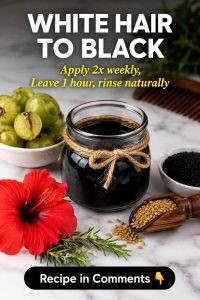
Remedy 1: Amla–Hibiscus Conditioning Mask for Normal Scalp
Ingredients
- 2 tablespoons amla powder
- 1 tablespoon hibiscus powder
- 2 tablespoons plain aloe vera gel
- 1 tablespoon coconut oil
- 1 teaspoon ground black sesame seeds
- 2–3 tablespoons water
Scientific Working of the Ingredients
Amla: Amla contains polyphenols and other antioxidant compounds. It has a long history of traditional use for hair, including premature graying, although this traditional use should not be confused with clinical proof of repigmentation. Human research has shown potential benefits of oral amla preparations for certain forms of hair loss. (PubMed)
Hibiscus: Hibiscus contains flavonoids, anthocyanins and other plant antioxidants. Laboratory and animal research has demonstrated hair-growth-promoting activity, although equivalent evidence for reversing gray hair in humans is lacking. (PubMed)
Coconut oil: Coconut oil is particularly useful for protecting the hair shaft. Research found that it penetrates hair and reduces protein loss more effectively than mineral and sunflower oils. (PubMed)
Aloe vera: Primarily provides a moisturizing base and makes the mask easier to spread without requiring harsh ingredients.
Black sesame: Sesame is nutritious, but there is currently insufficient high-quality human evidence that topical black sesame restores melanin to gray hair.
Procedure
Mix the amla and hibiscus powders. Add ground sesame, aloe vera and coconut oil. Gradually add enough water to make a smooth paste. Apply it over the scalp and hair, avoiding vigorous rubbing. Leave for about 20–30 minutes, then rinse thoroughly and wash gently.
How Often to Apply
Use twice weekly. Continue for at least 6–8 weeks if it agrees with your scalp.
Initial Results
Within the first few applications, expect improvements mainly in softness, manageability and shine—not a dramatic change from white to black.
Remedy 2: Lightweight Amla–Rosemary Treatment for Combination Scalp
Ingredients
- 1 tablespoon amla powder
- 1 tablespoon aloe vera gel
- 1 teaspoon coconut oil
- 2 drops rosemary essential oil
- 1 tablespoon cooled green tea
- 1 tablespoon water
Scientific Working
Rosemary: Rosemary is one of the better-studied herbal ingredients for hair. In a randomized comparative trial involving androgenetic alopecia, rosemary oil was associated with increased hair count after six months. The study concerned hair growth rather than gray-hair reversal, so it should not be interpreted as evidence that rosemary turns white hair black. (PubMed)
Amla: Supplies antioxidant phytochemicals and has traditional hair-care use.
Coconut oil: Helps limit protein loss and protects vulnerable hair fibers.
Green tea: Supplies polyphenols with antioxidant activity, although topical green tea has not been established as a treatment for gray hair.
Aloe vera: Gives the treatment a light, hydrating consistency suitable for areas that become dry without requiring a large amount of oil.
Procedure
Combine amla with cooled green tea and aloe vera. Mix in coconut oil. Add only 2 drops of rosemary essential oil and stir thoroughly. Never apply undiluted rosemary essential oil directly to the scalp.
Apply mainly to the scalp and roots and lightly coat dry ends. Leave for 20–30 minutes, then rinse.
How Often to Apply
Use 1–2 times per week for 6–8 weeks.
Initial Results
During the first few days, hair may feel softer and less rough. Changes in pigmentation should not be expected within days.
Remedy 3: Oil-Control Herbal Mask for Oily Scalp
Ingredients
- 1½ tablespoons amla powder
- 1 tablespoon hibiscus powder
- 2 tablespoons aloe vera gel
- 2 tablespoons cooled green tea
- 1 teaspoon coconut oil
- 1 teaspoon finely ground black sesame
Scientific Working
This version uses considerably less oil. Amla and hibiscus supply antioxidant plant compounds while aloe and tea form the majority of the mask.
Oxidative stress is relevant because melanogenesis itself produces reactive oxygen species. Research on gray follicles has found impaired antioxidant defenses, including reduced catalase-related activity. (PubMed Central (PMC))
That provides a biological reason to maintain good antioxidant nutrition, but applying antioxidant-rich herbs should not be assumed to reactivate follicular melanocytes.
Procedure
Mix the powders first. Add aloe and green tea until creamy. Stir in coconut oil and ground sesame.
Apply a thin layer to the scalp rather than heavily saturating it. Leave for approximately 20 minutes and shampoo thoroughly.
How Often to Apply
Apply once or twice weekly.
Initial Results
After 1–3 applications, the main noticeable changes may be cleaner-feeling roots and softer lengths. Pigmentation changes cannot realistically be promised in this period.
Remedy 4: Coconut–Amla Treatment for Dry, Coarse Gray Hair
Ingredients
- 2 tablespoons virgin coconut oil
- 1 tablespoon amla powder
- 1 tablespoon hibiscus powder
- 1 tablespoon aloe vera gel
- 1 teaspoon ground sesame
- 1 tablespoon warm water
Scientific Working
Dry gray hair frequently benefits more from protecting the existing fiber than from aggressive attempts to recolor it.
Coconut oil is the key ingredient here. Studies demonstrate its ability to penetrate human hair fibers and reduce protein loss. (PubMed)
Amla provides polyphenolic antioxidants, while hibiscus contains several phytochemicals. Experimental hibiscus research has also reported hair-growth activity, though this has not established gray-hair reversal in people. (PubMed)
Procedure
Warm the coconut oil only until comfortably lukewarm. Never make it hot.
Combine amla and hibiscus with warm water, then mix in aloe, sesame and coconut oil. Massage gently through the hair and lightly over the scalp.
Leave for 30–45 minutes, then shampoo.
How Often to Apply
Use twice weekly for 6–8 weeks.
Initial Results
Dry hair may feel smoother and appear shinier after the first few treatments. Reduced dryness can also make naturally dark and gray strands look healthier and more defined.
Remedy 5: Gentle Amla Conditioning Pack for Sensitive Scalp
Ingredients
- 1 teaspoon amla powder
- 2 tablespoons plain aloe vera gel
- 1 teaspoon coconut oil
- 1 tablespoon finely ground oats
- 2 tablespoons lukewarm water
Scientific Working
Sensitive scalps need fewer potentially irritating botanicals. For that reason, this recipe intentionally excludes essential oils, lemon juice, onion juice and strongly acidic ingredients.
Coconut oil supports hair-fiber protection, while amla contributes antioxidant plant compounds. Oats and aloe primarily provide a gentle, conditioning base.
Procedure
Mix the oat powder and amla with water. Add aloe and coconut oil and stir until smooth.
Patch-test first. If there is no irritation, apply gently to the hair and scalp for 15–20 minutes before rinsing.
How Often to Apply
Start once weekly. Increase to twice weekly only if the scalp tolerates it.
Initial Results
The realistic early goal is less roughness and improved softness rather than rapid repigmentation.
Can Amla, Hibiscus or Black Sesame Really Make White Hair Black?
Amla has perhaps the strongest traditional association with dark, healthy hair among these ingredients. Modern research also supports several biological properties of amla, and a randomized controlled trial has investigated an amla preparation for female androgenetic alopecia. (PubMed)
However, this still does not prove that an amla mask converts established white hairs back to black.
A 2024 comprehensive review concluded that effective evidence-based therapies for premature hair graying remain inadequate. (PubMed Central (PMC)) Therefore, claims such as “white hair to black in 3 days” or “permanently reverse gray hair naturally” should be treated cautiously.
Final Tips
Keep the scalp clean without excessive shampooing, avoid very hot water and minimize repeated bleaching, straightening and high-temperature styling. Use clean combs and towels, protect hair from excessive sun exposure and patch-test every homemade preparation before putting it over the entire scalp.
Do not use lemon juice, baking soda or undiluted essential oils as aggressive gray-hair treatments. They cannot restore lost follicular pigment and may instead irritate the scalp or damage already fragile hair.
Natural conditioning benefits such as softness and shine can appear after the first few applications. Actual biological repigmentation, when it occurs at all, takes much longer and cannot reasonably be promised within 2–3 days.
Diet Plan for Premature White Hair
Diet matters most when nutritional inadequacy is contributing to premature graying. Reviews have linked premature graying with deficiencies involving vitamin B12, iron and copper, while observational research has also reported lower iron, copper and calcium levels in some people with premature graying. (PubMed Central (PMC))
For breakfast, choose eggs or fortified cereal with milk/yogurt, plus fresh fruit. At lunch, include lentils, chickpeas, beans, fish, chicken or another protein source together with leafy vegetables. Snack on a small serving of nuts and seeds. Dinner can include fish, eggs, lean meat or legumes with vegetables and whole grains.
Copper-containing foods include sesame seeds, nuts, legumes and some whole grains. Iron sources include meat, lentils, beans and leafy greens. Vitamin B12 occurs naturally mainly in animal-derived foods and fortified foods.
Do not start high-dose iron, copper or vitamin B12 supplements simply because your hair is gray. Excess supplementation can be harmful. Suspected deficiencies should ideally be confirmed medically.
How Long Should You Continue?
Use a well-tolerated hair mask for 6–8 weeks to judge its conditioning and scalp benefits. Healthy-hair measures can be continued longer.
If white hair appears unusually early, progresses rapidly, occurs alongside significant hair loss, or you have other unexplained symptoms, see a doctor or dermatologist. Evaluation may include possible nutritional deficiencies, thyroid disease and other underlying conditions. Premature graying can sometimes be associated with treatable medical or nutritional factors. (PubMed Central (PMC))
References for the above remedy
- Kumar AB, Shamim H, Nagaraju U. Premature Graying of Hair: Review with Updates. International Journal of Trichology.
https://pmc.ncbi.nlm.nih.gov/articles/PMC6290285/ - Poonia K, Bhalla M. Premature Graying of Hair: A Comprehensive Review and Recent Insights. Indian Dermatology Online Journal.
https://pmc.ncbi.nlm.nih.gov/articles/PMC11444426/ - Panahi Y, et al. Rosemary oil vs minoxidil 2% for the treatment of androgenetic alopecia: a randomized comparative trial. Skinmed.
https://pubmed.ncbi.nlm.nih.gov/25842469/ - Akhbari M, et al. The effect of an oral product containing Amla fruit (Phyllanthus emblica L.) on female androgenetic alopecia: A randomized controlled trial. Journal of Ethnopharmacology.
https://pubmed.ncbi.nlm.nih.gov/37487962/ - Rele AS, Mohile RB. Effect of mineral oil, sunflower oil, and coconut oil on prevention of hair damage. Journal of Cosmetic Science.
https://pubmed.ncbi.nlm.nih.gov/12715094/ - Adhirajan N, Ravi Kumar T, Shanmugasundaram N, Babu M. In vivo and in vitro evaluation of hair growth potential of Hibiscus rosa-sinensis Linn. Journal of Ethnopharmacology.
https://pubmed.ncbi.nlm.nih.gov/12963149/ - Daulatabad D, et al. Research discussing trace elements and premature hair graying.
https://pmc.ncbi.nlm.nih.gov/articles/PMC6369637/ - Yale K, et al. Medication-Induced Repigmentation of Gray Hair: A Systematic Review.
https://pmc.ncbi.nlm.nih.gov/articles/PMC6995950/