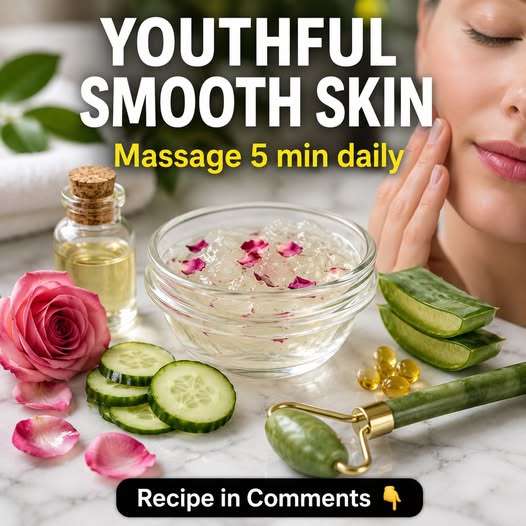
Dryness, rough texture and dehydration can make fine lines look deeper and leave the face appearing tired. A gentle five-minute massage may temporarily improve facial blood flow, while humectants and natural emollients can help the outer skin layer retain water and feel smoother. However, no homemade mask can rebuild collagen or permanently erase wrinkles within three days. The earliest realistic improvements are better hydration, softness and a temporarily plumper appearance. Scientific evidence generally supports the individual ingredients used below rather than these exact homemade mixtures. (PubMed)
Remedy 1: Aloe, Oat and Green Tea Massage Gel for Normal Skin
Scientific Working of Each Ingredient
Aloe vera provides water-based slip for massage and may temporarily increase moisture in the outer skin layer. Colloidal oatmeal contains beta-glucans and avenanthramides that help soothe the skin and support its protective barrier. Glycerin draws water into the stratum corneum, helping reduce roughness. Green tea supplies antioxidant catechins, while sunflower seed oil adds linoleic acid and reduces moisture loss without creating an excessively heavy coating. (PubMed)
Ingredients
- 1 tablespoon pure aloe vera gel: provides hydration and massage slip
- 1 tablespoon strong, cooled green tea: supplies antioxidant catechins
- 1 teaspoon finely ground colloidal oatmeal: soothes and supports the barrier
- ¼ teaspoon vegetable glycerin: attracts and holds water
- ¼ teaspoon cold-pressed sunflower seed oil: softens and seals in moisture
Procedure
Mix the aloe gel, cooled tea and oatmeal in a clean bowl. Add the glycerin and sunflower oil and stir until evenly blended. Apply a thin layer to clean, slightly damp skin.
Massage very gently for five minutes using the pads of your fingers. Move upward from the jaw towards the cheeks and from the eyebrows towards the hairline. Avoid pulling or stretching the skin. Leave the mixture on for another five minutes, then rinse with lukewarm water.
How Often to Apply
Apply once daily for the first three days. After that, use three times weekly for four weeks.
Initial Results
Within one to three days, the skin may feel softer and look temporarily smoother because the outer layer is holding more water. Permanent wrinkle reduction should not be expected during this period.
Remedy 2: Honey and Green Tea Balancing Mask for Combination Skin
Scientific Working of Each Ingredient
Combination skin needs lightweight hydration on the oily areas and additional barrier support on dry areas. Green tea has shown sebum-reducing effects in topical formulations after continued use. Honey acts as a humectant, while oatmeal helps soothe dry or easily irritated patches. Aloe adds light hydration, glycerin binds water and a small quantity of sunflower oil protects the cheeks without heavily coating the T-zone. Evidence involving honey generally comes from properly formulated or medical-grade preparations, so it should not be applied to broken skin. (PubMed)
Ingredients
- 1 tablespoon cooled green tea: lightweight antioxidant base
- 1 tablespoon aloe vera gel: supplies moisture without heaviness
- 1 teaspoon finely ground colloidal oatmeal: supports dry areas
- ½ teaspoon pure honey: helps retain moisture
- ⅛ teaspoon vegetable glycerin: hydrates the outer skin layer
- ¼ teaspoon sunflower seed oil: conditions dry cheeks
Procedure
Combine the green tea, aloe, oatmeal, honey and glycerin. Apply a thin layer over the face. Place the sunflower oil only on the dry cheeks and around the jaw, avoiding an oily forehead or nose.
Massage for three minutes over the cheeks and jaw and only one minute over the T-zone. Leave the treatment on for five additional minutes and rinse thoroughly.
How Often to Apply
Use on alternate days for five days, followed by two or three applications weekly.
Initial Results
The cheeks may feel less tight after the first use. Within three days, makeup may sit more smoothly on dry areas, although excessive oil production usually takes several weeks to improve.
Remedy 3: Oil-Free Oat and Green Tea Treatment for Oily Skin
Scientific Working of Each Ingredient
Oily skin can still become dehydrated, so removing every trace of oil may increase tightness and irritation. Green tea catechins have demonstrated gradual sebum-control potential in small clinical studies. Aloe and glycerin provide hydration without a heavy oily layer. Colloidal oatmeal supports the barrier, while a small amount of honey improves moisture retention. These ingredients will not shrink pores permanently, but better hydration can make texture appear more even. (PubMed)
Ingredients
- 2 tablespoons strong, cooled green tea: helps provide lightweight sebum care
- 1 tablespoon pure aloe gel: hydrates and gives slip
- 1 teaspoon colloidal oatmeal: calms dryness and roughness
- ½ teaspoon pure honey: acts as a moisture-binding ingredient
- ⅛ teaspoon vegetable glycerin: supports hydration
Procedure
Stir all ingredients into a smooth, thin gel. Apply it after cleansing, keeping it away from the eyelids. Use gentle fingertip movements for three to five minutes without pressing active spots or inflamed pimples.
Leave the mixture on for five minutes and rinse completely. Do not allow it to dry into a hard, tight layer because this may increase irritation.
How Often to Apply
Apply once daily for three days. Continue every other day for three to four weeks when the skin remains comfortable.
Initial Results
The face may feel fresher and less tight within one to three days. Shine may temporarily look reduced after rinsing, but meaningful sebum changes generally require continued care for several weeks.
Remedy 4: Coconut, Honey and Oat Moisture Massage for Dry Skin
Scientific Working of Each Ingredient
Dry skin benefits from humectants that attract water and emollients that reduce evaporation. Glycerin improves stratum-corneum hydration, while oatmeal supports the skin barrier. Virgin coconut oil has improved hydration and symptoms of xerosis in controlled research. Honey contributes humectant properties, aloe supplies water-based hydration and sunflower oil adds barrier-supporting fatty acids. (PubMed)
Ingredients
- 1 tablespoon aloe vera gel: supplies a water-based foundation
- 1 teaspoon colloidal oatmeal: soothes rough, flaky areas
- ½ teaspoon pure honey: supports moisture retention
- ¼ teaspoon vegetable glycerin: increases surface hydration
- ½ teaspoon virgin coconut oil: reduces dryness and softens skin
- ¼ teaspoon sunflower seed oil: supports the lipid barrier
Procedure
Blend the aloe, oatmeal, honey and glycerin. Melt the coconut oil between clean fingertips, mix it with the sunflower oil and stir both oils into the mask.
Apply to damp skin and massage gently for five minutes. Use very light pressure around the eyes. Leave the mask on for ten minutes and remove it using lukewarm water and a soft, clean cloth.
How Often to Apply
Use daily for three days, then three times weekly for four to six weeks.
Initial Results
Dryness and surface roughness may improve after the first application. Fine dehydration lines may appear softer within two or three days because moisturized skin becomes temporarily plumper.
Remedy 5: Fragrance-Free Oat Barrier Mask for Sensitive Skin
Scientific Working of Each Ingredient
Sensitive skin should avoid rose fragrance, essential oils, lemon juice, baking soda and rough exfoliation. Colloidal oatmeal has clinical evidence for supporting hydration and barrier function in dry, irritated skin. Glycerin increases water retention, aloe provides gentle slip and sunflower oil can preserve barrier integrity. Honey is included in a very small amount, but anyone with pollen, bee-product or honey allergies should leave it out and add extra aloe instead. (PubMed)
Ingredients
- 2 teaspoons colloidal oatmeal: reduces roughness and supports the barrier
- 1 tablespoon pure, fragrance-free aloe gel: provides soothing slip
- 1 tablespoon cooled boiled water: creates a gentle consistency
- ⅛ teaspoon vegetable glycerin: prevents rapid moisture evaporation
- ¼ teaspoon sunflower seed oil: provides lightweight emollient protection
- ¼ teaspoon honey: adds humectant action when tolerated
Procedure
Mix the oatmeal with cooled boiled water and let it stand for two minutes. Add the aloe, glycerin, oil and honey. Apply a thin layer without rubbing.
During the first application, massage for only one minute and leave it on for five minutes. When two applications cause no redness or itching, massage for up to three minutes. A full five-minute massage is unnecessary for reactive skin.
How Often to Apply
Use once every other day for the first five days. Continue twice weekly when well tolerated.
Initial Results
The skin may feel less tight within one or two uses. Stop immediately if burning, itching, swelling or persistent redness occurs.
Final Tips for Smooth and Youthful-Looking Skin
Prepare every water-containing remedy fresh and discard leftovers immediately. Homemade mixtures do not contain preservatives and can quickly become contaminated. Patch-test the complete mixture on a small area of the inner arm for at least 48 hours before applying it to the face.
Clean your hands, bowls and massage tools before every treatment. Massage should feel relaxing, not painful. Avoid massage over inflamed acne, active rosacea, eczema flares, sunburn, broken skin or painful cysts.
Do not apply lemon juice, undiluted essential oils or baking soda to the face. Topical vitamin E capsules are also unsuitable for many people because vitamin E has caused contact dermatitis in clinical research. (PubMed)
Moisturizing may make fine lines look softer, but consistent sun protection is the most important step for preventing premature wrinkles. Daily sunscreen use reduced measurable skin ageing in a randomized trial. Use broad-spectrum SPF 30 or higher and combine it with shade and protective clothing. (PubMed)
Visible softness and hydration may begin within two to three days. Improvements in barrier function usually need several weeks, while meaningful changes in wrinkles or elasticity take months and may require professional dermatological treatment.
Diet Plan for Smooth, Healthy-Looking Skin
At breakfast, eat oatmeal or plain yogurt with guava, berries, oranges or another vitamin-C-rich fruit. Add walnuts, chia seeds or ground flaxseed for healthy fats.
At lunch, combine lentils, chickpeas, beans, fish or chicken with leafy vegetables, tomatoes and bell peppers. Include whole-grain roti, brown rice or another minimally processed grain.
Choose fruit, plain yogurt, pumpkin seeds or a small handful of nuts as a snack. At dinner, eat fish, beans, tofu, eggs or lean meat with several vegetables. Drink water regularly according to thirst and climate, but remember that excessive water intake cannot directly erase wrinkles.
Higher vitamin C and linoleic-acid intakes have been associated with less dryness and a lower likelihood of a wrinkled appearance. Healthy, fruit-rich dietary patterns have also been associated with fewer facial wrinkles, although these observational findings do not prove that one food reverses ageing. (PubMed)
Continue the suitable home remedy for four to six weeks and follow the balanced diet for at least eight to twelve weeks. Consult a dermatologist if dryness, itching, redness, acne or rough patches persist, or if a mole, sore or pigmented area changes in size, shape or colour.
References for the above remedy
- Miyaji A, Sugimori K, Hayashi N. Short- and long-term effects of using a facial massage roller on facial skin blood flow and vascular reactivity.
https://pubmed.ncbi.nlm.nih.gov/30477852/ - Dal’Belo SE, Gaspar LR, Maia Campos PMBG. Moisturizing effect of cosmetic formulations containing Aloe vera extract.
https://pubmed.ncbi.nlm.nih.gov/17026654/ - Fluhr JW, Darlenski R, Surber C. Glycerol and the skin: holistic approach to its origin and functions.
https://pubmed.ncbi.nlm.nih.gov/18510666/ - Capone K, et al. Effects of colloidal oatmeal cream on skin microbiome and barrier properties.
https://pubmed.ncbi.nlm.nih.gov/32484623/ - Mahmood T, et al. A comparison of the effects of topical green tea and lotus on facial sebum control.
https://pubmed.ncbi.nlm.nih.gov/23935347/ - Danby SG, et al. Effect of olive and sunflower seed oil on the adult skin barrier.
https://pubmed.ncbi.nlm.nih.gov/22995032/ - Agero ALC, Verallo-Rowell VM. Virgin coconut oil compared with mineral oil for xerosis.
https://pubmed.ncbi.nlm.nih.gov/15724344/ - Čuříková-Kindlová BA, et al. Honey-based preparations and measured skin hydration and smoothness.
https://pubmed.ncbi.nlm.nih.gov/39770550/ - Hughes MCB, et al. Sunscreen and prevention of skin aging: a randomized trial.
https://pubmed.ncbi.nlm.nih.gov/23732711/ - Cosgrove MC, et al. Dietary nutrient intakes and skin-aging appearance among middle-aged women.
https://pubmed.ncbi.nlm.nih.gov/17921406/