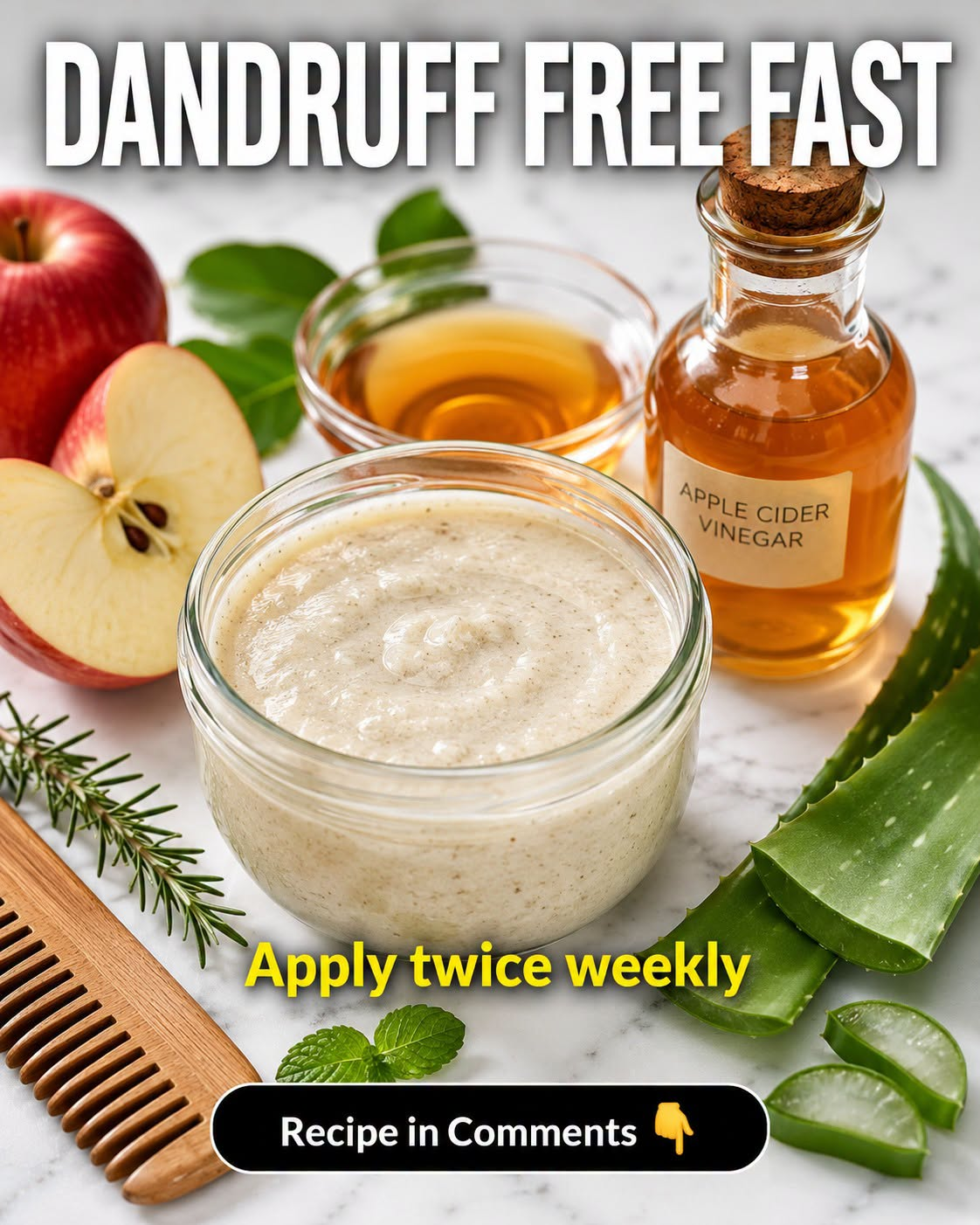
Dandruff can make clean hair look untidy and may cause itching, visible flakes, scalp discomfort, and embarrassment. It is not simply a sign of poor hygiene. Dandruff is linked to several factors, including scalp oil, skin-barrier changes, sensitivity, and the activity of Malassezia yeast. Mild dandruff may improve with regular scalp cleansing, while stubborn or inflamed dandruff may require an anti-dandruff treatment or medical care. (PMC)
The image includes apple cider vinegar, but it is not used as the main remedy in this article because reliable clinical evidence for treating dandruff with vinegar remains limited. Acidic homemade mixtures may also cause dryness or irritation, especially on scratched or sensitive skin. (Healthline)
The natural active ingredients below have individual scientific support, but the complete homemade combinations have not been tested as finished medical treatments. Prepare each remedy fresh, choose only the one suitable for your scalp type, and perform a patch test before full application.
Remedy 1: For Normal Scalp — Raw Honey and Green Tea Scalp Treatment
Ingredients
- 3 tablespoons raw honey
- 1 teaspoon boiled and slightly warm water
- 1 teaspoon pure aloe vera gel
- 1 teaspoon cooled green tea
- ½ teaspoon finely powdered colloidal oatmeal
Scientific Working of Each Ingredient
Raw honey: A small clinical study investigated diluted crude honey for dandruff and seborrheic dermatitis. Participants reported improvements in scaling, itching, and skin lesions after repeated use. Honey also contains humectant, antioxidant, and antimicrobial compounds. (PubMed)
Aloe vera: Aloe contains soothing polysaccharides and water-binding compounds. A controlled clinical trial found that an aloe-based preparation improved seborrheic dermatitis symptoms. (Taylor & Francis Online)
Green tea: Green tea supplies antioxidant polyphenols that may help calm environmental and inflammatory stress on the scalp. It is included as a supportive ingredient rather than a proven dandruff treatment.
Colloidal oatmeal: Oat compounds may reduce dryness and irritation while supporting the skin barrier. (PubMed)
Procedure
Mix the honey with warm water until evenly diluted. Add aloe gel, green tea, and finely powdered oatmeal. Part the hair and apply a thin layer directly to the scalp. Leave it on for 20–30 minutes, then rinse thoroughly and wash with a gentle shampoo.
How Often to Apply
Apply twice weekly for at least 2 weeks. Continue for up to 4 weeks when the scalp remains comfortable.
Initial Results
The scalp may feel softer and less itchy within 1–3 applications. Visible dandruff usually takes longer to improve, and the original honey research observed benefits over several weeks rather than overnight.
Remedy 2: For Combination Scalp — Lemongrass and Aloe Balancing Routine
Ingredients
- 1 teaspoon professionally formulated 5–10% lemongrass scalp tonic
- 1 tablespoon pure aloe vera gel
- 1 tablespoon boiled and cooled water
- 1 teaspoon colloidal oatmeal
- ¼ teaspoon vegetable glycerin
Scientific Working of Each Ingredient
Lemongrass: Lemongrass essential oil has antifungal activity against yeast associated with dandruff. In a randomized clinical evaluation, professionally formulated lemongrass scalp tonics reduced dandruff, with improvement observed after approximately one week. (PubMed)
Use only a properly formulated scalp tonic. Do not apply pure lemongrass essential oil directly because concentrated essential oils can irritate or burn the scalp.
Aloe vera: Aloe helps supply lightweight moisture to areas that feel dry without heavily coating an oily T-zone or crown area. (Taylor & Francis Online)
Colloidal oatmeal: Oatmeal helps support dry or uncomfortable sections of combination scalp.
Vegetable glycerin: Glycerin attracts water toward the outer skin layer and may reduce tightness caused by frequent washing.
Procedure
Use the lemongrass tonic according to its concentration and label directions. For dry sections, separately combine aloe, cooled water, oatmeal, and glycerin. Apply this soothing mixture only to tight or flaky areas for 5–8 minutes, then rinse.
How Often to Apply
Use the formulated lemongrass treatment twice weekly for the first 2 weeks. Apply the aloe mixture only when dry areas need comfort.
Initial Results
Loose flakes and oiliness may begin decreasing during the first week. The scalp may feel calmer within 2–3 days, but complete dandruff control generally requires continued treatment.
Remedy 3: For Oily Scalp — Evidence-Based Tea Tree Scalp Wash
Ingredients
- 1 tablespoon ready-formulated 5% tea tree oil shampoo
- Lukewarm water as required
- 1 teaspoon pure aloe vera gel
- 1 teaspoon finely powdered colloidal oatmeal
- 1 tablespoon boiled and cooled water
Scientific Working of Each Ingredient
Tea tree oil: Tea tree oil is one of the better-studied natural dandruff ingredients. In a randomized clinical study, a shampoo containing 5% tea tree oil significantly improved dandruff severity compared with placebo after four weeks. (PubMed)
A ready-formulated 5% shampoo is recommended because essential oil must be evenly dispersed at a controlled concentration. Adding random drops of pure oil to shampoo may create uneven areas of high concentration and increase irritation risk.
Aloe vera: Aloe provides lightweight hydration after cleansing and may reduce tightness.
Colloidal oatmeal: Oatmeal can help soothe irritation caused by oil buildup, scratching, or frequent washing. (PubMed)
Procedure
Wet the scalp completely. Massage the 5% tea tree shampoo gently into the scalp rather than rubbing the hair lengths. Leave it on for approximately 3 minutes, then rinse thoroughly.
When the scalp feels tight after washing, combine aloe, oatmeal, and cooled water. Apply for 5 minutes and rinse again.
How Often to Apply
Use 2–3 times weekly for 4 weeks. Wash sweaty or very oily hair regularly because excess oil and buildup may worsen visible flaking. (American Academy of Dermatology)
Initial Results
Oiliness may decrease after the first few washes. Itching and loose flakes may begin improving within several days, while the strongest clinical results were measured after approximately four weeks.
Remedy 4: For Dry Scalp — Coconut, Aloe and Oat Pre-Wash Mask
Ingredients
- 1 teaspoon virgin coconut oil
- 1 tablespoon aloe vera gel
- 1 tablespoon colloidal oatmeal
- ½ teaspoon raw honey
- ¼ teaspoon vegetable glycerin
- 1 tablespoon boiled and cooled water
Scientific Working of Each Ingredient
Virgin coconut oil: Research examining coconut oil use on the scalp found improvements in scalp barrier measurements and dandruff scores while also observing changes associated with a healthier scalp microbiome. (PMC)
Use only a small amount. Heavy oiling may cause greasy buildup in some people and is unsuitable when the scalp has thick, oily, yellow scales.
Aloe vera: Aloe provides water-based soothing support and may reduce uncomfortable dryness. (Ben-Gurion University Research Portal)
Colloidal oatmeal: Oat beta-glucans and avenanthramides help support hydration and calm dry, irritated skin. (PubMed)
Honey and glycerin: Both act as humectant ingredients that help the outer scalp retain moisture.
Procedure
Warm the coconut oil between clean fingertips. Mix it with aloe, oatmeal, honey, glycerin, and cooled water. Apply a thin layer to the scalp without scratching or vigorous massage. Leave for 15 minutes, then wash thoroughly.
How Often to Apply
Apply twice weekly for 2–3 weeks. Stop when the scalp becomes oilier, more itchy, or develops heavier flakes.
Initial Results
Dryness and tightness may improve within 1–3 uses. The scalp may look less powdery as hydration improves, but persistent dandruff usually needs continued antifungal care.
Remedy 5: For Sensitive Scalp — Minimal Aloe and Oat Comfort Mask
Ingredients
- 2 tablespoons pure aloe vera inner-leaf gel
- 1 tablespoon colloidal oatmeal
- 2 tablespoons boiled and completely cooled water
- ¼ teaspoon vegetable glycerin
- ½ teaspoon raw honey
Scientific Working of Each Ingredient
Aloe vera: Aloe-based treatment has clinical evidence for seborrheic dermatitis and may help reduce discomfort and visible scaling. However, aloe can still cause allergy in some people, so patch testing is important. (Taylor & Francis Online)
Colloidal oatmeal: Oatmeal has anti-inflammatory and barrier-supporting properties and is commonly studied for dry, itchy, sensitive skin. (PubMed)
Glycerin: Glycerin helps hold moisture in the outer scalp layer and may reduce tightness.
Honey: Honey provides gentle humectant support. Its clinical dandruff evidence is promising but comes from small studies, so it should not replace prescribed care. (PubMed)
Procedure
Mix all ingredients into a thin, smooth paste. Apply gently without rubbing or using a scalp brush. Leave for only 5–8 minutes and rinse with cool or lukewarm water.
How Often to Apply
Apply once every 2–3 days for one week. Continue twice weekly only when no burning, swelling, increased redness, or itching develops.
Initial Results
The scalp may feel less tight within the first few applications. This mask mainly supports comfort and hydration; it may not control yeast-related dandruff by itself.
Final Tips for Remaining Dandruff-Free
Wash the scalp regularly according to its oil level. Apply shampoo to the scalp instead of concentrating it on the hair ends. Avoid scratching flakes with fingernails because broken skin can increase irritation and infection risk.
Keep combs, brushes, pillowcases, towels, hats, and hair accessories clean. Reduce heavy hair oils, thick styling creams, and frequent dry-shampoo buildup when the scalp is naturally oily.
Manage stress and sleep consistently because stress may contribute to seborrheic dermatitis flare-ups. Cold, dry weather can also worsen symptoms. (American Academy of Dermatology)
A cleaner appearance and fewer loose flakes may begin within 2–3 days, but long-lasting improvement normally requires several weeks. Dandruff is often recurrent, so maintenance treatment may still be necessary after symptoms improve. (Mayo Clinic)
Diet Plan to Support Scalp Health
No specific food can cure dandruff. Current research suggests that diet may influence seborrheic dermatitis, but the evidence is still developing. A balanced eating pattern is more appropriate than restrictive diets or unnecessary supplements. (PubMed)
Breakfast: Oatmeal with fruit and seeds, or eggs with whole-grain bread and vegetables.
Mid-morning: One serving of fresh fruit with a small handful of walnuts or almonds.
Lunch: Whole-grain roti, brown rice, lentils, beans, fish, or chicken with vegetables.
Evening snack: Fruit, cucumber, carrots, roasted chickpeas, or unsweetened yogurt when tolerated.
Dinner: Vegetable soup, lentils, grilled fish, eggs, beans, or chicken with a moderate serving of whole grains.
Include fruit and vegetables regularly. An observational study associated a higher fruit intake with a lower likelihood of seborrheic dermatitis, while a Western-style dietary pattern was associated with more disease in some participants. This association does not prove that diet alone prevents dandruff. (ScienceDirect)
Do not begin high-dose biotin, zinc, selenium, or vitamin supplements without medical advice. Evidence is insufficient to recommend routine biotin or zinc supplementation for everyone, and excessive nutrient intake can create health problems. (PubMed)
How Long to Continue the Home Remedy and Diet Plan
Continue the selected scalp remedy for approximately 2–4 weeks unless irritation occurs. Follow the balanced diet consistently for at least 8–12 weeks as part of general health rather than expecting an immediate dandruff cure.
Consult a doctor or dermatologist when dandruff remains severe after four weeks, repeatedly returns, causes thick yellow scales, spreading redness, bleeding, pain, pus, major hair loss, or intense itching. Scalp psoriasis, eczema, allergic reactions, and fungal infections may resemble ordinary dandruff and require different treatment. (American Academy of Dermatology)
References for the above remedy
- Satchell AC, et al. Treatment of Dandruff with 5% Tea Tree Oil Shampoo.
https://pubmed.ncbi.nlm.nih.gov/12451368/ - Al-Waili NS. Therapeutic and Prophylactic Effects of Crude Honey on Chronic Seborrheic Dermatitis and Dandruff.
https://pubmed.ncbi.nlm.nih.gov/11485891/ - Vardy DA, et al. A Double-Blind, Placebo-Controlled Trial of an Aloe Vera Emulsion in the Treatment of Seborrheic Dermatitis.
https://doi.org/10.3109/09546639909055904 - Chaisripipat W, et al. Anti-Dandruff Hair Tonic Containing Lemongrass Oil.
https://pubmed.ncbi.nlm.nih.gov/26566122/ - Saxena R, et al. Longitudinal Study of the Scalp Microbiome Suggests Coconut Oil to Enrich Healthy Scalp Commensals.
https://pubmed.ncbi.nlm.nih.gov/33790324/ - Reynertson KA, et al. Anti-Inflammatory Activities of Colloidal Oatmeal.
https://pubmed.ncbi.nlm.nih.gov/25607907/ - American Academy of Dermatology Association. How to Treat Dandruff.
https://www.aad.org/public/diseases/hair-and-scalp-problems/dandruff-how-to-treat - American Academy of Dermatology Association. Seborrheic Dermatitis: Diagnosis and Treatment.
https://www.aad.org/public/diseases/a-z/seborrheic-dermatitis-treatment - Woolhiser E, et al. Nutrition, Obesity, and Seborrheic Dermatitis: A Systematic Review.
https://pubmed.ncbi.nlm.nih.gov/39102684/ - Sanders MGH, et al. Association Between Diet and Seborrheic Dermatitis.
https://pubmed.ncbi.nlm.nih.gov/30130619/