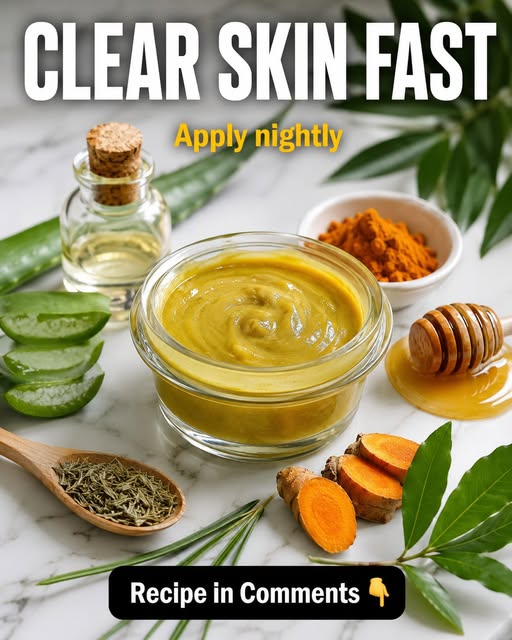
Clear, healthy-looking skin can improve confidence, but “clear skin fast” should mean calming excess oil, dryness, irritation, and dullness—not expecting acne, pigmentation, or scars to disappear overnight. A carefully chosen evening remedy may make skin feel softer, smoother, and less irritated within the first few days. However, active acne usually needs several weeks of consistent care. The following natural remedies are tailored to normal, combination, oily, dry, and sensitive skin so that each skin type receives suitable support without harsh scrubbing or unnecessary ingredients. (American Academy of Dermatology)
The ingredients below have scientific evidence for individual skin benefits, but the exact homemade mixtures have not been tested as complete clinical formulas. Therefore, consider them supportive skincare rather than medical acne treatment. Choose only the remedy designed for your skin type, perform a patch test, prepare a fresh mixture each evening, and rinse it off before sleeping.
Remedy 1: For Normal Skin — Green Tea, Aloe and Turmeric Balance Mask
Ingredients
1 tablespoon clear aloe vera inner-leaf gel; 1 tablespoon freshly prepared and cooled green tea; 1 teaspoon finely ground colloidal oatmeal or plain oat flour; ¼ teaspoon vegetable glycerin; and a very small pinch of turmeric powder.
Scientific Working of Each Ingredient
Green tea contains antioxidant polyphenols, including EGCG, that may help reduce inflammatory activity and support balanced oil production. Research suggests topical green tea preparations can improve inflammatory acne, although most studies used standardized extracts rather than homemade tea. (PubMed)
Aloe vera gel provides water-rich soothing compounds and may reduce irritation. A clinical trial found that aloe gel improved the effectiveness and tolerability of conventional topical acne treatment, but aloe alone should not be considered a complete acne cure. (PubMed)
Colloidal oatmeal contains beta-glucans and avenanthramides that support skin hydration and help calm inflammation. Vegetable glycerin attracts water into the outer skin layer and supports softness. Turmeric contains curcumin, which has antioxidant and anti-inflammatory activity, although evidence for rapid facial clearing remains limited. (PubMed)
Procedure
Mix all ingredients until smooth. Apply a thin layer to cleansed skin, avoiding the eyes and lips. Leave it on for 8–10 minutes, rinse with lukewarm water, and gently pat the face dry. Turmeric can stain, so use only a tiny amount.
How Often to Apply
Apply once in the evening for 3 consecutive days. Continue for up to 5 days only when no burning, itching, or redness develops.
Initial Results
Within 1–3 days, the skin may feel softer, calmer, and more hydrated. Existing acne, blackheads, and pigmentation are unlikely to disappear during this short period.
Remedy 2: For Combination Skin — Two-Zone Green Tea and Oat Treatment
Ingredients
1 tablespoon cooled green tea; 1 tablespoon aloe vera gel; 2 teaspoons finely ground oatmeal; ⅛ teaspoon vegetable glycerin; and 2 drops of high-linoleic sunflower seed oil.
Scientific Working of Each Ingredient
Combination skin needs lighter care on the oily forehead, nose, and chin while protecting the drier cheeks. Green tea may help reduce visible oiliness and inflammatory redness. Oatmeal provides gentle barrier support without physical scrubbing. Aloe vera supplies light hydration, while glycerin helps retain moisture. Sunflower seed oil contains barrier-supporting fatty acids and has been shown to improve hydration while preserving the integrity of the outer skin layer. (PubMed)
Procedure
Divide the oatmeal between two small bowls. For the T-zone, mix one portion with green tea to form a light paste. For the cheeks, combine the remaining oatmeal with aloe, glycerin, and sunflower oil. Apply each mixture only to its intended area. Leave for 8 minutes, rinse thoroughly, and pat dry.
How Often to Apply
Use nightly for 3 days. When well tolerated, continue for a total of 5 evenings, then reduce to 2–3 applications per week.
Initial Results
The T-zone may look less shiny, while the cheeks may feel less tight within 2–3 days. Pore size will not permanently shrink, although better hydration may temporarily make pores appear less noticeable.
Remedy 3: For Oily Skin — Green Tea and Diluted Tea Tree Night Mask
Ingredients
1 tablespoon cooled strong green tea; 1 tablespoon aloe vera gel; 1 teaspoon finely ground oatmeal; ¼ teaspoon vegetable glycerin; and only 1 drop of tea tree essential oil.
Scientific Working of Each Ingredient
Green tea polyphenols may help reduce inflammatory acne activity and excess sebum. Tea tree oil has been studied in topical acne formulations, and a randomized clinical trial found that a standardized 5% tea tree gel improved mild-to-moderate acne. However, essential oils may cause irritation or allergic reactions, and a homemade mixture is not equivalent to a clinical gel. (PubMed)
Aloe supports soothing hydration, while oatmeal may reduce dryness caused by excessive cleansing. Glycerin helps maintain water in the skin so that oily skin is not unnecessarily stripped or dehydrated. (PubMed)
Procedure
Mix the green tea, aloe, oatmeal, and glycerin first. Add exactly one drop of tea tree oil and blend thoroughly. Apply a very thin layer for 5–7 minutes, then rinse. Never apply undiluted tea tree oil directly to the face.
How Often to Apply
Patch-test before facial use. Apply on alternate evenings during the first 3 days. When no irritation develops, use once nightly for up to 5 days.
Initial Results
Oiliness and surface redness may appear reduced within 2–3 days. Inflamed pimples generally require longer treatment, and deep acne will not clear in five days.
Remedy 4: For Dry Skin — Oat, Honey and Sunflower Moisture Mask
Ingredients
2 tablespoons finely ground colloidal oatmeal; 1 tablespoon aloe vera gel; ½ teaspoon vegetable glycerin; ¼ teaspoon high-linoleic sunflower seed oil; and ½ teaspoon plain honey.
Scientific Working of Each Ingredient
Colloidal oatmeal supports the skin barrier and can improve dryness, roughness, and hydration. Glycerin acts as a humectant by attracting and retaining water in the outer skin layer. Sunflower seed oil provides emollient fatty acids and may reduce moisture loss without the barrier disruption associated with some heavier oils. (PubMed)
Aloe vera provides soothing, water-based hydration. Honey has humectant, antioxidant, and antimicrobial properties; however, research does not prove that ordinary household honey clears acne. Its purpose in this mask is moisture support rather than acne treatment. (PubMed)
Procedure
Mix all ingredients into a creamy paste. Apply to slightly damp, cleansed skin. Leave for 10 minutes, rinse gently, and pat dry. Do not use honey when you have a known allergy to honey, bees, pollen, or related substances.
How Often to Apply
Use once nightly for 3–5 days. After the initial period, apply 2–3 times weekly when needed.
Initial Results
Dryness, tightness, and rough texture may begin improving within 1–3 days. Fine dehydration lines may look temporarily softer as skin hydration improves.
Remedy 5: For Sensitive Skin — Minimal Oat Barrier-Comfort Mask
Ingredients
2 tablespoons finely powdered colloidal oatmeal; 1 tablespoon aloe vera gel; ¼ teaspoon vegetable glycerin; 2 drops of high-linoleic sunflower seed oil; and 1–2 tablespoons boiled and completely cooled water.
Scientific Working of Each Ingredient
Sensitive skin usually benefits from fewer ingredients. Colloidal oatmeal contains antioxidant and anti-inflammatory compounds and has clinical evidence for improving barrier function and hydration. Glycerin supports moisture retention, while a very small amount of sunflower seed oil provides gentle emollient support. Aloe vera may feel cooling and soothing, although some people are allergic to it. The cooled water thins the mixture and reduces rubbing during application. (PubMed)
Procedure
Mix the oatmeal and cooled water first. Add aloe, glycerin, and sunflower oil. Apply without rubbing or massaging. Leave for only 5 minutes and rinse carefully. Stop immediately if the skin stings, burns, or becomes red.
How Often to Apply
Use once daily for the first 3 days. When completely comfortable, continue for up to 5 days. Avoid introducing other new skincare ingredients during this period.
Initial Results
Sensitive skin may feel less tight and more comfortable within 1–3 days. Persistent redness, itching, swelling, or burning needs professional evaluation rather than repeated home treatments.
Final Tips for Clear and Healthy-Looking Skin
Wash the face gently rather than scrubbing it. Keep pillowcases, makeup brushes, facial cloths, and skincare tools clean. Avoid touching or squeezing pimples because picking can increase inflammation, dark marks, and scarring. (American Academy of Dermatology)
Drink enough water, sleep regularly, and protect the skin from excessive sun exposure. Perform a patch test before every new remedy and avoid lemon juice, undiluted vinegar, baking soda, toothpaste, strong essential oils, and harsh scrubs.
Visible softness and a temporary glow may begin within 2–3 days because better hydration reflects light more evenly. Long-term acne clearing, pigmentation improvement, collagen support, and wrinkle reduction require consistent care over several weeks or months and cannot be guaranteed by a five-day mask routine.
Diet Plan for Supporting Clear Skin
Follow this simple eating pattern for at least 8–12 weeks while observing how your skin responds.
Breakfast: Oatmeal with chia seeds and a small serving of berries, or eggs with whole-grain bread and vegetables.
Mid-morning: One low-sugar fruit, such as an apple, pear, orange, or guava, with a small handful of unsalted nuts.
Lunch: Brown rice, whole-grain roti, or another high-fibre carbohydrate with lentils, beans, fish, chicken, or another protein source. Fill approximately half the plate with vegetables.
Evening snack: Cucumber, carrots, roasted chickpeas, or unsweetened herbal tea.
Dinner: Vegetables with beans, lentils, fish, chicken, or eggs. Keep sugary drinks, sweets, fried foods, and highly refined snacks occasional rather than daily.
Some studies suggest that a low-glycaemic eating pattern may reduce acne severity in certain people, but diet does not replace medical treatment. Results are not universal, and highly restrictive diets are unnecessary. (American Academy of Dermatology)
How Long to Continue
Use your skin-type remedy for 3–5 days initially. When it suits your skin, reduce use to 2–3 evenings per week rather than applying a homemade mask indefinitely. Continue the balanced, lower-glycaemic diet for 8–12 weeks before judging its effect.
When acne remains unchanged, worsens, causes painful cysts, leaves scars, or affects confidence, consult a dermatologist. Seek medical advice promptly for sudden severe breakouts, facial swelling, widespread itching, infection, or a strong reaction to any ingredient. Deep or painful acne usually requires appropriate medical treatment. (American Academy of Dermatology)
References for the above remedy
- American Academy of Dermatology Association. Acne: Tips for Managing.
https://www.aad.org/public/diseases/acne/skin-care/tips - Kim S, et al. The Effects of Green Tea on Acne Vulgaris: A Systematic Review and Meta-Analysis.
https://pubmed.ncbi.nlm.nih.gov/32812270/ - Hajheydari Z, et al. Effect of Aloe Vera Topical Gel Combined with Tretinoin in Treatment of Mild and Moderate Acne Vulgaris.
https://pubmed.ncbi.nlm.nih.gov/23336746/ - Capone K, et al. Effects of Colloidal Oatmeal Topical Treatment on Skin Barrier Function and Hydration.
https://pubmed.ncbi.nlm.nih.gov/32484623/ - Fluhr JW, Darlenski R, Surber C. Glycerol and the Skin: Holistic Approach to Its Origin and Functions.
https://pubmed.ncbi.nlm.nih.gov/18510666/ - Danby SG, et al. Effect of Olive and Sunflower Seed Oil on the Adult Skin Barrier.
https://pubmed.ncbi.nlm.nih.gov/22995032/ - Vaughn AR, Branum A, Sivamani RK. Effects of Turmeric on Skin Health: A Systematic Review.
https://pubmed.ncbi.nlm.nih.gov/27213821/ - Enshaieh S, et al. The Efficacy of 5% Topical Tea Tree Oil Gel in Mild to Moderate Acne Vulgaris.
https://pubmed.ncbi.nlm.nih.gov/17314442/ - Burlando B, Cornara L. Honey in Dermatology and Skin Care: A Review.
https://pubmed.ncbi.nlm.nih.gov/24305429/ - Smith RN, et al. A Low-Glycemic-Load Diet Improves Symptoms in Acne Vulgaris Patients.
https://pubmed.ncbi.nlm.nih.gov/17616769/