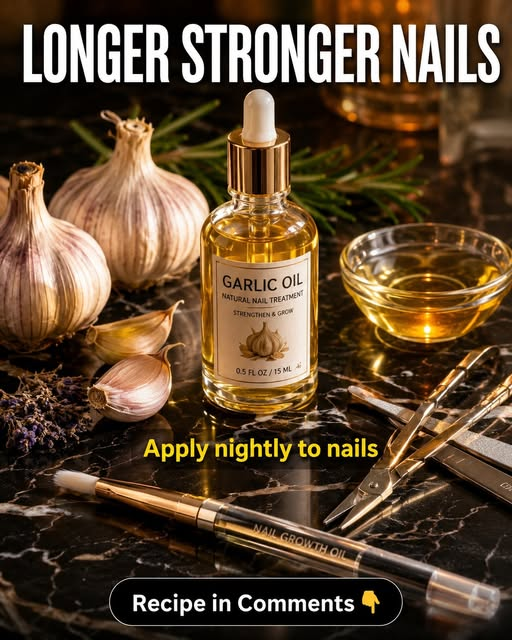
Long, smooth nails can make the hands look polished and healthy, but frequent washing, detergents, nail-polish remover, gel manicures, biting and repeated wet-and-dry cycles can leave nails peeling, splitting or breaking before they gain length. Natural oils and moisturising masks cannot force the nail matrix to produce nail faster, but they can soften dry cuticles, reduce moisture loss and protect the existing nail plate from everyday damage. Because fingernails take months to grow out, genuine improvements in thickness and breakage require patience rather than an overnight treatment. Dermatology guidance supports regular moisturising, gentle trimming and protection from excessive water and chemicals as the foundation of healthier nails. (American Academy of Dermatology)
Does Garlic Oil Really Make Nails Grow?
Garlic contains sulfur-containing compounds with laboratory antifungal activity. Garlic-derived ajoene has also been studied in formulated preparations for fungal skin infections. However, this does not prove that homemade garlic oil increases nail growth, thickness or hardness. Raw crushed garlic can cause irritant dermatitis, allergic reactions and even chemical burns when left on the skin. For this reason, rubbing raw garlic directly over the nails or covering it overnight is not recommended. (PMC)
The remedies below focus on hydration and protection—the natural approaches with the most realistic value for brittle nails. Evidence generally supports the individual moisturising ingredients or professionally prepared formulations, not the exact homemade mixtures.
Remedy 1: Sunflower and Shea Nail Balm for Normal Skin
Ingredients and Scientific Benefits
Use one teaspoon of pure sunflower-seed oil to improve flexibility around the nail folds; half a teaspoon of virgin coconut oil to provide an occlusive moisturising layer; half a teaspoon of unrefined shea butter to soften cuticles; one-quarter teaspoon of finely ground colloidal oatmeal to calm dryness; and one-quarter teaspoon of honey to help retain moisture.
Scientific Working of Each Ingredient
Sunflower-seed oil is rich in linoleic acid. Human research found that it preserved the outer skin barrier and improved hydration without causing the irritation observed with olive oil. Coconut oil has performed well as a moisturiser in a randomised trial involving people with dry skin. Colloidal oatmeal contains soothing compounds called avenanthramides and has improved hydration and barrier function in clinical studies. Shea butter mainly functions as an emollient that fills rough spaces on the surface, while honey works as a humectant and helps keep the balm from feeling excessively dry. (PubMed)
These ingredients protect the skin surrounding the nail and reduce dehydration of the visible nail plate. They do not directly stimulate the nail root.
Procedure
Warm the shea butter and coconut oil between clean fingertips. Add the sunflower oil, oatmeal and honey, then mix until smooth. Massage a rice-grain-sized amount over each nail, underneath the free edge and around the cuticle for two minutes. Leave it on for at least 30 minutes or wear clean cotton gloves overnight.
Prepare a fresh quantity every two days and keep water away from the container.
How Often to Apply
Apply nightly for five consecutive days. Continue four or five nights weekly for at least eight to twelve weeks.
Initial Results
Within one to three days, the cuticles may feel softer and the nails may look shinier. Reduction in splitting can only be assessed as protected nail grows forward over several weeks.
Remedy 2: Aloe and Green-Tea Treatment for Combination Skin
Ingredients and Scientific Benefits
Combine one teaspoon of pure aloe vera gel for lightweight hydration; one teaspoon of strongly brewed and cooled green tea for antioxidant support; half a teaspoon of colloidal oatmeal for barrier care; one-quarter teaspoon of honey for moisture retention; and four drops of sunflower-seed oil for the drier sides of the nails.
Scientific Working of Each Ingredient
This treatment suits hands with oily palms but dry cuticles. Aloe gel provides water without leaving a thick oily coating. Green tea supplies antioxidant polyphenols, although there is no clinical evidence that it accelerates nail growth. Oatmeal improves comfort around rough nail folds, while honey reduces the drying effect of a water-based mixture. A small amount of sunflower oil limits moisture loss without making the entire fingertip greasy.
Procedure
Mix the aloe, green tea, oatmeal and honey. Add the sunflower oil and whisk again. Apply the mixture over the nail plate and dry cuticle edges. Avoid spreading a heavy layer over naturally oily fingertips. Leave it on for ten minutes, rinse and dry the hands thoroughly.
Do not store this water-based mixture because it contains no preservative.
How Often to Apply
Use on alternate evenings for five days. Continue two or three times weekly for eight weeks.
Initial Results
The skin surrounding the nails may feel smoother within two or three applications. The treatment will not create visibly longer nails in this period.
Remedy 3: Light Oat Nail Mask for Oily Hands
Ingredients and Scientific Benefits
Use one teaspoon of cooled green tea; one teaspoon of aloe gel; half a teaspoon of finely ground oatmeal; half a teaspoon of rice flour; one-quarter teaspoon of honey; and three drops of sunflower-seed oil.
Scientific Working of Each Ingredient
Rice flour gives the treatment a less greasy texture and absorbs temporary surface moisture. It should not be used as a scrub because friction can damage the thin layers of a peeling nail. Aloe and green tea form a lightweight base, while oatmeal and honey reduce tightness. Three drops of sunflower oil provide limited emollience without coating oily fingertips heavily.
The purpose of this treatment is to keep the nail folds comfortable while avoiding prolonged moisture. Nails that remain wet for extended periods can become soft and more vulnerable to damage, so thorough drying is essential. Dermatologists recommend keeping nails clean, dry and moisturised appropriately. (American Academy of Dermatology)
Procedure
Mix all ingredients into a smooth, thin paste. Spread it over clean nails without pushing back or cutting the cuticles. Leave it on for five to seven minutes. Rinse thoroughly and dry around and beneath each nail.
How Often to Apply
Apply three times during the first five days. Continue twice weekly for six to eight weeks.
Initial Results
The nails may look cleaner and smoother within one to three days. Stop using the mask if the nail plate becomes soft from excessive soaking.
Remedy 4: Intensive Coconut and Beeswax Balm for Dry, Brittle Nails
Ingredients and Scientific Benefits
Combine one teaspoon of virgin coconut oil; one teaspoon of sunflower-seed oil; one teaspoon of shea butter; one-quarter teaspoon of cosmetic-grade beeswax; one-quarter teaspoon of colloidal oatmeal; and one-quarter teaspoon of honey.
Scientific Working of Each Ingredient
Coconut oil and sunflower oil soften dry skin and reduce moisture loss. Shea butter adds a rich emollient layer, while beeswax leaves a protective coating that can reduce direct contact with air and water. Oatmeal supports the surrounding skin barrier, and honey helps hold moisture within the mixture.
This balm may make brittle nails more flexible and less likely to snap from dryness. It cannot repair a split that has already travelled into the attached nail plate, and it cannot replace treatment for thyroid disease, iron deficiency, psoriasis or fungal infection. Brittle-nail reviews emphasise identifying and treating any underlying cause alongside protective care. (PMC)
Procedure
Melt the beeswax, shea butter and coconut oil gently over warm water. Remove from heat and mix in the sunflower oil. Allow it to cool slightly before adding the oatmeal and honey. Transfer it to a clean, dry container.
Massage a very small amount into every nail and cuticle at bedtime. Do not use the balm over inflamed or infected skin.
How Often to Apply
Apply every night for at least five days. Continue nightly for twelve weeks, especially after washing the hands and before sleep.
Initial Results
Rough cuticles may soften within one or two days. Nails may feel less dry within three days, but stronger new nail must grow from the base over the following months.
Remedy 5: Gentle Oat Compress for Sensitive Skin
Ingredients and Scientific Benefits
Use one teaspoon of colloidal oatmeal; two teaspoons of boiled and completely cooled water; half a teaspoon of sunflower-seed oil; one-quarter teaspoon of shea butter; and one-quarter teaspoon of vegetable glycerin.
Scientific Working of Each Ingredient
Colloidal oatmeal has direct antioxidant and anti-inflammatory activity and is widely used in barrier-supporting preparations. Sunflower oil helps preserve hydration, while shea butter creates a soft protective layer. Vegetable glycerin attracts water into the outer surface, reducing the tight feeling common around sensitive cuticles. The cooled water allows the oatmeal to form a soft compress without requiring essential oils or strongly scented ingredients. (PubMed)
Procedure
Combine the oatmeal and cooled water. Mix in the glycerin, sunflower oil and softened shea butter. Place the mixture on clean cotton gauze and rest it over the nails for five minutes. Remove the compress, rinse gently and pat the hands completely dry.
Patch-test the mixture on one finger and wait 24–48 hours before treating all nails.
How Often to Apply
Use once on the first day. When no itching, swelling or redness appears, repeat on days three and five. Continue once or twice weekly.
Initial Results
Dry, sensitive nail folds may feel calmer within one to three days. Discontinue use if irritation develops.
Final Tips for Longer and Stronger Nails
Keep nails short while they are peeling so that damaged edges do not catch and tear. File in one direction with a fine file rather than aggressively sawing from side to side. Wear gloves while washing dishes, cleaning or handling detergents. Apply a moisturising balm after handwashing, but dry underneath the nails first.
Do not cut or aggressively push back the cuticles because they help seal the space between the nail and surrounding skin. Limit acetone remover, acrylic nails and repeated gel manicures. Dermatologists note that artificial and gel nail practices can contribute to brittleness, peeling and cracking. (American Academy of Dermatology)
Visible softness and shine may begin within two to three days. Reduced breakage usually requires eight to twelve weeks, while replacing a substantially damaged fingernail can take several months.
Diet Plan for Healthy Nail Growth
Begin breakfast with cooked eggs and wholegrain toast, oatmeal with sunflower seeds and almonds, or plain yoghurt with fruit. Cooked eggs are preferable to large amounts of raw egg white because raw egg white contains avidin, which can reduce biotin absorption. (Office of Dietary Supplements)
For lunch, choose lentils, chickpeas, beans, chicken or fish with leafy vegetables and wholegrain roti or brown rice. Add a vitamin C source such as guava, citrus fruit, tomatoes or bell peppers to meals containing plant-based iron.
For dinner, include fish, eggs, tofu, chicken, beans or lentils with vegetables. Snack on almonds, peanuts, pumpkin seeds, sunflower seeds, roasted chickpeas or whole fruit. Protein supplies amino acids used throughout the body, while eggs, fish, nuts, seeds and sweet potatoes provide dietary biotin. Zinc is available from meat, seafood, beans, nuts and fortified foods. (Office of Dietary Supplements)
Continue the diet and protective nail routine for at least twelve weeks. Do not begin high-dose biotin simply because the nails are weak. Evidence in healthy people is limited, and high supplemental doses can interfere with thyroid, heart and other laboratory tests. (PubMed)
See a doctor or dermatologist if the problem persists after eight to twelve weeks or if nails become painful, swollen, thick, yellow, crumbly, deeply pitted, curved or separated from the nail bed. A new dark streak, bleeding around a nail or a change affecting only one nail also requires professional assessment. (American Academy of Dermatology)
References for the above remedy
- American Academy of Dermatology. Nail Care Secrets.
https://www.aad.org/public/everyday-care/nail-care-secrets - Chessa MA, et al. Pathogenesis, Clinical Signs and Treatment Recommendations in Brittle Nails: A Review.
https://pmc.ncbi.nlm.nih.gov/articles/PMC6994568/ - Danby SG, et al. Effect of Olive and Sunflower Seed Oil on the Adult Skin Barrier.
https://pubmed.ncbi.nlm.nih.gov/22995032/ - Agero ALC, Verallo-Rowell VM. A Randomized Double-Blind Trial Comparing Coconut Oil with Mineral Oil for Xerosis.
https://pubmed.ncbi.nlm.nih.gov/15724344/ - Capone K, et al. Effects of Colloidal Oatmeal Topical Treatment on Skin Barrier Function and Hydration.
https://pubmed.ncbi.nlm.nih.gov/32484623/ - Lipner SR. Biotin for the Treatment of Nail Disease: What Is the Evidence?
https://pubmed.ncbi.nlm.nih.gov/29057689/ - National Institutes of Health, Office of Dietary Supplements. Biotin Fact Sheet for Health Professionals.
https://ods.od.nih.gov/factsheets/Biotin-HealthProfessional/ - Sharp O, et al. A Garlic Burn.
https://pmc.ncbi.nlm.nih.gov/articles/PMC6040548/ - Ledezma E, et al. Efficacy of Ajoene in the Treatment of Tinea Pedis.
https://pubmed.ncbi.nlm.nih.gov/11050588/ - American Academy of Dermatology. Twelve Nail Changes a Dermatologist Should Examine.
https://www.aad.org/public/everyday-care/nail-care-secrets/basics/nail-changes-dermatologist-should-examine