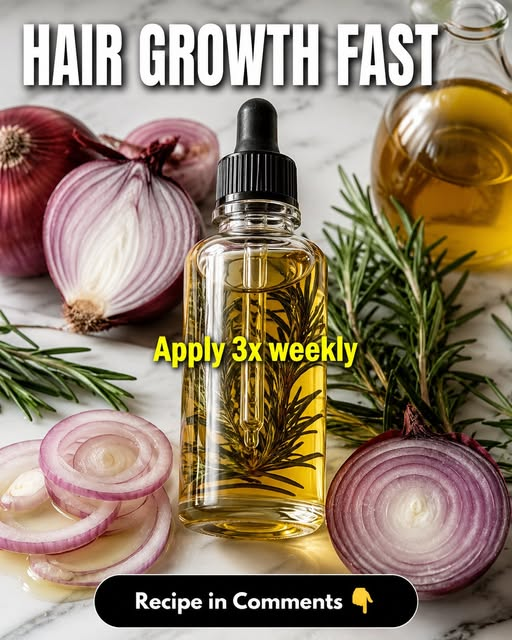
Hair thinning, excessive shedding and slow length retention can affect confidence, especially when the scalp becomes more visible or the hair keeps breaking before it grows longer. However, no onion-and-rosemary oil, kitchen mask or overnight treatment can produce dramatically longer hair within a few days. Hair growth depends on the follicles, genetics, hormones, nutrition, health conditions and the natural growth cycle. Home remedies may support scalp comfort, reduce breakage and help some types of hair loss, but identifying the cause remains essential. Dermatologists may recommend blood tests or a scalp examination when hair loss could be related to nutritional deficiency, infection, hormonal imbalance or inflammatory disease. (American Academy of Dermatology)
Among natural ingredients, rosemary oil has limited but promising human evidence. In a randomized comparative study involving androgenetic, or pattern, hair loss, rosemary oil and 2% minoxidil both increased hair count after six months. The study does not prove that rosemary works within days or that every homemade concentration is effective. Onion juice has also been studied, but only in a small trial involving patchy alopecia areata—not ordinary hereditary thinning. (PubMed)
Remedy 1: Rosemary and Jojoba Scalp Oil for a Normal Scalp
Ingredients
Jojoba oil: 2 teaspoons, providing a lightweight carrier for diluted rosemary oil.
Virgin coconut oil: 1 teaspoon, helping reduce protein loss and breakage along the hair shaft.
Sunflower-seed oil: 1 teaspoon, supporting the scalp’s protective barrier.
Argan oil: 1 teaspoon, conditioning dry strands and improving manageability.
Rosemary essential oil: 3 drops, providing the main evidence-informed botanical ingredient.
Scientific Working of Each Ingredient
Rosemary oil may influence scalp circulation and follicle activity, although its precise mechanism and ideal concentration remain uncertain. The main human trial observed meaningful hair-count changes after six months, not after a few applications. Jojoba, sunflower and argan oils mainly act as carriers and conditioners rather than direct growth stimulants.
Coconut oil has a low molecular weight and an affinity for hair proteins. Research comparing coconut, sunflower and mineral oils found that coconut oil significantly reduced protein loss from both damaged and undamaged hair. Preventing breakage does not make follicles grow faster, but it can help the hair retain length. (PubMed)
Procedure
Place all the carrier oils in a clean, dry glass bottle. Add three drops of rosemary essential oil and shake gently. Part the hair into sections and apply approximately one teaspoon of the mixture across the scalp.
Massage gently with the fingertips for four minutes without scratching or using the nails. A small study found that standardized scalp massage increased hair thickness after 24 weeks, although the evidence remains preliminary. (PubMed)
Leave the oil on for 30–45 minutes and wash with a gentle shampoo. Do not apply undiluted rosemary essential oil directly to the scalp.
How Often to Apply
Apply three times weekly for at least three months. Continue for six months before judging its effect on pattern-related thinning.
Initial Results
Within one to three days, the hair may feel softer and look shinier. Reduced dryness may appear quickly, but new growth will not be visible during this period.
Remedy 2: Short-Contact Onion and Aloe Treatment for a Combination Scalp
Ingredients
Fresh onion juice: 1 teaspoon, providing sulfur-containing plant compounds.
Boiled and completely cooled water: 2 teaspoons, reducing the strength of the raw juice.
Pure aloe vera gel: 1 teaspoon, providing lightweight hydration.
Colloidal oatmeal: ½ teaspoon, helping calm dryness and irritation.
Honey: ½ teaspoon, supporting moisture retention.
Jojoba oil: 2 drops, applied only to dry hair ends.
Scientific Working of Each Ingredient
A small controlled study found that crude onion juice produced more regrowth than tap water in people with patchy alopecia areata. This evidence does not establish onion juice as a treatment for pattern baldness, postpartum shedding, thyroid-related loss or nutritional hair loss. (PubMed)
Raw onion can also irritate the scalp. Water, aloe and oatmeal create a gentler short-contact mixture, but this diluted recipe is not equivalent to the preparation tested clinically. Honey acts mainly as a humectant, while jojoba is reserved for dry ends so an oily scalp is not heavily coated.
Procedure
Grate a small piece of onion and press it through clean gauze. Measure one teaspoon of fresh juice and mix it with cooled water, aloe, oatmeal and honey.
Patch-test behind the ear and wait 24–48 hours. When no irritation occurs, apply the fresh mixture only to the scalp. Leave it on for five to ten minutes and rinse thoroughly. Apply two drops of jojoba oil to dry ends after washing.
Do not store leftover onion treatment.
How Often to Apply
Use twice weekly for four weeks. Stop immediately if it causes burning, swelling, intense itching or a rash.
Initial Results
The scalp may feel hydrated within one to three days. Onion odor may remain temporarily. Actual regrowth cannot be expected this quickly.
Remedy 3: Honey and Green-Tea Mask for an Oily, Flaky Scalp
Ingredients
Raw honey: 1 tablespoon, providing humectant and antimicrobial properties.
Warm water: 1 teaspoon, making the honey easier to spread.
Strongly brewed and cooled green tea: 1 tablespoon, supplying antioxidant polyphenols.
Pure aloe vera gel: 1 teaspoon, providing non-greasy hydration.
Colloidal oatmeal: 1 teaspoon, helping calm itching and dryness.
Finely ground rice flour: ½ teaspoon, thickening the preparation without heavy oil.
Scientific Working of Each Ingredient
Flaking, itching and seborrheic dermatitis can increase scratching and make shedding appear worse. In a small study, diluted crude honey applied to seborrheic dermatitis every other day improved itching and scaling within weeks and produced subjective improvement in associated hair loss. The study used a much stronger honey preparation and left it on for three hours, so this shorter homemade treatment should be considered supportive rather than equivalent. (PubMed)
Green tea and aloe provide a light base, while oatmeal supports the skin barrier. Rice flour is included only to improve the consistency; it should not be rubbed into the scalp as an exfoliating scrub.
Procedure
Combine the honey and warm water until smooth. Add the green tea, aloe, oatmeal and rice flour. Apply a thin layer to the scalp, concentrating on mildly flaky areas.
Leave the mixture on for ten minutes, then rinse and shampoo gently. Avoid applying it to infected, oozing or severely inflamed skin.
How Often to Apply
Use on days one, three and five. Continue twice weekly for three to four weeks.
Initial Results
Mild tightness or surface flaking may feel better within two or three applications. Persistent dandruff usually needs an appropriate antifungal or medicated treatment.
Remedy 4: Coconut and Shea Breakage-Control Balm for a Dry Scalp and Brittle Hair
Ingredients
Virgin coconut oil: 2 teaspoons, reducing hair-shaft protein loss.
Sunflower-seed oil: 1 teaspoon, supporting scalp-barrier comfort.
Jojoba oil: 1 teaspoon, improving spreadability.
Unrefined shea butter: ½ teaspoon, sealing moisture into dry lengths.
Argan oil: ½ teaspoon, improving softness and flexibility.
Rosemary essential oil: 2 drops, providing a low-dose botanical active.
Scientific Working of Each Ingredient
This remedy is intended mainly to reduce breakage rather than accelerate follicle growth. Coconut oil can penetrate the hair fibre and reduce protein loss during washing and grooming. Shea, jojoba and argan soften rough hair and reduce friction between strands. Sunflower oil supports dry skin, while diluted rosemary supplies the ingredient with limited human hair-growth evidence. (PubMed)
Reducing breakage can make hair appear to grow more successfully because less length is lost from split or snapping ends.
Procedure
Gently soften the shea butter and coconut oil over warm water. Remove from the heat and add the sunflower, jojoba and argan oils. Mix in two drops of rosemary essential oil after the blend has cooled.
Massage a small quantity over the scalp and distribute the remaining balm through the middle lengths and ends. Leave it on for 30 minutes and shampoo thoroughly.
How Often to Apply
Apply two or three times weekly for at least five days. Continue weekly for eight to twelve weeks.
Initial Results
Hair may feel smoother and easier to detangle after the first application. A reduction in snapping requires several weeks of gentle care.
Remedy 5: Fragrance-Free Oat Compress for a Sensitive Scalp
Ingredients
Colloidal oatmeal: 1 tablespoon, supporting a sensitive skin barrier.
Boiled and completely cooled water: 2 tablespoons, forming the compress.
Pure aloe vera gel: 1 teaspoon, adding water-based hydration.
Vegetable glycerin: ¼ teaspoon, attracting moisture to the surface.
Sunflower-seed oil: ½ teaspoon, reducing water loss.
Shea butter: ¼ teaspoon, sealing dry patches after treatment.
Scientific Working of Each Ingredient
A sensitive scalp may become more irritated when treated with onion, essential oils or strongly scented preparations. Essential oils contain many chemicals capable of causing contact allergy, and rosemary-related dermatitis has been reported in susceptible individuals. (PubMed)
This simple remedy does not directly stimulate hair follicles. Its purpose is to calm dryness and reduce scratching, which can damage fragile strands. Oatmeal, glycerin, sunflower oil and shea butter support hydration, while aloe provides a cooling base.
Procedure
Mix the oatmeal, water, aloe and glycerin. Place the preparation inside clean cotton gauze and rest it gently over the irritated area for five minutes.
Remove without rubbing. Blend the sunflower oil and shea butter, then press a very thin layer over the damp scalp. Patch-test every ingredient before full application.
How Often to Apply
Apply once on the first day. When no delayed reaction occurs, repeat on days three and five. Continue once weekly.
Initial Results
The scalp may feel calmer within one to three days. Stop immediately if itching, burning, swelling or increased shedding develops.
Final Tips for Faster-Looking Hair Growth
Keep the scalp clean, but avoid aggressive scratching and very hot water. Apply shampoo mainly to the scalp and conditioner primarily to the lengths. Detangle gently with a wide-tooth comb, beginning at the ends.
Limit straighteners, curling irons, bleach, chemical relaxers and tight ponytails or braids. Excessive heat and pulling can weaken hair or cause traction alopecia, which may eventually become permanent. (American Academy of Dermatology)
Do not mix rosemary essential oil with onion juice and leave it overnight. Do not swallow essential oils, and never apply concentrated rosemary oil to broken or inflamed skin. A patch test should be completed 24–48 hours before every new topical remedy.
Improved softness and reduced tangling may begin within two to three days. Reduced breakage may become noticeable after six to eight weeks. Any genuine increase in density should be assessed after three to six months.
Diet Plan to Support Healthy Hair Growth
A diet cannot cure hereditary baldness, but inadequate protein, iron or total calorie intake can contribute to shedding. Excessive supplementation can also worsen hair loss, so nutrients should come mainly from food unless a deficiency has been diagnosed. (PubMed)
For breakfast, choose eggs with wholegrain bread, oatmeal with seeds and plain yogurt, or a chickpea-flour pancake with vegetables. At lunch, include lentils, beans, chicken, fish or chickpeas with leafy vegetables and wholegrain roti or brown rice.
Dinner can include fish, eggs, tofu, chicken or lentil soup with vegetables. Choose nuts, seeds, whole fruit, plain yogurt or roasted chickpeas as snacks. Pumpkin seeds provide protein, zinc and healthy fats. Oral pumpkin-seed oil has shown promising results in one trial involving men with androgenetic alopecia, but that study does not prove that ordinary pumpkin seeds or topical homemade oil will regrow hair. (PubMed)
Continue the appropriate home remedy and diet plan for at least twelve weeks, and allow six months when evaluating rosemary-based care. See a dermatologist if shedding persists for more than six to eight weeks, the part becomes wider, bald patches appear, or the scalp develops pain, pus, severe itching or thick scaling. Seek professional assessment sooner when hair loss is sudden or accompanied by fatigue, weight change, irregular periods, pale skin or other unexplained symptoms.
References for the above remedy
- Panahi Y, et al. Rosemary Oil vs Minoxidil 2% for the Treatment of Androgenetic Alopecia.
https://pubmed.ncbi.nlm.nih.gov/25842469/ - Sharquie KE, Al-Obaidi HK. Onion Juice, a New Topical Treatment for Alopecia Areata.
https://pubmed.ncbi.nlm.nih.gov/12126069/ - Rele AS, Mohile RB. Effect of Mineral Oil, Sunflower Oil and Coconut Oil on Prevention of Hair Damage.
https://pubmed.ncbi.nlm.nih.gov/12715094/ - Koyama T, et al. Standardized Scalp Massage Results in Increased Hair Thickness.
https://pubmed.ncbi.nlm.nih.gov/26904154/ - Al-Waili NS. Therapeutic and Prophylactic Effects of Crude Honey on Seborrheic Dermatitis and Dandruff.
https://pubmed.ncbi.nlm.nih.gov/11485891/ - Hay IC, et al. Randomized Trial of Aromatherapy for Alopecia Areata.
https://pubmed.ncbi.nlm.nih.gov/9828867/ - Cho YH, et al. Effect of Pumpkin-Seed Oil on Hair Growth in Men with Androgenetic Alopecia.
https://pubmed.ncbi.nlm.nih.gov/24864154/ - Rushton DH. Nutritional Factors and Hair Loss.
https://pubmed.ncbi.nlm.nih.gov/12190640/ - American Academy of Dermatology. Hair Loss: Diagnosis and Treatment.
https://www.aad.org/public/diseases/hair-loss/treatment/diagnosis-treat - American Academy of Dermatology. Ten Hair-Care Habits That Can Damage Your Hair.
https://www.aad.org/public/everyday-care/hair-scalp-care/hair/habits-that-damage-hair