Dandruff causes visible white or yellowish flakes, itching and scalp discomfort that can affect confidence, especially when flakes collect on dark clothing. It is usually considered a mild form of seborrheic dermatitis and is influenced by scalp oil, individual sensitivity, skin-barrier disruption and microorganisms such as Malassezia yeast. Natural treatments can reduce mild flaking and irritation, but dandruff is often recurrent rather than permanently curable. With the right routine, itching and loose flakes may begin improving within three to five days, although reliable control usually requires two to four weeks. (PMC)
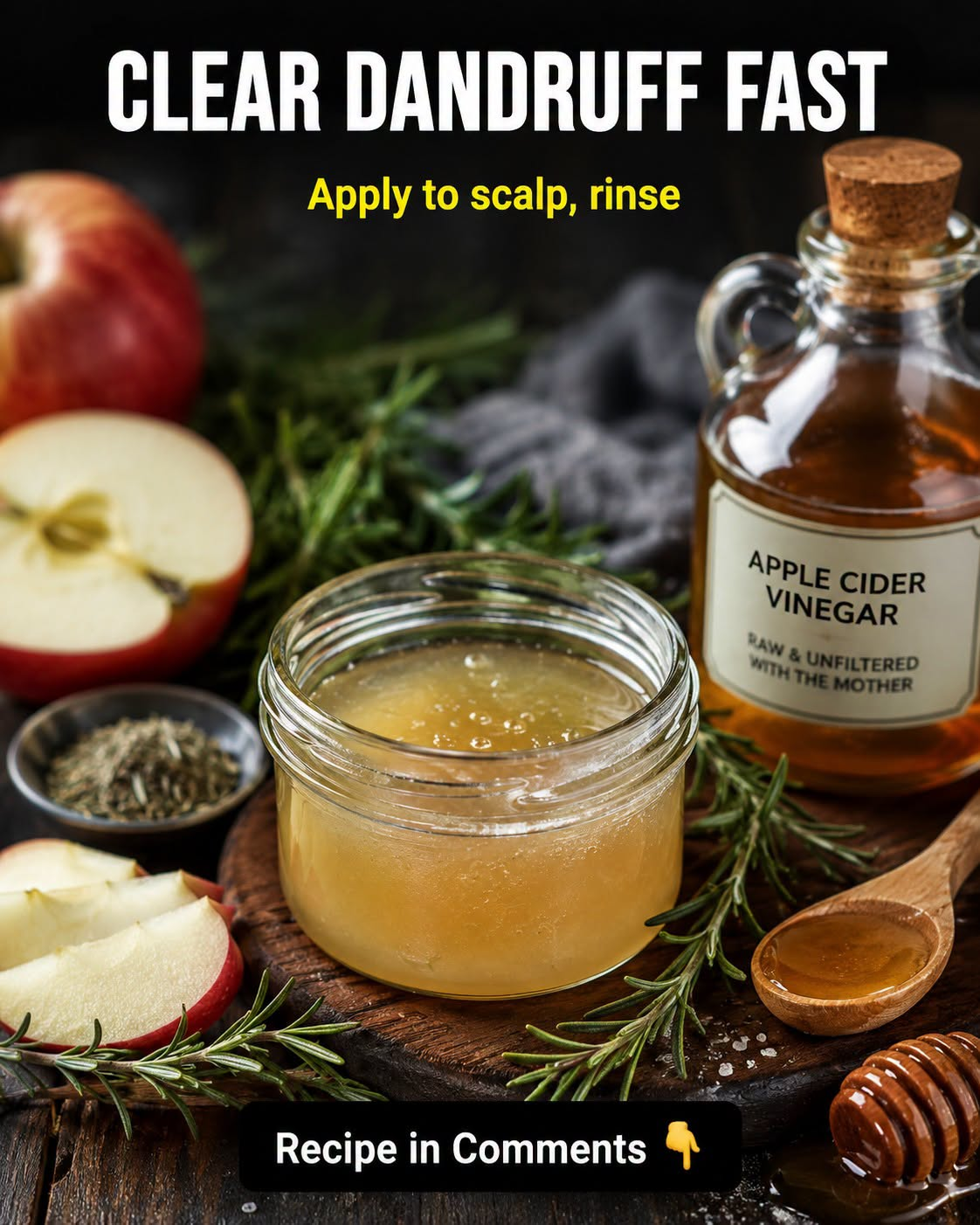
The image recommends apple cider vinegar, but strong vinegar is not a clinically established dandruff treatment. Its acetic acid may irritate inflamed skin, and improperly diluted vinegar has caused chemical burns. For that reason, the remedies below prioritize natural ingredients with better human evidence, including tea tree oil, aloe vera, honey, rosemary extract and lemongrass. Do not apply undiluted vinegar, essential oil or concentrated plant extract directly to the scalp. (PubMed)
Remedy 1: Tea Tree and Green Tea Routine for a Normal Scalp
Ingredients
- Professionally formulated 5% tea tree oil shampoo – enough for one wash
- Pure aloe vera gel – 1 tablespoon
- Cooled unsweetened green tea – 1 tablespoon
- Colloidal oatmeal – 1 teaspoon
- Raw honey – ½ teaspoon
Scientific Working of Each Ingredient
Tea tree oil contains terpinen-4-ol and related compounds with antimicrobial and anti-inflammatory activity. In a randomized controlled trial, a shampoo containing 5% tea tree oil produced a 41% improvement in dandruff severity after four weeks, compared with 11% in the placebo group. The trial also reported improvements in itching and greasiness. Use a properly formulated shampoo rather than trying to create a concentrated essential-oil mixture at home. (PubMed)
Aloe vera supplies water-rich polysaccharides that may calm irritation. Green tea provides antioxidant polyphenols, while colloidal oatmeal contains soothing avenanthramides and barrier-supporting beta-glucans. Honey acts as a humectant and has demonstrated antifungal and anti-inflammatory properties, although these supporting ingredients have not been clinically tested in this exact combination.
Procedure
Mix the aloe gel, cooled green tea, oatmeal and honey into a smooth pre-wash mask. Part the hair and apply a thin layer directly to the scalp. Leave it on for 10 minutes.
Rinse with lukewarm water. Wash the scalp with a professionally formulated shampoo containing 5% tea tree oil. Massage gently with the fingertips for the period stated on the label, then rinse thoroughly.
How Often to Apply
Use the soothing mask twice during the first five days. Use the tea tree shampoo two or three times weekly for four weeks, depending on hair type and label directions.
Initial Results
Itching and excessive greasiness may begin decreasing within two or three washes. Noticeable reduction in persistent flaking normally takes two to four weeks.
Remedy 2: Honey and Aloe Mask for a Combination Scalp
A combination scalp may become oily near the crown while feeling dry or tight around the hairline and temples.
Ingredients
- Raw honey – 1 tablespoon
- Warm boiled water – 1 teaspoon
- Pure aloe vera gel – 1 tablespoon
- Cooled green tea – 1 teaspoon
- Finely milled colloidal oatmeal – 1 teaspoon
- Sunflower seed oil – 2 drops
Scientific Working of Each Ingredient
A small clinical study investigated diluted raw honey for chronic dandruff and seborrheic dermatitis. Participants applied 90% honey diluted with warm water, and improvements were reported in itching, scaling and skin lesions. However, the study was small and lacked the stronger design of a large randomized trial, so honey should be considered a supportive option rather than a guaranteed cure. (PubMed)
A randomized, placebo-controlled trial involving adults with seborrheic dermatitis found that an aloe vera emulsion improved scaling and itching. Green tea and oatmeal may help calm irritation, while two drops of sunflower oil can soften dry areas without making the oily crown excessively greasy. (Ben-Gurion University Research Portal)
Procedure
Dilute the honey with warm water. Add the aloe, green tea and oatmeal, then stir until smooth. Mix in the sunflower oil.
Apply the mask mainly to flaky areas rather than coating the entire length of the hair. Leave it on for 20 minutes. Rinse well and wash with a gentle shampoo. Avoid very hot water because it can increase scalp dryness and irritation.
How Often to Apply
Apply on alternate days for the first five days, then continue twice weekly for three weeks.
Initial Results
The scalp may feel less tight or itchy within one to three applications. Thick, attached flakes may require several weeks of consistent treatment.
Remedy 3: Rosemary Scalp Routine for an Oily Scalp
Ingredients
- Professionally prepared, alcohol-free rosemary extract scalp lotion – as directed
- Pure aloe vera gel – 1 tablespoon
- Cooled green tea – 1 tablespoon
- Colloidal oatmeal – ½ teaspoon
- Plant-derived glycerin – 2 drops
- Boiled and cooled water – 1 tablespoon
Scientific Working of Each Ingredient
A recent double-blind randomized clinical trial compared a topical rosemary-extract lotion with 2% ketoconazole lotion in people with scalp seborrheic dermatitis. Both groups improved, although this evidence applies to a standardized rosemary formulation rather than homemade rosemary water or undiluted rosemary essential oil. (PubMed)
Aloe, oatmeal and glycerin support hydration and comfort without coating an oily scalp with heavy oils. Green tea may help reduce oxidative stress, but it should be viewed as a soothing rinse rather than an antifungal medicine.
Procedure
Mix the aloe, green tea, oatmeal, glycerin and cooled water. Apply this lightweight mixture to the irritated areas for five to eight minutes, then rinse.
After drying the scalp, use a standardized rosemary-extract scalp lotion according to its instructions. Do not substitute undiluted rosemary essential oil, which may cause burning, dermatitis or increased shedding after irritation.
How Often to Apply
Use the soothing rinse twice during the first five days. Apply the standardized rosemary lotion only at its recommended frequency.
Wash an oily scalp regularly enough to remove accumulated sebum, sweat and styling residue. Leaving heavy oil on an already greasy scalp can make flakes more noticeable.
Initial Results
Oiliness and itching may begin improving within three to five days. A clinical response to rosemary treatment should be judged over several weeks, not after one application.
Remedy 4: Coconut, Oat and Honey Pre-Wash Mask for a Dry Scalp
Ingredients
- Virgin coconut oil – 1 teaspoon
- Raw honey – 1 teaspoon
- Pure aloe vera gel – 1 tablespoon
- Colloidal oatmeal – 1 teaspoon
- Warm boiled water – 1 tablespoon
- Sunflower seed oil – 3 drops
Scientific Working of Each Ingredient
Coconut oil can reduce roughness and help limit moisture loss. A longitudinal scalp-microbiome study suggested that regular coconut-oil application encouraged microorganisms associated with a healthier scalp. However, this does not prove that coconut oil alone cures dandruff, and heavy oiling may worsen buildup in some people. (PubMed)
Honey supplies humectant and antimicrobial properties. Aloe and oatmeal soothe dry, uncomfortable skin, while sunflower oil contains linoleic acid that supports the skin barrier.
Procedure
Combine the coconut oil and honey. Mix in the aloe, oatmeal, warm water and sunflower oil.
Apply a thin layer only to dry, flaky areas. Leave it on for 15 minutes, then shampoo thoroughly. Do not leave a thick coating overnight because residual oil may trap flakes and make the scalp look greasier.
How Often to Apply
Use once on day one and again on day four. Continue once weekly for three to four weeks if it improves comfort without increasing oiliness or itching.
Initial Results
Dryness and tightness may improve after one or two applications. Loose flakes can become easier to remove during shampooing, but recurring dandruff usually needs an antifungal shampoo.
Remedy 5: Aloe and Oat Soothing Treatment for a Sensitive Scalp
Ingredients
- Pure fragrance-free aloe vera gel – 1 tablespoon
- Colloidal oatmeal – 1 tablespoon
- Rice starch – 1 teaspoon
- Boiled and cooled water – 2 tablespoons
- Plant-derived glycerin – 2 drops
Scientific Working of Each Ingredient
Sensitive scalps frequently react to fragrances, concentrated essential oils, acids and aggressive scrubbing. Aloe vera has limited but positive clinical evidence in seborrheic dermatitis, while oatmeal supports the outer barrier and reduces irritation. Rice starch gives the mixture a smooth texture, and glycerin helps retain water.
This remedy is intended to calm mild dryness and irritation. It does not directly replace proven antifungal treatment when Malassezia-related dandruff is present. Topical aloe can occasionally cause burning, itching or eczema, so patch testing remains necessary. (Taylor & Francis Online)
Procedure
Mix the oatmeal and rice starch. Gradually add the water, aloe and glycerin until a thin paste forms.
Apply to a small scalp section first. When no burning develops, spread a light layer over flaky areas. Leave it on for five minutes and rinse gently. Stop immediately if redness or itching increases.
How Often to Apply
Apply once on the first day. If no reaction develops, repeat on day three and day five.
Initial Results
The scalp may feel calmer within one to three days. Persistent yellow scales, redness or severe itching require more than a soothing mask.
What About Apple Cider Vinegar for Dandruff?
Apple cider vinegar is often promoted as a way to change scalp pH or control yeast, but reliable clinical trials proving that it clears dandruff are lacking. It should never be applied undiluted or left on an irritated, scratched or inflamed scalp. Vinegar can cause chemical injury, especially under prolonged contact. The absence of immediate burning does not prove that it is safe or effective. (PubMed)
Final Tips for Faster Dandruff Control
Wash the scalp regularly instead of relying only on dry shampoo. Use the fingertips rather than fingernails, and do not pick attached scales. Rinse shampoo and masks completely, clean combs and brushes weekly, and wash pillowcases regularly.
Avoid mixing several essential oils together. Tea tree, lemongrass and rosemary preparations used in clinical research had controlled concentrations and professionally designed bases. Homemade concentrated essential-oil treatments can cause allergic contact dermatitis.
Medicated dandruff shampoos remain the most dependable first-line option. Common active ingredients include ketoconazole, selenium sulfide, salicylic acid and zinc-based antifungal agents. The American Academy of Dermatology advises allowing the shampoo enough contact time to work and alternating active ingredients when one stops controlling the flakes. (American Academy of Dermatology)
Visible improvement may begin within three to five days, but continue the selected routine for at least two to four weeks unless irritation occurs. Dandruff may return, so maintenance washing is often necessary.
Diet Plan to Support Scalp Health
Diet alone cannot remove dandruff, but a varied eating pattern supports normal skin-barrier and immune function.
Breakfast: Oatmeal or whole-grain bread with eggs, plain yogurt or unsweetened soy food. Add berries, guava or citrus fruit.
Lunch: Lentils, beans, chicken or fish with leafy vegetables, tomatoes and brown rice or whole-grain bread.
Snack: Fresh fruit with a small portion of walnuts, almonds, pumpkin seeds or sunflower seeds.
Dinner: Fish, eggs, tofu, beans or lean meat with cooked vegetables and a whole-grain carbohydrate.
Fluids: Drink water according to thirst, climate and physical activity. Limit excessive sugary drinks and frequent heavily processed meals.
Research on diet and seborrheic dermatitis remains limited. An observational study found an association between higher fruit intake and a lower risk of seborrheic dermatitis, but it did not prove that fruit prevents or cures the condition. A recent systematic review also concluded that stronger nutritional studies are needed. (PubMed)
Continue the home-care plan for two to four weeks. See a dermatologist if dandruff remains severe, spreads to the eyebrows or ears, causes pain, bleeding, crusting, pus, patchy hair loss or sleep-disturbing itching. Medical evaluation is also important when the flakes may actually be psoriasis, eczema, fungal infection or an allergic reaction to hair dye.
References for the above remedy
- American Academy of Dermatology Association. How to Treat Dandruff.
https://www.aad.org/public/diseases/hair-and-scalp-problems/dandruff-how-to-treat - Satchell AC, et al. Treatment of Dandruff with 5% Tea Tree Oil Shampoo.
https://pubmed.ncbi.nlm.nih.gov/12451368/ - Al-Waili NS. Therapeutic and Prophylactic Effects of Crude Honey on Chronic Seborrheic Dermatitis and Dandruff.
https://pubmed.ncbi.nlm.nih.gov/11485891/ - Vardy DA, et al. A Double-Blind, Placebo-Controlled Trial of an Aloe Vera Emulsion in Seborrheic Dermatitis.
https://doi.org/10.3109/09546639909055904 - Chaisripipat W, et al. Anti-Dandruff Hair Tonic Containing Lemongrass Essential Oil.
https://pubmed.ncbi.nlm.nih.gov/26566122/ - Panahi Y, et al. Efficacy of Topical Rosemary Extract Lotion Versus Ketoconazole in Seborrheic Dermatitis.
https://pubmed.ncbi.nlm.nih.gov/39652968/ - Saxena R, et al. Longitudinal Study of the Scalp Microbiome and Coconut Oil.
https://pubmed.ncbi.nlm.nih.gov/33790324/ - Borda LJ, Wikramanayake TC. Seborrheic Dermatitis and Dandruff: A Comprehensive Review.
https://pmc.ncbi.nlm.nih.gov/articles/PMC4852869/ - Feldstein S, et al. Chemical Burn from Vinegar Following an Internet-Based Protocol.
https://pubmed.ncbi.nlm.nih.gov/26155328/ - Woolhiser E, et al. Nutrition, Obesity, and Seborrheic Dermatitis: A Systematic Review.
https://pubmed.ncbi.nlm.nih.gov/39102684/