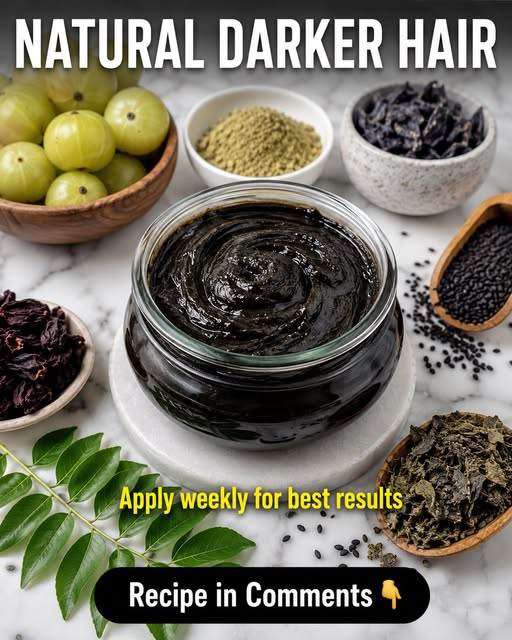
Dark, glossy hair can create a healthier and more youthful appearance, but natural greying occurs when hair follicles gradually stop producing enough melanin. Genetics and ageing are the leading causes, while unusually early greying may sometimes be associated with vitamin B12 deficiency, thyroid disorders, iron or copper deficiency, smoking and certain autoimmune conditions. Once a strand has grown without pigment, kitchen ingredients cannot reliably restart melanin production inside it. Natural plant dyes can, however, coat or penetrate the hair shaft and temporarily produce brown, auburn or black tones. (American Academy of Dermatology)
The image shows amla, black seeds, curry leaves and other traditional herbs. These ingredients may condition the hair or contribute tannins and antioxidants, but strong clinical evidence that they permanently reverse white hair is lacking. The most dependable natural darkening ingredients are henna and indigo. Henna supplies lawsone, a reddish-brown pigment that binds with hair keratin, while indigo deposits a blue pigment over the henna base to create dark brown or black results. Botanical colours are usually temporary or semi-permanent and fade gradually with washing and sunlight. (PMC)
Always complete a skin patch test and a hidden-strand test at least 48 hours before colouring the entire head. Prepare enough mixture for one application and do not store wet herbal dye.
Remedy 1: Amla, Coffee and Henna Colour Pack for Normal Hair
Ingredients
- Pure henna powder: 4 tablespoons
- Amla powder: 1 tablespoon
- Strong black coffee: ½ cup
- Hibiscus powder: 1 tablespoon
- Acacia catechu powder, also called kattha: 1 teaspoon
- Pure aloe vera gel: 1 tablespoon
Scientific Working of Each Ingredient
Henna provides the main colour through lawsone, a plant pigment that interacts with keratin and produces a copper-to-brown stain. Amla contains tannins and is traditionally used to reduce the overly orange appearance of henna. Coffee and kattha contribute brown pigments and tannins that can temporarily deepen the final tone. Hibiscus supplies anthocyanin pigments, while aloe helps make the paste easier to spread.
A human-volunteer study evaluated herbal formulations containing henna, amla, coffee, hibiscus, kattha and other botanicals. The highest-performing formulation produced measurable dark colouring and had the greatest volunteer acceptance. However, the professionally prepared extract in that research is not identical to a homemade mixture, so individual results will vary. (PMC)
Procedure
Brew strong unsweetened coffee and let it cool until warm. Mix the henna, amla, hibiscus and kattha powders. Add the coffee gradually until a smooth, yogurt-like paste forms. Stir in the aloe vera gel.
Cover the bowl and allow the mixture to rest according to the instructions supplied with the henna powder. Apply it to clean, dry hair, concentrating on grey strands and roots. Wear gloves and protect the hairline with a little plain oil.
Leave the mixture on for 90–120 minutes. Rinse thoroughly with water and avoid shampooing until the following day.
How Often to Apply
Apply once every three to four weeks. Weekly colouring is generally unnecessary and may make the hair feel dry.
Initial Results
Grey strands may develop a warm brown or reddish-brown tone after one application. The colour can deepen during the following 24–48 hours.
Remedy 2: Black Tea and Henna Gloss for Combination Hair
Ingredients
- Pure henna powder: 3 tablespoons
- Indigo powder: 1 tablespoon
- Strong black tea: ½ cup
- Amla powder: 1 teaspoon
- Colloidal oatmeal: 1 teaspoon
- Aloe vera gel: 1 tablespoon
Scientific Working of Each Ingredient
This formula is suitable for hair that becomes oily at the roots but dry through the lengths. Henna gives the necessary warm base, while a smaller quantity of indigo changes the colour toward medium or dark brown. Black tea contains tannins that may deposit a temporary darker tone. Laboratory research has investigated black-tea extracts for colouring white hair, although an ordinary tea rinse is much weaker than the formulated delivery system used in that research. (PubMed)
Aloe and oatmeal do not darken hair. They reduce the rough, dry feeling that herbal powders can sometimes leave.
Procedure
Prepare very strong black tea and cool it until lukewarm. Mix the henna, amla and oatmeal, then add enough tea to form a paste. Stir in the aloe.
Add the indigo immediately before application because freshly mixed indigo begins losing dye strength relatively quickly. Apply more paste to the grey roots and a thinner layer over dry lengths.
Leave it on for 60–90 minutes, then rinse carefully.
How Often to Apply
Use once every four weeks. During later applications, treat only the new roots and apply the remaining paste to the lengths for the final 10–15 minutes.
Initial Results
White strands may become warm medium brown after the first treatment. A one-step henna-and-indigo mixture normally gives brown rather than jet-black colour.
Remedy 3: Two-Step Henna and Indigo Treatment for Oily Hair
Ingredients
- Pure henna powder: 4 tablespoons
- Amla powder: 1 teaspoon
- Warm water: as required
- Pure indigo powder: 4 tablespoons
- Fine salt: ¼ teaspoon
- Rice starch: 1 teaspoon
Scientific Working of Each Ingredient
The two-step method offers the strongest naturally derived black or brown-black coverage. Henna colours the white strand orange-copper first. Indigo then deposits blue pigment over this warm foundation, creating a much darker optical result. Reviews of natural hair colourants describe henna quinones and indigo compounds as direct dyes that attach to the cuticle and partially enter the hair structure. (PMC)
Amla can cool the warmth of the first stage. Rice starch thickens the indigo paste without adding oil, making this method more comfortable for greasy roots.
Procedure
First, mix the henna and amla with warm water. Let the paste rest according to the henna instructions, apply it to the hair and leave it on for 90 minutes. Rinse it out completely.
Immediately prepare the second paste by combining indigo, salt, rice starch and warm water. Apply it to the freshly henna-coloured strands. Leave it on for 45 minutes for dark brown or up to 90 minutes for a deeper tone.
Rinse with water and delay shampooing for 24–48 hours.
How Often to Apply
Repeat every four to six weeks or when new white roots become noticeable.
Initial Results
Grey hair should darken after the first complete session. The shade normally continues developing for one or two days as the plant pigments oxidize.
Remedy 4: Moisture-Protective Herbal Colour for Dry Hair
Ingredients
- Pure henna powder: 3 tablespoons
- Pure indigo powder: 2 tablespoons
- Fenugreek powder: 1 teaspoon
- Aloe vera gel: 1 tablespoon
- Warm water: as required
- Virgin coconut oil: ½ teaspoon
- Sunflower seed oil: ½ teaspoon
Scientific Working of Each Ingredient
Henna and indigo provide the actual colour. Fenugreek becomes slippery when hydrated and helps reduce tangling during application. Aloe adds water-based moisture.
Coconut oil is best used after the dye has developed rather than mixed heavily into the colour paste. Research shows that coconut oil can enter the hair fibre and reduce protein loss, helping dry, fragile hair retain length and softness. Sunflower oil adds surface lubrication but does not change natural pigment production.
Procedure
Mix the henna, fenugreek and aloe with warm water. Allow the henna to release its dye, apply it for 60–90 minutes and rinse.
Prepare the indigo separately with warm water. Apply it for 30–60 minutes, depending on the desired darkness, and rinse again.
Wait until the following day. Mix the coconut and sunflower oils, rub two or three drops between the palms and smooth them over damp lengths and ends.
How Often to Apply
Colour the roots once every four to six weeks. Use the light conditioning oil once or twice weekly.
Initial Results
Grey strands may become brown or brown-black after colouring. Dryness and tangling may improve within one to three conditioning applications, although this does not represent biological reversal of greying.
Remedy 5: Minimal Brown Colour Pack for Sensitive Scalp
Ingredients
- Body-art-quality pure henna: 3 tablespoons
- Pure indigo powder: 1 tablespoon
- Colloidal oatmeal: 1 teaspoon
- Aloe vera gel: 1 tablespoon
- Boiled and cooled water: as required
- Sunflower seed oil: 2 drops
Scientific Working of Each Ingredient
Sensitive scalps benefit from a shorter ingredient list. Pure henna generally produces reddish-brown colour and has lower allergenic potential than many permanent oxidative dyes, although reactions are still possible. A small quantity of indigo can deepen the colour to brown.
Oatmeal and aloe support scalp comfort, while sunflower oil can be placed around the hairline to limit staining and dryness. Plant-based does not automatically mean allergy-free: reactions to pure henna, black tea and indigo have all been reported. (PubMed)
Procedure
Patch-test the henna and indigo separately behind the ear or on the inner elbow for 48 hours.
Mix the henna, oatmeal, aloe and water into a paste. Apply it for 45–60 minutes and rinse. When the separate indigo patch test is negative, mix the indigo with water and apply it for 20–30 minutes.
Rinse immediately if burning, swelling or intense itching develops.
How Often to Apply
Use no more than once monthly. Avoid colouring while the scalp is scratched, sunburned, inflamed or affected by active eczema.
Initial Results
The first stage creates an auburn or copper-brown result. The shorter indigo stage can deepen this to medium brown, but may not produce complete black coverage.
Do Amla, Curry Leaves and Black Sesame Reverse Grey Hair?
Amla, curry leaves and black sesame are nutritious traditional ingredients, but applying their paste or oil has not been shown in strong clinical trials to permanently reactivate pigment production in established white hair. They may condition the hair and make naturally dark strands appear shinier, which can create the impression of a richer colour.
Natural plant dyes work cosmetically by colouring the existing strand. They do not repair inactive melanocytes inside the follicle. Dermatologists currently report that no consistently effective medical treatment can return normal age-related grey hair to its previous colour. Correcting an underlying nutritional or thyroid disorder may help selected people with premature greying. (American Academy of Dermatology)
Final Tips for Safer Natural Hair Darkening
Wear gloves, protect clothing and complete a new patch test before every application. Ingredient composition can vary between batches, and a person can develop an allergy after previously tolerating a dye.
Avoid powders marketed as “instant black henna.” Products using that name may contain para-phenylenediamine, or PPD, which can cause severe blistering, swelling and allergic sensitization. Read the full ingredient list and avoid products containing undisclosed blackening agents, metallic salts or synthetic colour boosters. The FDA advises patch-testing every dye, following the stated processing time and never using scalp hair dye on eyelashes or eyebrows. (U.S. Food and Drug Administration)
Do not colour the hair within 14 days of bleaching, perming or chemical relaxing. Rinse the scalp well, avoid excessive heat styling and use gentle shampoo to slow colour fading. Botanical colour can fade faster after frequent washing and ultraviolet exposure.
Diet Plan to Support Normal Hair Pigmentation
Diet cannot recolour already-white strands unless greying is related to a correctable deficiency, but balanced nutrition supports normal follicle function.
Breakfast: Eat eggs, milk, plain yogurt or fortified plant milk with whole-grain bread or oatmeal. These foods can provide protein and vitamin B12.
Lunch: Include lentils, chickpeas, fish, chicken or lean meat with leafy vegetables and a vitamin-C-rich food.
Snack: Choose black sesame, pumpkin seeds, almonds, cashews or roasted chickpeas. Seeds and nuts supply protein, copper and other minerals, but they should not be treated as instant grey-hair cures.
Dinner: Eat beans, tofu, eggs, fish or lean meat with vegetables and whole grains.
For vegetarians and vegans: Use reliably fortified vitamin B12 foods and discuss testing or supplementation with a healthcare professional.
Follow this eating pattern for at least eight to twelve weeks. Do not take iron, copper, vitamin B12 or other high-dose supplements without confirming a deficiency, because unnecessary supplementation can be ineffective or harmful.
Consult a dermatologist or doctor when greying begins suddenly, develops during childhood or early adulthood, or progresses together with fatigue, numbness, pale skin, hair loss, weight changes or symptoms of thyroid disease. Blood tests may be recommended for vitamin B12, ferritin, folate and thyroid function. (PMC)
References for the above remedy
- American Academy of Dermatology Association. What Causes Gray Hair, and Can I Stop It?
https://www.aad.org/public/everyday-care/hair-scalp-care/hair/gray-hair-causes - Kumar AB, Shamim H, Nagaraju U. Premature Graying of Hair: Review with Updates.
https://pmc.ncbi.nlm.nih.gov/articles/PMC6290285/ - Cui H, et al. Recent Advancements in Natural Plant Colorants Used for Hair Dye Applications.
https://pmc.ncbi.nlm.nih.gov/articles/PMC9692289/ - Singh V, et al. Study of Colouring Effect of Herbal Hair Formulations on Graying Hair.
https://pmc.ncbi.nlm.nih.gov/articles/PMC4471652/ - Saini R, et al. Traditional Uses, Bioactive Composition, Pharmacology and Toxicology of Indian Gooseberry.
https://pubmed.ncbi.nlm.nih.gov/34480995/ - Sonthalia S, et al. Association of Vitamin B12 Deficiency and Thyroid Dysfunction with Premature Hair Graying.
https://pmc.ncbi.nlm.nih.gov/articles/PMC5448266/ - U.S. Food and Drug Administration. Hair Dyes: Safety Information and Precautions.
https://www.fda.gov/cosmetics/cosmetic-products/hair-dyes - U.S. Food and Drug Administration. Temporary Tattoos, Henna and Black Henna Fact Sheet.
https://www.fda.gov/cosmetics/cosmetic-products/temporary-tattoos-hennamehndi-and-black-henna-fact-sheet - He L, et al. Hair Dye Ingredients and Potential Health Risks.
https://pmc.ncbi.nlm.nih.gov/articles/PMC9214764/ - Poonia K, Bhalla M. Premature Graying of Hair: A Comprehensive Review and Recent Insights.
https://pmc.ncbi.nlm.nih.gov/articles/PMC11444426/