
Naturally pink, smooth lips are often associated with a fresh and healthy appearance, but lip colour is largely determined by genetics and natural melanin. Lips may become darker or duller because of sun exposure, smoking, dehydration, repeated licking, irritating cosmetics, allergic cheilitis, or inflammation. Home remedies cannot safely bleach genetically pigmented lips, but they can repair dryness, remove loose flakes without scrubbing, prevent further irritation, and restore the lips’ natural healthy-looking tone. Lip hyperpigmentation can also have medical, hormonal, inflammatory, or medication-related causes, so persistent or rapidly changing colour should be professionally assessed. (PubMed)
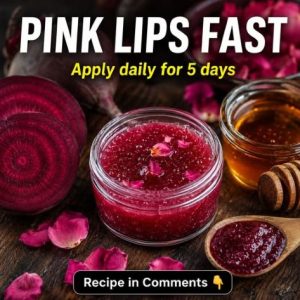
The beetroot and honey mixture shown in the image can temporarily stain the lips red, but beetroot has not been clinically proven to reduce melanin or permanently make dark lips pink. Honey may improve moisture, but it is not a proven lightening treatment. Lemon juice, sugar scrubs, baking soda, toothpaste, cinnamon, peppermint oil, rose fragrance, and undiluted essential oils have been excluded because irritation can lead to additional dryness and pigmentation. Dermatologists advise stopping any lip product that burns, stings, or tingles. (American Academy of Dermatology)
Patch-test every ingredient for 24 hours before applying it to the lips. Do not use these remedies on bleeding cracks, cold sores, infected skin, or unexplained ulcers.
Remedy 1: For Normal Lips
Shea, Sunflower and Hemp Softening Balm
Ingredients and Scientific Working
- Shea butter — 1 teaspoon: Creates an emollient layer that softens rough lip skin and reduces moisture loss.
- Hemp seed oil — ½ teaspoon: A lightweight oil recommended by dermatologists as a potentially helpful ingredient for chapped lips.
- High-linoleic sunflower oil — ½ teaspoon: Supports the skin barrier and helps prevent excessive water loss.
- Virgin coconut oil — ¼ teaspoon: Clinical research shows that coconut oil can improve skin hydration and surface lipid levels.
- Castor seed oil — ¼ teaspoon: Improves slip and reduces friction between dry lip surfaces.
- Colloidal oatmeal — a small pinch: Oat beta-glucans and avenanthramides help support hydration and calm irritation.
The scientific purpose of this balm is to improve barrier function rather than bleach the lips. Better hydration makes the surface smoother and helps the lips reflect light more evenly, which can make their natural colour appear fresher. Shea butter, hemp oil, and castor oil are among the ingredients recommended for chapped-lip care. (American Academy of Dermatology)
Procedure
Place the shea butter and coconut oil in a heat-safe bowl. Stand the bowl in warm water until the ingredients soften. Add the sunflower, hemp, and castor oils, followed by a small pinch of colloidal oatmeal.
Transfer the mixture to a clean container and allow it to cool. Apply a rice-grain-sized amount to clean lips without rubbing vigorously.
How Often to Apply
Apply three times daily for the first five days, including once before bed. Continue twice daily for three to four weeks.
Initial Results
Within one to three days, the lips may feel smoother, softer, and less tight. Their natural tone may appear brighter as dryness improves, but permanent colour change should not be expected.
Remedy 2: For Combination Lips
Combination lips may have flaky edges while the centre remains relatively soft.
Honey, Aloe and Oat Hydration Mask
Ingredients and Scientific Working
- Pasteurized honey — ½ teaspoon: Acts as a humectant that attracts water to the surface.
- Pure aloe vera gel — ½ teaspoon: Supplies lightweight moisture and helps create a soothing texture.
- Colloidal oatmeal — ¼ teaspoon: Reduces dryness and supports the delicate barrier.
- Boiled and cooled water — ½ teaspoon: Softens the oatmeal so no scrubbing is required.
- Sunflower seed oil — 2 drops: Helps seal moisture into the dry lip edges.
- Shea butter — a rice-grain-sized amount: Forms a protective layer after the mask is removed.
Research involving honey mainly relates to medical wound dressings rather than cosmetic lip lightening. It is included here for its moisture-supporting properties, not as a pigmentation remover. (PubMed)
Procedure
Combine the oatmeal and cooled water and leave them for one minute. Add the honey and aloe gel.
Apply the mixture gently without massaging. Leave it on for five minutes, rinse with lukewarm water, and pat dry. Apply two drops of sunflower oil to the flaky edges, followed by a very thin layer of shea butter.
Prepare the mask fresh for every application.
How Often to Apply
Use once daily for three to five days. After the flaking improves, reduce application to twice weekly.
Initial Results
Loose flakes and tightness may improve within one to three days. Smoother lips may appear more evenly coloured because cracked areas no longer create dull shadows.
Remedy 3: For Acne-Prone Skin Around the Lips
The lips do not produce facial sebum, but heavy balms can spread onto acne-prone skin surrounding the mouth.
Lightweight Aloe and Hemp Lip Seal
Ingredients and Scientific Working
- Pure aloe vera gel — ½ teaspoon: Provides water-based hydration without a heavy oily coating.
- Hemp seed oil — ¼ teaspoon: Softens the lips with a lightweight texture.
- High-linoleic sunflower oil — ¼ teaspoon: Supports barrier repair and reduces dryness.
- Shea butter — ¼ teaspoon: Provides limited occlusion when used sparingly.
- Colloidal oatmeal — a small pinch: Helps calm irritated or overwashed lips.
- Boiled and cooled water — ½ teaspoon: Dilutes the gel and allows thin application.
This treatment is designed to stay on the coloured lip surface rather than spread onto the skin around the mouth. The oils provide lubrication, while aloe, water, and oatmeal support hydration.
Procedure
Mix the aloe gel, cooled water, and oatmeal. Add the hemp and sunflower oils and whisk thoroughly.
Apply the mixture to the lips for five minutes and rinse. Seal the remaining moisture with the smallest possible amount of shea butter. Keep the treatment within the natural lip border.
How Often to Apply
Use once daily for the first five days. Continue three times weekly if it does not cause bumps or redness around the mouth.
Initial Results
The lips may feel more comfortable within one to three days without developing a thick, greasy coating. Stop treatment if small bumps, itching, or a spreading rash appears.
Remedy 4: For Very Dry and Cracked Lips
Intensive Coconut, Shea and Oat Night Mask
Ingredients and Scientific Working
- Virgin coconut oil — 1 teaspoon: Improves hydration and reduces roughness.
- Shea butter — 1 teaspoon: Softens thick flakes and limits overnight moisture loss.
- Sunflower seed oil — ½ teaspoon: Supplies barrier-supporting linoleic acid.
- Castor seed oil — ¼ teaspoon: Reduces friction over dry or peeling areas.
- Colloidal oatmeal — ¼ teaspoon: Helps soothe irritation and maintain moisture.
- Pasteurized honey — ¼ teaspoon: Adds humectant support when honey is tolerated.
Clinical research supports coconut oil as a moisturizer and sunflower oil as a barrier-supporting oil. Colloidal oatmeal has also demonstrated benefits for dry, irritated skin. These findings relate to moisture and barrier repair, not permanent lip lightening. (PubMed)
Procedure
Soften the shea butter and coconut oil in a warm-water bath. Add the sunflower and castor oils. Once the mixture is cool, blend a single-use portion with honey and oatmeal.
Before bed, dampen the lips with clean water. Apply a thin layer of the mask and leave it on for 15 minutes. Remove the excess gently, leaving a light protective coating overnight.
How Often to Apply
Apply nightly for five days. Continue every night for two to three weeks if the lips remain severely dry.
Initial Results
Tightness and superficial flaking may begin improving within one to three nights. Deeper cracks may require two to three weeks and should not be peeled.
Remedy 5: For Sensitive Lips
Minimal Oat and Shea Recovery Treatment
Ingredients and Scientific Working
- Colloidal oatmeal — ¼ teaspoon: Provides soothing and barrier-supporting compounds.
- Boiled and cooled water — 1 teaspoon: Creates a gentle, fragrance-free base.
- Pure shea butter — ¼ teaspoon: Seals moisture into the lips.
- High-linoleic sunflower oil — 2 drops: Reduces moisture loss.
- Pure aloe vera gel — ¼ teaspoon: Adds hydration when already known to be tolerated.
Lip products can cause allergic contact cheilitis, with reported triggers including castor oil, fragrances, flavourings, waxes, propolis, and sunscreen ingredients. Sensitive lips therefore benefit from short contact times and as few ingredients as possible. (PubMed)
Procedure
Combine the oatmeal and water. Add aloe only if you have used it safely before.
Apply the mixture to a small section of the lower lip for three minutes. Observe the area for 24 hours. After a successful test, apply it across the lips for five minutes and rinse.
Seal the lips with shea butter mixed with two drops of sunflower oil. Stop immediately if burning, swelling, itching, or worsening darkness develops.
How Often to Apply
Use every other day for the first five days. Continue twice weekly, while applying the tolerated shea-and-sunflower seal daily.
Initial Results
Irritation-related dryness may begin settling within two to three days after the triggering product is discontinued. Pigmentation caused by chronic inflammation can take several weeks or months to improve.
Final Tips for Naturally Healthy-Looking Lips
Apply a fragrance-free SPF 30 or higher lip balm before going outdoors and reapply it every two hours. Ultraviolet exposure can worsen dryness and uneven pigmentation. Persistent sun-related scaling can also indicate actinic cheilitis, a potentially precancerous condition that requires medical evaluation. (American Academy of Dermatology)
Do not lick, bite, peel, or scrub your lips. Saliva evaporates quickly and leaves the lips drier, while repeated licking can cause irritant dermatitis around the mouth. (PubMed)
Avoid lip products containing lemon, citrus flavour, cinnamon, mint, menthol, camphor, eucalyptus, peppermint oil, perfume, or “plumping” ingredients. Tingling is usually a sign of irritation rather than proof that a product is working.
Beetroot can be used occasionally as a temporary cosmetic tint after a successful patch test, but it should not be scrubbed into the lips or presented as a permanent pigmentation treatment.
Visible softness and a healthier glow may begin within two to three days. Fine dehydration lines may look less noticeable with continued moisturising, but natural melanin and established lip wrinkles will not be removed by a five-day remedy.
Smoking is strongly associated with increased lip and gingival pigmentation. Stopping tobacco exposure can help prevent additional darkening while providing significant overall health benefits. (PubMed)
Home Remedy and Diet Plan
Select one remedy and follow it consistently for two to three weeks. Irritation-related pigmentation may require eight to twelve weeks or longer to improve after the trigger has been removed.
Breakfast: Eat eggs, oats, yogurt, or fortified cereal with a vitamin C-rich fruit.
Lunch: Choose lentils, beans, chicken, fish, or meat with vegetables and whole-grain roti or rice.
Snack: Have fresh fruit, nuts, seeds, or plain yogurt.
Dinner: Include a protein source with cooked vegetables and whole grains.
Fluids: Drink water regularly according to thirst, climate, and physical activity. Water helps prevent general dehydration but cannot directly bleach dark lips.
Include dietary sources of iron, vitamin B12, folate, zinc, and riboflavin. Eggs, dairy foods, meat, fish, lentils, beans, leafy vegetables, and fortified grains can help meet these needs. Nutritional deficiencies may contribute to cracking or inflammation around the corners of the mouth, but supplements should only be taken after appropriate medical assessment. (PubMed)
See a doctor or dermatologist if dryness, cracking, burning, or pigmentation persists beyond two to three weeks. Seek earlier evaluation for a changing dark patch, persistent scaling on one lip, bleeding, swelling, ulcers, white patches, painful corner cracks, or a sore that does not heal.
References for the above remedy
- American Academy of Dermatology. Seven dermatologists’ tips for healing dry, chapped lips.
URL: https://www.aad.org/public/everyday-care/skin-care-basics/dry/heal-dry-chapped-lips - Alawi F. Approaches to the evaluation of lip hyperpigmentation.
URL: https://pubmed.ncbi.nlm.nih.gov/22715817/ - Agero ALC, Verallo-Rowell VM. A randomized double-blind trial comparing virgin coconut oil with mineral oil for xerosis.
URL: https://pubmed.ncbi.nlm.nih.gov/15724344/ - Danby SG, et al. Effect of olive and sunflower seed oil on the adult skin barrier.
URL: https://pubmed.ncbi.nlm.nih.gov/22995032/ - Capone K, et al. Effects of colloidal oatmeal cream on skin-barrier properties.
URL: https://pubmed.ncbi.nlm.nih.gov/32484623/ - Jull AB, et al. Honey as a topical treatment for wounds.
URL: https://pubmed.ncbi.nlm.nih.gov/25742878/ - Pal B, et al. Allergic contact dermatitis to lip-care cosmetic products: A systematic review.
URL: https://pubmed.ncbi.nlm.nih.gov/37904533/ - Fonseca A, et al. Practical interventions in lip-licking dermatitis.
URL: https://pubmed.ncbi.nlm.nih.gov/33898702/ - Haresaku S, et al. Association of lip pigmentation with smoking and gingival melanin pigmentation.
URL: https://pubmed.ncbi.nlm.nih.gov/17241433/ - Bolognia-related clinical review. Cheilitis: A diagnostic algorithm and review of underlying etiologies.
URL: https://pubmed.ncbi.nlm.nih.gov/38422211/