
Hair thinning, slow length retention, widening of the part, and excessive shedding can affect confidence, but no homemade oil can create visible new hair in a few days. Hair loss may be related to genetics, hormonal changes, illness, childbirth, restrictive dieting, nutritional deficiencies, autoimmune disease, scalp inflammation, tight hairstyles, or repeated chemical damage. Rosemary oil has limited but promising human evidence for androgenetic alopecia, while onion juice has been studied mainly for patchy alopecia areata. These ingredients should not be presented as universal cures for every form of hair loss. (PubMed)
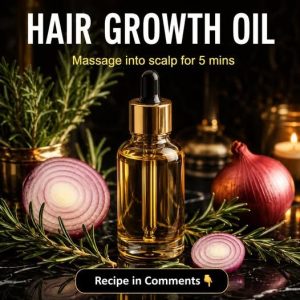
The image recommends combining onion and rosemary oil, massaging for ten minutes, and leaving it overnight. A safer approach is to use diluted rosemary oil as a short pre-shampoo treatment and fresh onion juice as a separate rinse-off mask. Raw onion juice contains water, microorganisms, and reactive sulfur compounds, so it should not be stored inside a bottle of oil or left on the scalp overnight. Rosemary essential oil must also be diluted because concentrated rosemary can trigger itching, redness, or allergic contact dermatitis. (PubMed)
Patch-test every mixture for 24 hours. Do not apply these remedies to broken skin, infected follicles, severe dandruff, psoriasis flares, painful bumps, or a burning scalp.
Remedy 1: For a Normal Scalp
Rosemary and Pumpkin Seed Pre-Shampoo Oil
Ingredients and Scientific Working
Pumpkin seed oil — 1 tablespoon: Topical pumpkin seed oil showed promising changes in hair-shaft diversity, vellus hairs, and regrowing hairs in a randomized trial involving women with pattern hair loss.
Grapeseed oil — 1 tablespoon: This lightweight carrier helps spread and safely dilute rosemary essential oil. Grapeseed and jojoba oils were used as carriers in a controlled aromatherapy study for alopecia areata.
Virgin coconut oil — 1 teaspoon: Coconut oil penetrates the hair fibre and reduces protein loss, helping prevent breakage so hair can retain more length.
Jojoba oil — 1 teaspoon: Jojoba improves lubrication and makes the blend easier to distribute without excessive pulling.
Rosemary essential oil — 4 drops: In a six-month comparative trial, rosemary oil increased hair counts in participants with androgenetic alopecia. No significant increase occurred at three months, demonstrating that results are gradual.
Lavender essential oil — 1 drop: Lavender was part of a clinically studied essential-oil blend for alopecia areata, although the study does not prove that lavender alone stimulates growth. (PubMed)
Procedure
Combine all the oils in a clean, dark glass bottle. Shake gently before every application.
Part the hair into four to six sections. Apply approximately one teaspoon of oil across the scalp rather than saturating the entire head. Massage gently with the fingertips for four minutes. Do not scratch with the nails.
Leave the oil on for 30 to 45 minutes and wash with a mild shampoo. Avoid overnight application during the first month because longer contact increases the risk of irritation.
How Often to Apply
Use twice weekly for the first five days. Continue two or three times weekly for at least three months, provided the scalp remains comfortable.
Initial Results
Within one to three applications, the hair may feel smoother, shinier, and easier to detangle. New growth should not be expected within three days. Rosemary-related changes may require approximately six months.
Remedy 2: For a Combination Scalp
Fresh Onion, Aloe and Oat Scalp Mask
Ingredients and Scientific Working
Freshly strained onion juice — 1 tablespoon: A small controlled trial found greater regrowth with onion juice than tap water in people with patchy alopecia areata. This evidence does not establish onion juice as a treatment for hereditary thinning or stress-related shedding.
Pure aloe vera gel — 1 tablespoon: Aloe gives the mask a soothing, water-based consistency and may reduce the tight sensation caused by onion juice.
Cooled green tea — 1 tablespoon: Green-tea polyphenols provide antioxidant support and help create a lighter formula for oily scalp areas.
Colloidal oatmeal — 1 teaspoon: Oatmeal supports the skin barrier and may reduce dryness or irritation.
Pumpkin seed oil — ½ teaspoon: This adds a small quantity of an oil with preliminary clinical evidence for pattern hair loss.
Boiled and cooled water — 1 teaspoon: Water dilutes the onion juice and reduces its intensity on drier scalp areas. (PubMed)
Procedure
Grate a small piece of onion and press it through clean muslin. Measure one tablespoon of juice.
Mix the juice with aloe, green tea, oatmeal, water, and pumpkin seed oil. Stir immediately before applying because the ingredients will naturally separate.
Apply a thinner layer to the oily crown and a slightly thicker layer to dry areas. Leave it on for 10 to 15 minutes, then shampoo thoroughly.
Prepare the treatment fresh each time. Never refrigerate or reuse leftover onion mixture.
How Often to Apply
Apply twice during the first five days. Continue once or twice weekly for six to eight weeks if there is no burning or rash.
Initial Results
The scalp may feel cleaner and less coated after one to three uses. Onion smell may remain temporarily. Any true regrowth would require several weeks and would depend on the cause of hair loss.
Remedy 3: For an Oily Scalp
Lightweight Rosemary and Grapeseed Treatment
Ingredients and Scientific Working
Grapeseed oil — 1 tablespoon: Provides a relatively light carrier that is easier to wash from an oily scalp.
Jojoba oil — 2 teaspoons: Improves spreadability, allowing a small quantity of oil to cover a larger scalp area.
Pumpkin seed oil — 1 teaspoon: Has limited but encouraging topical evidence in female pattern hair loss.
Rosemary essential oil — 3 drops: Supplies the main growth-related botanical ingredient in the formula.
Cedarwood essential oil — 1 drop: Cedarwood was included with rosemary, thyme, and lavender in a seven-month controlled trial for alopecia areata. Its independent effect has not been established.
Virgin coconut oil — ½ teaspoon: A small amount helps protect fragile hair against washing-related protein loss without making the blend excessively heavy. (PubMed)
Procedure
Mix the oils in a clean bottle. Apply no more than half to one teaspoon across the entire scalp.
Massage gently for three to four minutes. More force does not increase growth and can pull out fragile hairs. Leave the treatment on for 20 minutes before shampooing.
Do not apply additional oil to an already greasy scalp, and do not use the mixture on inflamed dandruff or folliculitis.
How Often to Apply
Use once during the first three days. If the scalp remains comfortable, apply twice weekly for three to six months.
Initial Results
The hair may feel softer after washing without becoming heavily coated. Follicular growth cannot be assessed within one to three days.
Remedy 4: For a Dry Scalp and Breakage-Prone Hair
Coconut and Rosemary Length-Retention Oil
Ingredients and Scientific Working
Virgin coconut oil — 1 tablespoon: Coconut oil reduces protein loss from damaged and undamaged hair, helping protect brittle strands from breakage.
Pumpkin seed oil — 1 tablespoon: Adds a botanical oil with preliminary evidence for pattern hair loss.
High-linoleic sunflower oil — 2 teaspoons: Helps lubricate dry scalp skin and reduce surface moisture loss.
Jojoba oil — 1 teaspoon: Improves slip and reduces friction during scalp massage.
Rosemary essential oil — 3 drops: May support gradual improvement in androgenetic hair loss when used consistently and safely diluted.
Colloidal oatmeal — ¼ teaspoon: Helps soothe dry surrounding skin, although it does not directly stimulate follicles. (PubMed)
Procedure
Mix the liquid oils and rosemary oil. Do not add dry oatmeal directly to the storage bottle.
Before each use, place the oatmeal in a separate bowl and combine it with one teaspoon of the prepared oil. Apply the smooth portion to the scalp and spread the remaining plain oil over dry mid-lengths and ends.
Massage gently for four minutes. Leave it on for 30 minutes and shampoo.
How Often to Apply
Use twice during the first five days, then continue twice weekly for at least twelve weeks.
Initial Results
Roughness, tangling, and frizz may improve after one to three applications. Reduced breakage can help hair appear fuller and retain length, but this is different from producing new follicles.
Remedy 5: For a Sensitive Scalp
Essential-Oil-Free Pumpkin Seed Treatment
Ingredients and Scientific Working
Pumpkin seed oil — 1 teaspoon: Provides the main botanical ingredient with limited human hair-growth evidence.
Virgin coconut oil — 1 teaspoon: Protects the hair shaft and reduces protein loss.
High-linoleic sunflower oil — 1 teaspoon: Provides lightweight lubrication for dry, reactive scalp skin.
Pure aloe vera gel — 1 tablespoon: Adds soothing water-based hydration when aloe is tolerated.
Colloidal oatmeal — 1 teaspoon: Supports the scalp barrier and helps calm irritation.
Boiled and cooled water — 1 tablespoon: Dilutes the mask and makes it easier to rinse without aggressive shampooing.
A sensitive scalp should not automatically be exposed to rosemary, onion, peppermint, clove, or other strong botanical ingredients. Essential oils can cause allergic contact dermatitis, particularly when used repeatedly in homemade cosmetics. (PubMed)
Procedure
Mix the aloe, oatmeal, and cooled water. Whisk in the three oils immediately before application.
Patch-test behind the ear for 24 hours. After a successful test, apply a thin layer to the scalp for 10 minutes. Rinse and shampoo gently.
Because the formula contains water, prepare it fresh and discard all leftovers.
How Often to Apply
Use once during the first three days. If tolerated, continue once or twice weekly for eight to twelve weeks.
Initial Results
Tightness and dryness may improve within one to three applications. Stop immediately if itching, bumps, swelling, or burning develops.
Final Tips for Healthy Hair Growth
Massage should remain gentle. One small study involving nine men reported greater hair thickness after four minutes of standardized daily scalp massage for 24 weeks, but it did not demonstrate an increase in hair density or growth rate. Ten minutes of forceful rubbing is therefore unnecessary. (PubMed)
Avoid tight ponytails, braids, harsh bleaching, frequent straightening, and aggressive brushing. These practices can damage strands and, when tension is persistent, contribute to hair loss.
Normal shedding is commonly around 50 to 100 hairs each day. Greater shedding may occur several months after childbirth, surgery, fever, significant weight loss, illness, or intense stress. The hair often recovers after the trigger resolves, but hereditary hair loss usually continues without appropriate treatment. (American Academy of Dermatology)
Initial softness and reduced breakage may appear within two to three days. Meaningful changes in density require at least three to six months. Take monthly photographs under the same lighting rather than judging the scalp every day.
Home Remedy and Diet Plan
Select only one treatment according to your scalp type. Continue it for at least twelve weeks, and assess rosemary-based routines after approximately six months. Do not combine all five remedies or apply fresh onion juice overnight.
A balanced daily diet may include:
Breakfast: Eggs, oats, yogurt, or lentil pancakes with whole fruit.
Lunch: Fish, chicken, beans, chickpeas, or lentils with vegetables and whole-grain roti or rice.
Snack: Pumpkin seeds, almonds, walnuts, fresh fruit, or plain yogurt.
Dinner: A protein-rich food with cooked vegetables and whole grains.
Include protein, iron, zinc, vitamin B12, and vitamin D from varied foods. Nutrient deficiencies can contribute to some forms of hair loss, but evidence for routine supplementation in people without a diagnosed deficiency is inconsistent. Excessive vitamin A, selenium, or other supplements may even worsen shedding. (PubMed)
Consult a dermatologist if shedding continues beyond eight to twelve weeks, the part rapidly widens, round bald patches appear, or the scalp develops pain, pus, thick scaling, bleeding, or scarring. Medical evaluation may include examination, blood testing, or a scalp biopsy to identify hormonal, nutritional, autoimmune, infectious, or hereditary causes. (American Academy of Dermatology)
References for the above remedy
- Panahi Y, et al. Rosemary oil vs minoxidil 2% for the treatment of androgenetic alopecia: A randomized comparative trial.
URL: https://pubmed.ncbi.nlm.nih.gov/25842469/ - Sharquie KE, Al-Obaidi HK. Onion juice, a new topical treatment for alopecia areata.
URL: https://pubmed.ncbi.nlm.nih.gov/12126069/ - Ibrahim IM, et al. Pumpkin seed oil vs minoxidil 5% topical foam for female pattern hair loss.
URL: https://pubmed.ncbi.nlm.nih.gov/33544448/ - Hay IC, et al. Randomized trial of aromatherapy for alopecia areata.
URL: https://pubmed.ncbi.nlm.nih.gov/9828867/ - Rele AS, Mohile RB. Effect of mineral oil, sunflower oil and coconut oil on prevention of hair damage.
URL: https://pubmed.ncbi.nlm.nih.gov/12715094/ - Koyama T, et al. Standardized scalp massage results in increased hair thickness.
URL: https://pubmed.ncbi.nlm.nih.gov/26904154/ - Almohanna HM, et al. The role of vitamins and minerals in hair loss: A review.
URL: https://pubmed.ncbi.nlm.nih.gov/30547302/ - American Academy of Dermatology. Do you have hair loss or hair shedding?
URL: https://www.aad.org/public/diseases/hair-loss/insider/shedding - American Academy of Dermatology. Hair loss: Diagnosis and treatment.
URL: https://www.aad.org/public/diseases/hair-loss/treatment/diagnosis-treat - González-Muñoz P, et al. Rosmarinus officinalis as a cause of contact dermatitis.
URL: https://pubmed.ncbi.nlm.nih.gov/23827646/