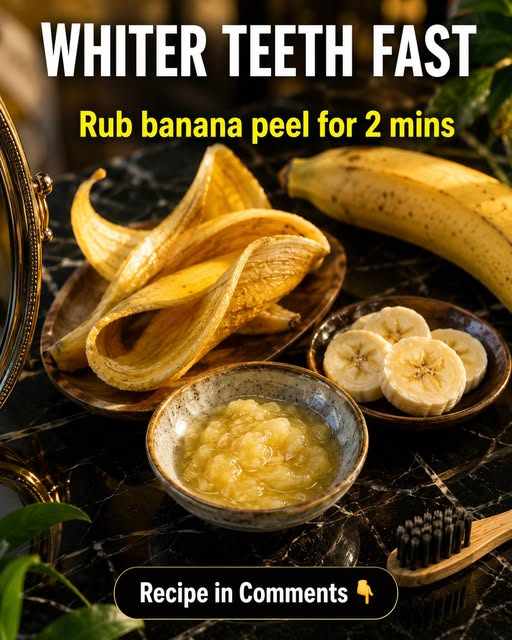
A brighter smile can improve confidence, but viral teeth-whitening remedies often promise results that are faster than science supports. The image recommends rubbing banana peel on the teeth for two minutes, yet current evidence does not show that this method can produce meaningful whitening. Tooth colour depends on enamel thickness, the naturally yellow dentin beneath it, age, diet, tobacco exposure, plaque, tartar, medicines and internal tooth changes. Surface stains may become less noticeable with careful cleaning, but deeper discolouration normally requires an evidence-based whitening treatment or professional dental care.
Because mixing five to seven kitchen ingredients can expose enamel to unnecessary acids and abrasives, the routines below use only the minimum safe supplies. Lemon juice, vinegar, charcoal, salt scrubs and fruit-acid pastes have not been included.
Does Rubbing Banana Peel on Teeth Make Them Whiter?
Banana peel contains minerals and plant compounds, but the presence of potassium or magnesium does not mean these substances can enter enamel and bleach tooth pigments. A 2024 laboratory study compared banana peel with professional hydrogen-peroxide bleaching. Banana peel produced only a modest, statistically insignificant colour change, while the professional bleaching agent produced substantially greater whitening. The American Dental Association also warns that most fruit-based and other do-it-yourself whitening methods have limited evidence and may be ineffective or damaging. (Annals of Dental Specialty)
Rubbing banana peel for two minutes may temporarily make teeth look shinier because moisture coats the surface. This is not the same as changing the actual shade of enamel. Anyone who tries the method should not expect visible bleaching within seven days.
Remedy 1: Gentle Surface-Stain Routine for Normally Healthy Teeth
What You Need and Why It Works
- A pea-sized amount of fluoride toothpaste containing baking soda: fluoride protects against cavities, while sodium bicarbonate helps loosen and remove superficial stains.
- A soft-bristled toothbrush: soft bristles clean plaque without unnecessary enamel or gum abrasion.
- Dental floss or an interdental cleaner: removes stained plaque from areas a toothbrush cannot reach.
- Plain water: helps clear loosened food particles and toothpaste residue.
- A two-minute timer: ensures adequate cleaning without prolonged scrubbing.
Scientific Working of the Routine
Baking soda does not chemically bleach the inside of a tooth. It acts mainly as a relatively mild abrasive that helps remove coloured deposits attached to enamel. Systematic reviews have found that properly formulated baking-soda dentifrices can improve plaque removal and control external staining. These findings apply to balanced toothpaste formulations, not aggressive homemade powders mixed with lemon, vinegar or peroxide. (PubMed Central (PMC))
Fluoride remains important because brushing with plain baking soda alone does not provide complete protection against decay.
Procedure
Floss gently before brushing. Place a pea-sized amount of toothpaste on a soft brush and clean every tooth with small circular movements for two minutes. Do not press hard. Spit out the foam and avoid repeatedly rinsing with large amounts of water immediately afterwards so that some fluoride can remain on the teeth.
How Often to Apply
Brush twice daily for at least seven days and continue as a permanent oral-care routine.
Initial Results
Within one to three days, the teeth may feel smoother and look cleaner because surface film and plaque are being removed. A noticeable shade change generally requires several weeks and depends on the cause of the discolouration.
Remedy 2: Water-Rinse Method for Coffee and Tea Stains
What You Need and Why It Works
- A glass of plain water: washes away some staining compounds before they remain on enamel.
- A reusable straw for cold dark drinks: may reduce contact between the beverage and the front teeth.
- Fluoride toothpaste: protects enamel and removes daily surface deposits.
- A soft toothbrush: provides controlled mechanical cleaning.
- Dental floss: prevents dark buildup between teeth.
- Sugar-free gum when brushing is unavailable: stimulates saliva, which naturally clears food and neutralises acids.
Scientific Working of the Routine
Coffee, tea, cola, tobacco and strongly coloured foods can produce extrinsic stains by depositing pigmented compounds on enamel. Reducing their contact time and removing plaque regularly may limit further staining. Whitening toothpaste can improve external stains, but it cannot substantially change colour located inside dentin. (ADA)
Procedure
Drink water after tea, coffee or another dark beverage. For cold drinks, use a straw without holding the liquid in the mouth. Brush normally twice a day rather than brushing after every cup. When a drink is acidic, wait approximately an hour before brushing so softened enamel is not scrubbed immediately.
How Often to Apply
Follow the water-rinse step after every staining drink for at least seven days and continue it long term.
Initial Results
The mouth may feel fresher after the first day, and new surface staining may accumulate more slowly. Existing dark bands or heavy brown deposits will not disappear in three days and may require professional cleaning.
Remedy 3: Complete Plaque-Removal Routine for Dull or Yellow-Looking Teeth
What You Need and Why It Works
- Fluoride toothpaste: cleans while supporting enamel against decay.
- A soft toothbrush: disrupts the plaque layer on exposed tooth surfaces.
- Floss: removes plaque from tight spaces.
- An interdental brush where gaps are present: cleans areas that ordinary floss may miss.
- A tongue cleaner: reduces tongue coating and improves overall mouth freshness.
- Plain water: helps rinse away food debris.
Scientific Working of the Routine
Plaque is a sticky bacterial film that can collect pigments and make teeth look dull. Once it mineralises into hard tartar, brushing cannot remove it. Removing soft plaque may therefore improve brightness, but hardened yellow or brown calculus must be scaled by a dental professional. The ADA recommends brushing twice daily with fluoride toothpaste and cleaning between the teeth every day. (MouthHealthy)
Procedure
Clean between the teeth gently once daily. Brush for two minutes, spending equal time on the outer, inner and chewing surfaces. Clean the tongue lightly without scraping until it bleeds. Replace the toothbrush when the bristles become worn or spread out.
How Often to Apply
Follow the routine every morning and evening for seven days, then continue indefinitely.
Initial Results
A cleaner appearance, smoother tooth surfaces and fresher breath may be noticed within one to three days. Thick deposits near the gumline will remain until professionally removed.
Remedy 4: Enamel-Safe Care for Sensitive Teeth
What You Need and Why It Works
- Fluoride toothpaste formulated for sensitivity: supports enamel and helps reduce sensitivity with repeated use.
- A soft or extra-soft toothbrush: limits pressure on sensitive areas.
- Lukewarm water: avoids temperature-triggered discomfort.
- Gentle dental floss: removes plaque without abrasive scrubbing.
- A clean cup: prevents contamination of oral-care tools.
- A timer: helps prevent excessive brushing.
Scientific Working of the Routine
Whitening treatments may cause temporary sensitivity because whitening agents can penetrate tooth tissues. Harsh scrubs may also wear enamel or expose more yellow dentin, making teeth look darker rather than whiter. Professional and over-the-counter bleaching can work, but stronger concentrations are more likely to cause sensitivity or gum irritation. (ADA)
Procedure
Brush gently with lukewarm water twice daily. Do not rub banana peel, charcoal, salt, turmeric, lemon or baking-soda powder onto sensitive teeth. Avoid beginning a bleaching treatment until a dentist has checked for cavities, cracks, leaking fillings, gum recession or enamel erosion.
How Often to Apply
Continue this gentle routine for at least seven to fourteen days before considering any whitening option.
Initial Results
Sensitivity may not disappear within three days, but avoiding acids and harsh abrasives can prevent it from worsening. Teeth may look cleaner, although a dramatic whitening effect should not be expected.
Remedy 5: Dentist-Guided Plan for Deep Yellowing, Grey Teeth or One Dark Tooth
What You Need
- A dental examination.
- Professional plaque and tartar removal when required.
- Assessment of existing fillings, crowns, veneers or implants.
- A dentist-recommended whitening plan.
- Daily fluoride toothpaste and floss.
- A record of medicines, injuries and previous dental treatment.
Scientific Working of the Plan
Internal discolouration can be caused by ageing, tooth injury, decay, pulpal damage, developmental conditions, fluorosis or exposure to certain medicines. Surface remedies cannot remove these pigments. A single tooth that suddenly turns grey or dark may have internal damage and requires assessment rather than cosmetic scrubbing. Crowns, fillings, veneers and implants also do not whiten in the same way as natural teeth. (ADA)
Procedure
Arrange an examination before whitening, particularly when only one tooth is affected or there is pain, swelling, bleeding, bad taste, a cavity, cracked enamel or severe sensitivity. The dentist may recommend cleaning, supervised home trays, an appropriate whitening system or treatment of the underlying dental problem.
How Often to Apply
Follow the professional schedule exactly. Do not increase the amount or application time to obtain faster results.
Initial Results
Professional cleaning can improve surface staining immediately. Bleaching may require several days or weeks, depending on the stain and method. Deep developmental or injury-related discolouration may need a different cosmetic or restorative approach.
Home Methods to Avoid
Do not combine banana peel with lemon juice, vinegar, strawberries or other acidic fruits. Acids can soften and erode enamel, potentially causing sensitivity and revealing the yellower dentin underneath. Charcoal and salt mixtures may be overly abrasive, while coconut-oil pulling has not been shown to produce reliable tooth whitening. The ADA reports insufficient evidence for fruit scrubs, charcoal and oil pulling as whitening treatments. (MouthHealthy)
Never place concentrated household hydrogen peroxide or bleach on the teeth. Do not use whitening treatments over cavities, cracked teeth, inflamed gums or untreated dental disease.
Final Tips for a Naturally Cleaner Smile
Brush gently twice daily and clean between the teeth once a day. Rinse with water after strongly coloured foods and drinks, limit tobacco exposure, and keep toothbrushes and oral-care tools clean. Avoid pressing harder in an attempt to whiten faster; additional force does not bleach enamel.
A cleaner appearance may begin within two or three days when plaque is the main problem. Surface stains may improve over two to six weeks with consistent care. Naturally cream-coloured or slightly yellow teeth are not necessarily unhealthy, and no safe home remedy can guarantee paper-white teeth in seven days.
Diet Plan for Healthy Teeth
A tooth-friendly diet supports enamel and gum health but does not directly bleach teeth.
Breakfast: Choose eggs, plain yogurt, oats or whole-grain bread. Drink water and keep sweetened tea or coffee limited.
Mid-morning: Have water with nuts, cheese or a whole piece of fruit instead of sipping fruit juice for a prolonged period.
Lunch: Include vegetables, lentils, beans, fish, chicken or another protein source with whole grains. Drink plain water rather than frequently consuming cola or sweetened drinks.
Afternoon: When drinking tea or coffee, avoid slowly sipping it for several hours. Rinse the mouth with water afterwards.
Dinner: Select a balanced meal containing vegetables, protein and a moderate portion of carbohydrate. Avoid frequent sugary snacks before bedtime.
Continue the home oral-care routine permanently. When staining does not improve after four to six weeks, or when pain, gum bleeding, persistent bad breath, sensitivity, cavities, white patches or one dark tooth are present, consult a dentist.
References for the above remedy
- American Dental Association. Whitening: Oral Health Topics.
https://www.ada.org/resources/ada-library/oral-health-topics/whitening - American Dental Association, MouthHealthy. Natural Teeth Whitening: Fact vs. Fiction.
https://www.mouthhealthy.org/all-topics-a-z/natural-teeth-whitening - American Dental Association, MouthHealthy. Brushing and Beyond: Key Oral Health Tips.
https://www.mouthhealthy.org/oral-health-recommendations - Alrabiah A, et al. Effect of Banana Peels on Dental Bleaching: An in Vitro Study. Annals of Dental Specialty. 2024.
https://annalsofdentalspecialty.net.in/article/effect-of-banana-peels-on-dental-bleaching-an-in-vitro-study-gjfvtpltcjxzisg - Li Y. Stain Removal and Whitening by Baking Soda Dentifrice: A Review of Literature. Journal of the American Dental Association.
https://www.sciencedirect.com/science/article/pii/S0002817717308115 - Valkenburg C, et al. The Efficacy of Baking Soda Dentifrice in Controlling Plaque and Gingivitis: A Systematic Review.
https://pmc.ncbi.nlm.nih.gov/articles/PMC6850485/ - Soeteman GD, et al. Effect of Whitening Dentifrice on Discoloration of Tooth Surface: An Updated Systematic Review and Meta-Analysis.
https://pmc.ncbi.nlm.nih.gov/articles/PMC12010553/ - NHS. Teeth Whitening.
https://www.nhs.uk/tests-and-treatments/teeth-whitening/ - Vural UK, et al. Whitening Efficacy of Popular Natural Products on Dental Enamel.
https://pmc.ncbi.nlm.nih.gov/articles/PMC9645194/ - Joiner A. Efficacy of Dental Bleaching with Whitening Dentifrices: A Systematic Review.
https://pmc.ncbi.nlm.nih.gov/articles/PMC6232812/