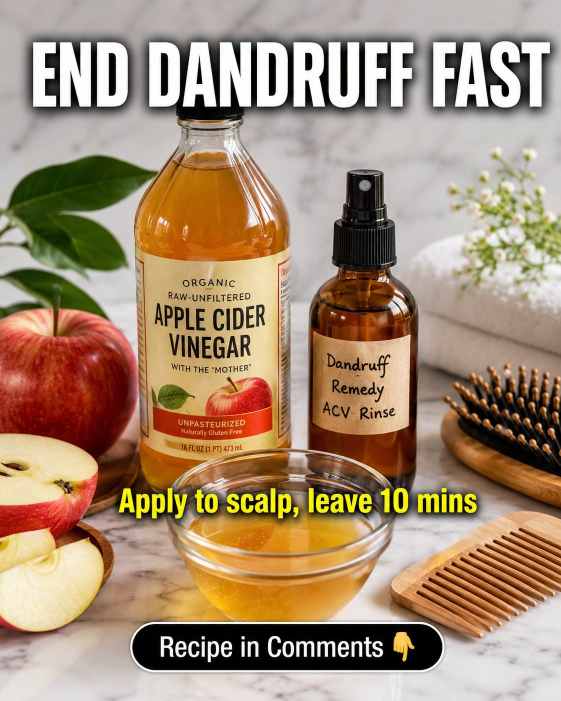
Dandruff can make an otherwise healthy head of hair look dry, unclean, and difficult to manage. White flakes, itching, greasy scaling, and repeated irritation may also affect confidence, especially when flakes become visible on dark clothing. Dandruff is closely associated with changes in the scalp barrier, inflammation, sebum, and the yeast Malassezia. Natural ingredients can help some people, but “overnight cures” are unrealistic. Human studies on tea tree oil, aloe vera, lemongrass, raw honey, and coconut oil provide more credible support than many viral DIY treatments. (PubMed)
One important point about the apple-cider-vinegar remedy shown in the image: good-quality clinical trials proving that an ACV rinse eliminates dandruff are currently lacking. Undiluted vinegar can also irritate an already inflamed scalp. Therefore, the remedies below focus primarily on natural ingredients with stronger human evidence rather than presenting ACV as a clinically proven cure.
Remedy 1: For Normal Scalp — Raw Honey and Aloe Scalp Treatment
Ingredients and Scientific Working
- Raw honey — 3 tablespoons: Human research specifically investigated diluted crude honey in people with chronic dandruff and seborrheic dermatitis. Honey has antimicrobial activity and also acts as a humectant.
- Warm water — 1 teaspoon: Makes the honey easier to distribute without aggressive rubbing.
- Pure inner-leaf aloe vera gel — 1 teaspoon: Aloe vera has been evaluated in a randomized placebo-controlled study of seborrheic dermatitis and was associated with reductions in scaling and itching.
- Colloidal oatmeal — ½ teaspoon: Provides soothing beta-glucans and helps reduce dryness and irritation.
- Vegetable glycerin — 2–3 drops: Helps retain water at the skin surface and reduces the tight feeling that can follow washing.
The strongest direct evidence in this mixture is for honey and aloe. In a clinical study, patients using diluted crude honey every other day experienced marked improvements, with itching improving first and scaling reducing over the following days. (PubMed)
Procedure
Mix the honey with warm water first. Add aloe, oatmeal, and glycerin and stir until smooth. Part the hair and spread a thin layer directly over the scalp. Massage very gently for about two minutes.
Leave for 30–60 minutes for a practical home treatment, then rinse thoroughly with lukewarm water. The published honey study used a longer three-hour contact time, so the shorter home version should not be assumed to provide identical results.
How Often to Apply
Use every other day for at least 5 days. If tolerated well, continue two or three times weekly for 3–4 weeks.
Initial Results
Within 1–3 days, itching and scalp tightness may begin to feel calmer. A major reduction in flakes usually requires longer; the honey study reported disappearance of scaling within about one week rather than overnight. (PubMed)
Remedy 2: For Combination Scalp — Lemongrass Clarifying Scalp Tonic
Ingredients and Scientific Working
- Lemongrass essential oil — carefully diluted: Lemongrass contains citral and has demonstrated antifungal activity relevant to Malassezia.
- Pure aloe vera gel — 1 tablespoon: Helps offset excessive dryness while soothing irritated areas.
- Distilled water — 2 tablespoons: Provides a lightweight base.
- Vegetable glycerin — ¼ teaspoon: Adds hydration to drier scalp areas.
- Cooled green-tea infusion — 1 tablespoon: Provides antioxidant polyphenols and a lightweight water-based carrier.
A human study tested lemongrass hair tonics at 5%, 10%, and 15%. The 10% formulation produced the strongest improvement, with a substantial reduction in dandruff after 7 days and further improvement by day 14. (PubMed)
Procedure
Essential oils do not properly dissolve in plain water, so do not simply pour lemongrass oil into water and spray it directly onto the scalp. For home use, use only a properly pre-diluted, skin-safe lemongrass preparation and mix it into the aloe-based tonic.
Apply mainly to greasy, flaky areas while using less on dry sections. Leave for approximately 10 minutes and rinse thoroughly.
How Often to Apply
Use once daily for the first 3 days if there is no irritation, then every other day. Continue for 7–14 days before judging the effect.
Initial Results
Oiliness and itch may feel reduced during the first few days. Clinical improvement in visible dandruff was documented more clearly from around day 7 onward, so “one-use removal” should not be expected. (PubMed)
Remedy 3: For Oily Scalp — Tea Tree Oil Anti-Flake Treatment
Ingredients and Scientific Working
- Tea tree essential oil — properly diluted: Tea tree oil contains terpinen-4-ol and related compounds with antimicrobial activity.
- Aloe vera gel — 1 tablespoon: Supplies a lightweight soothing base.
- Cooled green tea — 1 tablespoon: Helps keep the mixture light rather than oily.
- Vegetable glycerin — 2 drops: Prevents unnecessary drying.
- Distilled water — 1 tablespoon: Dilutes the scalp application.
Tea tree oil has some of the best human evidence among natural dandruff ingredients. In a randomized controlled study, a shampoo containing 5% tea tree oil produced approximately 41% improvement in dandruff severity compared with about 11% with placebo over four weeks. It also improved itching and greasiness. (PubMed)
Procedure
The clinical trial tested a standardized 5% tea-tree shampoo, not undiluted essential oil. For that reason, never apply pure tea tree oil directly to the scalp.
Use a properly formulated or appropriately diluted tea-tree preparation. Spread over the scalp, leave approximately 5–10 minutes and rinse thoroughly.
How Often to Apply
Use every other day for the first 5 days. If well tolerated, continue two or three times per week for up to four weeks.
Initial Results
A cleaner scalp and less greasiness may be noticeable during the first 1–3 days. Significant improvement in dandruff should be assessed over several weeks, consistent with the clinical trial rather than after a single treatment. (PubMed)
Remedy 4: For Dry Scalp — Aloe, Coconut and Oat Comfort Mask
Ingredients and Scientific Working
- Pure aloe vera gel — 2 tablespoons: Helps soothe inflammatory scalp symptoms and provides water-rich hydration.
- Virgin coconut oil — ½ teaspoon: Helps condition dry hair and scalp and has been studied for its effects on scalp microbial ecology.
- Raw honey — 1 teaspoon: Works as a humectant and provides additional antimicrobial activity.
- Colloidal oatmeal — 1 teaspoon: Helps relieve dryness and supports the skin barrier.
- Vegetable glycerin — 2 drops: Draws water into the superficial skin layers.
A longitudinal scalp study found that coconut oil use was associated with changes in the scalp microbiome consistent with a healthier scalp environment. It should be viewed mainly as supportive care rather than a proven stand-alone antifungal dandruff cure. (PubMed) Aloe and honey provide the stronger direct clinical evidence for scaling and seborrheic symptoms. (PubMed)
Procedure
Whisk the aloe and honey together, then blend in only a small amount of coconut oil. Add oatmeal and glycerin.
Apply to dry, flaky sections for 15–20 minutes. Rinse and cleanse gently so excess oil does not remain on the scalp.
How Often to Apply
Use every other day for the first 3–5 days and then twice weekly for two to four weeks.
Initial Results
The scalp may feel less tight and hair may feel softer within 1–3 days. Visible dandruff usually takes longer to improve.
Remedy 5: For Sensitive Scalp — Gentle Aloe, Honey and Oat Mask
Ingredients and Scientific Working
- Pure aloe vera gel — 2 tablespoons: Clinical research supports aloe preparations for reducing scaling and itching associated with seborrheic dermatitis.
- Raw honey — 1 teaspoon: Adds moisturizing and antimicrobial activity.
- Colloidal oatmeal — 1 teaspoon: Helps calm itch-prone, easily irritated skin.
- Distilled water — 1 tablespoon: Makes the mixture easier to spread without rubbing.
- Vegetable glycerin — 1–2 drops: Provides simple hydration without fragrance or exfoliation.
Sensitive scalps should avoid strong essential oils at first. Aloe vera was studied in a double-blind, placebo-controlled trial involving adults with seborrheic dermatitis, with significantly better overall improvement in the aloe group than placebo. (Taylor & Francis Online)
Procedure
Combine everything into a thin gel. Patch-test behind the ear or on a small scalp area first.
If there is no burning, swelling, or persistent redness, apply a thin layer for 10 minutes and rinse gently.
How Often to Apply
Apply every other day for 3–5 days. Continue two or three times weekly if the scalp remains comfortable.
Initial Results
Itching and tightness may improve within the first few days. Persistent thick scaling, sores, or inflammation should not be repeatedly treated with DIY masks.
Should You Use Apple Cider Vinegar for Dandruff?
Apple cider vinegar is popular because its acidity may alter the scalp environment, but that biological theory is not the same as clinical proof. There is currently much stronger human evidence for tea tree oil, honey, aloe vera, and lemongrass than for an ACV rinse.
If you still choose to try vinegar, never apply it undiluted, never use it on scratched or inflamed skin, and stop immediately if it burns. It should not replace appropriate dandruff treatment when symptoms are persistent.
Final Tips for Faster Dandruff Control
Wash the scalp regularly enough to prevent heavy buildup of oil, sweat, and styling residue. Do not scratch flakes off with fingernails because this can create inflammation and small wounds. Keep combs, brushes, pillowcases, towels, and hair accessories clean.
Patch-test botanicals and essential oils before widespread application. More concentrated does not mean more effective; it often means more irritation.
Sleep adequately and manage stress where possible, because inflammatory scalp disorders can fluctuate over time.
You may notice less itching or oiliness within 2–3 days, but meaningful flake reduction is more realistically assessed after 1–4 weeks, depending on the cause and treatment used.
Diet Plan to Support a Healthy Scalp
Diet should support overall skin and hair health, but food alone is not a proven cure for Malassezia-associated dandruff.
Breakfast: Eggs or plain yogurt with oats and a vitamin-C-rich fruit such as guava, kiwi, oranges, or berries.
Mid-morning: A small handful of walnuts, almonds, pumpkin seeds, or sunflower seeds.
Lunch: Fish, chicken, lentils, beans, or tofu with vegetables, salad, and whole grains.
Afternoon: Fresh fruit with water or unsweetened tea.
Dinner: Protein such as fish, eggs, legumes, or chicken with leafy vegetables and a moderate portion of brown rice or whole-grain bread.
Include zinc-containing foods such as meat, seafood, pumpkin seeds, lentils, and beans, as well as omega-3 sources such as oily fish, walnuts, flaxseed, and chia seeds. Avoid relying on sugar-free “detoxes,” juices, or supplements as dandruff cures.
How Long Should You Continue the Home Remedy?
Try one well-tolerated remedy consistently for 2–4 weeks rather than changing treatments every day. Some clinically studied natural approaches required several weeks for maximum benefit. (PubMed)
If dandruff remains severe after 2–4 weeks, repeatedly returns, spreads to the eyebrows or sides of the nose, or is accompanied by marked redness, thick crusts, bleeding, pus, painful sores, or significant hair loss, see a doctor or dermatologist. Psoriasis, eczema, fungal infection, contact dermatitis, and seborrheic dermatitis can resemble ordinary dandruff and may need specific medical treatment.
References for the above remedy
- Satchell AC, Saurajen A, Bell C, Barnetson RS. Treatment of dandruff with 5% tea tree oil shampoo. Journal of the American Academy of Dermatology. 2002.
https://pubmed.ncbi.nlm.nih.gov/12451368/ - Chaisripipat W, Lourith N, Kanlayavattanakul M. Anti-dandruff hair tonic containing lemongrass oil. Forschende Komplementärmedizin. 2015.
https://pubmed.ncbi.nlm.nih.gov/26566122/ - Al-Waili NS. Therapeutic and prophylactic effects of crude honey on chronic seborrheic dermatitis and dandruff. European Journal of Medical Research. 2001.
https://pubmed.ncbi.nlm.nih.gov/11485891/ - Vardy DA, Cohen AD, Tchetov T, Medvedovsky E, Biton A. A double-blind, placebo-controlled trial of an Aloe vera (A. barbadensis) emulsion in the treatment of seborrheic dermatitis. Journal of Dermatological Treatment.
https://doi.org/10.3109/09546639909055904 - Wuthi-Udomlert M, Chotipatoomwan P, Panyadee S, Gritsanapan W. Inhibitory effect of formulated lemongrass shampoo on Malassezia furfur: a yeast associated with dandruff. Southeast Asian Journal of Tropical Medicine and Public Health. 2011.
https://pubmed.ncbi.nlm.nih.gov/21710859/ - Saxena R, Mittal P, Clavaud C, et al. Longitudinal study of the scalp microbiome suggests coconut oil to enrich healthy scalp commensals. Scientific Reports. 2021.
https://pubmed.ncbi.nlm.nih.gov/33790324/ - Danby SG, AlEnezi T, Sultan A, et al. Effect of olive and sunflower seed oil on the adult skin barrier. Pediatric Dermatology. 2013.
https://pubmed.ncbi.nlm.nih.gov/22995032/ - Reynertson KA, Garay M, Nebus J, et al. Anti-inflammatory activities of colloidal oatmeal contribute to the effectiveness of oats in treatment of itch associated with dry, irritated skin. Journal of Drugs in Dermatology. 2015.
https://pubmed.ncbi.nlm.nih.gov/25607907/