
Introduction
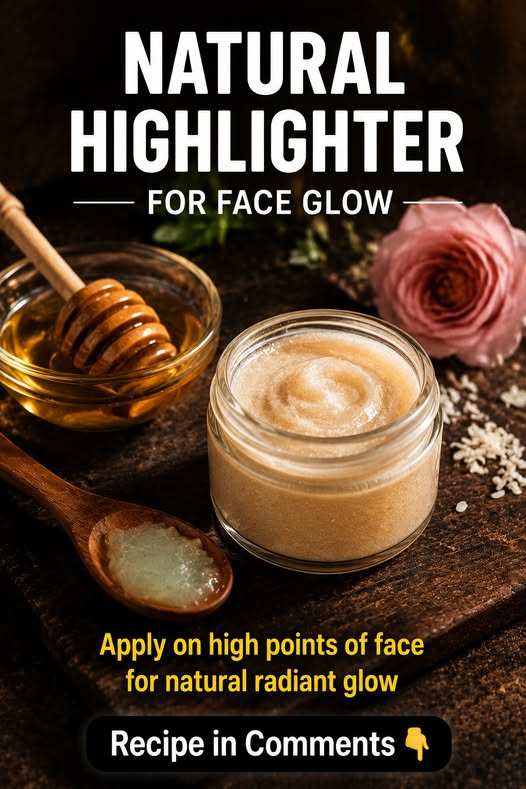
The image shows a honey, rice and aloe-style homemade highlighter for cheekbones, the nose bridge and brow bones. A thin layer can create a temporary dewy appearance; it does not permanently brighten skin or treat pigmentation, pores or wrinkles.
Rice-derived ingredients have antioxidant and moisturising potential, but homemade rice paste is not a standardised extract. A black-rice-bran trial cannot prove that rice water lightens the face.[1] Honey may attract water and has antimicrobial properties, although the strongest medical evidence concerns selected topical honey preparations for wounds rather than ordinary kitchen honey used as a highlighter.[2] Aloe can feel soothing but may cause burning, itching, rash or eczema.[3] These are short-contact cosmetic masks, not proven treatments for facial ageing or skin disease.
How to Prepare the Base Glow Balm Safely
Cook 1 tablespoon of white rice in ½ cup of water until very soft. Cool it completely, blend it with 1 teaspoon of the cooking water and strain if necessary. Mix 1 teaspoon rice paste with ½ teaspoon honey and ½ teaspoon fragrance-free aloe gel. Prepare one use. Apply thinly to clean skin for 5–8 minutes, rinse and moisturise. As a highlighter, use a pin-sized amount on cheekbones and remove it before sleeping.
Do not use raw rice grains as a scrub, because rubbing can worsen irritation. Avoid lemon juice, baking soda, essential oils and perfume. Patch-test every new version on the inner forearm for 24–48 hours. Stop immediately if there is burning, swelling, itching or a rash.
Remedy 1: For Normal Skin — Rice, Honey and Aloe Dew Balm
Ingredients and scientific benefit
Use 1 teaspoon smooth rice paste, ½ teaspoon honey, ½ teaspoon aloe gel, 2 drops jojoba oil, ½ teaspoon cucumber juice, 1 drop glycerin and 1 drop vitamin-E oil if previously tolerated. Rice paste provides starch and a soft film; honey and glycerin attract moisture; aloe and cucumber add a fresh, water-rich feel; jojoba reduces the dry sensation; vitamin E is an antioxidant ingredient, although it can cause contact dermatitis in some people. Rice research remains formulation-specific.[1]
Procedure
Mix all ingredients into a smooth, thin balm. Apply a tiny amount to the cheekbones, brow bones and the centre of the nose, avoiding eyelids, lips and broken skin. Leave for 5–8 minutes if using it as a mask. For glow only, use less and remove it before bed.
How Often to Apply
Use two or three times during five days, never more than once daily. Do not layer it over another exfoliating treatment.
Initial Results
A dewy sheen may appear immediately or within three days. This reflects moisture, not permanent brightening or wrinkle reduction.
Remedy 2: For Combination Skin — Lightweight Rice and Green Tea Glow Gel
Ingredients and scientific benefit
Combine 1 teaspoon rice paste, ½ teaspoon aloe gel, ½ teaspoon cooled green tea, ¼ teaspoon honey, ½ teaspoon cucumber juice, 1 drop glycerin and 1 drop squalane. The formula is lighter than an oil-rich balm. Green tea contains polyphenols studied for antioxidant and anti-inflammatory activity; aloe and cucumber provide a cooling feel; glycerin and honey support surface moisture; squalane adds a small amount of emollience without a heavy texture.
Procedure
Stir until smooth. Apply a thin veil to the upper cheeks and a very small amount to the forehead or nose if those areas are not oily. Leave for 5 minutes and rinse, or dab a trace onto the cheekbones as a temporary highlighter. Do not rub while removing it.
How Often to Apply
Apply every other day for five days. Skip the oily central face if it becomes shiny or congested.
Initial Results
High points may look more luminous after application. It will not close pores, regulate sebum or fade dark spots quickly.
Remedy 3: For Oily Skin — Rice, Aloe and Kaolin Matte-Glow Balm
Ingredients and scientific benefit
Use 1 teaspoon rice paste, ½ teaspoon aloe gel, ½ teaspoon kaolin clay, ¼ teaspoon honey, ½ teaspoon cooled green tea, ½ teaspoon cucumber juice and 1 drop glycerin. Kaolin can absorb some surface oil, while rice paste gives slip and a soft finish. Aloe, green tea and cucumber may soothe; honey and glycerin limit dryness. They do not cure acne or permanently reduce oil.
Procedure
Mix into a smooth paste. Apply only to the cheekbones and other high points, avoiding active inflamed acne and the oily sides of the nose. Leave for no more than 5 minutes, rinse before the clay dries hard and apply a non-comedogenic moisturiser.
How Often to Apply
Use once or twice during five days, not daily. Do not scrub the clay away.
Initial Results
Shine may look controlled while the cheekbones retain a subtle glow. It will not remove blackheads, scars or enlarged-looking pores.
Remedy 4: For Dry Skin — Rice, Honey and Avocado Radiance Cream
Ingredients and scientific benefit
Mix 1 teaspoon rice paste, 1 teaspoon honey, ½ teaspoon aloe gel, 1 teaspoon mashed avocado, 2 drops sunflower oil, ½ teaspoon colloidal oatmeal and 1 drop glycerin. Honey, glycerin and aloe attract water; avocado and sunflower oil add emollient lipids; colloidal oatmeal is associated with improved hydration and barrier comfort in tested products.[4] The mixture may reduce the look of dull surface dryness, but it cannot rebuild collagen.
Procedure
Blend well and apply a thin layer to the cheekbones and dry high points. Leave for 8 minutes, rinse gently and moisturise while the skin is still slightly damp. Avoid applying it to cracked, infected or actively inflamed skin.
How Often to Apply
Use every three days for five days, with no more than two applications.
Initial Results
Dry patches may look less obvious after moisturising. Fine lines may look softer from hydration, not tightening.
Remedy 5: For Sensitive Skin — Minimal Rice-Aloe Comfort Balm
Ingredients and scientific benefit
Use 1 teaspoon rice paste, ½ teaspoon colloidal oatmeal, ½ teaspoon cooled boiled water, ½ teaspoon fragrance-free aloe gel, ¼ teaspoon glycerin, ¼ teaspoon honey and no fragrance or essential oil. The deliberately short ingredient list reduces potential triggers. Oatmeal may support barrier comfort, while aloe, honey and glycerin help the surface feel less dry. Aloe remains a possible irritant, so sensitivity testing is essential.[3]
Procedure
Patch-test the mixture for 24–48 hours. If tolerated, apply a very thin layer to one cheek for 5 minutes, rinse and observe for another day. Do not massage, use a roller or apply it to skin that is burning, peeling or sunburned.
How Often to Apply
Use once during five days. Do not repeat during an eczema, rosacea or unexplained-redness flare.
Initial Results
The early result should be comfort and a mild sheen, not whitening or tightening. Rinse immediately if burning, itching or swelling occurs.
Final Tips
A highlighter reflects light; it cannot replace sunscreen. Use broad-spectrum SPF 30 or higher, cleanse gently, moisturise and choose non-comedogenic products.[5] Use it only on intact skin, keep it away from eyes and discard leftovers. Do not sleep in the mixture; food ingredients can support microbial growth.
Do not add lemon juice, cinnamon, undiluted vinegar or abrasive rice powder. “Natural” is not risk-free. Test ingredients and stop anything that stings. For persistent pigmentation, acne, itching, dryness or a changing lesion, see a dermatologist. Glow may appear within three days, but ageing requires long-term protection.
Diet Plan
For five days, use no more than one facial application. Eat protein, vegetables, fruit, legumes, whole grains, nuts or seeds and drink adequate fluids. Vitamin-C-rich peppers, berries, broccoli and citrus eaten as food support skin nutrition; they need not be rubbed on the face. Limit smoking, alcohol and added sugar.
Continue the routine for two to four weeks if comfortable. If dullness, pigmentation or another problem persists or worsens, see a doctor or dermatologist rather than applying it more often. People with eczema, rosacea, allergies, pregnancy or regular medicines should ask a clinician before trying new preparations.
References for the above remedy
- Zamil DH, et al. “Dermatological Uses of Rice Products: Trend or True?” Journal of Cosmetic Dermatology (2022). https://pubmed.ncbi.nlm.nih.gov/35587098/
- McLoone P, et al. “Honey: A Therapeutic Agent for Disorders of the Skin.” Central Asian Journal of Global Health (2016 ). https://pmc.ncbi.nlm.nih.gov/articles/PMC5661189/
- National Center for Complementary and Integrative Health. “Aloe Vera: Usefulness and Safety.” https://www.nccih.nih.gov/health/aloe-vera
- Ilnytska O, et al. “Colloidal Oatmeal (Avena sativa ) Improves Skin Barrier Through Multi-Therapy Activity.” Journal of Drugs in Dermatology (2016). https://pubmed.ncbi.nlm.nih.gov/27272074/
- American Academy of Dermatology. “What Can Treat Large Facial Pores?” https://www.aad.org/public/everyday-care/skin-care-secrets/face/treat-large-pores
- American Academy of Dermatology. “Wrinkle Remedies.” https://www.aad.org/public/everyday-care/skin-care-secrets/anti-aging/wrinkle-remedies
Note: These references support selected ingredient properties and skincare practices; they do not prove that a homemade rice, honey and aloe mixture permanently brightens skin or functions as a clinical highlighter.