Introduction
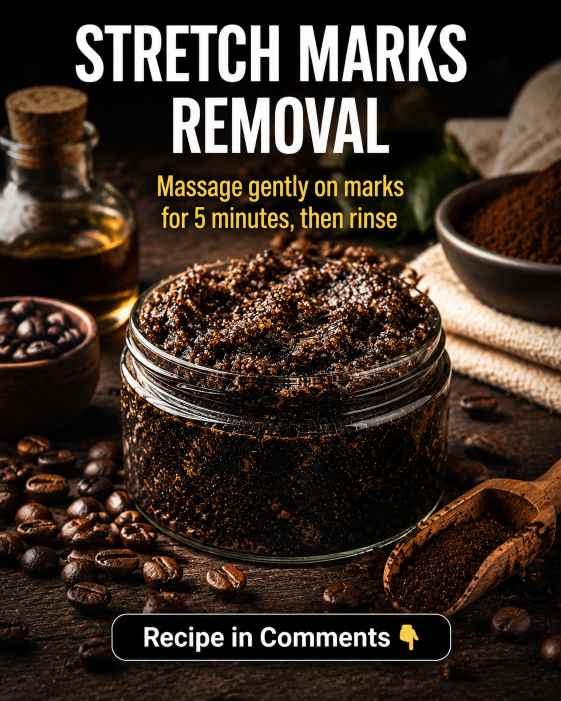
The image presents a dark coffee-based scrub promoted for stretch-mark removal. Stretch marks, or striae, are common bands that develop when skin stretches or changes rapidly, including during pregnancy, puberty, muscle gain or weight change. They are a form of dermal scarring, not simply a layer of dead skin that can be polished away. A homemade scrub may temporarily improve softness and surface glow, but it cannot reliably remove established stretch marks or rebuild damaged dermal tissue.
Coffee contains caffeine and antioxidant compounds. Caffeine can temporarily increase the sensation of tightness or circulation when applied to skin, while the granules provide physical exfoliation. These effects are cosmetic and short-lived; strong clinical evidence that coffee scrubs erase striae is lacking. Safer care focuses on moisturising, avoiding vigorous friction, protecting the skin barrier and allowing time. New, red or purple marks and older pale marks may respond differently, and professional treatments are more predictable than kitchen recipes.[1]
How to Prepare and Apply the Scrub Safely
Use 1 tablespoon finely ground coffee, 1 tablespoon plain fragrance-free moisturiser or colloidal-oatmeal lotion and 1 teaspoon sunflower or jojoba oil. Mix a small fresh portion. Apply to damp, intact skin with the fingertips using very light circular movements for no more than 30 seconds. Rinse with lukewarm water, pat dry and moisturise again if needed.
Do not use coarse grounds, salt, sugar, lemon juice, baking soda or undiluted essential oils. Do not scrub over broken skin, eczema, active rash, sunburn, infection, freshly shaved skin, surgical scars or a recent peel, laser treatment or waxing session. Patch-test each ingredient on a small area for 24 hours. Stop if there is burning, swelling, itching, blistering or persistent redness. Physical exfoliation can worsen irritation and may make darker skin develop post-inflammatory pigmentation.[2]

Remedy 1: For Normal Skin — Fine Coffee and Moisturiser Polish
Ingredients and scientific benefit
Use 1 tablespoon finely ground coffee, 1 tablespoon fragrance-free moisturiser and 1 teaspoon jojoba oil. Coffee particles lift some surface flakes, moisturiser reduces friction and jojoba oil adds slip. The mixture may make skin feel smoother, but its action is limited to the surface; it does not stimulate enough collagen to remove stretch marks.
Procedure
Apply to damp thighs, hips, abdomen or upper arms. Massage gently for 20–30 seconds without pressing. Rinse and moisturise. Use clean hands and discard unused mixture.
How Often to Apply
Use once weekly for three to five weeks. Do not scrub daily.
Initial Results
Skin may feel smoother immediately after rinsing. Colour, width and texture of stretch marks will not meaningfully change in one to three days.
Remedy 2: For Dry Skin — Coffee, Oat and Sunflower-Oil Comfort Scrub
Ingredients and scientific benefit
Use 2 teaspoons fine coffee, 1 tablespoon colloidal oatmeal, 1 tablespoon plain moisturiser and 1 teaspoon sunflower oil. Oatmeal supports surface comfort, moisturiser reduces water loss and sunflower oil provides emollient lipids. This is a gentler option than a coffee-only scrub, but oil does not erase dermal scar tissue.[3]
Procedure
Spread the mixture over damp skin without rubbing first. After one minute of contact, use only a few gentle strokes, rinse and apply moisturiser while the skin is still slightly damp.
How Often to Apply
Use once every 7–10 days for three to five weeks. Moisturise daily between applications.
Initial Results
Dry flaking may look reduced and tightness may improve. Pale or reddish stretch marks will remain visible.
Remedy 3: For Oily or Follicle-Bumpy Skin — Coffee and Plain Oat Rinse-Off Scrub
Ingredients and scientific benefit
Use 2 teaspoons fine coffee, 1 tablespoon colloidal oatmeal, 2 tablespoons clean water and 1 teaspoon lightweight, fragrance-free lotion. Water keeps the mixture light, while oatmeal reduces the need for aggressive rubbing. Coffee is not an acne or keratosis-pilaris treatment, and scrubbing bumps can increase inflammation.
Procedure
Apply only to the body, not active acne, inflamed follicles or broken skin. Massage for no more than 20 seconds, rinse fully and use a non-comedogenic moisturiser. Avoid tight clothing immediately afterward if friction triggers bumps.
How Often to Apply
Use once weekly for three weeks, stopping if bumps, itching or redness increase.
Initial Results
The surface may feel cleaner and temporarily smoother. The scrub will not remove stretch marks or cure follicular conditions.
Remedy 4: For Sensitive Skin — Oat-Based Coffee-Free Comfort Pack
Ingredients and scientific benefit
Use 1 tablespoon colloidal oatmeal, 1 tablespoon plain fragrance-free moisturiser and 1–2 teaspoons water. Omit coffee because its particles can be abrasive and botanical ingredients can irritate sensitive skin. The oatmeal pack supports comfort and hydration but is not a scar treatment.[3]
Procedure
Apply as a soft layer to a small area for five minutes, then rinse gently without rubbing. Patch-test before broader use. Use a moisturiser already known to be tolerated.
How Often to Apply
Use once weekly for three weeks. Do not use it while the skin is stinging, peeling or inflamed.
Initial Results
The skin may feel less dry after one application. Any rash or burning is a reason to stop, not to repeat the remedy.
Remedy 5: For New Red or Purple Marks — Gentle Moisture and Sun Protection Routine
Ingredients and scientific benefit
Use 1 tablespoon plain moisturiser, 1 teaspoon colloidal oatmeal and 1 teaspoon jojoba oil. Skip coffee while marks are new, tender or itchy. Moisturising reduces dryness and friction, while broad-spectrum sunscreen protects exposed areas from uneven darkening. Neither step removes striae, but both support a calmer skin barrier.[4]
Procedure
Apply the moisturiser mixture without scrubbing. If marks are on exposed shoulders or arms, use broad-spectrum SPF 30 or higher during the day and cover the area when practical. Avoid picking or scratching.
How Often to Apply
Moisturise once or twice daily for at least eight to twelve weeks. Do not exfoliate new marks until the skin is fully comfortable.
Initial Results
Itch and dryness may improve within days. Stretch marks usually fade gradually over months and may remain permanently visible to some degree.
Final Tips
The honest answer is that no natural scrub has been proven to remove stretch marks quickly. Skin may look temporarily brighter because surface flakes and body lotion have changed its texture. That is different from repairing the deeper dermis. Rapid weight changes, pregnancy and growth can create striae, so avoid extreme dieting and support gradual, sustainable health habits.
Keep tools and containers clean, use fresh mixtures and never store water-containing homemade scrubs at room temperature. Avoid vigorous massage, especially if the marks are new. Do not apply topical retinoids during pregnancy unless a clinician specifically advises otherwise; prescription treatments require individual assessment. See a dermatologist for sudden widespread marks, marks developing without an obvious cause, severe itch, pain, bleeding, skin thinning or concern about steroid or hormone exposure. If stretch marks remain bothersome after eight to twelve weeks, professional options such as prescription treatment, microneedling or laser may be discussed according to skin type and medical history.[1]
Diet Plan
For five days and beyond, eat regular meals containing vegetables, fruit, beans, lentils, eggs, fish, tofu, yoghurt or fortified alternatives, whole grains, nuts and seeds. Include adequate protein and drink water according to thirst. A varied diet supports normal skin maintenance, but no food, juice or supplement can guarantee stretch-mark removal. Avoid unproven high-dose supplements marketed for collagen or skin repair unless a clinician identifies a need.
Continue balanced eating, gradual activity, sleep and moisturising for at least eight to twelve weeks before judging comfort or appearance. If stretch marks occur with unexplained weight change, muscle weakness, easy bruising, prolonged steroid use or other symptoms, see a doctor. If the problem persists or affects confidence, consult a dermatologist rather than increasing scrub strength or frequency.
References for the above remedy
- American Academy of Dermatology. “Stretch Marks: Why They Appear and How to Get Rid of Them.” https://www.aad.org/public/cosmetic/younger-looking/stretch-marks-why-appear
- American Academy of Dermatology. “How to Safely Exfoliate at Home.” https://www.aad.org/public/everyday-care/skin-care-secrets/routine/safely-exfoliate-at-home
- National Eczema Association. “Colloidal Oatmeal.” https://nationaleczema.org/eczema/treatment/colloidal-oatmeal/
- American Academy of Dermatology. “Sun Protection.” https://www.aad.org/public/everyday-care/sun-protection
- National Institutes of Health, PubMed Central. “Caffeine in Dermatology: A Review of Its Uses and Mechanisms.” https://pmc.ncbi.nlm.nih.gov/articles/PMC6415709/
- American College of Obstetricians and Gynecologists. “Skin Conditions During Pregnancy.” https://www.acog.org/womens-health/faqs/skin-conditions-during-pregnancy
Note: These references support information about stretch marks, exfoliation safety, colloidal oatmeal, sun protection, caffeine research and pregnancy-related skin care. They do not prove that a coffee scrub can permanently remove stretch marks.