
Acne can leave behind brown, red, or grey marks that affect the evenness of the complexion and sometimes a person’s confidence. However, flat discoloration after a breakout is usually post-inflammatory hyperpigmentation rather than a permanent scar. These marks can gradually fade, while indented, ice-pick, rolling, raised, or keloid scars generally require professional treatment. Natural ingredients may calm inflammation, maintain the skin barrier and support gradual fading, but they cannot rebuild deeply scarred tissue within a few days. (American Academy of Dermatology)
The following remedies are designed for different skin types. Scientific studies generally evaluate standardized extracts or professionally formulated preparations, not homemade combinations, so results from kitchen remedies are less predictable. Patch-test every mixture and discontinue it immediately if burning, itching or swelling occurs.
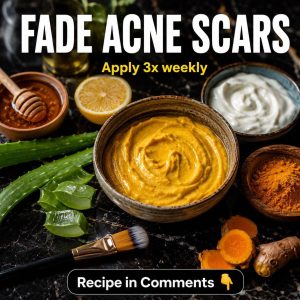
Remedy 1: Aloe, Oat and Green Tea Mask for Normal Skin
Ingredients and Their Scientific Benefits
- One tablespoon pure aloe vera gel provides moisture and may support skin-repair processes.
- One teaspoon finely ground colloidal oatmeal contains beta-glucan and avenanthramides that help reduce dryness and irritation.
- One teaspoon plain unsweetened yogurt provides moisture and a small, variable amount of naturally occurring lactic acid.
- One teaspoon strongly brewed, cooled green tea supplies catechins such as EGCG.
- Half a teaspoon honey works mainly as a humectant, helping the mask retain moisture.
How This Remedy Works Scientifically
Green tea extracts have reduced inflammatory acne lesions in clinical research, which may help prevent additional acne marks. Colloidal oatmeal supports the protective skin barrier and has documented anti-inflammatory effects. Aloe vera has shown wound-supporting and moisturizing properties, although its evidence relates mainly to wounds rather than acne scars. Honey is included for hydration, not as a proven acne treatment; a randomized trial did not establish that medical-grade honey was significantly more effective for acne than the comparison treatment. (PubMed)
Procedure
Mix the ingredients in a clean bowl until smooth. Apply a thin layer to freshly cleansed skin without rubbing. Leave it on for 10 minutes, rinse with lukewarm water and pat the skin dry. Follow with a gentle, non-comedogenic moisturizer.
How Often to Apply
Apply three times weekly, such as on days one, three and five. Continue for at least two weeks if no irritation develops.
Initial Results
Within one to three days, the skin may feel softer, calmer and better hydrated. Visible fading of post-acne pigmentation usually requires several weeks, not three days.
Remedy 2: Licorice and Soy Balancing Mask for Combination Skin
Ingredients and Their Scientific Benefits
- One tablespoon aloe vera gel supplies lightweight hydration.
- One teaspoon cooled green tea helps soothe oily or inflamed areas.
- One teaspoon unsweetened soy milk contains soy-derived proteins and isoflavones.
- One teaspoon colloidal oatmeal helps protect dry areas of combination skin.
- One teaspoon cooled licorice-root infusion provides diluted botanical compounds associated with pigmentation control.
How This Remedy Works Scientifically
Licorice contains compounds such as glabridin that can influence tyrosinase, an enzyme involved in melanin formation. Soy-derived preparations may also help improve uneven pigmentation. However, clinical evidence generally involves measured, standardized topical extracts rather than homemade soy milk or licorice tea. This gentle mixture should therefore be viewed as supportive care, not a clinically equivalent replacement for a formulated treatment. (PubMed)
Procedure
Combine all ingredients and allow the oats to soften for two minutes. Apply a light layer to the entire face, placing slightly more over dry cheek areas and less over the oily T-zone. Leave it on for eight minutes and rinse thoroughly.
How Often to Apply
Use two or three times weekly for at least five days. Avoid daily use because repeated exposure to food-based ingredients can irritate some skin types.
Initial Results
The face may feel less tight and more balanced within one to three applications. Dark marks should not be expected to disappear during this period.
Remedy 3: Green Tea, Aloe and Turmeric Mask for Oily Skin
Ingredients and Their Scientific Benefits
- One tablespoon cooled green tea provides anti-inflammatory polyphenols.
- One tablespoon aloe vera gel hydrates without adding heavy oil.
- One teaspoon colloidal oatmeal reduces irritation and helps thicken the mask.
- One-quarter teaspoon cosmetic-grade kaolin clay temporarily absorbs excess surface oil.
- A very small pinch of turmeric, no more than one-sixteenth teaspoon, supplies curcumin compounds.
How This Remedy Works Scientifically
Topical green tea has the strongest acne-related evidence among these ingredients and may reduce inflammatory lesions when used consistently. Turmeric has antioxidant and anti-inflammatory activity, but clinical evidence for ordinary kitchen turmeric as an acne-scar treatment remains limited. Kaolin can reduce a greasy appearance temporarily, but it does not erase pigmentation or repair indented scars. (PubMed)
Procedure
Mix the green tea and aloe first. Add the oatmeal, clay and tiny pinch of turmeric. Apply a very thin layer for five to seven minutes. Do not let the clay dry until it cracks. Rinse gently without scrubbing.
How Often to Apply
Apply twice weekly initially. It may be increased to three times weekly after five days if the skin remains comfortable.
Initial Results
Reduced surface oil and a calmer appearance may be noticeable within one to three days. Turmeric may temporarily stain very light skin or facial hair, so use only a tiny amount.
Remedy 4: Moisture-Restoring Mask for Dry, Acne-Prone Skin
Ingredients and Their Scientific Benefits
- One tablespoon aloe vera gel supplies water-based hydration.
- One tablespoon plain unsweetened yogurt softens dry skin.
- One teaspoon colloidal oatmeal helps reduce moisture loss.
- Half a teaspoon honey attracts and holds water.
- Two drops rosehip seed oil provide emollient fatty acids.
How This Remedy Works Scientifically
Dryness and irritation can weaken the skin barrier, making existing discoloration appear more obvious. Colloidal oatmeal has clinically documented moisturizing, soothing and barrier-supporting properties. Aloe and honey can improve the feel of dryness, while rosehip oil functions mainly as an emollient. Evidence that household rosehip oil removes acne scars is insufficient, so it should not be described as a scar-removal treatment. (PubMed)
Procedure
Stir everything together and apply a thin layer to damp, cleansed skin. Leave it on for eight to ten minutes. Rinse and immediately apply moisturizer to seal in water.
How Often to Apply
Use three times weekly for two weeks. People who notice clogged pores should remove the rosehip oil and use the other four ingredients only.
Initial Results
Dryness and roughness may begin improving after one or two applications. Pigmentation needs considerably longer and may require targeted dermatological care.
Remedy 5: Minimal Soothing Mask for Sensitive Skin
Ingredients and Their Scientific Benefits
- One tablespoon finely ground colloidal oatmeal supports the skin barrier.
- One tablespoon cooled boiled water dilutes the mask and reduces friction.
- One teaspoon pure aloe vera gel provides lightweight moisture.
- One teaspoon cooled green tea offers diluted antioxidant compounds.
- One teaspoon peeled cucumber purée provides water and a cooling sensation.
How This Remedy Works Scientifically
Sensitive skin often benefits more from minimizing irritation than from using several strong brightening agents. Oatmeal has the best direct evidence in this mixture for relieving dry, irritated skin. Green tea and aloe may provide additional soothing support, while cucumber mainly contributes water and temporary cooling. None of these ingredients can fill deep acne scars. (PubMed)
Procedure
Mix the oatmeal with water first and allow it to form a soft gel. Add the remaining ingredients. Apply without massaging and leave it on for five minutes. Rinse immediately if tingling occurs.
How Often to Apply
Use once during the first three days. When no reaction occurs, apply twice weekly. Sensitive skin should not automatically follow the “three times weekly” instruction shown in social-media remedies.
Initial Results
Temporary cooling, softness and reduced tightness may occur after the first use. Meaningful fading should be assessed over six to twelve weeks.
Final Tips for Preventing and Fading Acne Marks
Wear broad-spectrum, water-resistant SPF 30 or higher every morning because ultraviolet exposure can make post-inflammatory pigmentation more persistent. Do not squeeze, scratch or repeatedly touch acne, as picking increases inflammation and the risk of dark marks and true scarring. Use clean bowls, brushes, towels and pillowcases, and discard every homemade mixture after one use rather than storing it.
Patch-test each remedy on the jawline or inner arm for 24 hours. Avoid lemon juice, lime, baking soda, undiluted apple-cider vinegar, raw ginger and essential oils on acne-marked skin. Citrus juice followed by sunlight can cause a phototoxic reaction and additional pigmentation. (DermNet®)
Drink enough water, sleep regularly and continue a simple cleansing and moisturizing routine. Hydration, softness and temporary glow may begin within two or three days. Fine dehydration lines can look softer as moisture improves, but masks do not produce lasting wrinkle reduction or repair pitted acne scars.
Diet Plan to Support Acne-Prone Skin
Follow this balanced, low-glycemic eating pattern for eight to twelve weeks rather than expecting a three-day cure.
Breakfast: Eat unsweetened oatmeal with chia seeds and berries, or eggs with whole-grain bread and cucumber.
Mid-morning: Choose an apple, pear, orange or a small handful of unsalted nuts.
Lunch: Eat lentils, beans, grilled fish or chicken with a large salad and a moderate portion of brown rice or whole-grain roti.
Afternoon: Choose hummus with vegetables, fruit, roasted chickpeas or unsweetened yogurt when dairy does not appear to trigger breakouts.
Dinner: Eat fish, beans, chicken or tofu with cooked vegetables and a small serving of whole grains.
Drinks: Prefer water and unsweetened tea. Limit sugary beverages, energy drinks, sweets, white bread and highly refined snacks.
Research suggests that high-glycemic diets may modestly worsen acne in some people. Evidence concerning dairy is mixed, so complete dairy avoidance is unnecessary unless an individual repeatedly notices a clear connection. Diet can support acne management but cannot remove established scar tissue. (PubMed)
Continue the appropriate home remedy for six to eight weeks only when the skin remains comfortable. See a dermatologist if acne is painful, cystic, rapidly scarring, itchy, infected or unchanged after eight to twelve weeks. Professional assessment is especially important for ice-pick, boxcar, rolling, raised or keloid scars because procedures such as microneedling, subcision, laser treatment, chemical peeling or injections may be required. (American Academy of Dermatology)
References for the above remedy
- American Academy of Dermatology Association. “Acne scars: Signs and symptoms.”
https://www.aad.org/public/diseases/acne/derm-treat/scars/symptoms - American Academy of Dermatology Association. “Acne scars: Consultation and treatment.”
https://www.aad.org/public/diseases/acne/derm-treat/scars/treatment - American Academy of Dermatology Association. “Acne: Tips for managing.”
https://www.aad.org/public/diseases/acne/skin-care/tips - Kim S, et al. “The effects of green tea on acne vulgaris: A systematic review and meta-analysis of randomized clinical trials.”
https://pubmed.ncbi.nlm.nih.gov/32812270/ - Reynertson KA, et al. “Anti-inflammatory activities of colloidal oatmeal contribute to its effectiveness in dry, irritated skin.”
https://pubmed.ncbi.nlm.nih.gov/25607907/ - Hekmatpou D, et al. “The Effect of Aloe Vera Clinical Trials on Prevention and Healing of Skin Wound: A Systematic Review.”
https://pubmed.ncbi.nlm.nih.gov/30666070/ - Hollinger JC, et al. “Are Natural Ingredients Effective in the Management of Hyperpigmentation? A Systematic Review.”
https://pubmed.ncbi.nlm.nih.gov/29552273/ - Semprini A, et al. “Randomised controlled trial of topical kanuka honey for the treatment of acne.”
https://pmc.ncbi.nlm.nih.gov/articles/PMC4746462/ - Meixiong J, et al. “Diet and acne: A systematic review.”
https://pubmed.ncbi.nlm.nih.gov/35373155/ - DermNet New Zealand. “Phytophotodermatitis.”
https://dermnetnz.org/topics/phytophotodermatitis