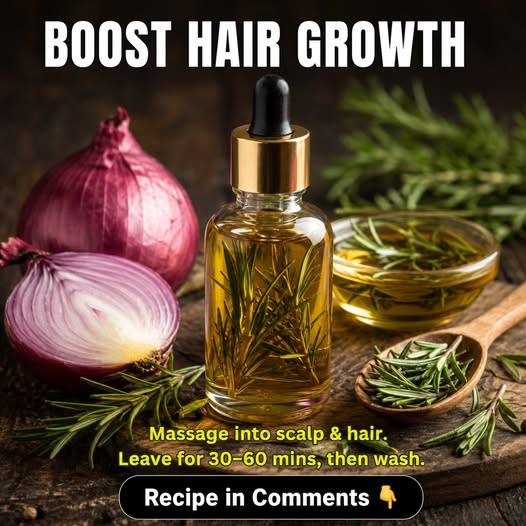
Hair thinning, excessive shedding and slow length retention can affect confidence, but the correct remedy depends on the cause. Genetics, illness, childbirth, nutritional deficiencies, scalp disease, stress and tight hairstyles can all contribute to hair loss. Natural oils may support the scalp and reduce hair breakage, but they cannot treat every form of alopecia. Identifying the underlying cause early generally offers the best chance of improvement. (American Academy of Dermatology)
Rosemary oil has limited but promising human evidence. In one trial involving 100 adults with androgenetic alopecia, neither rosemary oil nor 2% minoxidil significantly changed hair count after three months, but both groups improved after six months. A small onion-juice trial involved people with patchy alopecia areata—not ordinary pattern thinning—and reported initial regrowth after two weeks. These findings do not prove that every homemade onion-and-rosemary mixture works. (PubMed)
The exact recipes below have not been clinically tested as complete mixtures. They combine carefully diluted ingredients with evidence for hair growth, dandruff control, scalp comfort or reduced hair-shaft damage. Visible regrowth cannot occur within one to three days; early changes are usually improved softness, reduced dryness and less breakage.
Remedy 1: For a Normal Scalp
Rosemary, Onion and Coconut Pre-Wash Treatment
Ingredients and Scientific Benefits
- Fresh onion juice – 1 teaspoon: Onion juice produced regrowth in a small trial involving patchy alopecia areata, although the evidence does not cover all types of hair loss.
- Virgin coconut oil – 2 teaspoons: Coconut oil can enter the hair shaft and reduce protein loss from damaged and undamaged hair.
- Jojoba oil – 1 teaspoon: Serves as a lightweight carrier that helps dilute rosemary essential oil.
- Rosemary essential oil – 3 drops: Has limited human evidence for improving hair count after prolonged use in androgenetic alopecia.
- Pure aloe vera gel – 1 teaspoon: Adds moisture and helps the mixture spread without excessive rubbing.
How the Ingredients Work Scientifically
Rosemary oil may influence scalp microcirculation and follicular activity, while onion contains sulfur compounds and antioxidant substances. However, rosemary required six months to produce measurable changes in the published trial, and onion juice was studied for a specific autoimmune hair-loss condition. Coconut oil does not activate follicles, but it helps prevent protein loss and breakage, allowing more existing hair to remain intact. (PubMed)
Procedure
Extract onion juice by grating and straining a small onion. Combine one teaspoon with the aloe gel. Separately mix the coconut and jojoba oils with three rosemary drops. Apply the onion mixture to the scalp, followed by the oil blend. Massage gently for two minutes, leave for 20–30 minutes and wash thoroughly.
How Often to Apply
Use two or three times weekly for at least 12 weeks. Prepare it fresh each time.
Initial Results
Hair may feel smoother within one to three applications. Reduced breakage may appear over several weeks, while measurable regrowth may require three to six months.
Remedy 2: For a Combination Scalp
Diluted Onion and Aloe Scalp Pack with Coconut on the Ends
Ingredients and Scientific Benefits
- Fresh onion juice – 1 tablespoon: Provides the ingredient studied for patchy alopecia areata.
- Cooled boiled water – 1 tablespoon: Reduces onion concentration and potential irritation.
- Aloe vera gel – 1 tablespoon: Creates a lightweight base for the scalp.
- Finely ground colloidal oatmeal – 1 teaspoon: Helps soothe dry or easily irritated areas.
- Virgin coconut oil – 1 teaspoon: Protects dry lengths and ends from protein loss.
- Rosemary essential oil – 2 drops: Provides a low-concentration addition for thinning areas.
How the Ingredients Work Scientifically
Combination scalps may have an oily crown but dry lengths. The diluted onion-and-aloe portion remains mainly on the scalp, while coconut oil is applied only to dry ends. Onion and rosemary have limited condition-specific regrowth evidence, whereas coconut oil’s better-supported role is reducing structural damage to the hair fibre. (PubMed)
Procedure
Mix the onion juice, water, aloe, oatmeal and rosemary oil immediately before use. Apply it in sections to the scalp without soaking the hair. Smooth coconut oil over the final few centimetres of the lengths. Leave for 15–20 minutes and shampoo gently.
How Often to Apply
Apply twice weekly for at least three months. Do not use it on scratched, inflamed or recently chemically treated skin.
Initial Results
The scalp may feel cleaner and the ends softer after one to three uses. Do not expect visible new hair during this period.
Remedy 3: For an Oily or Dandruff-Prone Scalp
Rosemary and Tea Tree Lightweight Treatment
Ingredients and Scientific Benefits
- Jojoba oil – 2 teaspoons: Provides a lightweight carrier for essential oils.
- Grapeseed oil – 1 teaspoon: Helps spread the treatment thinly over an oily scalp.
- Rosemary essential oil – 2 drops: Has limited long-term evidence for androgenetic hair thinning.
- Tea tree essential oil – 1 drop: Tea tree oil has human evidence for reducing dandruff when professionally formulated in a 5% shampoo.
- Aloe vera gel – 1 teaspoon: Provides non-heavy hydration.
- Cooled green tea – 1 teaspoon: Dilutes the aloe portion and provides antioxidant polyphenols.
How the Ingredients Work Scientifically
Dandruff-related itching can encourage scratching and hair breakage. A randomized trial found that a formulated 5% tea tree shampoo improved dandruff severity, itching and greasiness over four weeks. This homemade lower-concentration treatment is not equivalent to that clinical shampoo and should be viewed as supportive care rather than an antifungal medicine. (PubMed)
Procedure
Combine the carrier oils and essential oils. Stir the aloe and green tea together separately. Apply the aloe mixture first, followed by only a few drops of the oil blend across the scalp. Massage for one minute, leave for 15 minutes and shampoo well.
How Often to Apply
Use once or twice weekly for three to four weeks. Stop if dandruff, burning or redness becomes worse.
Initial Results
The scalp may feel less greasy or itchy within several applications. Persistent thick scaling usually requires an appropriate medicated treatment.
Remedy 4: For a Dry Scalp and Brittle Hair
Coconut, Oat and Rosemary Retention Mask
Ingredients and Scientific Benefits
- Virgin coconut oil – 1 tablespoon: Helps limit protein loss and hair-shaft porosity.
- Shea butter – 1 teaspoon: Coats dry strands and reduces roughness.
- Aloe vera gel – 1 tablespoon: Supplies water-based moisture.
- Colloidal oatmeal – 1 teaspoon: Helps soothe dryness.
- Plain honey – ½ teaspoon: Acts as a humectant.
- Rosemary essential oil – 2 drops: Provides a carefully diluted rosemary component.
How the Ingredients Work Scientifically
Dry, fragile hair often appears to “stop growing” because the ends break as quickly as the roots produce new length. Coconut oil has demonstrated a stronger ability to reduce hair protein loss than sunflower or mineral oil. Therefore, the main benefit of this mask is improved length retention rather than accelerated follicle growth. (PubMed)
Procedure
Mix the aloe, oatmeal and honey. Apply a small amount to the scalp. Melt the coconut oil and shea butter between the fingertips, add rosemary oil and distribute through the lengths. Leave for 30 minutes, then wash and condition gently.
How Often to Apply
Apply twice weekly for at least four weeks. Very fine hair may need only half the oil quantity.
Initial Results
Hair may feel softer after the first use. Reduced tangling and breakage can become noticeable after several weeks.
Remedy 5: For a Sensitive Scalp
Fragrance-Free Coconut and Oat Barrier Treatment
Ingredients and Scientific Benefits
- Cooled boiled water – 1 tablespoon: Provides simple hydration.
- Colloidal oatmeal – 1 tablespoon: Helps calm dryness and irritation.
- Pure aloe vera gel – 1 tablespoon: Creates a lightweight soothing base.
- Virgin coconut oil – 1 teaspoon: Protects the hair shaft from grooming damage.
- Vegetable glycerin – ¼ teaspoon: Helps the outer skin layer retain water.
- Sunflower seed oil – ½ teaspoon: Softens dry scalp skin without essential-oil fragrance.
How the Ingredients Work Scientifically
Sensitive scalps should generally avoid onion juice, rosemary oil and other fragrant essential oils because natural fragrances can trigger irritant or allergic contact dermatitis. This remedy does not claim to stimulate follicles directly. Its purpose is to protect the scalp and reduce breakage while the cause of hair loss is assessed. (DermNet®)
Procedure
Mix the water, oatmeal, aloe and glycerin into a soft paste. Add the coconut and sunflower oils and apply a thin layer to a small scalp area first. When no reaction develops, apply lightly to dry areas for 10 minutes and rinse.
How Often to Apply
Use once during the first three days. If tolerated, apply once weekly for three to four weeks.
Initial Results
Dryness or tightness may improve after one to three uses. Stop immediately if itching, swelling, burning or a rash develops.
Final Tips for Stronger, Fuller-Looking Hair
Massage with the fingertips rather than the nails. One very small study found that four minutes of daily scalp massage increased hair thickness after 24 weeks, but it did not significantly increase hair density or growth rate. Massage should therefore be considered supportive, not a replacement for treatment. (PubMed)
Always dilute essential oils, patch-test new mixtures and keep them away from the eyes. Do not apply rosemary oil or tea tree oil undiluted. Avoid aggressive brushing, tight ponytails, frequent high heat and harsh chemical processing. Gentle shampooing, conditioning and detangling can reduce breakage in already-thinning hair. (American Academy of Dermatology)
Softness and easier styling may begin within two or three days. Assess shedding over eight to twelve weeks and photograph the same scalp area monthly under similar lighting. True hair-growth results usually require several months.
Diet Plan to Support Healthy Hair Growth
Follow a balanced diet for at least three months rather than taking random “hair vitamins.”
Breakfast: Eggs, unsweetened yogurt or oatmeal with seeds and fruit.
Mid-morning: Guava, orange, berries or another vitamin-C-rich fruit.
Lunch: Lentils, beans, chicken, fish or lean meat with vegetables and whole-grain roti or brown rice.
Afternoon: Nuts, roasted chickpeas, yogurt or seeds.
Dinner: Include protein, vegetables and a moderate whole-grain portion.
Iron-supporting foods: Lean meat, lentils, beans and leafy vegetables. Pair plant sources with vitamin-C-rich foods.
Protein sources: Eggs, dairy foods, fish, poultry, lentils, beans, tofu and nuts.
Iron, zinc, vitamin D and several B vitamins participate in normal follicle function, but supplementation is most appropriate when deficiency is confirmed. Excessive intake of certain nutrients can also worsen hair loss. (PubMed)
Continue a tolerated natural routine for three to six months. See a dermatologist if shedding persists, the part becomes wider, bald patches appear, the scalp is painful or inflamed, or hair loss follows illness, childbirth, major weight loss or a new medicine. Blood testing may be needed when deficiency, thyroid disease or another medical cause is suspected. (American Academy of Dermatology)
References for the above remedy
- Panahi Y, et al. “Rosemary Oil vs Minoxidil 2% for the Treatment of Androgenetic Alopecia.”
https://pubmed.ncbi.nlm.nih.gov/25842469/ - Sharquie KE and Al-Obaidi HK. “Onion Juice, a New Topical Treatment for Alopecia Areata.”
https://pubmed.ncbi.nlm.nih.gov/12126069/ - Hay IC, Jamieson M and Ormerod AD. “Randomized Trial of Aromatherapy for Alopecia Areata.”
https://pubmed.ncbi.nlm.nih.gov/9828867/ - Rele AS and Mohile RB. “Effect of Mineral Oil, Sunflower Oil, and Coconut Oil on Prevention of Hair Damage.”
https://pubmed.ncbi.nlm.nih.gov/12715094/ - Satchell AC, et al. “Treatment of Dandruff with 5% Tea Tree Oil Shampoo.”
https://pubmed.ncbi.nlm.nih.gov/12451368/ - Koyama T, et al. “Standardized Scalp Massage Results in Increased Hair Thickness.”
https://pubmed.ncbi.nlm.nih.gov/26904154/ - American Academy of Dermatology Association. “Hair Loss: Overview.”
https://www.aad.org/public/diseases/hair-loss/causes/fall-out - American Academy of Dermatology Association. “Hair Loss: Diagnosis and Treatment.”
https://www.aad.org/public/diseases/hair-loss/treatment/diagnosis-treat - Almohanna HM, et al. “The Role of Vitamins and Minerals in Hair Loss: A Review.”
https://pubmed.ncbi.nlm.nih.gov/30547302/ - DermNet New Zealand. “Allergic Contact Dermatitis to Essential Oils.”
https://dermnetnz.org/topics/allergic-contact-dermatitis-to-essential-oils