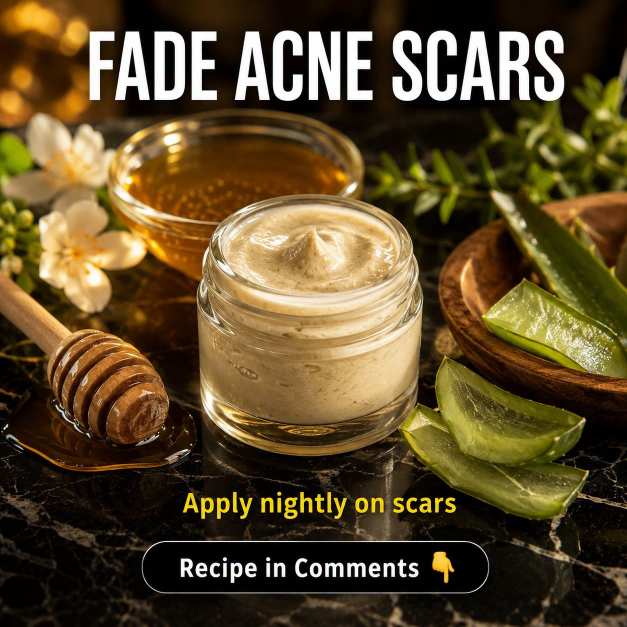
Acne can leave brown, grey or red marks that remain long after a breakout has healed, affecting skin tone and confidence. These flat marks are usually post-inflammatory hyperpigmentation or post-inflammatory erythema rather than permanent scars. True acne scars are raised or indented because the skin’s collagen structure has changed, and homemade masks cannot rebuild this lost tissue. Natural remedies can support hydration, calm residual inflammation and gradually improve the appearance of flat post-acne marks, but noticeable fading generally requires several weeks or months. (PubMed)
The image suggests applying honey and aloe vera nightly. This combination may soothe and moisturise the skin, but it should be used as a freshly prepared, short-contact mask rather than left on overnight. Raw mixtures lack preservatives and can irritate acne-prone skin when applied too heavily. The remedies below use different combinations for each skin type and distinguish scientifically supported ingredient functions from unrealistic scar-removal promises.
Remedy 1: Aloe, Licorice and Green Tea Gel for Normal Skin
Ingredients
- 1 teaspoon plain aloe vera gel
- 1 teaspoon strongly brewed, cooled green tea
- 1 teaspoon cooled licorice-root infusion
- 1 teaspoon colloidal oatmeal
- ½ teaspoon pure honey
- 1 drop vegetable glycerin
Scientific Working of Each Ingredient
Aloe vera supplies lightweight hydration and may help reduce redness. A clinical trial found that a professionally formulated aloe cream improved the appearance of surgical scars over several months, although this does not prove that fresh aloe can erase established acne scars. Green-tea extracts contain catechins that have demonstrated anti-inflammatory effects and reductions in inflammatory acne lesions, potentially lowering the risk of additional post-acne marks. (PubMed)
Licorice contains compounds such as glabridin and licochalcone that can influence inflammation and melanin production. Clinical evidence comes from measured cosmetic formulations, so homemade licorice tea is considerably weaker. Oatmeal supports the protective barrier, honey binds moisture and glycerin improves hydration and surface flexibility. Better hydration can make flat marks and rough texture look temporarily less prominent. (PubMed)
Procedure
Steep a small piece of dried licorice root or one plain licorice tea bag in hot water for five minutes. Allow it to cool completely. Mix one teaspoon of this infusion with the aloe, green tea, honey, oatmeal and glycerin.
Apply a thin layer to clean skin at night, avoiding active, broken pimples and the eye area. Leave it on for 10 minutes, rinse with lukewarm water and apply a gentle moisturiser.
How Often to Apply
Use once nightly for three days. Continue on alternate nights for three to four weeks if the skin remains comfortable.
Initial Results
Within one to three days, the skin may feel softer and less irritated. Actual dark-mark fading should not be expected this quickly.
Remedy 2: Soy, Rice and Aloe Mask for Combination Skin
Ingredients
- 1 tablespoon unsweetened soy milk
- 1 teaspoon aloe vera gel
- 1 teaspoon cooled green tea
- 1 teaspoon rice starch
- 1 teaspoon colloidal oatmeal
- ½ teaspoon honey
Scientific Working of Each Ingredient
Combination skin requires moisture on the cheeks without a heavy oily layer over the forehead and nose. Stabilised soy extracts have produced modest improvements in facial pigmentation in clinical research by interfering with processes involved in pigment transfer. Ordinary soy milk contains unpredictable concentrations and should be regarded only as a gentle supporting ingredient. (PubMed)
Green tea may help control inflammation and sebum when used consistently in properly formulated products. Rice starch supports recovery of a weakened skin barrier, while aloe, oatmeal and honey reduce the tight feeling that can develop when oily areas are treated too aggressively. (PubMed)
Procedure
Combine the soy milk, aloe and green tea. Add the rice starch, oatmeal and honey, stirring until the mixture resembles a soft gel.
Spread a thin layer over the forehead, nose and chin and a slightly thicker layer over drier cheeks. Leave it on for eight to ten minutes and rinse before it dries completely.
How Often to Apply
Apply on nights one, three and five. Continue twice weekly for four weeks if no clogged pores or irritation develop.
Initial Results
The cheeks may feel better hydrated, while the T-zone may look temporarily less oily. Flat post-acne marks require longer and will not vanish after three applications.
Remedy 3: Green Tea and Rice Mark-Care Pack for Oily Skin
Ingredients
- 1 tablespoon strongly brewed, cooled green tea
- 1 teaspoon aloe vera gel
- 1½ teaspoons rice starch
- 1 teaspoon colloidal oatmeal
- ½ teaspoon cooled licorice-root infusion
- ¼ teaspoon honey
Scientific Working of Each Ingredient
Oily skin often develops repeated acne marks because new inflammatory spots continue to form. Topical green-tea extracts have reduced inflammatory lesions in controlled research and have also produced gradual reductions in facial sebum. Less inflammation may mean fewer new marks, but brewed green tea is weaker than the formulations used in these studies. (PubMed)
Rice starch absorbs a small amount of surface oil without the harshness of coarse scrubs. Licorice-derived compounds have demonstrated pigment-modulating and anti-inflammatory activity in formulated products. Aloe, oatmeal and a small amount of honey provide hydration so the skin does not become excessively dry and irritated.
Procedure
Mix the green tea, aloe, licorice infusion and honey. Add the rice starch and oatmeal gradually until a light, spreadable paste forms.
Apply only a thin layer, especially over oily areas. Do not rub it into pimples or scars. Leave for six to eight minutes, rinse and follow with a lightweight moisturiser.
How Often to Apply
Use every other night for five days, giving three applications. Continue twice weekly for four to six weeks.
Initial Results
Oiliness and redness may appear reduced after the first few uses. Brown or grey marks will usually require at least several weeks of consistent care and sun protection.
Remedy 4: Honey, Aloe and Sunflower Mask for Dry Skin
Ingredients
- 1 teaspoon plain aloe vera gel
- 1 teaspoon pure honey
- 1 tablespoon colloidal oatmeal
- ½ teaspoon unsweetened soy milk
- ¼ teaspoon cold-pressed sunflower seed oil
- 2 drops vegetable glycerin
Scientific Working of Each Ingredient
Dry skin can make discolouration and uneven texture look more obvious. Honey and glycerin act as humectants, attracting water to the outer skin layer. Oatmeal supports barrier recovery, while sunflower seed oil provides linoleic-acid-rich lipids that help reduce moisture loss. Research comparing natural oils found that sunflower oil supported adult barrier integrity better than olive oil. (PubMed)
Aloe provides water-based hydration, and soy-derived compounds have shown modest pigment-lightening potential in standardised formulations. These ingredients can improve comfort and surface appearance but cannot fill indented scars.
Procedure
Mix the aloe, honey and soy milk. Stir in the oatmeal and glycerin, then add the sunflower oil last.
Apply to slightly damp skin for 10–12 minutes. Rinse without using a washcloth or scrub and immediately apply a fragrance-free moisturiser.
How Often to Apply
Use nightly for three days, then every other night for another two weeks.
Initial Results
Dryness and tightness may improve within one to three days. Well-hydrated skin may look brighter, but scar depth and pigmentation will remain largely unchanged at this early stage.
Remedy 5: Minimal Oat and Rice Mask for Sensitive Skin
Ingredients
- 1 tablespoon cooled boiled water
- 1½ teaspoons colloidal oatmeal
- 1 teaspoon rice starch
- ½ teaspoon plain aloe vera gel
- 2 drops vegetable glycerin
- 2 drops sunflower seed oil
Scientific Working of Each Ingredient
Sensitive skin can develop darker marks when strong remedies trigger additional inflammation. The priority is therefore preventing irritation rather than aggressively trying to lighten pigmentation. Colloidal oatmeal has improved hydration, barrier measurements and irritation in controlled studies. Rice starch can support the recovery of damaged skin, while glycerin and sunflower oil reduce dehydration. (PubMed)
Aloe is optional because some people develop contact irritation from botanical gels. Leave it out and add more cooled water if aloe has caused burning or itching in the past.
Procedure
Soak the oatmeal and rice starch in cooled boiled water for two minutes. Add the glycerin, sunflower oil and optional aloe.
Patch-test for 24 hours. Apply a very thin layer for five minutes and rinse gently. Do not massage sensitive, inflamed or recently treated skin.
How Often to Apply
Use every other night over five days. Continue once weekly only if the skin remains calm.
Initial Results
The skin may feel calmer and less dry after one to three uses. This barrier-supporting remedy is not expected to visibly lighten marks within a few days.
Final Tips for Fading Acne Marks Safely
Use broad-spectrum sunscreen every morning because ultraviolet and visible light can deepen post-inflammatory pigmentation and slow its improvement. Reviews of PIH treatment consistently identify SPF 30 or higher sunscreen as a central part of care. (PubMed)
Do not pick, squeeze or scratch pimples. Avoid lemon juice, baking soda, toothpaste, undiluted essential oils and rough sugar scrubs. These can cause irritation, chemical burns and additional pigmentation.
Prepare each mask fresh and discard leftovers. Surface softness and glow may begin within two or three days, while flat acne marks commonly need eight to twelve weeks or longer. Indented ice-pick, rolling and boxcar scars usually need professional options such as microneedling, subcision, laser therapy, chemical reconstruction or dermatologist-supervised peels.
Continue a suitable home remedy for four weeks only if the skin remains comfortable. See a dermatologist if marks are not improving after two to three months, active acne continues, or scars are raised, deep or worsening.
Diet Plan to Support Clearer Skin
Diet cannot remove existing scars, but controlling new acne can prevent additional marks. Follow this plan for at least eight to twelve weeks.
Breakfast: Choose eggs, lentils, plain yogurt or oatmeal with guava, berries, orange, papaya or another whole fruit.
Lunch: Eat fish, chicken, beans or lentils with vegetables and a moderate serving of brown rice or whole-grain bread.
Snack: Choose fruit, unsalted nuts, seeds or plain yogurt instead of sugary drinks, pastries and sweets.
Dinner: Include a protein source with leafy vegetables, carrots, tomatoes, broccoli or pumpkin.
Base most carbohydrates on oats, beans, lentils, vegetables and whole grains rather than highly refined foods. Randomised trials lasting 10–12 weeks found that low-glycaemic-load diets reduced inflammatory and non-inflammatory acne lesions in some participants. This may prevent new marks but does not directly fill old scars. (PubMed)
Drink according to thirst and avoid crash dieting. Do not take high-dose zinc, vitamin A, biotin or other supplements without medical advice. Continue the diet and skincare routine for at least two to three months. If acne or scarring persists, consult a doctor or dermatologist.
References for the above remedy
- Auffret N, et al. Acne-induced post-inflammatory hyperpigmentation: from grading to treatment.
https://pubmed.ncbi.nlm.nih.gov/40263971/ - Tan MG, et al. Topical treatment for post-inflammatory hyperpigmentation: a systematic review.
https://pubmed.ncbi.nlm.nih.gov/34525885/ - Kashetsky N, et al. Post-inflammatory hyperpigmentation: a systematic review of treatment outcomes.
https://pubmed.ncbi.nlm.nih.gov/37843491/ - Hajheydari Z, et al. Aloe vera topical gel combined with tretinoin in mild and moderate acne.
https://pubmed.ncbi.nlm.nih.gov/23336746/ - Kim S, et al. Effects of green tea on acne vulgaris: systematic review and meta-analysis.
https://pubmed.ncbi.nlm.nih.gov/32812270/ - Capone K, et al. Effects of colloidal oatmeal cream on skin-barrier properties.
https://pubmed.ncbi.nlm.nih.gov/32484623/ - Pierard GE, et al. Assessment of topical hypopigmenting agents, including stabilised soy extract.
https://pubmed.ncbi.nlm.nih.gov/12077522/ - Costa A, et al. Licorice, emblica and belides as an alternative treatment for facial pigmentation.
https://pubmed.ncbi.nlm.nih.gov/21152784/ - Fatima S, et al. The role of sunscreen in melasma and post-inflammatory hyperpigmentation.
https://pubmed.ncbi.nlm.nih.gov/32029932/ - Kwon HH, et al. Clinical and histological effects of a low-glycaemic-load diet in acne.
https://pubmed.ncbi.nlm.nih.gov/22678562/