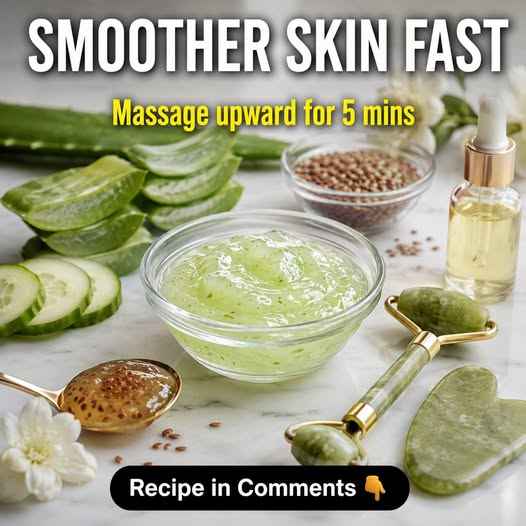
Smooth-looking skin depends largely on hydration, a healthy protective barrier and gentle removal of excess surface oil. Aloe vera, cucumber and facial massage may create a temporarily fresher appearance, but they cannot erase wrinkles, scars, pigmentation or enlarged pores in a few days. The five-minute upward massage shown in the image may temporarily increase facial blood flow, yet harder pressure does not produce better results. In a small human study, five minutes of roller massage increased circulation in the treated cheek for at least ten minutes; it did not prove an instant face-lifting or wrinkle-removal effect. (PubMed)
The exact homemade mixtures below have not been evaluated as complete formulas in clinical trials. Their individual ingredients, however, have evidence for supporting hydration, reducing roughness, maintaining the skin barrier or controlling surface oil. Prepare every mixture fresh, use clean utensils and patch-test it for 24 hours before applying it to your entire face.
Remedy 1: Aloe, Cucumber and Honey Smoothing Gel for Normal Skin
Ingredients
- 1 teaspoon plain aloe vera gel: provides lightweight surface hydration
- 1 teaspoon freshly strained cucumber juice: creates a cooling water-based texture
- 1 teaspoon pure honey: acts as a moisture-binding humectant
- 1 teaspoon cooled green tea: supplies antioxidant catechins
- 1 teaspoon colloidal oatmeal: reduces roughness and supports the skin barrier
- 1 drop vegetable glycerin: helps the outer skin layer retain water
Scientific Working of Each Ingredient
Aloe vera extracts have increased the water content of the outer skin layer after topical application. Glycerin supports hydration, skin elasticity and barrier recovery by attracting and holding water. Colloidal oatmeal contains starches, beta-glucans and antioxidant avenanthramides that help calm dryness and strengthen barrier function. Honey-containing creams have produced measurable improvements in moisturisation and smoothness, although raw kitchen honey has not been studied in exactly the same way. Cucumber juice mainly provides water and a cooling sensation rather than permanent skin tightening. (PubMed)
Procedure
Mix the aloe gel and honey until smooth. Add cucumber juice and cooled green tea, followed by the oatmeal and glycerin. Apply a thin layer to clean, slightly damp skin.
Leave the gel on for eight minutes. Wet your fingertips and massage using very light upward and outward movements for one minute. Rinse with lukewarm water and apply a simple moisturiser.
How Often to Apply
Apply once daily for three days. Continue two or three times weekly if the skin remains comfortable.
Initial Results
Within one to three days, normal skin may feel softer and look slightly smoother because of improved surface hydration. Deeper wrinkles and acne scars will not change during this period.
Remedy 2: Green Tea and Rice Balancing Mask for Combination Skin
Ingredients
- 1 tablespoon strong cooled green tea: may gradually reduce excess facial sebum
- 1 teaspoon aloe vera gel: hydrates without a heavy oily finish
- 1 teaspoon rice starch: creates a smooth absorbent base
- 1 teaspoon colloidal oatmeal: supports dry facial areas
- ½ teaspoon honey: prevents the mask from becoming excessively drying
- 1 drop vegetable glycerin: improves water retention
Scientific Working of Each Ingredient
Combination skin commonly has an oily forehead, nose and chin but drier cheeks. A human split-face study found that a formulated green-tea extract gradually reduced facial sebum over 60 days. Brewed green tea is weaker, so it should not be expected to deliver the same results immediately. Rice starch has supported recovery of experimentally weakened skin barriers, while oatmeal, aloe, honey and glycerin provide different forms of hydration. (PubMed)
Procedure
Combine the green tea, aloe, honey and glycerin. Stir in the rice starch and oatmeal. Apply a thin layer over the T-zone and a slightly thicker layer over dry cheeks.
Leave it on for seven to ten minutes. Rinse before the mixture dries completely. Do not scrub the rice starch into the skin.
How Often to Apply
Use on days one, three and five. Continue twice weekly for three weeks when no irritation develops.
Initial Results
The cheeks may feel less tight after one or two applications, while the T-zone may appear temporarily less shiny. The treatment cannot permanently shrink pores.
Remedy 3: Green Tea, Aloe and Gentle Clay Mask for Oily Skin
Ingredients
- 1 teaspoon cosmetic-grade kaolin clay: absorbs some excess surface oil
- 1 tablespoon cooled green tea: provides antioxidant catechins
- 1 teaspoon aloe vera gel: supplies oil-free hydration
- 1 teaspoon colloidal oatmeal: helps limit clay-related tightness
- ½ teaspoon rice starch: improves the mask’s smooth texture
- ¼ teaspoon honey: adds light moisture without a heavy oil
Scientific Working of Each Ingredient
Oil absorption can make the face feel smoother and less shiny, but clay does not permanently stop the sebaceous glands from producing oil. Green-tea formulations have shown gradual reductions in sebum, while aloe, oatmeal and honey can help prevent excessive dehydration. A clinical trial involving a specially formulated bentonite-based mask reported improvements in acne over four to eight weeks, but those results cannot be transferred directly to plain homemade clay. (PubMed)
Procedure
Mix the kaolin, oatmeal and rice starch. Add the green tea, aloe and honey, stirring until the texture resembles thin yogurt. Apply a very light layer over oily areas without covering broken or recently squeezed blemishes.
Leave it on for five minutes only. Rinse while the mask is still slightly damp. Follow with a lightweight, fragrance-free moisturiser.
How Often to Apply
Apply every other day during the first five days, giving three total applications. Afterward, use no more than once weekly.
Initial Results
The face may appear less oily and feel smoother after the first application. Blackheads, inflammatory acne and acne scars require longer-term treatment.
Remedy 4: Honey, Oat and Sunflower Moisture Mask for Dry Skin
Ingredients
- 1 tablespoon colloidal oatmeal: helps relieve dryness and rough texture
- 1 teaspoon aloe vera gel: adds initial water-based hydration
- 1 teaspoon pure honey: attracts moisture to the surface
- ¼ teaspoon cold-pressed sunflower seed oil: supplies barrier-supporting lipids
- 2 drops vegetable glycerin: improves water retention
- 1 teaspoon cooled boiled water: creates a soft, spreadable mask
Scientific Working of Each Ingredient
Dry skin often feels rough because the outer layer lacks both water and protective lipids. Glycerin and honey bind moisture, while sunflower seed oil helps reduce water loss by supplementing surface fats. In a human comparison, sunflower oil preserved barrier integrity and improved hydration, whereas olive oil weakened the barrier and caused mild redness. Colloidal-oatmeal creams have also improved dryness, hydration and barrier measurements in controlled studies. (PubMed)
Procedure
Soak the oatmeal in the cooled water for one minute. Add the aloe, honey and glycerin. Mix in the sunflower oil last.
Apply the mask to slightly damp skin and leave it on for ten minutes. Rinse gently, pat the face dry and immediately apply moisturiser to seal in water.
How Often to Apply
Use once daily for three to five days. Continue three times weekly for another two weeks.
Initial Results
Tightness and flaky texture may begin to improve within one to three applications. Fine dehydration lines may look temporarily softer, but established wrinkles require prolonged care.
Remedy 5: Minimal Oat and Rice Compress for Sensitive Skin
Ingredients
- 1 tablespoon cooled boiled water: forms a fragrance-free base
- 1½ teaspoons colloidal oatmeal: helps calm and protect the barrier
- 1 teaspoon rice starch: produces a soft, non-abrasive paste
- 2 drops vegetable glycerin: improves hydration
- 2 drops sunflower seed oil: reduces moisture loss
Scientific Working of Each Ingredient
Sensitive skin should be exposed to fewer ingredients, shorter application times and minimal massage. Colloidal-oatmeal preparations have improved hydration, skin pH and barrier function in people with irritated or eczema-prone skin. Glycerin can support barrier recovery, rice starch provides a soft protective base and sunflower oil supplies linoleic-acid-rich lipids without the fragrance found in many botanical mixtures. (PubMed)
Procedure
Combine the oatmeal and rice starch with cooled boiled water. Allow the mixture to soften for two minutes before adding the glycerin and sunflower oil.
Patch-test for 24 hours. Apply a thin layer for five minutes and rinse using only your fingertips. Do not use a roller, gua sha tool or prolonged upward massage on irritated skin.
How Often to Apply
Apply every other day for three to five days. Continue once weekly only when the skin remains calm.
Initial Results
The skin may feel less tight and rough within one to three applications. Stop immediately if itching, swelling, burning, persistent redness or small bumps appear.
How to Perform a Safe Five-Minute Upward Facial Massage
Begin with clean hands and enough gel or moisturiser to prevent dragging. Move from the centre of the chin toward the ears, from the sides of the nose toward the temples and from the eyebrows toward the hairline. Use feather-light pressure and make each movement slowly.
A massage roller may temporarily increase circulation, and a newer eight-week trial reported changes in elasticity and facial measurements after regular roller or gua sha use. These small studies do not prove that massage removes wrinkles, permanently tightens the face or increases collagen within five minutes. Avoid massage over inflamed acne, rosacea flares, sunburn, infection, recent cosmetic procedures or broken skin. (PubMed)
Final Tips for Keeping Skin Smooth
Use lukewarm rather than hot water, avoid rough scrubs and clean facial rollers after every use. Do not apply lemon juice, baking soda, undiluted essential oils or coarse sugar to the face. These can irritate the barrier and make roughness more noticeable.
Apply broad-spectrum sunscreen every morning. A large randomised trial found that daily sunscreen use reduced measurable skin ageing compared with discretionary use over approximately four and a half years. Sunscreen has considerably stronger evidence for preserving smooth texture than any instant homemade mask. (PubMed)
Realistic improvements in softness may begin within two or three days, while lasting improvements in texture require consistent care. Continue a suitable remedy for two to three weeks. Consult a dermatologist if roughness persists, worsens or occurs with itching, painful acne, facial swelling, eczema-like patches, pigmentation changes or recurrent redness.
Diet Plan for Smoother, Healthier-Looking Skin
Follow this balanced eating plan for at least four to six weeks. Diet will not remove wrinkles immediately, but adequate protein, healthy fats and colourful produce support normal skin maintenance.
Breakfast: Eat eggs, unsweetened yogurt, beans or oatmeal with berries, papaya, mango, guava or an orange.
Lunch: Choose fish, chicken, lentils or beans with leafy vegetables and brown rice or whole-grain bread.
Snack: Eat a small handful of walnuts, almonds, pumpkin seeds or ground flaxseed with whole fruit.
Dinner: Include a protein source with carrots, spinach, broccoli, pumpkin, tomatoes or other colourful vegetables.
Drink water according to thirst unless a doctor has advised fluid restriction. In a randomised crossover trial, a high-carotenoid fruit-and-vegetable diet produced measurable skin-colour changes after four weeks, without changing skin lightness. This supports eating varied produce but does not justify high-dose supplements or promises of overnight glow. (PubMed)
Maintain the diet and gentle skincare routine for at least one month. If persistent roughness occurs with unusual tiredness, hair loss, unexplained weight changes or widespread dryness, see a doctor to investigate possible nutritional, hormonal or dermatological causes.
References for the above remedy
- Dal’Belo SE, Gaspar LR, Maia Campos PMBG. Moisturizing effect of cosmetic formulations containing Aloe vera extract.
https://pubmed.ncbi.nlm.nih.gov/17026654/ - Capone K, Kirchner F, Klein SL, Tierney NK. Effects of colloidal oatmeal cream on skin-barrier properties.
https://pubmed.ncbi.nlm.nih.gov/32484623/ - Fluhr JW, Darlenski R, Surber C. Glycerol and the skin: functions in hydration and barrier repair.
https://pubmed.ncbi.nlm.nih.gov/18510666/ - Mahmood T, Akhtar N, Khan BA. Effects of topical green tea and lotus on facial sebum.
https://pubmed.ncbi.nlm.nih.gov/23935347/ - Danby SG, et al. Effect of olive oil and sunflower seed oil on the adult skin barrier.
https://pubmed.ncbi.nlm.nih.gov/22995032/ - Płaczek M, et al. Honey-based topical formulations and effects on skin moisturisation and smoothness.
https://pubmed.ncbi.nlm.nih.gov/39770550/ - Miyaji A, Sugimori K, Hayashi N. Short- and long-term effects of facial massage rollers on skin blood flow.
https://pubmed.ncbi.nlm.nih.gov/30477852/ - Salimi S, et al. Bentonite-based facial mask and acne severity: a randomised controlled trial.
https://pubmed.ncbi.nlm.nih.gov/41347526/ - Hughes MCB, Williams GM, Baker P, Green AC. Sunscreen and prevention of skin aging: a randomized trial.
https://pubmed.ncbi.nlm.nih.gov/23732711/ - Pezdirc K, et al. High-carotenoid fruit and vegetable intake and measurable skin changes.
https://pubmed.ncbi.nlm.nih.gov/27160341/