
Dark spots can develop after acne, insect bites, irritation, sun exposure, burns, or other inflammation. This is often called post-inflammatory hyperpigmentation (PIH), in which excess melanin remains after the original skin problem settles. PIH is particularly common and persistent in darker skin tones. (PubMed) Although natural ingredients can support a gentle skincare routine, claims that established dark spots can be completely removed in seven days are unrealistic. The American Academy of Dermatology notes that some superficial spots naturally take 6–12 months to fade, while deeper pigmentation can last longer. (American Academy of Dermatology) The safest approach combines gentle skincare, control of the original cause, consistent sun protection, and carefully selected ingredients. The remedies below deliberately avoid aggressive bleaching ingredients and use different formulations according to skin type.
Remedy 1: For Normal Skin – Turmeric, Green Tea and Aloe Brightening Mask
Ingredients
- 1 tablespoon pure aloe vera gel
- 2 teaspoons cooled brewed green tea
- ¼ teaspoon culinary turmeric
- 1 teaspoon finely ground oats
- 1 teaspoon plain unsweetened yogurt
- ½ teaspoon honey
Scientific Working of Each Ingredient
Turmeric: Turmeric contains curcumin, a polyphenol studied for antioxidant and anti-inflammatory activity. A systematic review of human studies found early evidence that oral and topical turmeric/curcumin preparations may benefit several dermatological conditions, although further research is required. (PubMed) Importantly, this evidence does not establish homemade turmeric masks as a clinically proven cure for hyperpigmentation.
Aloe vera: Aloe provides a soothing, water-rich base. Laboratory research has also investigated aloe constituents in relation to melanin, although clinical evidence for treating human dark spots with homemade aloe remains limited.
Green tea: Its catechin polyphenols provide antioxidant activity and make a gentle alternative to acidic DIY ingredients.
Oats: Finely ground oats thicken the mask while avoiding abrasive exfoliation.
Yogurt and honey: Primarily improve hydration and consistency rather than acting as proven pigment-removing agents.
Procedure
Brew green tea and cool it completely. Combine two teaspoons with aloe, turmeric, oats, yogurt, and honey. Apply a thin layer over clean skin without scrubbing.
Leave it for 10 minutes and rinse thoroughly with lukewarm water. Turmeric may temporarily stain very light skin or fabrics yellow.
How Often to Apply
Apply once daily or on alternate days for the first 5–7 days.
Initial Results
Within 1–3 days, skin may feel softer and appear less dull. Do not expect established melanin pigmentation to disappear in this period.
Remedy 2: For Combination Skin – Aloe, Oat and Turmeric Spot Mask
Ingredients
- 1½ tablespoons aloe vera gel
- 1 tablespoon finely ground oats
- 1 tablespoon cucumber puree
- ⅛–¼ teaspoon turmeric
- 1 teaspoon cooled green tea
- ½ teaspoon honey
Scientific Working of the Remedy
Combination skin requires moisture without covering the entire face in heavy oils.
Aloe and cucumber provide a lightweight base. Oats make the mixture easy to apply without harsh rubbing, while turmeric supplies curcuminoids with antioxidant and anti-inflammatory properties.
Clinical literature on topical curcumin is growing, but researchers note that the number of topical clinical studies remains relatively limited. (PubMed) Therefore, turmeric should be considered a supportive ingredient rather than a guaranteed depigmentation treatment.
The gentle nature of the mixture is particularly important because irritation itself can worsen pigmentation. The AAD advises that skincare products causing burning or stinging may make dark spots darker. (American Academy of Dermatology)
Procedure
Mix all ingredients into a smooth paste. Apply primarily over unevenly pigmented areas rather than piling a thick layer over the entire face.
Leave for approximately 10 minutes and rinse without rubbing.
How Often to Apply
Use once daily for up to 5 days, then reduce to 3–4 applications weekly.
Initial Results
Hydration and surface smoothness may improve in several days. Meaningful fading of a dark spot normally requires substantially longer.
Remedy 3: For Oily Skin – Green Tea, Aloe and Turmeric Gel Mask
Ingredients
- 2 tablespoons cooled brewed green tea
- 1 tablespoon aloe vera gel
- ¼ teaspoon turmeric
- 1 teaspoon cucumber juice
- 1 teaspoon finely ground oats
Why This Formula May Help
Oily and acne-prone skin is particularly vulnerable to PIH because every inflamed or picked pimple can leave another dark mark.
Green tea provides antioxidant polyphenols without adding oil. Aloe produces a lightweight gel base, and turmeric supplies curcumin.
The most important strategy, however, is preventing new inflammation. PIH occurs after inflammatory skin conditions or external injury, meaning repeatedly squeezing acne while attempting to lighten old marks can create new ones. (PubMed)
Procedure
Mix the ingredients thoroughly. Spread a thin layer across affected areas.
Leave for 8–10 minutes and rinse. Do not use a brush or scrub the oats against acne lesions.
How Often to Apply
Use once daily for 5–7 days if tolerated, followed by three applications weekly.
Initial Results
The complexion may look calmer and fresher after several applications. Existing pigmentation should be evaluated over weeks or months rather than seven days.
Remedy 4: For Dry Skin – Aloe, Oat, Honey and Turmeric Moisture Mask
Ingredients
- 2 tablespoons aloe vera gel
- 1 tablespoon finely ground oats
- 1 teaspoon honey
- ¼ teaspoon turmeric
- 1 teaspoon plain unsweetened yogurt
- ½ teaspoon virgin coconut oil
Scientific Working of Each Ingredient
Dry skin needs special attention because aggressive attempts to lighten pigmentation can compromise the skin barrier.
Turmeric contributes curcuminoids and is being investigated in dermatology for antioxidant and anti-inflammatory effects. A systematic review found encouraging but still limited clinical evidence across different skin disorders. (PubMed)
Aloe, honey and yogurt create a moisturizing base, while coconut oil adds emollience for dry skin.
Finely ground oats provide texture without requiring abrasive sugar or salt.
The scientific logic here is as much about avoiding inflammation as adding a “brightening” ingredient. Irritation can promote or worsen hyperpigmentation, so a gentle routine is particularly important. (American Academy of Dermatology)
Procedure
Combine the ingredients thoroughly. Apply a thin, even layer and leave it for approximately 10–15 minutes.
Rinse with lukewarm water and pat—not rub—the skin dry.
How Often to Apply
Apply every other day for the first week. Continue 2–3 times weekly if your skin remains comfortable.
Initial Results
Dryness and roughness may improve after a few applications, making the complexion appear healthier. Actual pigment fading takes considerably longer.
Remedy 5: For Sensitive Skin – Minimal Aloe, Oat and Green Tea Mask
Sensitive skin requires a different approach. More ingredients are not necessarily better.
Ingredients
- 2 tablespoons pure aloe vera gel
- 1 tablespoon cooled green tea
- 1 tablespoon finely ground oats
- 1 teaspoon cucumber juice
- ½ teaspoon honey, optional
Scientific Working of the Ingredients
This formula deliberately removes turmeric and acidic ingredients to minimize potential irritation.
Aloe supplies the gel base, green tea contributes antioxidant compounds, and finely ground oats make the mixture more conditioning.
The main scientific principle is avoiding additional inflammation. If an ingredient makes sensitive skin burn, sting, peel, or become red, continuing to use it in hopes of “bleaching” a dark mark can be counterproductive. The AAD specifically recommends gentle skincare when managing hyperpigmentation. (American Academy of Dermatology)
Procedure
Combine the ingredients and patch-test first. If no irritation develops, apply a thin layer for 5–10 minutes.
Rinse gently and discontinue immediately if burning, itching, swelling, or persistent redness develops.
How Often to Apply
Start on alternate days for 5–7 days.
Initial Results
Skin may feel more comfortable and hydrated within 1–3 days. Sensitive skin should never be aggressively exfoliated to obtain faster pigmentation results.
Why Lemon Is Not Included in These Dark-Spot Remedies
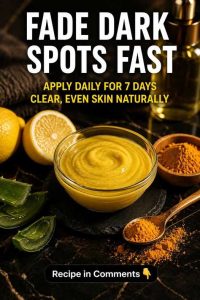
The image shows lemon, turmeric, and aloe vera, but raw lemon juice has intentionally been excluded.
Using an ingredient simply because it is acidic does not make it a safe pigmentation treatment. Dark spots often become more noticeable following inflammation, and irritating skin while trying to lighten it can work against the goal. Dermatologists specifically advise stopping skincare products that burn or sting because irritation can darken existing spots. (American Academy of Dermatology)
For the same reason, avoid repeatedly applying undiluted apple-cider vinegar, baking soda, toothpaste, harsh lemon mixtures, salt scrubs, or aggressive sugar scrubs to dark spots.
The Most Important Dark-Spot Remedy: Daily Sun Protection
No natural mask can compensate for repeated sun exposure.
The AAD states that effective treatment of dark spots begins with sunscreen. For people prone to hyperpigmentation, it recommends tinted sunscreen containing iron oxide, together with SPF 30 or higher, broad-spectrum protection, and water resistance. Iron oxide adds protection against visible light, which can contribute to hyperpigmentation, particularly in darker skin tones. (American Academy of Dermatology)
Apply sunscreen before outdoor exposure and reapply approximately every two hours while outdoors, particularly after swimming or sweating. (American Academy of Dermatology)
Final Tips for Fading Dark Spots
Do not squeeze acne, scratch healing blemishes, or repeatedly exfoliate pigmented areas. Keep makeup brushes, pillowcases, facial cloths, and skincare tools clean. Use gentle cleansing and maintain adequate hydration and sleep.
Patch-test every homemade preparation before putting it across your face. Natural ingredients can still cause contact dermatitis or irritation.
You might notice smoother, better-hydrated or less dull-looking skin within 2–3 days, but this is different from removing pigmentation. A dark mark should not be expected to vanish in seven days. AAD guidance notes that a spot only a few shades darker than the surrounding skin may take approximately 6–12 months to fade naturally once its cause has stopped. (American Academy of Dermatology)
Diet Plan to Support Healthy, Even-Looking Skin
No specific food has been clinically proven to erase an existing dark spot. Diet should therefore support general skin health rather than being presented as a pigmentation cure.
For breakfast, choose oats with berries, guava, kiwi, oranges, or another vitamin-C-rich fruit. Add nuts, seeds, eggs, or unsweetened yogurt for protein and healthy fats.
For lunch, combine leafy vegetables, tomatoes, carrots, bell peppers, lentils or beans with fish, chicken, eggs, tofu, or another protein source and a moderate serving of whole grains.
For an afternoon snack, choose whole fruit with nuts or seeds, roasted chickpeas, or unsweetened yogurt rather than highly processed sugary snacks.
For dinner, eat a mixture of colorful vegetables with protein and whole grains. Foods naturally providing vitamins C and E, carotenoids, protein, zinc, and healthy fats can form part of a balanced diet.
Maintain this diet, gentle skincare, and strict sun protection for at least 8–12 weeks before evaluating longer-term changes. More persistent pigmentation can take several months.
If dark spots are rapidly increasing, unusually shaped, raised, bleeding, itching, changing color, appearing without an obvious cause, or remain persistent despite several months of careful skincare and sun protection, see a doctor or dermatologist. Melasma and post-acne PIH may require established topical medications or dermatological procedures rather than stronger DIY remedies. Systematic reviews confirm that medical topical therapies, chemical peels, lasers, and other approaches have been studied for PIH. (PubMed)
References for the above remedy
- American Academy of Dermatology. How to fade dark spots in darker skin tones.
URL: https://www.aad.org/public/everyday-care/skin-care-secrets/routine/fade-dark-spots - Mar K, Khalid B, Maazi M, et al. Treatment of Post-Inflammatory Hyperpigmentation in Skin of Colour: A Systematic Review. Journal of Cutaneous Medicine and Surgery.
URL: https://pubmed.ncbi.nlm.nih.gov/39075672/ - Shenoy A, Madan R. Post-Inflammatory Hyperpigmentation: A Review of Treatment Strategies. Journal of Drugs in Dermatology.
URL: https://pubmed.ncbi.nlm.nih.gov/32845587/ - Tan MG, Kim WB, Jo CE, et al. Topical treatment for postinflammatory hyperpigmentation: a systematic review. Journal of Dermatological Treatment.
URL: https://pubmed.ncbi.nlm.nih.gov/34525885/ - Davis EC, Callender VD. Postinflammatory hyperpigmentation: a comprehensive overview—treatment options and prevention. Journal of the American Academy of Dermatology.
URL: https://pubmed.ncbi.nlm.nih.gov/28917452/ - Vaughn AR, Branum A, Sivamani RK. Effects of Turmeric (Curcuma longa) on Skin Health: A Systematic Review of the Clinical Evidence. Phytotherapy Research.
URL: https://pubmed.ncbi.nlm.nih.gov/27213821/ - Clinical Studies on Topical Curcumin.
URL: https://pubmed.ncbi.nlm.nih.gov/38008088/ - American Academy of Dermatology. How to decode a sunscreen label.
URL: https://www.aad.org/public/everyday-care/sun-protection/shade-clothing-sunscreen/understand-sunscreen-labels - American Academy of Dermatology. How to apply sunscreen.
URL: https://www.aad.org/public/everyday-care/sun-protection/shade-clothing-sunscreen/how-to-apply-sunscreen - American Academy of Dermatology. Melasma: Self-care.
URL: https://www.aad.org/public/diseases/a-z/melasma-self-care