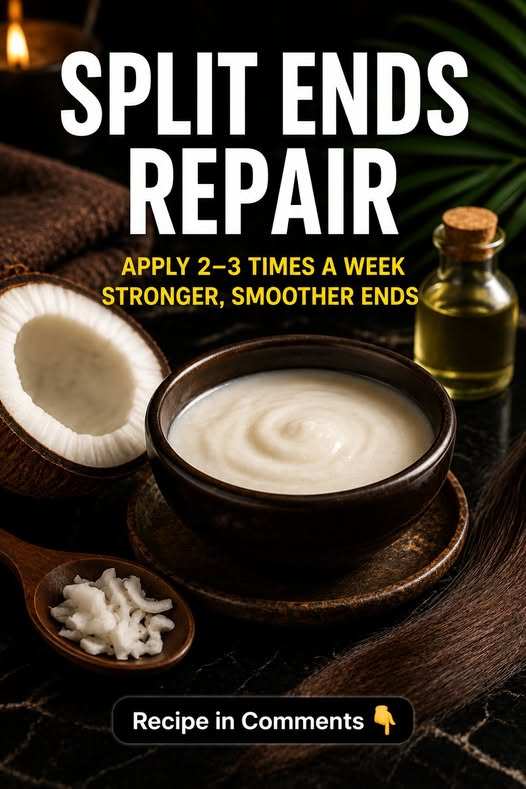
Split ends, medically called trichoptilosis, develop when the protective outer cuticle of the hair shaft becomes damaged and the fiber begins separating at its tip. Frequent heat styling, bleaching, chemical treatments, aggressive brushing, repeated washing, UV exposure, and friction can gradually weaken hair and make splitting more noticeable. Research confirms that hair is a keratin fiber susceptible to mechanical, chemical, and UV-related damage. (PubMed) Natural treatments can reduce dryness, friction, protein loss, and future breakage, making damaged ends look smoother. However, an important scientific distinction is necessary: once a hair fiber has physically split, no home remedy can permanently fuse it back together. Trimming is the definitive way to remove an existing split end. The following remedies are therefore designed to condition damaged ends and help prevent additional splitting.

Remedy 1: For Normal Hair – Coconut Oil, Aloe and Yogurt End Mask
Ingredients
- 1 tablespoon virgin coconut oil
- 2 tablespoons plain unsweetened yogurt
- 1 tablespoon pure aloe vera gel
- 1 teaspoon honey
- 1 teaspoon finely ground oats
- ½ teaspoon olive oil
Scientific Working of Each Ingredient
Coconut oil is the most important ingredient in this treatment. Unlike many oils that remain mainly on the hair surface, coconut oil’s lauric-acid-rich structure gives it an affinity for hair proteins. Research found that it penetrates the hair shaft and significantly reduces protein loss from both damaged and undamaged hair. (PubMed)
Aloe vera provides a water-rich base and makes the mixture easier to distribute.
Yogurt gives the mask a creamy consistency and coats rough ends, although strong clinical evidence that yogurt repairs split ends is lacking.
Honey acts as a humectant in the mixture, while olive oil supplies additional lubrication.
Ground oats thicken the mask so it stays on the ends rather than dripping.
Procedure
Warm the coconut oil only enough to liquefy it. Mix it with yogurt, aloe, honey, oats, and olive oil.
Apply from approximately the middle of the hair shaft downward, concentrating heavily on the final few inches. There is no need to coat the scalp.
Leave for 20–30 minutes and shampoo gently.
How Often to Apply
Apply 2 times weekly for at least 3–4 weeks.
Initial Results
After the first few applications, damaged ends may feel softer, smoother, and easier to comb. This is conditioning rather than permanent fusion of split fibers.
Remedy 2: For Combination Hair – Coconut Milk, Coconut Oil and Aloe Treatment
Combination hair often means an oilier scalp with relatively dry lengths and ends, so the treatment should remain concentrated below the ears.
Ingredients
- 2 tablespoons unsweetened coconut milk
- 1 teaspoon virgin coconut oil
- 1 tablespoon aloe vera gel
- 1 teaspoon honey
- 1 tablespoon plain yogurt
- ½ teaspoon olive oil
Scientific Working of the Remedy
Coconut oil provides the strongest evidence-supported benefit. A controlled investigation comparing coconut, sunflower, and mineral oils found coconut oil uniquely effective at reducing hair protein loss. (PubMed)
Another investigation using imaging techniques demonstrated that coconut oil actually penetrates human hair fibers, whereas mineral oil largely remains outside. The researchers proposed that limiting repeated swelling and shrinking of the fiber may help protect against damage. (PubMed)
Coconut milk contributes fats and produces a creamy conditioning base, but it should not be confused with coconut oil; the evidence for preventing protein loss specifically concerns coconut oil.
Aloe and yogurt provide moisture and slip, while honey helps the mixture remain conditioning.
Procedure
Whisk the ingredients until smooth. Keep the mixture away from an oily scalp and distribute it through the bottom half of the hair.
Leave for approximately 20 minutes. Rinse and shampoo gently, concentrating shampoo primarily on the scalp.
How Often to Apply
Use twice weekly for 3–5 weeks.
Initial Results
The lengths may feel smoother and less rough after 1–3 applications. With continued gentle care, reduced mechanical damage may help prevent new splits.
Remedy 3: For Oily Hair – Lightweight Coconut Pre-Wash End Treatment
An oily scalp does not mean the ends are adequately protected. Long hair can have an oily root area while the tips remain dry and weathered.
Ingredients
- 2 teaspoons virgin coconut oil
- 2 tablespoons aloe vera gel
- 1 tablespoon plain yogurt
- 1 teaspoon coconut milk
- 1 teaspoon honey
Why This Treatment Works Scientifically
The remedy uses a relatively small amount of oil and applies it only to damaged lengths.
Research comparing common hair oils found coconut oil substantially reduced protein loss when used as either a pre-wash or post-wash grooming treatment. Researchers attributed this to its lauric-acid-rich triglyceride structure, relatively low molecular weight, and affinity for hair proteins. (PubMed)
More recent laboratory research also found coconut-based hair oils could help prevent increases in hair porosity caused by washing-related surfactant damage and influence mechanical properties of damaged fibers. (PubMed)
Procedure
Mix the ingredients thoroughly.
Apply only to approximately the bottom third of the hair, especially visibly rough ends. Avoid massaging the mixture into an already oily scalp.
Leave for 15–20 minutes before shampooing.
How Often to Apply
Use 2 times weekly for 3–4 weeks.
Initial Results
Ends may become easier to detangle and appear less frizzy within the first few treatments. If the hair becomes greasy or weighed down, reduce the coconut oil quantity.
Remedy 4: For Dry Hair – Intensive Coconut Oil and Honey End Treatment
Dry hair generally needs more lubrication to reduce friction and mechanical stress.
Ingredients
- 1½ tablespoons virgin coconut oil
- 1 tablespoon coconut milk
- 1 tablespoon aloe vera gel
- 1 teaspoon honey
- 1 tablespoon plain yogurt
- 1 teaspoon olive oil
Scientific Working of Each Ingredient
Coconut oil can penetrate the hair shaft and reduce protein loss. (PubMed)
A study examining individual hair fibers also found coconut-oil treatment significantly increased the tensile strength of twisted fibers compared with mineral oil, with researchers attributing the difference to coconut oil penetration into the fiber. (PubMed)
Olive oil primarily supplies surface lubrication in this homemade formula.
Honey, aloe and yogurt make the mask moisturizing and easier to spread.
Coconut milk adds additional lipids, although its ability to repair hair should not be equated with the much better-studied coconut oil.
Procedure
Combine the ingredients into a creamy mask. Apply generously to the middle lengths and ends.
Cover the hair loosely and leave for 20–30 minutes. Shampoo gently with lukewarm rather than very hot water.
Avoid vigorously rubbing wet hair with a towel afterward.
How Often to Apply
Apply 2–3 times weekly for 4 weeks, then reduce to once weekly for maintenance.
Initial Results
Dry ends can feel noticeably softer after the first treatment. Over several weeks, minimizing protein loss, friction, and mechanical stress can help reduce further breakage.
Remedy 5: For Sensitive Scalp or Fine Hair – Simple Coconut and Aloe End Treatment
Fine hair can become overloaded by heavy DIY masks, while people with sensitive scalps may react to fragranced essential oils and complicated botanical mixtures.
Ingredients
- 1 teaspoon virgin coconut oil
- 2 tablespoons pure aloe vera gel
- 1 tablespoon plain yogurt
- 1 teaspoon coconut milk
- ½ teaspoon honey
Scientific Working of the Remedy
This recipe deliberately contains no essential oils, fragrance, lemon juice, egg, or strong herbal extracts.
The small amount of coconut oil provides the principal hair-protective ingredient. A systematic review investigating coconut, castor, and argan oils concluded that coconut oil has clinical evidence supporting benefits for brittle hair, whereas evidence for some other popular hair-oil claims is considerably weaker. (PubMed)
The aloe-yogurt base allows only a small quantity of coconut oil to be distributed over the ends.
Procedure
Mix thoroughly and patch-test if you have sensitive skin.
Apply exclusively to the lengths and ends rather than the scalp. Leave for 15 minutes and rinse thoroughly.
How Often to Apply
Begin once or twice weekly for 3–5 weeks.
Initial Results
Hair may feel smoother after the first few applications without the heaviness produced by coating fine hair with large amounts of oil.
Can Coconut Oil Actually Repair Split Ends?
This is where many home-remedy claims become misleading.
Coconut oil can help protect damaged hair, but it cannot permanently glue an already separated hair shaft back together. Research shows benefits including penetration of the fiber, reduced protein loss, and improved resistance to some forms of mechanical damage. (PubMed)
Therefore, coconut treatments are useful for preventing worsening damage and improving the appearance and feel of damaged ends.
For an end that has already visibly divided into two or more branches, trimming above the split is the practical solution. Leaving severely split fibers untrimmed can allow damage to progress farther along the shaft.
Final Tips to Prevent Split Ends
Use these treatments together with gentler hair handling. Avoid repeatedly passing a flat iron or curling iron over the ends, minimize bleaching and chemical processing, and detangle slowly instead of pulling through knots.
Hair is especially vulnerable to repeated mechanical and chemical weathering. UV exposure also damages hair proteins and pigments, so hats and physical sun protection are useful during prolonged outdoor exposure. (PubMed)
After washing, squeeze excess water from the hair instead of vigorously rubbing it with a towel. Detangle carefully with a wide-tooth comb and avoid unnecessarily tight hairstyles.
A mask can make the ends look and feel smoother within 1–3 applications, but preventing recurring split ends requires consistent care for several weeks or months.
Diet Plan for Strong, Healthy Hair
Hair treatments work on the existing shaft, while good nutrition provides the body with nutrients required to produce new hair.
For breakfast, choose eggs with whole-grain toast and fruit, or unsweetened yogurt with oats, nuts, seeds, and berries.
For lunch, include a protein source such as lentils, beans, chickpeas, fish, chicken, eggs, or tofu. Add leafy vegetables and whole grains.
For an afternoon snack, choose fruit with nuts or seeds, yogurt, roasted chickpeas, or another minimally processed protein-containing snack.
For dinner, combine vegetables with fish, poultry, beans, lentils, or another protein source and a moderate serving of whole grains.
Foods providing protein, iron, zinc, essential fatty acids, vitamin B12, folate, and other micronutrients should form part of a balanced diet. Avoid taking high-dose “hair vitamins” without identifying a deficiency; supplements are not automatically better than obtaining nutrients from a balanced diet.
Maintain the hair-care routine for at least 4–8 weeks, trim existing severely split ends, and then continue preventive care.
If hair repeatedly snaps despite gentle care, suddenly becomes extremely brittle, breaks close to the scalp, or is accompanied by significant hair loss, scalp disease, or unexplained thinning, see a doctor or dermatologist to investigate an underlying cause.
References for the above remedy
- Rele AS, Mohile RB. Effect of mineral oil, sunflower oil, and coconut oil on prevention of hair damage. Journal of Cosmetic Science. 2003.
URL: https://pubmed.ncbi.nlm.nih.gov/12715094/ - Ruetsch SB, Kamath YK, Rele AS, Mohile RB. Secondary ion mass spectrometric investigation of penetration of coconut and mineral oils into human hair fibers: relevance to hair damage. Journal of Cosmetic Science. 2001.
URL: https://pubmed.ncbi.nlm.nih.gov/11413497/ - Kaushik V, Chogale R, Mhaskar S. Single hair fiber assessment techniques to discriminate between mineral oil and coconut oil effect on hair physical properties. Journal of Cosmetic Dermatology. 2021.
URL: https://pubmed.ncbi.nlm.nih.gov/32949101/ - Phong C, Lee V, Yale K, Sung C, Mesinkovska N. Coconut, Castor, and Argan Oil for Hair in Skin of Color Patients: A Systematic Review. Journal of Drugs in Dermatology. 2022.
URL: https://pubmed.ncbi.nlm.nih.gov/35816075/ - Benefit of coconut-based hair oil via hair porosity quantification. International Journal of Cosmetic Science. 2022.
URL: https://pubmed.ncbi.nlm.nih.gov/35377477/ - Hair breakage index: an alternative tool for damage assessment of human hair. International Journal of Cosmetic Science.
URL: https://pubmed.ncbi.nlm.nih.gov/21635848/ - Health Effects of Coconut Oil—A Narrative Review of Current Evidence. Journal of the American College of Nutrition.
URL: https://pubmed.ncbi.nlm.nih.gov/30395784/ - Trüeb RM. The value of hair cosmetics and pharmaceuticals. Dermatology.
URL: https://pubmed.ncbi.nlm.nih.gov/20212426/ - UV damage of the hair. International Journal of Cosmetic Science.
URL: https://pubmed.ncbi.nlm.nih.gov/19138021/ - Sinclair RD. Healthy hair: what is it? Journal of Investigative Dermatology Symposium Proceedings.
URL: https://pubmed.ncbi.nlm.nih.gov/18004288/