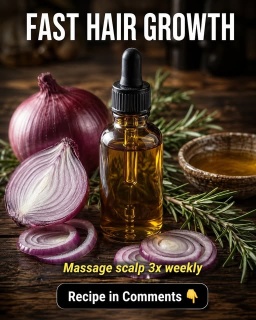
Slow hair growth, excessive shedding, thinning around the part, and repeated breakage can make hair appear much less dense than it once did. Hair growth is controlled by the follicle cycle, genetics, hormones, nutrition, scalp health, and the underlying cause of hair loss, which means no oil can safely produce dramatic new growth in a few days. However, several natural treatments have been investigated in human studies. Rosemary oil has clinical evidence in androgenetic alopecia, pumpkin seed oil has been studied in male and female pattern hair loss, onion juice has shown regrowth in a small alopecia areata trial, and a specific thyme-rosemary-lavender-cedarwood blend was tested in a randomized trial. (PubMed)
The rosemary-and-onion treatment suggested in the image therefore has some scientific basis, but the evidence needs to be interpreted correctly. Onion was studied for patchy alopecia areata, while rosemary was studied for androgenetic hair loss. Neither ingredient has been shown to make everyone’s hair grow dramatically faster within a week. The remedies below focus on realistic scalp support, reduced breakage, and evidence-based approaches that require consistency.
Remedy 1: For Normal Scalp — Rosemary and Grapeseed Growth Massage Oil
Ingredients and Scientific Working
- Grapeseed oil — 1 tablespoon: Works as a light carrier that helps dilute essential oils and reduce direct irritation. Grapeseed was also one of the carrier oils used in the randomized aromatherapy trial for alopecia areata. (PubMed)
- Jojoba oil — 1 tablespoon: Provides lubrication and makes scalp massage easier without using a large amount of heavy oil.
- Virgin coconut oil — 1 teaspoon: Coconut oil has been shown to penetrate hair fibers and reduce protein loss, helping existing hair resist breakage and retain length. (PubMed)
- Rosemary essential oil — 5 drops: In a six-month randomized comparative study, rosemary oil significantly increased hair count in people with androgenetic alopecia, although improvement was not significant at three months. (PubMed)
- Lavender essential oil — 2 drops: Lavender was one component of the clinically tested essential-oil combination for alopecia areata. (PubMed)
- Sunflower oil — 1 teaspoon: Provides extra slip and reduces friction during massage; it is included as a conditioning carrier rather than a proven follicle stimulant.
Procedure
Combine the carrier oils first, then add rosemary and lavender. Apply a small amount to the scalp rather than saturating the entire hair length.
Massage gently with the pads of your fingertips for 3–4 minutes. Leave the oil on for 30–45 minutes, then wash with a gentle shampoo.
How Often to Apply
Massage three times weekly. During the first 3–5 days, monitor for itching or irritation. Continue for at least 3 months and preferably 6 months before judging hair-density changes.
Initial Results
Within 1–3 days, the hair may feel smoother and experience less friction. New follicular growth should not be expected this early.
Remedy 2: For Combination Scalp — Pumpkin Seed and Aloe Root Treatment
Ingredients and Scientific Working
- Pumpkin seed oil — 2 teaspoons: Topical pumpkin seed oil has been investigated in women with female-pattern hair loss, while oral pumpkin seed oil produced significantly greater hair-count increases than placebo in men after 24 weeks. (PubMed)
- Jojoba oil — 1 teaspoon: Helps distribute pumpkin seed oil across the scalp without making the preparation excessively heavy.
- Grapeseed oil — 1 teaspoon: Keeps the mixture lighter for combination scalps.
- Pure aloe vera gel — 1 tablespoon: Adds water-based slip and can make dry scalp areas feel more comfortable.
- Virgin coconut oil — ½ teaspoon: Helps protect existing hair shafts from protein loss and breakage. (PubMed)
- Distilled or boiled-and-cooled water — 1 teaspoon: Lightens the aloe portion of the treatment.
Procedure
Mix pumpkin seed, jojoba, grapeseed, and coconut oils. Immediately before use, combine a teaspoon of this blend with the aloe gel and water.
Apply mainly to thinning or dry areas while using less over an oily T-zone-like scalp region. Massage for three minutes and wash after approximately 30 minutes.
How Often to Apply
Use every other day during the first 3–5 days if comfortable. Continue 2–3 times weekly for 12–24 weeks.
Initial Results
The scalp may feel better conditioned within several applications. Clinical pumpkin seed oil improvements were measured over months rather than days. (PubMed)
Remedy 3: For Oily Scalp — Diluted Onion and Aloe Pre-Wash Tonic
Ingredients and Scientific Working
- Fresh onion juice — 1 tablespoon: A controlled study involving patchy alopecia areata reported significantly more regrowth with crude onion juice than with tap water. (PubMed)
- Pure aloe vera gel — 1 tablespoon: Dilutes the onion and supplies lightweight hydration.
- Distilled water — 1 tablespoon: Reduces the concentration and potential sting of fresh onion juice.
- Cooled green tea — 1 tablespoon: Provides antioxidant polyphenols in an oil-free base.
- Vegetable glycerin — ¼ teaspoon: Helps prevent the scalp from becoming excessively dry after washing.
- Colloidal oatmeal — ½ teaspoon: Adds soothing support for easily irritated scalp skin.
Procedure
Grate fresh onion and strain it thoroughly through clean cloth. Measure only one tablespoon of juice and combine with the remaining ingredients.
Patch-test first. Apply a thin layer directly to the scalp, leave for 10 minutes, and shampoo thoroughly.
How Often to Apply
Begin twice weekly during the first 3–5 days. If no irritation develops, use up to three times weekly.
Initial Results
Oil and buildup may feel reduced within 1–3 days. In the onion study, visible terminal hair began appearing after about two weeks, and importantly, the participants had alopecia areata, not ordinary pattern thinning. (PubMed)
Remedy 4: For Dry Scalp — Thyme, Rosemary, Lavender and Cedarwood Aromatherapy Blend
Ingredients and Scientific Working
- Jojoba oil — 2 teaspoons: One of the carrier oils used in the clinical aromatherapy protocol.
- Grapeseed oil — 2 teaspoons: The second carrier used in the same randomized study.
- Rosemary essential oil — 2 drops: Has separate clinical evidence for androgenetic alopecia and was part of the alopecia-areata aromatherapy blend. (PubMed)
- Lavender essential oil — 2 drops: Included in the randomized essential-oil treatment.
- Thyme essential oil — 1 drop: Another active component of the clinical aromatherapy blend.
- Cedarwood essential oil — 1 drop: Completed the four-oil combination evaluated in patients with alopecia areata. (PubMed)
Procedure
Mix the jojoba and grapeseed oils first. Add the essential oils and shake gently.
Apply sparingly to the scalp and massage for approximately three minutes. Leave for 30–45 minutes before washing.
How Often to Apply
Begin three times weekly during the first 3–5 days to check tolerance. Continue regularly if comfortable.
Initial Results
Dryness and hair softness may improve quickly, but the randomized aromatherapy study assessed regrowth over seven months. The essential-oil group performed significantly better than the carrier-only control, but the study related specifically to alopecia areata. (PubMed)
Remedy 5: For Sensitive Scalp — Gentle Pumpkin Seed Oil and Scalp-Massage Routine
Ingredients and Scientific Working
- Pumpkin seed oil — 1 teaspoon: Provides the principal botanical with clinical hair-growth evidence. (PubMed)
- Jojoba oil — 1 tablespoon: Dilutes the pumpkin seed oil and provides gentle massage slip.
- Grapeseed oil — 1 tablespoon: Keeps the blend lightweight.
- Virgin coconut oil — ½ teaspoon: Helps reduce hair-fiber protein loss and breakage. (PubMed)
- Sunflower oil — ½ teaspoon: Provides extra lubrication.
- Pure aloe vera gel — 1 teaspoon: Can be applied separately after washing if the scalp feels dry.
Procedure
Combine the oils. Apply only several drops across the scalp.
Using fingertips—not fingernails—massage gently for four minutes. A small human study found that standardized four-minute daily scalp massage increased average hair thickness after 24 weeks. (PubMed)
Wash after 30 minutes and use aloe afterward only if needed.
How Often to Apply
Use the oil three times weekly during the first 3–5 days. Gentle dry scalp massage can be performed daily if it causes no irritation.
Initial Results
The early result is improved conditioning rather than new hair. The human massage study detected increased thickness after 24 weeks, demonstrating why consistency matters. (PubMed)
Does Rosemary and Onion Oil Really Cause Fast Hair Growth?
Rosemary is one of the more credible natural ingredients, but “fast” should not mean days. In the randomized study of 100 people with androgenetic alopecia, there was no significant hair-count change at three months; both the rosemary and 2% minoxidil groups showed significant improvement at six months. (PubMed)
Onion juice also deserves careful interpretation. Its clinical study involved people with patchy alopecia areata, which is an autoimmune form of hair loss. Those findings cannot automatically be applied to hereditary thinning, telogen effluvium, postpartum shedding, or nutritional hair loss. (PubMed)
Final Tips for Faster, Healthier Hair
Avoid tight hairstyles, rough brushing, repeated bleaching, and excessive heat. Dermatologists recommend matching washing frequency to scalp oiliness, shampooing primarily at the scalp, conditioning the hair appropriately, and limiting heat damage. (American Academy of Dermatology)
Never apply rosemary, thyme, cedarwood, or lavender essential oil undiluted. More concentrated oil is not more effective and can cause irritation.
Visible improvements in softness, scalp comfort, and reduced breakage can begin within 2–3 days. True improvements in hair count, density, or thickness usually require 3–6 months.
Diet Plan for Healthy Hair Growth
Breakfast: Two eggs or plain yogurt with oatmeal and guava, kiwi, berries, or orange.
Mid-morning: Pumpkin seeds, walnuts, almonds, or sesame seeds.
Lunch: Lentils, chickpeas, beans, fish, chicken, eggs, or tofu with spinach and whole grains.
Afternoon: Plain yogurt with fruit or roasted chickpeas.
Dinner: A protein source with vegetables and brown rice, potatoes, or whole-grain bread.
Hair is primarily protein, so avoid crash diets and prolonged severe calorie restriction. Include adequate dietary protein, iron-rich foods, zinc-containing foods, vitamin B12 sources, and healthy fats. Hair loss can also occur with thyroid disease, nutritional deficiencies, illness, childbirth, medication effects, or significant stress, so diet alone is not always the answer. (American Academy of Dermatology)
How Long Should You Continue?
Choose one remedy appropriate for your scalp type and use it consistently for 3–6 months. Do not rotate multiple strong botanical treatments every few days.
If excessive shedding continues, the hair part rapidly widens, round bald patches appear, the scalp becomes painful or scarred, or hair falls out in clumps, see a doctor or dermatologist. Determining the cause is important because effective treatment differs for androgenetic alopecia, alopecia areata, telogen effluvium, thyroid-related loss, infection, and nutritional deficiency. Dermatologists can use examination, blood tests, or scalp biopsy when needed to identify the cause. (American Academy of Dermatology)
References for the above remedy
- Panahi Y, Taghizadeh M, Marzony ET, Sahebkar A. Rosemary oil vs minoxidil 2% for the treatment of androgenetic alopecia: a randomized comparative trial.
https://pubmed.ncbi.nlm.nih.gov/25842469/ - Ibrahim IM, Hasan MS, Elsabaa KI, Elsaie ML. Pumpkin seed oil vs minoxidil 5% topical foam for the treatment of female pattern hair loss: a randomized comparative trial.
https://pubmed.ncbi.nlm.nih.gov/33544448/ - Cho YH, Lee SY, Jeong DW, et al. Effect of pumpkin seed oil on hair growth in men with androgenetic alopecia: a randomized, double-blind, placebo-controlled trial.
https://pubmed.ncbi.nlm.nih.gov/24864154/ - Sharquie KE, Al-Obaidi HK. Onion juice (Allium cepa L.), a new topical treatment for alopecia areata.
https://pubmed.ncbi.nlm.nih.gov/12126069/ - Hay IC, Jamieson M, Ormerod AD. Randomized trial of aromatherapy: successful treatment for alopecia areata.
https://pubmed.ncbi.nlm.nih.gov/9828867/ - Koyama T, Kobayashi K, Hama T, et al. Standardized scalp massage results in increased hair thickness by inducing stretching forces to dermal papilla cells.
https://pubmed.ncbi.nlm.nih.gov/26904154/ - Rele AS, Mohile RB. Effect of mineral oil, sunflower oil, and coconut oil on prevention of hair damage.
https://pubmed.ncbi.nlm.nih.gov/12715094/ - American Academy of Dermatology Association. Hair loss: Diagnosis and treatment.
https://www.aad.org/public/diseases/hair-loss/treatment/diagnosis-treat - American Academy of Dermatology Association. Hair loss: Who gets and causes.
https://www.aad.org/public/diseases/hair-loss/causes/18-causes - American Academy of Dermatology Association. Tips for healthy hair.
https://www.aad.org/public/everyday-care/hair-scalp-care/hair/healthy-hair-tips