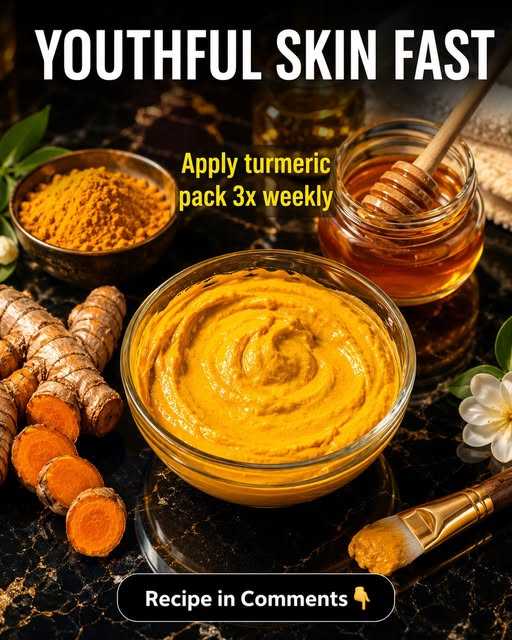
Youthful-looking skin is usually smooth, hydrated, even-toned, and resilient rather than completely free of lines or pores. With age, collagen and elastin gradually change, while ultraviolet radiation, smoking, dryness, inflammation, and environmental exposure can accelerate visible aging. Natural skincare can improve hydration, texture, dullness, and some fine lines, but no turmeric mask or other homemade remedy can reverse years of skin aging in several days. Dermatologists note that moisturizer can plump fine lines within a few days, whereas most genuine anti-aging changes require at least six weeks and sometimes three months. (American Academy of Dermatology)
The turmeric-and-honey pack shown in the image is a reasonable inspiration, but the science needs to be interpreted carefully. Turmeric contains curcumin with antioxidant and anti-inflammatory properties, and a systematic review found encouraging clinical evidence for turmeric or curcumin in dermatology. However, this does not prove that an ordinary kitchen turmeric paste removes wrinkles. (PubMed)
Remedy 1: For Normal Skin — Turmeric, Soy and Aloe Youthful-Glow Mask
Ingredients and Their Scientific Working
- Turmeric powder — ⅛ teaspoon: Curcumin has antioxidant and anti-inflammatory actions relevant to UV-related skin stress. Human dermatology evidence is promising but still limited for homemade anti-aging masks. (PubMed)
- Plain unsweetened soy yogurt — 1 tablespoon: Stabilized topical soy has demonstrated improvements in fine wrinkles, texture, pigmentation, and overall photoaged appearance in human research.
- Pure aloe vera gel — 1 tablespoon: Provides water-rich hydration that can make superficial lines look softer.
- Colloidal oatmeal — ½ teaspoon: Helps maintain the skin barrier and reduce dryness or irritation.
- Raw honey — ½ teaspoon: Works primarily as a humectant and emollient, helping skin retain moisture.
- High-linoleic sunflower oil — 2 drops: Human research found sunflower oil preserved skin-barrier integrity and improved hydration. (PubMed)
Procedure
Mix the turmeric with soy yogurt first, then add aloe, oatmeal, honey, and sunflower oil. Apply a thin layer to clean skin and leave it for 8–10 minutes. Rinse thoroughly with lukewarm water.
Turmeric can temporarily stain very light skin, so use only a small quantity.
How Often to Apply
Apply 3 times weekly, as suggested in the image. Continue for 6–8 weeks if your skin tolerates it.
Initial Results
Within 1–3 days, better hydration may make the complexion look softer and brighter. Permanent wrinkle reduction or lifting should not be expected in this short period.
Remedy 2: For Combination Skin — Bakuchiol, Green Tea and Jojoba Renewal Mask
Ingredients and Their Scientific Working
- Properly formulated 0.5% bakuchiol preparation — 2 drops: In a randomized double-blind trial, 0.5% bakuchiol significantly improved wrinkle surface area and hyperpigmentation after 12 weeks and caused less scaling and stinging than retinol. (PubMed)
- Cooled green tea — 1 tablespoon: Supplies antioxidant catechins. Green-tea preparations have been clinically investigated in women with photoaged skin. (PubMed)
- Pure aloe vera gel — 1 tablespoon: Provides lightweight hydration.
- Jojoba oil — 2 drops: Functions as a light emollient for drier facial areas.
- Rice starch — ½ teaspoon: Creates a smooth, non-abrasive texture.
- Cucumber juice — 1 teaspoon: Adds cooling hydration without a heavy oily layer.
Procedure
Mix aloe, green tea, cucumber, and rice starch. Add jojoba and the pre-diluted bakuchiol last. Apply more sparingly over the oily T-zone.
Leave for 7–8 minutes and rinse gently.
How Often to Apply
Start every other night for 3–5 days, then continue three nights weekly.
Initial Results
Skin can feel smoother within several days, while bakuchiol-related wrinkle and pigmentation changes should be evaluated after approximately 8–12 weeks, consistent with clinical research. (PubMed)
Remedy 3: For Oily Skin — Green Tea, Soy and Licorice Lightweight Gel
Ingredients and Their Scientific Working
- Strong cooled green tea — 2 tablespoons: Provides EGCG and related antioxidant polyphenols studied for photoaged skin. (PubMed)
- Plain soy milk — 1 tablespoon: Supplies soy-derived compounds associated with smoother texture and more even-looking tone.
- Pure aloe vera gel — 1 tablespoon: Hydrates without a heavy oil layer.
- Skin-safe diluted licorice extract — 1 drop: Licorice compounds can influence melanin-related pathways, helping address age-related uneven tone.
- Rice starch — 1 teaspoon: Keeps the mixture lightweight.
- Colloidal oatmeal — ½ teaspoon: Prevents excessive drying, which can make fine lines appear more obvious.
Procedure
Blend all ingredients into a thin gel. Apply a light layer over the face, avoiding the eyelids. Leave for 7 minutes and rinse.
How Often to Apply
Use three times weekly for 6–8 weeks.
Initial Results
A less dehydrated, smoother finish may appear within 1–3 days. Antioxidant and tone-related changes require repeated use rather than one application.
Remedy 4: For Dry Skin — Centella, Shea and Sunflower Firmness Mask
Ingredients and Their Scientific Working
- Standardized Centella asiatica extract — ¼ teaspoon: A systematic review of randomized trials found Centella preparations improved wrinkles and significantly increased skin hydration. (PubMed)
- Pure shea butter — ¼ teaspoon: Supplies emollient lipids that soften rough, dry skin.
- Sunflower seed oil — ¼ teaspoon: Helps preserve barrier integrity and hydration. (PubMed)
- Aloe vera gel — 1 tablespoon: Supplies water-rich hydration.
- Colloidal oatmeal — 1 teaspoon: Helps calm dry, easily irritated skin.
- Raw honey — ½ teaspoon: Provides additional moisture-retaining action.
Procedure
Soften the shea butter between clean fingers. Blend with sunflower oil, then mix in aloe, honey, oatmeal, and Centella.
Apply to slightly damp skin for 10 minutes and rinse gently.
How Often to Apply
Use every other evening for the first 3–5 days, then three times weekly for 8–12 weeks.
Initial Results
Dryness lines may look softer within several days. Centella studies assessing actual wrinkle improvement used treatment periods of several weeks. (PubMed)
Remedy 5: For Sensitive Skin — Echinacea and Oat Barrier-Smoothing Mask
Ingredients and Their Scientific Working
- Cosmetic-grade Echinacea purpurea extract — ¼ teaspoon: A small human study found Echinacea cream and gel improved hydration and reduced measured wrinkles after one month. (PubMed)
- Colloidal oatmeal — 1 teaspoon: Helps support sensitive and dry skin.
- Pure aloe vera gel — 1 tablespoon: Adds soothing hydration.
- Rice starch — ½ teaspoon: Provides a smooth, non-scrubbing base.
- Sunflower seed oil — 2 drops: Supports the lipid barrier. (PubMed)
- Vegetable glycerin — 1 drop: Helps the outer skin retain water.
Procedure
Combine oatmeal and rice starch. Add aloe and Echinacea, followed by glycerin and sunflower oil.
Patch-test before facial use. If comfortable, apply for only 5–7 minutes and rinse.
How Often to Apply
Use every other day for the first 3–5 days. Continue twice weekly if there is no irritation.
Initial Results
Sensitive skin may appear calmer and more hydrated within several days. The Echinacea study observed wrinkle improvement after approximately one month, and it involved only ten participants, so the evidence should be considered preliminary. (PubMed)
Can Turmeric Really Make Skin Look Younger?
Turmeric is scientifically interesting because curcumin influences inflammatory and oxidative pathways involved in photoaging. Reviews describe potential anti-photoaging actions, but much of the mechanistic evidence comes from laboratory or experimental research rather than large trials of homemade turmeric masks. (PubMed)
Therefore, turmeric is best used as one small part of a gentle skincare routine—not as a replacement for sunscreen or proven dermatological treatment.
Avoid mixing it with raw lemon juice, baking soda, or harsh exfoliating ingredients.
Final Tips for Maintaining Youthful Skin
Daily sun protection is the most important anti-aging habit. A randomized trial found that regular sunscreen use slowed visible skin aging, while dermatologists recommend broad-spectrum SPF 30 or higher as the foundation of anti-aging skincare. (PubMed)
Moisturize consistently, sleep adequately, avoid smoking and tanning, keep brushes and facial tools clean, and patch-test new ingredients. Do not introduce several aggressive treatments simultaneously because irritation can make skin look older. (American Academy of Dermatology)
Visible hydration, softness, and glow may begin within 2–3 days. Improvements in fine wrinkles, uneven tone, and elasticity usually need 6–12 weeks, while deep wrinkles or significant sagging generally require professional treatment.
Diet Plan for Younger-Looking Skin
Breakfast: Eggs or plain yogurt with oats and strawberries, guava, kiwi, or orange.
Mid-morning: A small handful of almonds. Randomized research suggests regular almond consumption may improve facial wrinkle severity and pigmentation over time. (PubMed)
Lunch: Fish, chicken, lentils, beans, tofu, or eggs with tomatoes, carrots, bell peppers, leafy greens, and whole grains.
Afternoon: One whole fruit with water or unsweetened green tea.
Dinner: A protein source with two vegetables, plus brown rice, potatoes, or whole-grain bread.
Drink enough water throughout the day. Human research suggests increasing water intake can improve some measurements of skin hydration, particularly in people whose usual intake is low. (PubMed)
How Long Should You Continue?
Choose one remedy matched to your skin type and continue it for 8–12 weeks rather than using all five together. Maintain moisturizer and daily sun protection throughout this period.
If your skin remains persistently irritated, severely dry, suddenly changes color or texture, develops sores, or you want treatment for deep wrinkles or significant sagging, see a doctor or dermatologist. Creams and home remedies cannot correct every form of skin aging. (American Academy of Dermatology)
References for the above remedy
- Vaughn AR, Branum A, Sivamani RK. Effects of Turmeric (Curcuma longa) on Skin Health: A Systematic Review of the Clinical Evidence.
https://pubmed.ncbi.nlm.nih.gov/27213821/ - Dhaliwal S, et al. Prospective, Randomized, Double-Blind Assessment of Topical Bakuchiol and Retinol for Facial Photoageing.
https://pubmed.ncbi.nlm.nih.gov/29947134/ - Kongkaew C, et al. Efficacy and Safety of Centella asiatica on Wrinkles: A Systematic Review and Network Meta-Analysis.
https://pubmed.ncbi.nlm.nih.gov/33413787/ - Chiu AE, et al. Double-Blinded, Placebo-Controlled Trial of Green Tea Extracts in the Clinical and Histologic Appearance of Photoaging Skin.
https://pubmed.ncbi.nlm.nih.gov/16029678/ - Yotsawimonwat S, et al. Skin Improvement and Stability of Echinacea purpurea Dermatological Formulations.
https://pubmed.ncbi.nlm.nih.gov/20384903/ - Danby SG, et al. Effect of Olive and Sunflower Seed Oil on the Adult Skin Barrier.
https://pubmed.ncbi.nlm.nih.gov/22995032/ - Hughes MCB, et al. Sunscreen and Prevention of Skin Aging: A Randomized Trial.
https://pubmed.ncbi.nlm.nih.gov/23732711/ - Rybak I, et al. Prospective Randomized Controlled Trial on the Effects of Almonds on Facial Wrinkles and Pigmentation.
https://pubmed.ncbi.nlm.nih.gov/33673587/ - Palma L, Marques LT, Bujan J, Rodrigues LM. Dietary Water Affects Human Skin Hydration and Biomechanics.
https://pubmed.ncbi.nlm.nih.gov/26345226/ - American Academy of Dermatology Association. How to Maximize Results From Anti-Aging Skin Care Products.
https://www.aad.org/public/everyday-care/skin-care-secrets/anti-aging/maximize-anti-aging-products