
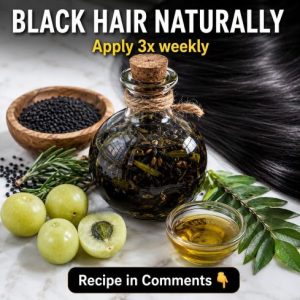
Black, glossy hair can strongly influence appearance and confidence, so premature gray strands may feel frustrating. The image suggests a traditional oil made with black seeds, rosemary and amla, but it is important to distinguish traditional claims from proven results. Hair becomes gray when follicles produce less melanin. No homemade oil has been clinically proven to permanently turn established gray hair black. Pure henna and indigo can naturally cover gray strands, while protective oils and good nutrition may improve strength, shine and scalp health. Correcting a confirmed vitamin deficiency or thyroid condition may sometimes help when premature graying has an underlying medical cause. (American Academy of Dermatology)
What Science Says About Naturally Blackening Hair
The visible hair shaft is no longer living tissue. Applying rosemary, black-seed, amla or curry-leaf oil cannot restart melanin production inside that shaft. Current dermatology guidance states that there is no consistently effective treatment for restoring pigment to ordinary age-related gray hair. Henna and indigo work differently: they deposit natural color onto the hair fiber instead of reviving melanin inside the follicle. (American Academy of Dermatology)
Remedy 1: Two-Step Henna and Indigo Pack for Normal Hair
Ingredients and Their Scientific Working
- 50–100 grams pure henna powder: Its lawsone pigment binds with hair keratin and creates a red-orange foundation.
- 50–100 grams pure indigo powder: Its blue pigment combines visually with the henna base to produce dark brown or black.
- Lukewarm water as required: Hydrates the powders and permits even color distribution.
- 1 teaspoon plain aloe vera gel: Improves slip and helps prevent excessive pulling during application.
- 1 teaspoon coconut oil: Used after rinsing, it helps reduce hair-fiber protein loss and dryness.
Henna contains a natural coloring molecule called lawsone. Indigo supplies the darker blue tone required to convert henna’s warm color into brown-black. These ingredients color the shaft; they do not reactivate follicular melanin. Coconut oil has stronger evidence for reducing protein loss than sunflower or mineral oil. (PMC)
Procedure
Patch-test the henna and indigo separately 48 hours before use. Mix henna with water and aloe until it resembles thick yogurt. Follow the powder supplier’s dye-release directions, apply to clean hair and leave for 60–90 minutes. Rinse without shampoo.
Prepare indigo freshly with water, apply immediately over the henna-treated hair and leave for 45–90 minutes. Rinse thoroughly. Once dry, apply coconut oil sparingly to the ends.
How Often to Apply
Complete the two steps once. Do not use this pack three times weekly. Retouch new roots approximately every three to four weeks.
Initial Results
Gray strands may first appear copper-colored after henna and then dark brown or black after indigo. The final shade usually settles during the following 24–48 hours.
Remedy 2: One-Step Dark Henna-Indigo Blend for Combination Hair
Ingredients and Their Scientific Working
- 2 tablespoons pure henna powder: Creates the warm base required for darker botanical coloring.
- 4 tablespoons pure indigo powder: Moves the finished shade toward dark brown or soft black.
- 1 teaspoon amla powder: Contains antioxidant polyphenols, although it is not proven to repigment gray hair.
- 1 tablespoon aloe vera gel: Adds moisture for drier sections.
- Lukewarm water as required: Produces an evenly spreadable paste.
- ½ teaspoon coconut oil: Conditions dry tips without making oily roots heavier.
Procedure
Prepare the henna according to its instructions. Mix the indigo separately immediately before application, then combine it with the henna, amla and aloe. Apply generously to gray roots and more lightly to already-dark lengths. Leave for 60–90 minutes and rinse. Use coconut oil only on dry ends.
How Often to Apply
Apply once and observe the shade and scalp for at least five days. Repeat only when new gray roots become noticeable, normally after three to four weeks.
Initial Results
Hair may appear darker and more evenly blended within one or two days. A one-step blend generally creates dark brown or soft black rather than the deeper black produced by the two-step method.
Remedy 3: Rosemary-Amla Pre-Wash for Oily Hair
Ingredients and Their Scientific Working
- 2 teaspoons coconut oil: Helps protect the hair shaft from wash-related protein loss.
- 2 drops rosemary essential oil: Clinical research supports possible hair-density benefits after prolonged use, not gray-hair reversal.
- 1 teaspoon aloe vera gel: Creates a lighter texture and adds hydration.
- 1 teaspoon amla powder: Provides antioxidant plant compounds and traditional conditioning.
- 1 teaspoon boiled and cooled water: Dilutes the treatment to reduce heaviness.
A randomized trial found an improvement in hair count after six months of rosemary-oil use in people with androgenetic hair loss. No meaningful change occurred after three months, and the study did not show that rosemary turns gray hair black. An oral amla trial also reported improved hair-growth measurements after 12 weeks, but it did not prove pigment restoration or validate homemade topical amla masks. (PubMed)
Procedure
Mix the ingredients immediately before use. Massage a small amount onto the scalp for two minutes and spread the remainder over the upper hair lengths. Leave for 15–20 minutes, then shampoo thoroughly. Never put undiluted rosemary essential oil directly on the scalp.
How Often to Apply
Use twice weekly for eight to twelve weeks, provided no itching or redness develops.
Initial Results
Hair may feel smoother and look glossier within one to three days, making naturally dark hair appear richer. Gray roots will not become black from this treatment.
Remedy 4: Coconut, Oat and Amla Mask for Dry Hair
Ingredients and Their Scientific Working
- 1 tablespoon coconut oil: Penetrates the fiber and helps reduce protein loss.
- 1 tablespoon plain aloe vera gel: Adds water and slip to dry strands.
- 1 teaspoon honey: Works as a humectant that helps retain surface moisture.
- 1 teaspoon finely ground plain oats: Supports the skin barrier and soothes dryness.
- 1 teaspoon amla powder: Adds antioxidant compounds but is not a proven gray-hair cure.
Procedure
Mix everything into a smooth paste. Apply mainly to the lengths, using only a thin layer on the scalp. Leave for 20 minutes. Add a little lukewarm water, massage gently, shampoo and rinse thoroughly.
How Often to Apply
Use twice during the first five days and then once weekly. Stop if it causes buildup, itching or increased flaking.
Initial Results
Hair may feel softer and reflect more light after one or two applications. Improved shine can make dark hair look deeper, but the mask cannot biologically recolor white strands. Evidence supports coconut oil mainly for reducing brittleness and protein loss, not stimulating pigment production. (PubMed)
Remedy 5: Oat-Aloe Comfort Pack for Sensitive Hair and Scalp
Ingredients and Their Scientific Working
- 1 tablespoon finely ground plain oats: Supports moisture-barrier comfort.
- 1 tablespoon plain aloe vera gel: Adds lightweight hydration.
- 1 teaspoon honey: Helps prevent excessive dryness.
- 2 teaspoons boiled and cooled water: Produces a thin, low-friction paste.
- ½ teaspoon coconut oil: Conditions dry strands; omit it if oils trigger scalp bumps.
Procedure
Patch-test the mixture on the inner arm for 24 hours. Apply a thin layer to the scalp for five minutes, then rinse and shampoo gently. This is a scalp-comfort remedy, not a black hair dye.
People with eczema, psoriasis, scalp wounds or previous dye allergies should not experiment with henna or indigo without professional guidance. Even pure plant dyes can occasionally cause allergic contact dermatitis. (PubMed)
How Often to Apply
Use every other day for three applications. Continue once weekly only when the scalp remains comfortable.
Initial Results
The scalp may feel less tight or dry within one to three days, while the hair may look smoother. A pigment-restoring claim would not be scientifically justified.
Final Tips for Maintaining Naturally Dark Hair
Always patch-test herbal powders and essential oils. Avoid products advertised as instant black henna when their complete ingredients are unclear. Products called black henna may contain para-phenylenediamine, or PPD, a powerful sensitizer associated with blistering, swelling and potentially lifelong hair-dye allergy. Natural indigo and pure henna can also trigger reactions in susceptible individuals. (PubMed)
Do not repeatedly pluck gray hairs because the replacement strand will generally grow back gray, while repeated plucking may damage the follicle. Limit high-heat styling, avoid tight hairstyles, use clean combs and towels, sleep adequately and avoid smoking. Smoking has been associated with both premature graying and hair loss.
Softness and shine may improve within two or three days. Reduced breakage requires several weeks, while rosemary-related hair-density results, when they occur, may require six months. Natural pigment restoration should not be promised unless a reversible medical cause is identified.
Diet Plan to Support Hair Pigment and Growth
Diet cannot recolor an existing white hair shaft, but it can help prevent deficiencies associated with premature graying and shedding.
For breakfast, choose eggs or yogurt with oats and fruit. Vegans should include a reliable vitamin-B12-fortified food. At lunch, combine lentils, chickpeas, beans, chicken or lean meat with leafy vegetables and a vitamin-C-rich food. For a snack, eat a small handful of sesame seeds, sunflower seeds, cashews or almonds. Dinner may include fish, chicken, tofu or beans with whole grains and cooked vegetables.
These foods provide protein, vitamin B12, iron, folate and copper—nutrients involved in normal blood formation, follicular activity and pigment-related biological processes. Studies have reported associations between premature graying and lower levels of vitamin B12, ferritin and vitamin D, as well as thyroid abnormalities. However, this does not mean that everyone with gray hair has a deficiency. (PubMed)
Continue the balanced diet and gentle hair routine for eight to twelve weeks. Do not take iron, copper, biotin or high-dose vitamins without medical advice because unnecessary supplementation may be ineffective or harmful.
Consult a dermatologist or physician if graying begins suddenly, occurs unusually early, progresses rapidly or appears with hair loss, fatigue, numbness, weight changes or menstrual problems. A clinician may consider checking a complete blood count, ferritin, vitamin B12, vitamin D and thyroid function. Stop any remedy immediately if it causes burning, swelling, blistering or breathing difficulty.
References for the above remedy
- American Academy of Dermatology. What causes gray hair, and can I stop it?
https://www.aad.org/public/everyday-care/hair-scalp-care/hair/gray-hair-causes - Mahendiratta S, et al. Premature graying of hair: Risk factors, co-morbid conditions, pharmacotherapy and reversal—A systematic review and meta-analysis.
https://pubmed.ncbi.nlm.nih.gov/32654282/ - Kumar K, et al. Premature hair graying: A multifaceted phenomenon.
https://pubmed.ncbi.nlm.nih.gov/39697103/ - Gavazzoni Dias MFR, et al. Recent Advancements in Natural Plant Colorants Used for Hair Dye Applications: A Review.
https://pmc.ncbi.nlm.nih.gov/articles/PMC9692289/ - Rele AS, Mohile RB. Effect of mineral oil, sunflower oil, and coconut oil on prevention of hair damage.
https://pubmed.ncbi.nlm.nih.gov/12715094/ - Panahi Y, et al. Rosemary oil vs minoxidil 2% for the treatment of androgenetic alopecia: A randomized comparative trial.
https://pubmed.ncbi.nlm.nih.gov/25842469/ - Akhbari M, et al. The effect of an oral product containing Amla fruit on female androgenetic alopecia: A randomized controlled trial.
https://pubmed.ncbi.nlm.nih.gov/37487962/ - de Groot AC. Side-effects of henna and semi-permanent “black henna” tattoos: A full review.
https://pubmed.ncbi.nlm.nih.gov/23782354/ - Swan BC, et al. Allergic contact dermatitis to substitute hair dyes: Pure henna, black tea and indigo powder.
https://pubmed.ncbi.nlm.nih.gov/26916211/ - Kumar L, et al. A Demographic and Biochemical Profile of Patients with Premature Graying of Hair: A Case-Control Study.
https://pubmed.ncbi.nlm.nih.gov/41981836/