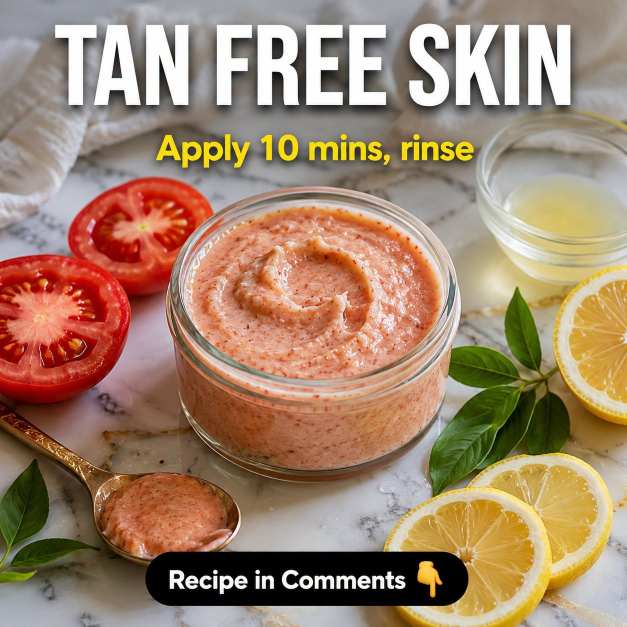
A suntan develops when ultraviolet radiation stimulates the skin to produce more melanin as a protective response. Although tanning may temporarily make the complexion look uneven or darker, it is also a sign that ultraviolet exposure has affected the skin. Natural masks can calm dryness, improve softness and support gradual skin renewal, but they cannot safely erase melanin within ten minutes or completely remove a tan in three days. The most effective strategy is to prevent further tanning with shade, protective clothing and a broad-spectrum, water-resistant sunscreen of SPF 30 or higher. Consistent sunscreen use has also been shown to reduce long-term photoaging. (American Academy of Dermatology)
Although the uploaded image shows lemon, direct lemon juice should not be applied to sun-exposed skin. Citrus juice contains photoreactive compounds that may cause redness, blistering and darker pigmentation after ultraviolet exposure. Aloe vera may feel cooling, but a controlled study found that it did not bleach a tan or provide reliable sunburn protection. Therefore, the following remedies use gentler ingredients and make realistic claims. (PubMed)
The evidence is strongest for professionally formulated ingredients such as colloidal oatmeal and green-tea extracts. A homemade mask is not identical to a laboratory-tested formulation, so consider these recipes supportive skincare rather than medical treatment.
Remedy 1: Yogurt, Oat and Green Tea Mask for Normal Skin
Ingredients and Their Scientific Working
- 1 tablespoon plain unsweetened yogurt: Contains naturally occurring lactic acid and proteins that may make the surface feel smoother and more hydrated. A clinical investigation of a yogurt-based mask reported improved facial moisture, although kitchen yogurt has not been proven to remove tanning.
- 1 tablespoon finely ground plain oats: Oat compounds support moisture retention and help calm a mildly irritated skin barrier. Clinical evidence is strongest for standardized colloidal oatmeal.
- 1 teaspoon honey: Works as a humectant, helping attract and retain moisture on the skin’s surface.
- 1 teaspoon strongly brewed, cooled green tea: Contains catechin polyphenols with antioxidant activity. Human studies of concentrated topical green-tea extracts found reduced signs of ultraviolet injury, but ordinary brewed tea is weaker and is not sunscreen.
- 1 teaspoon cucumber juice: Adds water and gives a temporary cooling effect without harsh exfoliation. (PubMed)
Procedure
Mix the ingredients into a smooth paste. Apply a thin layer to cleansed skin, avoiding the eyes and lips. Leave it on for 8–10 minutes without letting it become completely dry. Rinse gently with cool or lukewarm water and apply a fragrance-free moisturizer.
How Often to Apply
Apply once daily for three days, then every other day if the skin remains comfortable.
Initial Results
Within one to three days, the skin may look fresher and feel softer because of improved surface hydration. A noticeable reduction in tanning normally requires several weeks of sun protection and natural skin turnover.
Remedy 2: Balancing Oat and Aloe Mask for Combination Skin
Ingredients and Their Scientific Working
- 2 teaspoons plain yogurt: Provides mild surface exfoliation for oilier areas.
- 2 teaspoons finely powdered oats: Helps absorb excess surface oil while reducing the tight feeling that stronger scrubs can cause.
- 1 teaspoon clear aloe gel: Supplies water and creates a lightweight soothing layer, but should not be treated as a bleaching agent.
- 1 teaspoon cooled green tea: Provides plant polyphenols that may help reduce the appearance of temporary redness.
- ½ teaspoon honey: Improves moisture retention on dry areas.
- 1 drop sunflower seed oil: Apply only around dry cheeks, not across an oily T-zone. Adult skin research found sunflower oil preserved barrier integrity and improved hydration more effectively than olive oil. (PubMed)
Procedure
Combine everything except the sunflower oil. Spread the mask over the face for eight minutes. Add one drop of sunflower oil to the mixture remaining on your fingers and press it only onto dry areas. Rinse without rubbing.
How Often to Apply
Use on alternate days for five days. Stop if you develop new bumps, itching or burning.
Initial Results
The T-zone may feel cleaner while the cheeks feel less dry after one or two applications. Pigmentation will not disappear immediately, but better hydration may make the complexion appear more even.
Remedy 3: Cooling Green Tea Mask for Oily Skin
Ingredients and Their Scientific Working
- 1 tablespoon cooled green tea: Green-tea catechins have demonstrated antioxidant and anti-inflammatory activity in human ultraviolet-exposure studies.
- 1 tablespoon clear aloe gel: Creates a light, non-greasy base and may reduce temporary tightness.
- 1 teaspoon finely ground oats: Provides gentle oil absorption without abrasive scrubbing.
- 1 teaspoon cucumber pulp: Adds a cooling water-rich texture.
- ½ teaspoon honey: Prevents the mask from becoming excessively drying.
- 1 teaspoon boiled and cooled water: Dilutes the mixture so it spreads without friction. (PubMed)
Procedure
Blend the ingredients and refrigerate the mixture for five minutes. Apply a thin layer for seven to eight minutes. Rinse before it dries firmly. Pat the face dry instead of rubbing it with a towel.
How Often to Apply
Apply once daily for three days, followed by twice weekly.
Initial Results
Oiliness and heat-related discomfort may feel reduced within one to three days. This mask does not unclog severe acne or bleach melanin. Avoid applying it over broken or inflamed acne lesions.
Remedy 4: Honey, Yogurt and Sunflower Mask for Dry Skin
Ingredients and Their Scientific Working
- 1 tablespoon plain yogurt: Adds water, proteins and mild lactic-acid activity.
- 1 tablespoon finely ground oats: Helps reduce moisture loss and supports the outer skin barrier.
- 1 teaspoon honey: Acts as a moisture-binding humectant.
- 1 teaspoon aloe gel: Improves spreadability and provides lightweight hydration.
- 2 drops sunflower seed oil: Supplies linoleic-acid-rich lipids that can soften dry skin.
- 1 teaspoon cooled green tea: Provides antioxidant polyphenols while thinning the mask to a creamy consistency. (PubMed)
Procedure
Mix until creamy and apply to slightly damp skin. Leave it on for 8–10 minutes. Massage in a few drops of water before rinsing so the oats do not pull against dry skin. Moisturize immediately afterward.
How Often to Apply
Use once daily for three to five days, followed by two applications weekly.
Initial Results
Dryness, rough texture and dullness may improve after the first few applications. Deeper tanning should fade gradually, provided the skin is protected from additional ultraviolet exposure.
Remedy 5: Minimal Oat Compress for Sensitive Skin
Ingredients and Their Scientific Working
- 1 tablespoon very finely ground oats: Oat-based preparations have demonstrated improvements in hydration, skin-barrier function and irritation in clinical research.
- 1 teaspoon clear aloe gel: Adds moisture, although it is not a proven tan remover.
- 1 teaspoon cucumber puree: Creates a cool, low-acid base.
- 1 teaspoon weak, cooled green tea: Offers a small amount of antioxidant polyphenols.
- 1–2 teaspoons boiled and cooled water: Reduces concentration and friction.
- 1 drop sunflower seed oil, optional: May reduce tightness but should be omitted if oils usually trigger bumps. (PubMed)
Procedure
Mix the ingredients and patch-test behind the ear or on the inner arm. If no reaction develops after 24 hours, apply the mixture as a thin compress for only five minutes. Rinse with cool water and avoid washcloths or facial brushes.
How Often to Apply
Use every other day for three to five days. Do not increase the duration to speed up results.
Initial Results
Sensitive skin may feel calmer and less tight within one to three days. Stop immediately if burning, swelling, itching or persistent redness occurs.
Final Tips for Preventing and Fading a Suntan
Apply broad-spectrum, water-resistant SPF 30 or higher approximately 15 minutes before going outside and reapply according to the label, especially after sweating or swimming. Wear a wide-brimmed hat, seek shade and avoid unnecessary midday exposure. A mask cannot compensate for continued ultraviolet exposure. (American Academy of Dermatology)
Avoid lemon, lime, baking soda, toothpaste, undiluted vinegar, rough sugar scrubs and aggressive daily exfoliation. These methods may damage the skin barrier and make pigmentation more noticeable. Keep bowls, spoons and applicators clean, prepare only enough mask for one use, and never store a yogurt-based mixture for later.
Complete a patch test before using any recipe. People with eczema, rosacea, active acne, food allergies or a damaged skin barrier should consult a dermatologist before experimenting with homemade masks. Visible improvements in softness and surface glow may begin within two or three days. Tan fading usually takes weeks, while consistent sunscreen and moisturization may gradually reduce photoaging and the appearance of dehydration-related fine lines.
Diet Plan to Support Healthy, Even-Looking Skin
Diet cannot replace sunscreen or directly bleach a tan, but antioxidant-rich foods may support the skin’s response to oxidative stress. Human trials found that regular dietary intake of tomato-derived lycopene or mixed carotenoids increased resistance to ultraviolet-induced redness or pigmentation after approximately 10–12 weeks. These benefits developed slowly and did not function as complete sun protection. (PubMed)
For breakfast, eat plain yogurt or eggs with oats and a vitamin-C-rich fruit such as guava, orange, kiwi or strawberries. At lunch, include leafy vegetables, carrots, bell peppers, tomatoes, lentils and whole grains. For an afternoon snack, choose a small portion of nuts or seeds with fresh fruit. Dinner can include fish, chicken, beans or tofu with cooked vegetables and salad.
Use cooked tomatoes regularly because heating and consuming them with a small amount of dietary fat improves their usefulness as a source of lycopene. Drink according to thirst and maintain normal hydration, particularly in hot weather; excessive water intake will not rapidly fade pigmentation.
Continue sun protection daily and use a suitable gentle mask for two to four weeks. Consult a dermatologist if pigmentation remains unchanged after six to eight weeks, becomes patchy, spreads without sun exposure or is accompanied by itching, scaling or pain. Seek prompt medical care for blistering sunburn, severe swelling, fever, dizziness or signs of infection.
References for the above remedy
- American Academy of Dermatology. How to apply sunscreen.
https://www.aad.org/public/everyday-care/sun-protection/shade-clothing-sunscreen/how-to-apply-sunscreen - Hughes MCB, et al. Sunscreen and prevention of skin aging: a randomized trial.
https://pubmed.ncbi.nlm.nih.gov/23732711/ - Elmets CA, et al. Cutaneous photoprotection from ultraviolet injury by green tea polyphenols.
https://pubmed.ncbi.nlm.nih.gov/11209110/ - Kalaaji AN, Wallo W. A randomized controlled clinical study of a colloidal oatmeal moisturizing lotion.
https://pubmed.ncbi.nlm.nih.gov/25607563/ - Capone K, et al. Effects of colloidal oatmeal cream on skin-barrier properties.
https://pubmed.ncbi.nlm.nih.gov/32484623/ - Kim EJ, et al. Clinical efficacy of facial masks containing yoghurt and natural ingredients.
https://pubmed.ncbi.nlm.nih.gov/22152494/ - Puvabanditsin P, Vongtongsri R. Efficacy of aloe vera cream in prevention and treatment of sunburn and suntan.
https://pubmed.ncbi.nlm.nih.gov/16623024/ - Rothman AL. Lemons in the Arizona sunshine: phytophotodermatitis and burn-like injuries.
https://pubmed.ncbi.nlm.nih.gov/29324427/ - Danby SG, et al. Effect of olive and sunflower seed oil on the adult skin barrier.
https://pubmed.ncbi.nlm.nih.gov/22995032/ - Rizwan M, et al. Tomato paste rich in lycopene protects against cutaneous photodamage in humans.
https://pubmed.ncbi.nlm.nih.gov/20854436/