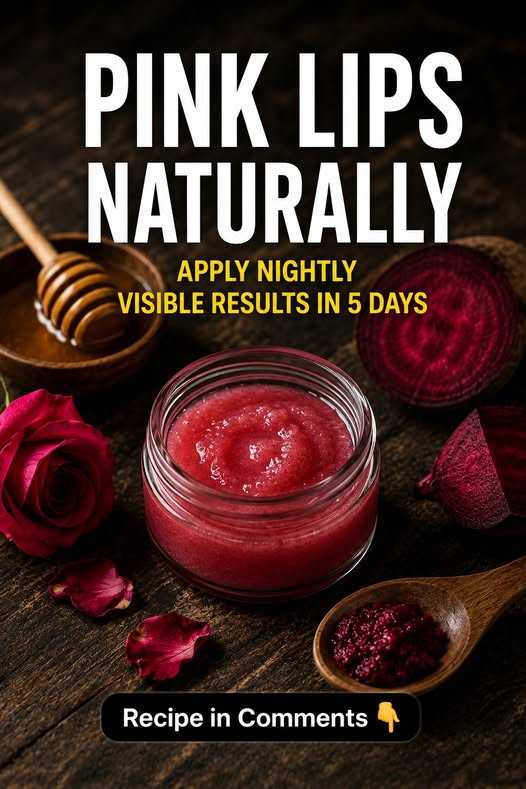
Naturally healthy lips look smooth, hydrated, and even-toned, but their natural color varies considerably from person to person. Dryness, repeated lip licking, sun exposure, smoking, dehydration, irritation from cosmetics or toothpaste, and allergic contact cheilitis can all make lips appear darker, rougher, or duller. In fact, dermatology references confirm that lip cosmetics and other products can sometimes cause inflammation followed by persistent pigmentation. (DermNet®) Natural care can improve dryness, softness, surface smoothness, and the appearance of dull lips, but no home remedy can safely guarantee permanently pink lips or change genetically determined lip color in five days. The following remedies therefore focus on restoring moisture and minimizing irritation while using gentle, easily available ingredients.
Remedy 1: For Normal Lips – Beetroot, Aloe and Honey Lip Mask
Ingredients
- 1 teaspoon fresh beetroot juice
- 1 teaspoon pure aloe vera gel
- ½ teaspoon honey
- ½ teaspoon finely ground oats
- ¼ teaspoon virgin coconut oil
Scientific Working of Each Ingredient
Beetroot contains naturally colored betalain pigments and antioxidants. It can temporarily tint the lip surface, giving it a brighter reddish-pink appearance, although this should not be confused with permanent treatment of pigmentation.
Aloe vera provides a water-rich, soothing base and helps make the mixture comfortable on the delicate lip surface.
Honey has well-established antimicrobial, anti-inflammatory, and wound-healing properties in dermatological research, although evidence for specifically lightening lips is lacking. (PubMed)
Finely ground oats provide texture without requiring harsh exfoliation.
Virgin coconut oil functions primarily as an emollient. A randomized clinical trial found that virgin coconut oil significantly improved skin hydration in people with dry skin. (PubMed)
Procedure
Mix the beetroot juice and aloe first. Add honey, finely powdered oats, and coconut oil. Apply a thin coating over clean lips without aggressively rubbing them. Leave it on for 10–15 minutes and rinse with lukewarm water.
How Often to Apply
Apply once nightly for 5 days. If there is no irritation, it can then be used three or four times weekly.
Initial Results
Within 1–3 days, lips may feel softer and less dry. Beetroot can leave a temporary rosy stain. Five days may improve surface appearance, but genuine pigmentation usually takes much longer to change.
Remedy 2: For Combination Lips – Beetroot, Cucumber and Aloe Hydration Treatment
Combination lips may feel dry around the edges while remaining relatively comfortable in the center.
Ingredients
- 1 teaspoon beetroot juice
- 1 teaspoon aloe vera gel
- 1 teaspoon cucumber juice
- ½ teaspoon honey
- ¼ teaspoon coconut oil
- ½ teaspoon finely powdered oats
Why This Remedy Works
Cucumber juice is mainly useful as a water-rich, cooling ingredient rather than a clinically established pigmentation treatment.
Aloe vera creates a light moisturizing base without the need for irritating acids.
Honey supplies humectant and soothing properties, while coconut oil forms an emollient layer that reduces the rough feeling associated with dryness.
Beetroot provides natural color rather than bleaching the lips. This distinction is important: the goal is to make lips healthier and smoother, not chemically strip their natural pigment.
Procedure
Combine all ingredients into a smooth paste. Apply a small amount across the lips. Do not scrub. Leave for approximately 10 minutes before gently rinsing.
How Often to Apply
Use once each evening for 3–5 days, followed by alternate nights if needed.
Initial Results
Hydration and smoothness can improve within several applications. The temporary beetroot tint may make lips appear rosier immediately, but natural underlying pigmentation will remain.
Remedy 3: For Oily or Frequently Sweaty Lip Area – Aloe, Beetroot and Honey Mask
People with naturally less-dry lips generally do not require large amounts of oils.
Ingredients
- 1½ teaspoons pure aloe vera gel
- 1 teaspoon beetroot juice
- ½ teaspoon honey
- 1 teaspoon cucumber juice
- ½ teaspoon finely ground oats
Scientific Working of the Remedy
The formula deliberately minimizes oil. Aloe and cucumber provide a lightweight base, while honey helps maintain moisture.
Honey’s antimicrobial properties have been studied extensively in dermatology, although researchers emphasize that laboratory antimicrobial activity does not mean honey is proven to treat every skin condition. (PubMed)
Beetroot provides the cosmetic pink tint. There is not sufficient clinical evidence to claim that beetroot permanently removes lip pigmentation, so it should be considered a temporary color-enhancing ingredient.
Procedure
Mix everything thoroughly and apply a thin layer. Leave it for 10 minutes. Rinse gently and avoid rubbing the lips with a towel.
How Often to Apply
Apply once nightly for 5 days. Reduce the frequency if lips become sensitive.
Initial Results
The lips can feel smoother within 1–3 days, while beetroot may provide an immediate temporary rosy appearance.
Remedy 4: For Dry Lips – Coconut Oil, Honey, Aloe and Beetroot Repair Mask
Dry lips require barrier support rather than aggressive exfoliation.
Ingredients
- 1 teaspoon virgin coconut oil
- 1 teaspoon pure aloe vera gel
- ½ teaspoon honey
- ½ teaspoon beetroot juice
- ½ teaspoon finely ground oats
- ½ teaspoon cucumber puree
Scientific Working of Each Ingredient
Coconut oil is the central ingredient here. In a randomized double-blind clinical trial involving people with mild-to-moderate xerosis, virgin coconut oil performed effectively as a moisturizer and improved skin hydration. (PubMed)
Honey has documented wound-healing and anti-inflammatory properties. (PubMed)
Aloe and cucumber create a moist base, while beetroot contributes temporary natural color.
Procedure
Blend the aloe, honey, and beetroot first. Stir in the coconut oil, cucumber, and powdered oats. Apply a thin layer for 10–15 minutes. Rinse gently.
For severely dry lips, skip the beetroot and oats and simply concentrate on a bland, well-tolerated moisturizer.
How Often to Apply
Use once nightly for at least 5 days. Moisturization itself can be continued daily.
Initial Results
Dryness, roughness, and tightness may begin improving within 2–3 days. Healthy hydration can also make the natural lip color look more vibrant.
Remedy 5: For Sensitive Lips – Minimal Aloe and Oat Lip Mask
Sensitive lips should receive the simplest remedy of all. More ingredients mean more opportunities for irritation.
Ingredients
- 2 teaspoons pure aloe vera gel
- 1 teaspoon clean water
- ½ teaspoon finely powdered colloidal-style oats
- ½ teaspoon cucumber juice
- 2–3 drops beetroot juice, optional
Why This Remedy Is Different
Sensitive lips frequently become worse after exposure to flavorings, fragrances, cosmetics, toothpaste ingredients, and other allergens. Allergic contact cheilitis commonly causes dryness, scaling, cracking, itching, burning, and sometimes persistent pigmentation. (DermNet®)
Consequently, this remedy deliberately excludes honey, essential oils, lemon, spices, and multiple plant oils. Even natural substances can trigger allergies.
Procedure
Mix the ingredients into a smooth, thin paste. Patch-test first. Apply for only 5–10 minutes, then rinse gently.
If beetroot causes tingling or redness, remove it completely from the recipe.
How Often to Apply
Begin on alternate nights for 3–5 days rather than using it every night.
Initial Results
The primary early goal is softer, more comfortable lips. Sensitive or chronically inflamed lips should not be repeatedly treated simply to achieve a pinker color.
What You Should Never Put on Dark or Dry Lips
Avoid trying to bleach lips with lemon juice, baking soda, undiluted apple-cider vinegar, toothpaste, cinnamon, salt, or harsh sugar scrubs. Irritation can cause inflammation, and inflammation itself can contribute to pigmentation.
This is particularly important because pigmented contact cheilitis is a recognized condition in which exposure to an irritant or allergen produces brown-to-black lip discoloration. Once the trigger is removed, pigmentation can take months to fade. (DermNet®)
Also avoid constantly licking, biting, or peeling dry skin from the lips.
Final Tips for Naturally Healthy and Pink-Looking Lips
Drink enough fluids, maintain regular sleep, avoid smoking, and protect your lips from excessive sun exposure. Keep anything that regularly touches your lips clean and stop using a cosmetic or oral-care product if it consistently causes burning, itching, scaling, or darkening.
You may notice better hydration and softness within 2–3 days, and beetroot can create an immediate temporary rosy tint. However, claims that a natural paste will permanently turn dark lips pink within five days are not supported by strong clinical evidence.
Persistent pigmentation should be treated by identifying its cause rather than repeatedly exfoliating the lips.
Diet Plan for Healthy Lips
Diet cannot directly turn naturally pigmented lips pink, but good nutrition supports normal skin and mucosal health.
For breakfast, have eggs or unsweetened yogurt with oats and berries, guava, oranges, or another vitamin-C-rich fruit. Add nuts or seeds for healthy fats.
For lunch, choose lentils, chickpeas, beans, fish, chicken, or another protein source alongside green vegetables, carrots, tomatoes, and whole grains.
For an afternoon snack, choose whole fruit, nuts, seeds, or plain yogurt rather than highly processed sugary snacks.
For dinner, include protein with several vegetables and a whole-grain carbohydrate. Iron-rich foods such as lentils, beans, leafy vegetables, meat, and fortified cereals can also form part of a balanced diet.
Continue a balanced eating pattern consistently rather than relying on a short “pink lips diet.” Hydration should also be maintained throughout the day.
Try the gentle lip-care routine for approximately 2–4 weeks while avoiding potential irritants. If your lips remain persistently dark, suddenly change color, become painful, swollen, cracked or itchy, develop sores, or pigmentation continues to spread, see a doctor or dermatologist. Contact allergy may require patch testing to identify the responsible ingredient. (DermNet®)
References for the above remedy
- Agero ALC, Verallo-Rowell VM. A randomized double-blind controlled trial comparing extra virgin coconut oil with mineral oil as a moisturizer for mild to moderate xerosis. Dermatitis. 2004.
URL: https://pubmed.ncbi.nlm.nih.gov/15724344/ - McLoone P, Warnock M, Fyfe L. Honey: A realistic antimicrobial for disorders of the skin. Journal of Microbiology, Immunology and Infection. 2016.
URL: https://pubmed.ncbi.nlm.nih.gov/25732699/ - Samarghandian S, et al. Honey therapies for dermatological disorders: more than just a sweet elixir.
URL: https://pubmed.ncbi.nlm.nih.gov/38013499/ - DermNet. Pigmented Contact Cheilitis.
URL: https://dermnetnz.org/topics/pigmented-contact-cheilitis - DermNet. Allergic Contact Cheilitis.
URL: https://dermnetnz.org/topics/allergic-contact-cheilitis - DermNet. Contact Reactions to Lipsticks and Other Lipcare Products.
URL: https://dermnetnz.org/topics/contact-reactions-to-lipsticks-and-other-lipcare-products - DermNet. Contact Reactions to Cosmetics.
URL: https://dermnetnz.org/topics/contact-reactions-to-cosmetics - DermNet. Allergic Contact Dermatitis.
URL: https://dermnetnz.org/topics/allergic-contact-dermatitis